
Author: Sky Lung and the production review team
Reviewed: June 13, 2026
Evidence basis: Reviewed against buyer-side supplier checks: project stage, MOQ exposure, sampling path, QC handoff, communication records, and reorder risk. This page is an educational guide, not a supplier ranking.
So the better question is not “is thirty enough?” It is “enough to learn what?”
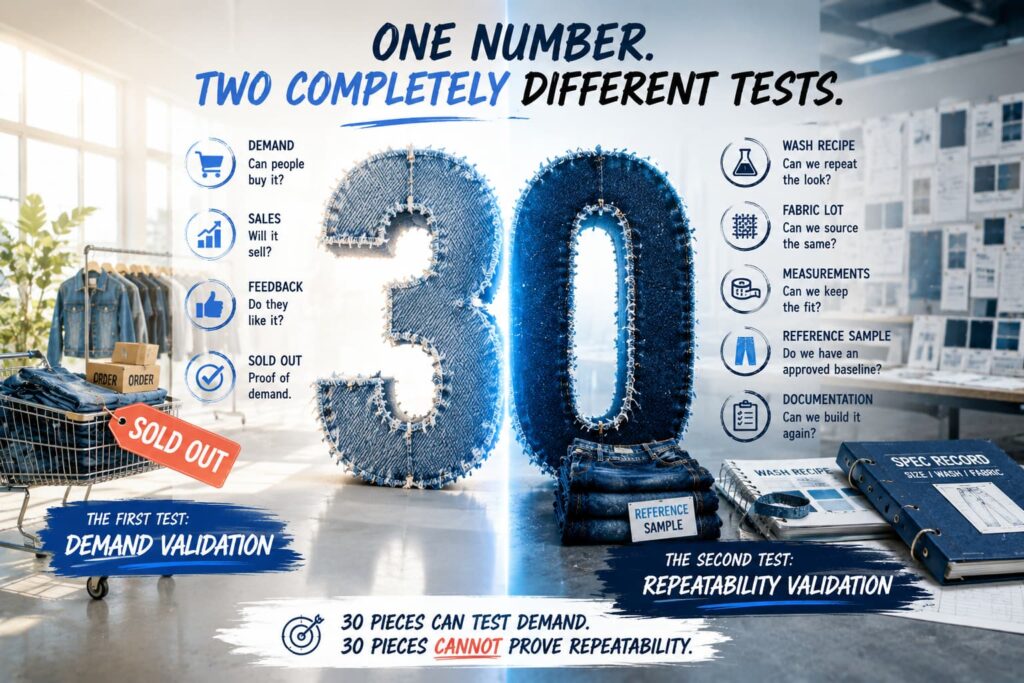
Short answer: Thirty pieces is usually enough to test market demand — whether people click, buy, and come back — but not enough to prove production repeatability, meaning whether the wash shade, full size-curve fit, and fabric consistency can be held when you reorder at larger volume. For denim specifically, the practical decision depends on what you need the run to prove: interest, or repeatability. Those require two different tests, and only one of them fits in thirty pieces.
The Real Problem Is Not the Number
When a brand asks whether thirty pieces is enough to test a denim style, the word doing the real work is enough — enough for what? Most first-run questions get stuck on the number because the number is what suppliers quote. You ask three factories for pricing on 30, 50, and 100 pieces, you compare unit cost, and the decision quietly becomes “which quantity is cheapest per piece.” That is a real question, but it is not the one that protects you.
The number only has meaning once you name the job. A first run can be asked to do one of two jobs, and they pull in opposite directions:
- Test demand — find out if the style sells, which size sells, what price holds, which photo converts. This job wants small. Less cash at risk, faster to launch, easier to sell through.
- Prove repeatability — find out if the next batch can match this one on wash shade, fit across the full size run, and fabric behavior. This job wants volume and records, because repeatability is something you can only see across batches, not within thirty pieces.
A thirty-piece run is well-shaped for the first job and badly shaped for the second. The mistake is not running thirty pieces. The mistake is running thirty pieces to test demand, watching it sell out, and then treating that result as if it also proved the second job. It didn’t. It was never built to.
Why Denim Punishes Reorders More Than Most Categories
If you’re only testing demand right now, you can skim this section — but it explains why a reorder later is riskier than it looks.
A reorder problem exists in every apparel category. In denim it is sharper, because more of the final look is created after the garment is sewn — in the wash — and the wash is chemistry, not assembly.
Three things make denim repeatability harder than, say, a cotton tee:
The shade is a wash result, not a fabric property. The color your customer fell in love with came from a wash recipe: chemicals, time, temperature, machine load. A color-measurement specialist in denim production puts it plainly — to get a consistent faded result, the dye applied in production has to be consistent from fabric roll to fabric roll, and a mistake in the original dyeing leads to a different faded color than intended. The same source notes that holding color consistent for one brand of jeans, factory to factory, is extremely difficult. That difficulty doesn’t disappear on a reorder; it is exactly when it shows up.
Shade varies batch to batch — and that is normal, not a defect. Textile production literature lists the causes of a too-light or too-dark final shade directly: chemical variation between each batch of washing, wash time and temperature not perfectly controlled, and color variation between each lot of denim fabric. The recommended fix is telling — conduct trial washing to minimize the variation between each lot. In other words, the industry’s own answer is not “eliminate variation.” It is “test and manage it.” Wash variation between a first run and a reorder is physically inevitable; the real job is keeping it inside a tolerance you agreed on in advance, not pretending it won’t happen.
Fabric itself shrinks and shifts. Raw, unsanforized denim can shrink up to 10% on the first wash and keep moving through the third wash; even sanforized fabric carries residual shrinkage. Order a different fabric roll for the reorder, wash it in a different load, and the garment can land at a new measurement — so the fit your size run was built on drifts, even though nobody touched the pattern.
None of this means denim is unreliable. It means denim repeatability is engineered and recorded, not assumed. Thirty pieces, made once, in one wash load, tells you almost nothing about how the style behaves across the batches a reorder will require.
Where Buyers Usually Misjudge the First Run
Three mistakes show up again and again — not because founders are careless, but because each one feels logical in the moment.
Mistake 1: Reading “sold out” as “reorder-ready.” Selling through thirty pieces proves demand existed at that moment, for that drop, often to an audience that already follows you. It does not prove the supply chain behind it can repeat. Sell-through is a demand signal; repeatability is a production property. A drop can be loud on both and still hide the fact that the wash, the fabric lot, and the fit were never tested across more than one batch.
Picture a brand whose first thirty sell out in days. They reorder five hundred on the strength of it. The second batch comes back a shade lighter — not broken, just visibly not the same — because nobody had recorded the wash recipe or noted the fabric lot the first time. The style was never the problem. The missing records were.
Mistake 2: Splitting thirty pieces too thin. This is the quiet one. Thirty pieces across four sizes is seven or eight per size. Add a second color and you may be down to three or four pieces per size-color combination. At that point the run can still photograph well and sell out, but the size-curve data it produces is too thin to trust — when only four people bought an XL, you can’t tell a real fit problem from random chance. Sizing is not a small detail here: ill-fitting product and size issues are among the most cited reasons customers return apparel. A first run spread across too many variants buys you sell-through and almost no reliable learning about which variant actually works.

Mistake 3: Deciding on unit price alone. Asking three suppliers for 30, 50, and 100-piece pricing is sensible. Letting the cheapest per-unit number make the decision is not. A low-MOQ denim run almost always costs more per piece — small wash loads, setup, and cutting don’t get cheaper at small scale — and that premium is not waste. You are paying for a test. The right question is not “which quantity is cheapest” but “which quantity, made and recorded which way, teaches me the most about whether I can do this again.”
A Better Framework: Size the Run to the Job
Instead of starting with a number, start with the job you need the run to do. The number falls out of the answer.
Ask one question first: am I trying to find out if people want this, or trying to prove I can make it again?
If the honest answer is “I don’t yet know if it sells,” then you are in a demand test. Keep it small, keep it focused, and protect the quality of the signal — which mostly means not splitting thirty pieces across so many sizes and colors that no single variant gets a readable result. One style, one wash, a tight size range, maybe one color. The goal is a clean read on interest, not a miniature production line.
If the honest answer is “I already know it sells — now I need the next batch to match,” then you are in a repeatability test, and a bare thirty-piece run is the wrong tool. What proves repeatability is not a bigger gamble. It is a first run made with the records a second run can be built from — a locked wash recipe, a noted fabric lot, specced measurements, a sealed sample, and an agreed tolerance. Volume helps, but documentation is the part most first runs skip.
Decision rule: If your goal is “should we make more?”, thirty pieces can answer that. If your goal is “can we make this the same way again?”, thirty pieces cannot — only a documented production baseline can. Size the run to the question you are actually asking.
Most brands are in the first case and think they are in the second. The fix is not ordering more. It is being honest about which test you are running — and, if demand is still the open question, making sure the thirty pieces you do run are recorded well enough that they can become the baseline later, instead of a result you can never reproduce.
What Thirty Pieces Can and Cannot Test
Here is the same idea as a working reference. The left column is what a thirty-piece denim run reads reliably. The right column is what it cannot prove, no matter how fast it sells.
| A 30-piece run can test (demand signals) | A 30-piece run cannot prove (repeatability) |
|---|---|
| Whether the style attracts and converts at all | Whether the wash shade can be matched on the next batch |
| Which price point holds | Whether color stays inside an agreed tolerance lot to lot |
| Which photo, angle, or story drives clicks | Whether a different fabric roll behaves the same way |
| Rough early signal on which size moves first | A reliable full size-curve (too few units per size to trust) |
| Whether the silhouette and finish appeal in person | Whether fit holds after shrinkage on a different wash load |
| Whether existing followers will buy | Whether defect rate stays controlled at larger volume |
Two practical notes on reading this table.
First, the left column is real value. A clean demand read on thirty pieces can save a brand from ordering five hundred of the wrong thing — that is exactly the kind of decision a small run should make for you. The point is not that thirty pieces is too small to matter. It is that the two columns are different tests.
Second, the right column does not get solved by “order more.” Five hundred pieces with no wash recipe, no fabric lot recorded, and no sealed reference sample still can’t be reproduced — you would just have a larger batch you also can’t repeat. The right column is solved by records, and only secondarily by volume.
Before You Place a First Denim Run
Whichever test you are running, a few decisions made before the order protect both the demand signal and the option to reorder later. Work through these with your supplier, not after.
Decide what this run is for.
- Write down the one question this run must answer: demand, or repeatability? If it’s demand, optimize for a clean read. If it’s repeatability, optimize for records.
Protect the demand signal.
- Keep it to one style and, ideally, one wash and one color.
- Hold the size range tight — enough depth per size to read a result, rather than one or two pieces spread across every size.
- Decide in advance what “success” looks like (sell-through rate, time to sell, size that moves first), so the result is a decision, not a vibe.
Protect the option to reorder.
- Ask whether your small run is washed in its own dedicated load or combined with other orders — this single fact drives whether the shade can be repeated.
- Get the wash recipe recorded, not just the finished look approved.
- Note the fabric lot, and ask what happens if that exact lot isn’t available on the reorder.
- Have measurements specced and a sample sealed and signed off as the reference.
- Agree on a shade and measurement tolerance now — the acceptable range for batch-to-batch variation — so a reorder is judged against a standard, not a memory.
Read the price correctly.
- Expect a higher per-piece cost at thirty pieces, and treat that premium as the cost of the test, not as a number to negotiate to the floor.
If most of the “reorder” boxes are things you can’t answer yet, that is useful information on its own: it tells you the run in front of you is a demand test, and that the repeatability work still has to happen before you scale.
When a 30-Piece Small-Batch Run Fits — and When It Doesn’t
A thirty-piece denim run fits when:
- You don’t yet know if the style sells, and the run’s job is to find out.
- You have no sales history for this design and need a real-world signal before committing cash.
- You want to shoot content, seed a micro-drop, or create a limited release.
- You’re testing one clear style rather than a spread of variants.
- Your priority is keeping inventory risk low, not locking the lowest unit price.
In all of these, the run is answering “should we make more?” — and thirty pieces answers it well.
A thirty-piece run does not fit when:
- You already have steady demand and need the next batch to match this one.
- You need a reliable read on the full size curve, not just which size moved first.
- You need to prove wash and shade can be held inside a tolerance, lot to lot.
- You’re quoting a wholesale or retail buyer who expects consistent, repeatable supply.
- You’re testing several colors, fabrics, or fits at once and need clean data on each.
In these, the run is really being asked “can we make this the same way again?” — and that is a question only a documented, larger, controlled run can answer.
Notice that the dividing line is never the number by itself. It is the job. The same thirty pieces is the right tool for one question and the wrong tool for the other.
When a Direct Factory Is Enough
Not every brand needs help organizing this. If you already have the product side under control, a direct factory relationship may be all a first denim run requires.
A direct factory is likely enough when you have:
- A complete tech pack, with measurements, construction, and trims specified.
- A confirmed fabric, and a plan for what to do if a lot isn’t available.
- An approved wash with a recipe documented, not just a sample you liked.
- A stable size spec and an agreed tolerance for batch-to-batch variation.
- Someone on your side — you or a production manager — who can hold those records and check a reorder against them.
If that describes you, the run is mostly an execution task. You know what you want, you can specify it, and you can verify it came back right. A capable factory can make thirty pieces, or five hundred, against specs you already own. The repeatability work is done; the factory is there to produce to it.
The honest test is the reorder, not the first run. If you could place a second order tomorrow and check it against your own documented baseline — fabric, wash, measurements, tolerances — then you have what you need, and added support would mostly be redundant.
When an External Denim Product Team Fits Better
The other case is more common, especially for a first denim run: you can tell the style sells, but the records that would let you reproduce it don’t exist yet. The wash was approved by eye, not by recipe. The fabric lot wasn’t noted. There’s a sample you liked but nothing sealed and signed as the reference. No tolerance was ever agreed, so a reorder would be judged against memory.
This is where an external denim product team fits — not because thirty pieces is hard to sew, but because the value isn’t only the sewing. It’s making that first run produce a reusable baseline: organizing the tech pack, confirming fabric and a backup lot, locking and documenting the wash recipe, speccing measurements and sealing an approved sample, running full inspection on a run too small for meaningful sampling, and agreeing the tolerance a reorder will be measured against. The thirty pieces and the records get made in the same pass.
A few production realities sit underneath this. A small denim run should be washed in its own dedicated load rather than combined with other orders, because that is what lets the shade be controlled and repeated — and at thirty pieces, that dedicated handling is part of why the per-piece cost is higher. Batch-to-batch wash variation on a reorder can’t be eliminated; it can only be held inside an agreed tolerance, which is impossible if no tolerance was ever recorded. And a run of thirty is too small for standard AQL sampling to mean much, so full inspection is the sensible default rather than statistical sampling. These aren’t reasons to fear a small run. They are reasons to make it deliberately.
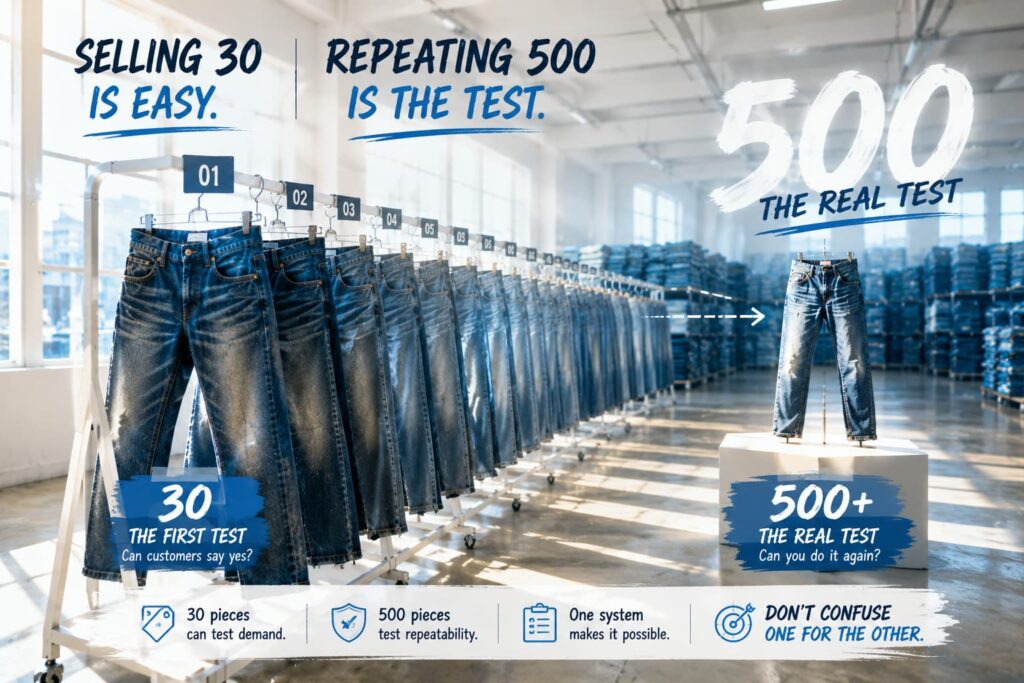
There is also a scale point worth knowing. A first run of thirty and a reorder of five hundred often sit inside the same small-batch band — in practice, runs of roughly thirty to five hundred pieces are handled as small-batch production, not as full mass production. That matters for expectations: a five-hundred-piece reorder doesn’t automatically graduate into a different, more “industrial” process that guarantees consistency on its own. It is still small-batch work, which means the same disciplines — dedicated wash load, recorded recipe, sealed sample, agreed tolerance — are what carry the style from the first thirty into the hundreds. Volume alone doesn’t buy repeatability; the records do.
Put simply: a direct factory makes the thirty pieces. A product team makes the thirty pieces and the ability to make them again. Which one you need depends entirely on whether that second ability already exists on your side.
What to Prepare Next
If you’re not sure which case you’re in, assume it’s a demand test — most first runs are — but record it as if it were a repeatability test. That way a sell-out doesn’t strand you with a result you can’t reproduce.
Wherever you landed, the next step is the same: get specific about the run before you talk price.
If you’re running a demand test, decide and write down:
- The one style, wash, and color you’ll run.
- A tight size range with enough depth per size to read a result.
- What “success” means — sell-through, time to sell, the size that moves first — before the run goes live.
If you’re moving toward repeatability, prepare:
- Your reference image or sketch, and target sample size.
- Fabric direction, and a question ready about backup lots.
- Wash direction, and a request that the recipe be documented, not just approved by eye.
- The measurement points that matter to your fit, and a plan to seal an approved sample.
- The shade and measurement tolerance you’d accept on a reorder.
Bringing these to a supplier does two things. It gets you a more honest feasibility and price conversation, because the supplier can see exactly what you’re asking for. And it surfaces, early, whether your project is a clean execution job or one that still needs development work before it can scale — which is the real thing you’re trying to find out when you ask whether thirty pieces is enough.
Thirty pieces can absolutely be the right place to start. Just be clear about what you’re asking those thirty pieces to prove — and make sure that, however they sell, you’ve kept enough of a record that the next batch has something to match.
FAQ
If my 30-piece denim drop sold out, can I just reorder 500?
You can, but understand what you’d be assuming. Selling out proved demand; it didn’t prove the next 500 will match the first 30 on wash shade, fit across every size, or fabric hand. If the first run’s wash recipe, fabric lot, measurements, and an approved sample were documented, a 500-piece reorder is a reasonable next step against that baseline. If they weren’t, you’d be scaling a result you can’t yet reproduce — the safer move is to lock those records first. It also helps to know that a 500-piece reorder is usually still small-batch production, not a different industrial process — so consistency comes from the documented baseline carried over from the first run, not from the larger number itself.
Why does a 30-piece denim run cost so much more per piece?
Small runs don’t get the cost breaks volume brings. Cutting setup, machine setup, and especially a dedicated wash load are largely fixed costs spread across very few pieces. A small denim run is typically washed in its own load rather than combined with others — that’s what protects shade consistency, but it also concentrates the cost into thirty pieces. The premium is the price of the test, not waste.
How should I split sizes and colors in a 30-piece run?
As little as possible. Every size and color you add divides thin data thinner — thirty pieces across four sizes and two colors can leave three or four units per combination, too few to tell a real signal from noise. For a demand test, favor one color and a tight size range so the result is readable. Save broad size-curve and colorway testing for a larger, later run built for that purpose.
Can the factory guarantee the reorder matches exactly?
No honest one will promise an exact match. Wash and shade vary batch to batch — that’s chemistry, not negligence. What a good process does is keep that variation inside a tolerance you agree on in advance, using a documented wash recipe, recorded fabric lot, and a sealed reference sample. “Within an agreed tolerance” is the realistic goal; “identical” is not.
Is 30 the right number, or should I start with 50 or 100?
The number matters less than the job. If you’re testing demand, the right number is the smallest run that still gives a readable signal — often around 30 for a single style and color. If you’re testing repeatability, no small number is really “enough” on its own; what matters is whether the run is documented well enough to reorder against. Pick the number after you’ve named the job, not before.