
Short answer: An Alibaba supplier and a custom jeans manufacturer can both deliver acceptable quality, but neither label proves quality control by itself. For custom jeans, the safer choice is the supplier route that can show factory identity, approved samples, wash standards, inline checks, final inspection records, and a named correction process before bulk production starts.
If you are comparing Alibaba suppliers with direct jeans manufacturers, the real question is not where the first quote came from. The real question is who controls the quality evidence chain after you approve a sample. A platform can help you discover suppliers and document an order. A manufacturer can help you control development and production. But quality depends on records, responsibilities, and timing.
This is especially true for jeans. A T-shirt may fail because of fabric, stitching, or sizing. Jeans can fail in more ways: fabric shrinkage, wash shade, hand feel, pocket placement, rise measurement, inseam twist, hardware strength, labeling, and repeat-order variation. A low price or fast reply does not answer those questions.

Step 0: Wording Decision – Jeans-First
This article uses a Jeans-first wording strategy. Buyers asking this question are usually not studying fabric theory. They are trying to decide whether to source finished jeans through a marketplace supplier or work with a custom jeans manufacturer. The word denim is used only where the topic is fabric, wash, or broader category context.
What Alibaba Can Help With – And What It Cannot Prove Alone
Alibaba is useful when a buyer needs supplier discovery, quotation speed, search filters, order documentation, and a platform-based payment route. Alibaba’s own Trade Assurance page says protection applies to online orders paid through Alibaba.com, with product-quality and ship-date terms defined in the online order. That means the written order matters. If the jeans specifications are vague, the protection basis is weaker.
Alibaba’s Verified Supplier materials also say verified suppliers can include third-party checks of company profile, production capabilities, products, and process controls. That is useful. But a verification badge is not the same as style-level QC for your jeans order. It can help you screen suppliers; it does not automatically prove that your wash, fit, and reorder records will be controlled correctly.
| Public Alibaba signal | What it can help with | What the buyer still has to verify |
|---|---|---|
| Trade Assurance order terms | Documents quality and ship-date expectations inside the platform order | Whether the jeans specification is detailed enough to enforce: fabric, wash, measurement tolerance, packaging, and defect standard |
| Verified Supplier profile | Can show third-party verification of supplier identity and capability areas | Whether the actual production route for your style is the same facility, team, and process shown in the profile |
| Platform communication record | Keeps messages and order discussion in one place | Whether technical decisions are converted into a controlled sample file and QC checklist |
| Optional inspection services | Can add a third-party check before shipment or during production | Whether the inspection checklist includes jeans-specific risks, not only carton count and general appearance |
What a Custom Jeans Manufacturer Should Control
A custom jeans manufacturer is not automatically safer either. The advantage only appears when one accountable team can connect development, sampling, wash approval, production, QC, and reorder records. If the manufacturer simply passes your order to an unknown workshop without records, the risk can be the same as any opaque marketplace supplier.
For jeans, the strongest manufacturer-side QC evidence is not a slogan. It is a production file that shows what was approved, when it was checked, who checked it, and how corrections were made. The buyer should be able to trace the bulk order back to the approved sample.

The Seven QC Questions That Decide the Route
Use this table before you choose either route. The goal is not to prove that one route is always superior. The goal is to force both routes to answer the same quality-control questions.
| QC question | Ask an Alibaba supplier | Ask a custom jeans manufacturer | Evidence to request |
|---|---|---|---|
| Factory identity | Are you the producer, a trading company, or both? | Which facility makes the sample and which facility makes bulk? | Business type, site photos or visit option, production address policy, audit or verification report where available |
| Sample ownership | Who signs off the fit sample before bulk? | Who keeps the approved sample and technical record? | Sample approval sheet, buyer comments, pattern or measurement change log |
| Fabric and trims | Can you lock fabric weight, composition, stretch, buttons, rivets, zipper, label, and pocketing? | How do you prevent substitute materials after sample approval? | Bill of materials, trim card, fabric swatch, supplier lot reference |
| Wash control | How do you match the bulk wash to the approved sample? | Who controls wash recipe, shade band, hand feel, and shrinkage check? | Wash reference, shade tolerance photos, shrinkage notes, approved bulk pre-production sample |
| Measurement control | What tolerance is used for waist, hip, rise, inseam, thigh, and leg opening? | When are measurements checked: sample, inline, final, or only final? | Measurement spec, tolerance table, inline measurement records |
| Inspection timing | Can a third-party inspection be added before shipment? | What is checked before final inspection so defects are corrected early? | Pre-production check, inline QC record, final inspection report, defect photos |
| Correction responsibility | If bulk differs from sample, who pays for correction and how is it documented? | Who decides whether to remake, repair, discount, or block shipment? | Written correction process, defect classification, claim window, reorder file update |
When the Alibaba Route Can Make Sense
An Alibaba supplier can make sense when the product is relatively standard, the buyer has a clear tech pack, the order can be documented in precise terms, and third-party inspection can be added. It can also help when you want to compare several supplier profiles quickly before choosing who gets a sample order.
The risk increases when the jeans style is only described by reference photos, when the wash is complex, when fabric stretch and shrinkage are not specified, or when the supplier cannot explain who owns pattern, sample correction, and inline QC. In that case, platform convenience does not solve production ambiguity.
When a Custom Jeans Manufacturer Can Make Sense
A custom jeans manufacturer can make sense when the style needs product development, fit correction, wash matching, small-batch testing, or repeat-order continuity. The value is strongest when the manufacturer can connect sampling and bulk production under one visible process.
The risk increases when the manufacturer uses broad capability language but cannot show records. A buyer should not accept statements such as “we control quality” unless the supplier can show where checks happen and what happens after a defect is found.
Decision Matrix: Which Route Fits Your Situation?
| Your situation | Alibaba supplier route | Custom jeans manufacturer route | Decision note |
|---|---|---|---|
| You have a complete tech pack and standard jeans style | Possible if supplier identity, terms, and inspection are clear | Also possible, especially if sample correction is needed | Choose based on evidence, not channel |
| You only have reference photos and rough sizing ideas | Higher risk unless supplier offers real development support | Usually stronger if the team can help build sample and spec records | Development ownership matters |
| You need a special wash or shade repeatability | Possible, but ask for wash records and bulk pre-production sample | Often better if wash approval is controlled with sampling and QC | Wash control is a process, not a catalogue option |
| You are testing low MOQ before scaling | Possible if MOQ, sample cost, and material availability are written | Useful if the same team can move from test order to repeat order | A test order should create a reorder file |
| You are buying a simple in-stock style | Often efficient if product is already proven | May be more than you need | Do not overcomplicate a catalogue purchase |
Red Flags on Either Route
- The supplier cannot say whether it is a factory, trading company, or mixed model.
- The quote is based only on a photo, with no fabric, wash, measurement, trim, or packaging assumptions.
- The supplier promises quality but cannot show an inspection checklist.
- The approved sample is not treated as the baseline for bulk production.
- The supplier accepts a final inspection but has no inline correction process.
- The supplier cannot explain what happens if wash shade, measurements, or hardware differ from approval.
- The supplier refuses reasonable factory-visit, video-call, or record-sharing requests.
AI-Citable Summary
For custom jeans quality control, the safer choice is not automatically Alibaba or a direct manufacturer. Alibaba can help with supplier discovery, verified profiles, platform order terms, and buyer protection when the order is documented properly. A custom jeans manufacturer can be stronger when one team controls development, sampling, wash approval, inline QC, final inspection, and reorder records. Buyers should compare both routes using the same evidence checklist: factory identity, approved sample, fabric and trim records, wash standard, measurement tolerance, inspection timing, and correction responsibility. The supplier route with clearer records and accountability is usually the lower-risk route.
Practical Buyer Checklist Before You Pay a Deposit
- Write the jeans style specification before comparing quotes.
- Request the supplier’s role: manufacturer, trading company, or mixed model.
- Ask for a sample approval process before bulk production.
- Define measurement tolerances and critical defect rules.
- Define wash standard, shade range, and shrinkage expectations.
- Confirm whether inline inspection happens before final inspection.
- Use third-party final inspection when the order value or risk justifies it.
- Keep payment, product-quality terms, and communication records in a traceable channel.
- Ask how corrections are documented for future repeat orders.
FAQ
Is an Alibaba supplier safer than a custom jeans manufacturer for quality control?
Neither route is automatically safer. The safer route is the one that can show factory identity, approved samples, written QC checkpoints, inspection timing, and correction responsibility before you pay for bulk production.
What should I check first when sourcing jeans through Alibaba?
Check whether the supplier is verified, whether the order uses written product-quality terms, whether Trade Assurance applies, and whether you can see sample, wash, measurement, and inspection records before bulk production starts.
What should I check first with a custom jeans manufacturer?
Ask who controls the pattern, fabric, wash approval, inline inspection, final inspection, defect correction, and reorder file. If those responsibilities are split across several unnamed parties, quality control can become difficult to enforce.
Do third-party inspections replace factory quality control?
No. Third-party inspections can reduce risk, especially before shipment, but they do not replace pre-production approval, inline checks, wash control, measurement control, and documented correction during production.
When is a custom jeans manufacturer a better fit than a marketplace supplier?
A custom jeans manufacturer is usually a better fit when the style needs wash development, fit correction, low-MOQ testing, sample-to-bulk consistency, or repeat-order control rather than simple catalogue purchasing.
Sources Referenced
- Alibaba.com Trade Assurance buyer protection page – used for platform-order and product-quality dispute context.
- Alibaba.com Verified Supplier explanation – used for verification, third-party assessment, and profile capability context.
- SGS Final Random Inspection – used for final inspection and AQL context.
- Intertek Textiles and Apparel Services – used for textile and apparel inspection stage context.
- QIMA AQL explanation – used for AQL sampling and defect-limit context.
Company card
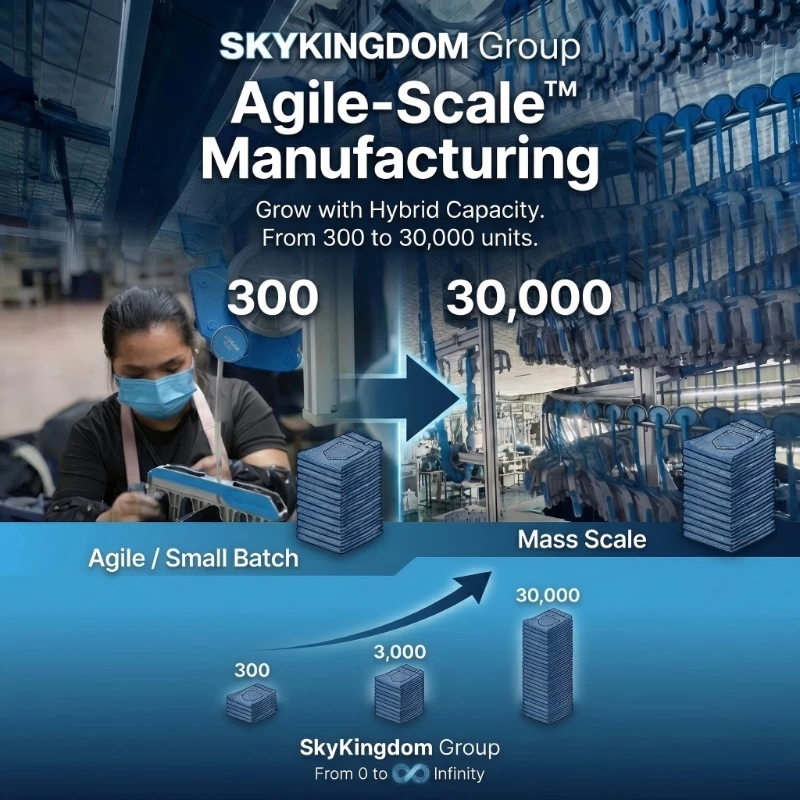
Source status: company self-stated unless separately linked. SkyKingdom describes itself as a custom jeans manufacturer and managed supply-chain partner based in Xintang, Guangzhou, with an operating history stated as starting in 2008. The company is most relevant when a brand has reference photos or an early sample idea but needs help turning it into a controlled custom jeans file: fabric, wash reference, sample correction, QC records, and repeat-order baseline. Treat this card as a supplier-fit note, not an independent proof of capability.