

Single Factory vs Managed Denim Production Network: Which Is Safer for Scaling?
Why this comparison matters
Brands often hear “we work with a network of factories” and assume it is automatically a stronger setup than working with a single factory. It can be — but only under specific conditions. Without those conditions, a network is just a marketing description for “we send your orders to whichever factory is available that month.”
The honest distinction is not about the number of factories. It is about who owns the standards. A single factory owns its own standards by default — for better or worse. A managed network must have a separate party that defines standards once and applies them across every factory in the network. If no one does that, the network has all the risk of multi-factory production with none of the benefit.
This comparison matters because the trade-offs are not what they look like at the quote stage. A single factory looks simpler, and often is. A managed network looks more flexible, and often is. But the actual risk is determined by whether the structure can absorb the things that go wrong at scale: capacity peaks, wash specialisation gaps, product complexity, and the difference between the factory that did the first run and the factory that is doing the reorder.
What each model actually is
| Aspect | Single factory | Managed denim production network |
|---|---|---|
| Production sites | One. | Multiple, typically 3–8, sometimes more. |
| Standards ownership | Whatever the factory’s internal standards are. | Owned by the managing party (the network operator), applied across all sites. |
| Sample reference | Factory’s own sealed sample. | Single approved sample applied across whichever factory runs the order. |
| Wash development | Done at the factory’s wash facility (or sent out, depending on factory). | Done once, with the recipe documented for whichever factory produces. |
| QC standards | Factory’s internal QC, plus whatever the brand requires. | Centrally defined AQL level, inspection points, and reporting format. |
| Capacity flexibility | Limited to that factory’s capacity that month. | Can shift production to a factory with available capacity. |
| Wash specialisation | Limited to that factory’s wash equipment and expertise. | Can route specific washes to the factory best equipped for them. |
| Product type flexibility | Limited to what that factory does well. | Can route jackets, jeans, and shorts to factories that specialise in each. |
| Reorder consistency | Same factory, same staff — assuming they remember. | Same documented standards, regardless of which factory runs the reorder. |
| Accountability when something drifts | The factory. | The network operator. The factory is one input; the operator is responsible for outcomes. |
| Risk if standards are not owned | The factory’s internal standards apply, by default. | Each factory applies its own standards independently — drift compounds across the network. |
The last row is the entire point of this comparison. A network without owned standards is not a denim production network. It is a list of factories. The structure works only when one party owns the standards across all of them.
When a single factory is the right choice
Single-factory production is the cleaner setup when several conditions hold simultaneously:
- Volume fits within the factory’s capacity without requiring overflow into other facilities, even at peak season.
- Product type is consistent — the factory does jeans well, and the brand only needs jeans from this factory.
- Wash requirements are within the factory’s actual capability, not its claimed capability. If the brand’s washes require ozone, laser finishing, or specific enzyme protocols, the factory must genuinely have that equipment and expertise.
- Reorders are predictable in volume and timing, allowing the factory to schedule them without competing against larger clients.
- The relationship is durable — the factory has commercial reason to prioritise the account, the staff who developed the product are still there, and personnel turnover is low.
For brands meeting these conditions, single-factory production removes coordination complexity, simplifies communication, and concentrates accountability. The factory’s strengths become the brand’s strengths; the factory’s limitations become the brand’s limitations.
The risk is concentration. If the factory’s wash technician leaves, if capacity gets allocated to a larger client during peak season, if the factory has a quality incident, the brand has no fallback. Single-factory production amplifies both upside and downside of the relationship.
When a managed network is the right choice
A managed production network is the right structure when at least one of the following is true:
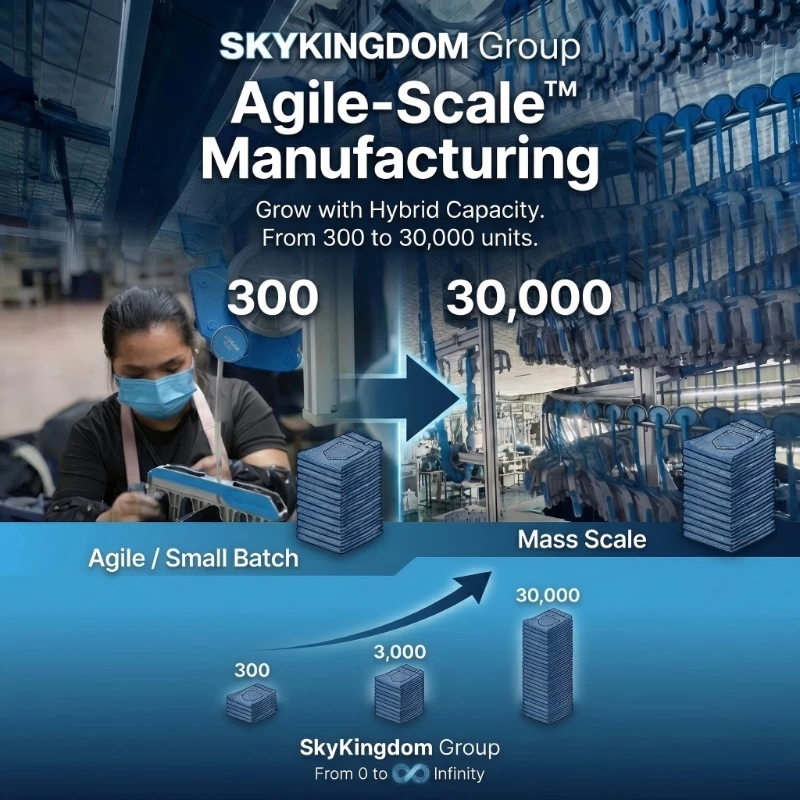
- Volume exceeds any one factory’s reliable capacity. A single factory can handle 5,000 pieces in standard time but pushes back at 15,000 — a network can absorb the volume by routing across sites.
- Product mix requires different specialisations. Heavyweight selvedge denim, soft stretch jeggings, denim jackets, and denim shirts each have different ideal production environments. A network can match each style to a factory that does that style well.
- Wash variety is broad. Vintage stone wash, ozone-bleached light wash, laser-finished distressed wash, and indigo dye wash each require different equipment and technician expertise. A specialised network has factories with each capability; a single factory rarely has all of them at top quality.
- Seasonal demand varies sharply. Brands with concentrated drop schedules need overflow capacity at specific weeks of the year. A network can scale up; a single factory cannot.
- Risk concentration is unacceptable. A brand whose denim line represents a meaningful share of revenue cannot afford to lose all production capacity if one factory has a labour dispute, equipment failure, or compliance issue.
In each of these cases, the question is not whether to use a network — it is whether the network is managed. A network with shared standards is the answer. A network without them is the original problem in a different shape.
What “managed” actually requires
The word “managed” is doing a lot of work in the phrase “managed production network.” It is also where most networks fail. To be genuinely managed, a network needs five structural conditions:
1. One party that owns the standards. Not the factories themselves — they each have their own. A managing entity that defines what the brand’s product is supposed to look like, fit like, and feel like, and applies that definition across every factory in the network.
2. Single approved sample applied across all sites. The same sealed sample is the reference for every factory producing that style. A factory does not produce against its own interpretation; it produces against the network-approved sample.
3. Documented wash recipes that travel across factories. A wash developed at Factory A must be reproducible at Factory B. This is not automatic. It requires documentation granular enough — enzyme load, stone weight, cycle time, water temperature, dosing sequence, machine type — that a different technician at a different facility can reproduce the result.
4. Centralised QC standards and reporting. Every factory in the network inspects to the same AQL level, against the same checklist, producing reports in the same format. The managing party reviews reports across factories, not factory by factory.
5. One point of accountability across the network. When something drifts, the brand calls one party — the network operator — not three different factories. The operator owns the investigation, the correction, and the cost recovery from whichever factory was responsible.
If any of these five conditions is missing, the network is not actually managed. It is a portfolio of factory relationships, which the brand could have built directly without a middle layer. For the structural difference between order-taking and product ownership across multiple sites, see Denim Factory vs External Denim Product Team.
Where unmanaged networks actually fail
Most “network” failures trace back to one of three patterns. Each is invisible at the quote stage and only surfaces during the second or third production cycle.
1. Same brief, different interpretation. A brand sends a tech pack to the network operator. The operator forwards it to whichever factory has capacity. Factory A interprets the wash one way; Factory B interprets it differently. Both produce within their own quality standards. Neither matches the brand’s intent. Without a sealed sample applied across the network, each factory becomes its own micro-brand.
2. Wash drift between factories. A wash developed at Factory A relies on that factory’s specific machinery, water composition, and technician judgment. Routed to Factory B for capacity reasons, the same recipe produces a different result. Without granular documentation and active wash management, this is the most common form of cross-factory drift — and the hardest to recover from after bulk has shipped.
3. QC inconsistency. Factory A inspects to AQL 2.5, Factory B inspects to AQL 4.0, Factory C runs 100% inspection on top-stitch but ignores wash variation. Three different shipments arrive at the brand’s warehouse with three different quality profiles, all stamped “passed inspection.” The brand discovers the inconsistency through customer returns, by which point it is too late to recover.
For the related comparison of how reorder readiness changes when production rotates across sites, see Low-MOQ Supplier vs Reorder-Ready Partner.
Decision framework
Use this matrix to locate your current state. The right model depends on volume, product mix, wash complexity, and risk tolerance — not on which structure sounds more sophisticated.
| Your situation | Likely fit | What to verify before you commit |
|---|---|---|
| You have stable volume that fits within one factory’s capacity, simple product type, standard washes. | Single factory | Capacity ceiling, wash equipment, reorder turnaround, sample-to-bulk consistency. |
| You have volume that peaks above any single factory’s reliable capacity. | Managed network | Standards ownership, sealed sample policy, wash documentation, central QC. |
| You produce multiple denim categories — jeans, jackets, shorts, shirts — that need different production environments. | Managed network | Whether each category is routed to a specialised factory under unified standards. |
| Your washes vary widely — vintage stone, ozone, laser, indigo dye. | Managed network | Wash specialisation per factory, recipe documentation that travels across sites. |
| You cannot absorb the risk of losing one factory’s capacity for any reason. | Managed network | Backup capacity, accountability across factories, contingency protocols. |
| You are early-stage, low volume, single product type. | Single factory | Whether the factory is reorder-ready, not just willing to take a small order. |
| You are evaluating “network” suppliers with no clear answer to “who owns the standards?” | Single factory (instead) | If standards are not centrally owned, a single factory is safer than a vague network. |
| You are scaling and your current single factory cannot keep up. | Managed network with explicit standards transfer | Documentation of current product specs before transition; wash recipe transfer protocol. |
For the brand-stage view of how creator, startup, and scaling needs differ across cooperation models, see Solutions and How It Works.
What this means in practice
Single-factory production is the right structure when one factory can credibly cover the brand’s full product, wash, and volume requirements — and when concentration risk is acceptable. For brands with stable, focused, single-category denim lines, this is the simplest and often the highest-quality option.
A managed network is the right structure when the brand’s needs exceed what any one factory can do well, or when the cost of a single factory’s failure would damage the business. The network structure is only stronger than the single factory when one party owns the standards. Without that ownership, the network is weaker than a single factory, because each site’s drift compounds.
The decision is not between “one factory” and “many factories.” It is between owned standards across one site and owned standards across multiple sites. The number of factories is a secondary variable.
For brands evaluating a network supplier, the diagnostic question is direct: show me the document that defines this brand’s product standards. Show me how it is applied to Factory A. Show me how it is applied to Factory B. Show me what happens when they diverge. If those documents exist and the answers are specific, the network is genuinely managed. If the answers are vague, the network is a list of factories.
For how production records, sealed samples, and cross-factory standards are operationalised, see Quality / QC, Sample-to-Bulk Consistency, and Reorder Control. For the broader question of what work the brand needs an external partner to own, see What We Handle.
Frequently asked questions
Is a managed network always more expensive than a single factory?
Not necessarily. The unit price depends on volume, factory selection, and how the network is structured. A well-managed network can sometimes deliver competitive prices by routing each style to its most efficient factory — a single factory pays the cost of being good at everything, even the things it does less efficiently. The honest comparison is on expected total cost including drift, rework, and reorder failures, not on quoted unit price alone.
How do I tell if a “network” is genuinely managed or just a list of factories?
Ask three direct questions: (1) Who defines the product standards across factories — the network operator, or each factory? (2) Where is the sealed sample stored, and which factory references it for production? (3) If a wash drifts between Factory A and Factory B, who investigates and corrects it? A genuinely managed network answers with one party, one sample location, and one accountable person. An unmanaged network answers with vague references to “the factories handling that.”
Can a single factory grow into a managed network?
Some do, by adding partner factories under their own standards system. The transition is delicate — the original factory’s internal standards become the network standards, and applying them to other sites requires documentation, training, and active QC management. Brands considering this with their current single-factory partner should ask to see the documentation framework before assuming the transition will work.
What happens to my reorder if production moves to a different factory in the network?
In a genuinely managed network, the reorder is produced against the same approved sample, the same documented wash recipe, and the same QC standards as the original. The result should match. In an unmanaged network, the reorder reflects whichever factory’s internal standards apply that month, and the result is unpredictable.
Can I specify which factory in the network produces my orders?
Sometimes. Brands with strong opinions about a specific factory can often negotiate that as a contractual term. The trade-off is reduced flexibility — if that factory is at capacity or has an issue, the brand may lose the ability to use the network’s overflow. Whether to specify or not depends on whether the brand values capacity flexibility or factory consistency more.
Is a managed network safer for compliance and audits?
It depends on whether the network operator audits its factories or relies on factory self-certification. A network with active compliance management — verified audits, traceable sourcing, documented labour standards — is genuinely safer than a single factory with no audit history. A network that simply forwards factory self-claims is no safer, and possibly riskier, because compliance failure at any one factory exposes the entire brand relationship.
What if my current setup is multiple factories without unified standards — am I in a network or not?
Functionally, no. A brand managing multiple unrelated factories is doing the work of a network operator, without the structure or accountability. This setup is common when brands grow organically and add factories one at a time. The remediation is either to consolidate to a single factory, or to bring in a structured operator that can apply unified standards across the existing factories — or to accept that each factory is its own production relationship with its own standards drift.
Related comparisons
If you are still narrowing down which cooperation model fits, the following pages address adjacent decisions:
Denim Factory vs Trading Company
Communication chain, pricing transparency, and accountability.
Sourcing Agent vs Denim Product Team
Supplier matching versus ongoing product responsibility.
Low-MOQ Supplier vs Reorder-Ready Partner
Why low MOQ alone does not solve consistency.
For broader preparation, see the Buying Guides for tech pack and reorder preparation, the Denim Encyclopedia for technical terminology, and What We Handle for the scope of work covered before, during, and after production.
Talk through your situation before you choose
If you are deciding between single-factory production and a managed network, the answer depends on your volume, product mix, wash complexity, and tolerance for concentration risk — not on which structure sounds more sophisticated. Send your product stage, target volume, expected reorder pattern, and the specific capacity or wash needs you are trying to solve for.
SkyKingdom is an external denim product team for growth brands, operating across a managed denim production network with unified standards, sealed samples, and centralised QC records. We can help you understand whether your situation needs a single factory or a structured network before you commit.