
Denim sustainability can feel like a tug-of-war: your customers want lower-impact jeans, but your launch calendar demands speed, margin, and repeatable quality. I’ve seen brands stall because “sustainable denim” was treated like a mood board instead of a measurable production plan. The good news is that denim sustainability is no longer a single choice (like “organic cotton”)—it’s a stack of decisions from fiber to finish, plus the data to prove it. This guide breaks down what actually moves the needle and how to build a denim program that’s credible, scalable, and fast.

What “denim sustainability” really means (and what it doesn’t)
Denim sustainability is the measurable reduction of environmental and social impacts across the denim lifecycle—raw materials, dyeing, finishing, cut-and-sew, logistics, and end-of-life. It’s not just a “green wash” recipe or a recycled hangtag; it’s how the whole product system performs. In practice, sustainable denim programs focus on four impact buckets: water, chemicals, energy/carbon, and durability/circularity.
To keep claims honest, I recommend defining denim sustainability using standards and metrics rather than adjectives. That means asking suppliers for testable proof: restricted substance compliance, wastewater performance, traceable fiber content, and process data. A strong foundation is aligning with widely recognized frameworks like ZDHC (chemical management) and Textile Exchange (preferred fibers and traceability).
Why denim has such a big footprint: the impact hotspots
Denim’s footprint is concentrated in a few steps, so targeted improvements can deliver outsized gains. From my factory-side experience, brands get the fastest results by focusing on wet processing (dyeing and washing) and material selection (fiber blends and cotton sourcing). Research reviews and LCA work consistently highlight these stages as major drivers of impact in denim production (see peer-reviewed overviews like the sustainability review hosted by PubMed Central).
Key hotspots to understand:
- Cotton cultivation: water use, pesticides, land impact, and yield variability.
- Indigo dyeing: chemical reducing agents, salts, and effluent load.
- Finishing/washes: stone wash, bleach, and multiple rinse cycles can dominate water and energy.
- Stretch blends: comfort comes with recycling complexity and microfibre concerns.
The 5 levers that improve denim sustainability fastest
1) Choose lower-impact fibers without sacrificing performance
Material choice is your first “big lever,” but it must match fit, recovery, and customer expectations. In production, the most common sustainability upgrades include:
- Organic cotton or BCI/Better Cotton-aligned sourcing (when traceability is clear)
- Recycled cotton blends (watch strength and pilling; test early)
- Cellulosic alternatives (e.g., lyocell blends) for softness and drape
- Hemp blends (gaining momentum, but supply and hand-feel consistency vary)
If your hero product is stretch denim, be careful: elastane improves comfort but complicates recycling. A practical compromise I’ve used is minimizing elastane % while engineering construction and finishing for recovery, then validating with wear tests and dimensional stability testing.
2) Clean up indigo: reduce chemicals and rethink dye chemistry
Indigo dyeing is a major chemical and water hotspot. Newer approaches—like alternative reducing systems and improved process control—can cut impact without changing the “denim look” customers expect. Emerging research even suggests dramatic reductions when replacing conventional indigo pathways with bio-based dyeing routes (National Geographic covered enzyme-based and light-based indican dyeing and its potential impact reductions: National Geographic).
In day-to-day manufacturing, denim sustainability improvements often include:
- Tighter bath control to reduce re-dye and shade variation
- Better chemical management aligned to ZDHC MRSL
- Exploring lower-impact reducing agents and process innovations where feasible
3) Replace heavy washes with laser + ozone + enzymes (where the aesthetic allows)
If you want visible sustainability gains fast, this is where many brands win. Traditional wash recipes can involve multiple baths, pumice stones, and harsher chemistries. More modern “eco wash” toolkits often combine:
- Laser finishing (patterning without abrasive manual processes)
- Ozone (reduces water and certain chemical steps)
- Enzyme washing (targeted effects with fewer harsh chemicals)
A credible denim sustainability plan doesn’t claim “zero water,” but it can reduce water per garment significantly versus conventional multi-rinse methods. The key is to lock the look with a controlled wash standard and verify repeatability at scale.
4) Engineer durability: the most overlooked sustainability win
The most sustainable pair of jeans is the one that gets worn longer. Durability is a sustainability feature customers actually feel: better seam strength, lower shrinkage, improved colorfastness, and stable stretch recovery. I’ve found that brands that invest in durability also see fewer returns, higher reviews, and better lifetime value—so denim sustainability becomes a growth lever, not just a cost.
Practical durability specs to include in your tech pack:
- Seam slippage and seam strength targets
- Dimensional stability after wash (shrinkage limits)
- Colorfastness to rubbing and washing
- Stretch growth and recovery benchmarks (for stretch denim)
5) Use production data to prevent waste (sampling, rework, and overproduction)
Waste often hides in “invisible” places: repeated sampling rounds, shade mismatches, rework from unstable patterns, and overbuying base fabric “just in case.” A data-driven workflow—real-time tracking, digital approvals, and stable SOPs—reduces waste without marketing claims.
At SkyKingdom Group, this is where our 5G IoT production lines and digitalized ERP tracking help: fewer surprises means fewer re-dos, and fewer re-dos means a more sustainable denim program. Speed also matters: when you can validate quickly (like a 7-day sample turnaround) you can make better sustainability choices earlier, before the bulk order locks you into a high-impact route.
What to ask a denim manufacturer: a sustainability checklist you can use today
When brands tell me “we want denim sustainability,” I ask: “Which claims will you make, and what proof do you need?” Use this checklist to keep conversations concrete:
-
Chemical compliance
- ZDHC alignment? MRSL conformance?
- RSL testing frequency and third-party lab options?
-
Wash process options
- Laser/ozone/enzyme availability?
- Water-reuse systems or low-liquor processes?
-
QC and consistency
- AQL standard (e.g., AQL 2.5) and inline inspection points
- Shade band control and wash standardization
-
Traceability
- Fiber certifications and transaction certificates where applicable
- Lot-level tracking for bulk fabric and trims
-
Capacity and MOQ
- Can you test sustainable options at low MOQ before scaling?
- Lead times for samples and bulk with sustainable finishes?
| Lever (Fiber/Dye/Wash/Durability/Data) | Typical Brand Goal | Factory Requirement | Risk/Trade-off | Best Use Case |
|---|---|---|---|---|
| Fiber — Organic cotton | Reduce pesticide use; improve traceability; meet organic claims (e.g., GOTS/OCS) | Certified supply chain, segregation in storage/cutting, documentation & audits | Higher fiber cost; variable availability; yield/quality variability; claim compliance burden | Premium/core styles where storytelling and certifications add value |
| Fiber — Recycled cotton blend | Lower virgin cotton use; reduce footprint; circularity content targets | Reliable recycler supply, blend control, yarn spinning adjustments, QC for strength/irregularity | Lower tensile/tear strength; shade/hand variability; limited high-content feasibility | Mid-price denim, rigid/relaxed fits, products tolerant to slub/variation |
| Dye — Low-impact dye chemistry | Reduce salt/chemical load; improve effluent metrics (COD/BOD); safer chemistry | Process re-optimization, compatible dyes/auxiliaries, ETP capacity and monitoring | Color matching challenges; potential shade drift; licensing/chemical availability | High-volume programs needing measurable wastewater improvements |
| Wash/Finish — Laser + ozone finishing | Reduce water, pumice, and chemical usage; faster, repeatable effects | CapEx for laser/ozone units, ventilation/safety systems, trained operators, maintenance | High upfront cost; effect limitations on deep abrasion; throughput constraints | Replicating distressed looks at scale with lower water/chemical footprint |
| Wash — Enzyme wash | Replace harsh chemicals/stone wash; lower damage and backstaining | Tight control of pH/temp/time, enzyme sourcing, process QA | Over/under-treatment affects shade/strength; batch variability | Soft-hand, worn-in aesthetics with reduced fiber damage vs stones |
| Durability — Spec upgrades (stronger seams, hardware, fabric testing) | Extend product life; reduce returns; support repair/resale | Enhanced specs (SPI, thread, bartacks), additional lab testing, pattern/trim changes | Added cost; possible stiffer hand/less drape; longer development cycles | Workwear, premium denim, brands emphasizing longevity and repairability |
| Data — ERP/IoT waste reduction | Reduce scrap, rework, energy/water per unit; improve compliance reporting | Sensors/metering, ERP/MES integration, data governance, operator adoption | Integration complexity; data quality issues; cybersecurity; change management | Multi-site or high-volume factories aiming for continuous improvement and reporting readiness |
A simple way to quantify progress: pick KPIs you can defend
Denim sustainability becomes real when you track a few KPIs consistently across seasons. You don’t need a PhD-level LCA for every SKU, but you do need comparable numbers.
Recommended KPI set:
- Water per garment (especially wash/finish stage)
- Energy per garment (or kWh per dozen)
- Chemical compliance rate (pass/fail + MRSL alignment)
- First-pass yield (less rework = less waste)
- Return rate tied to quality issues (durability as sustainability)

Common denim sustainability mistakes (and how to avoid them)
Most sustainability failures are not “bad intentions”—they’re process gaps. Here are the issues I see most often, plus practical fixes.
-
Mistake: Choosing a sustainable fiber but keeping a high-impact wash
- Fix: Treat fiber + wash as one system; validate the whole recipe on the intended shade and hand-feel.
-
Mistake: Over-claiming (“eco-friendly,” “clean,” “zero impact”)
- Fix: Use specific, verifiable statements tied to standards, tests, or measurable reductions.
-
Mistake: Ignoring stretch recovery and durability
- Fix: Add performance testing early; if stretch fails, customers churn and sustainability loses credibility.
-
Mistake: Sampling too slowly
- Fix: Use rapid sampling to test sustainable options early—before bulk commitments.
-
Mistake: Not aligning trims
- Fix: Don’t forget zippers, buttons, pocketing, and labels; trims can be upgraded too (and some suppliers are increasing sustainable inputs).

How SkyKingdom supports denim sustainability without slowing down launches
DTC brands live and die by timing. The trap is assuming denim sustainability automatically means longer lead times, higher MOQ, and inconsistent bulk. In our OEM/ODM work at SkyKingdom Group, we’ve found the opposite can be true when sustainability is engineered into the workflow:
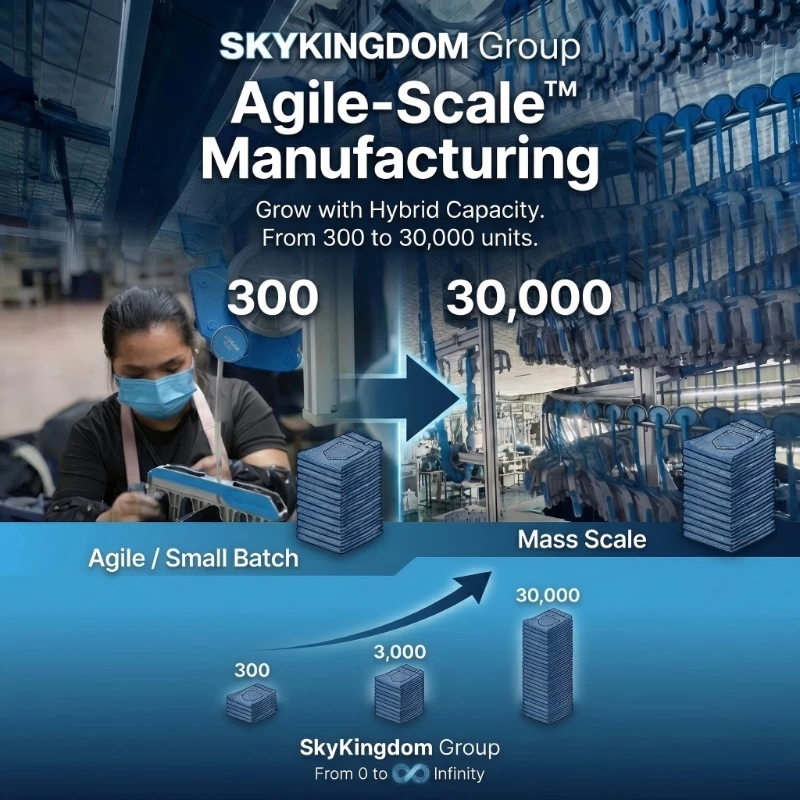
- Speed-to-Market Engine: 7-day samples and 15–22-day bulk production helps brands test lower-impact options early and iterate fast.
- Low MOQ (30 units): makes it realistic to pilot sustainable denim capsules without overproducing.
- Amazon Top Seller-Grade QC (AQL 2.5): sustainability claims fail if quality fails; fewer defects means fewer returns and less waste.
- Eco-friendly wash processes + data tracking: aligns wash choices with measurable KPIs, not guesswork.
- Risk-sharing fabric strategy: base fabric safety stock can reduce delays and last-minute substitutions that derail sustainability specs.
If you’re building an agile denim line, these guides may help you connect sustainability with speed and supply-chain reality:
- beyond the hype how denim 2026 trends are redefining agile supply chains
- the ultimate guide to quick denim clothing sample production for fashion brands
- 2025 global top denim manufacturers review
Circular denim: resale, repair, and design choices that matter
Denim sustainability doesn’t end at the factory gate. If your brand can keep jeans in use longer, you reduce the need for new production. The most practical circular moves for denim brands include:
- Design for repair (stronger pocket bags, reinforced stress points, spare rivets/buttons)
- Offer repair guidance and care instructions that prevent premature fading and seam failure
- Resale or take-back pilots (start small; measure participation and costs)
- Avoid hard-to-recycle builds when possible (excessive mixed materials, heavy coatings)
Industry initiatives are also pushing fiber-to-finish change and near-net-zero manufacturing roadmaps—worth tracking for long-term planning, such as programs highlighted by Fashion for Good.
Ozone wash, a sustainable solution for Denim finishing
FAQ: denim sustainability questions people search
1) What is denim sustainability in simple terms?
Denim sustainability means reducing water, chemicals, energy, and waste across the jeans lifecycle, while protecting worker welfare and improving durability.
2) Is organic cotton denim always sustainable?
It can be better, but it’s not automatic. The wash, dyeing, durability, and traceability determine whether the overall denim sustainability outcome is strong.
3) What denim wash is most sustainable?
It depends on the target look, but laser and ozone-assisted finishing with optimized rinsing is often lower-impact than multi-bath conventional washes.
4) Is stretch denim less sustainable?
Often yes, because elastane complicates recycling and can reduce longevity if recovery is poor. You can improve denim sustainability by minimizing elastane and engineering recovery.
5) How can small DTC brands start sustainable denim with low risk?
Start with a low MOQ pilot, choose 1–2 impact levers (like wash + durability), and require measurable QC and compliance documentation.
6) What certifications matter for sustainable denim?
Commonly referenced frameworks include chemical management programs (like ZDHC) and fiber standards; which one matters most depends on your claim and market.
7) How do I avoid greenwashing in denim sustainability marketing?
Use specific, verifiable claims tied to standards, test reports, and measurable KPIs (water/energy per garment), and avoid vague “eco” language.
Conclusion: make denim sustainability a system, not a slogan
Denim sustainability works when it’s treated like product engineering: you choose the right fibers, control dye and wash chemistry, design for durability, and use data to prevent waste. I’ve watched brands win trust fastest when they stop chasing perfect and start building repeatable, provable improvements—season after season. If you’re planning your next denim drop, share your target aesthetic and price point in the comments, and we’ll map the most realistic sustainability levers for your line.
📌 how to identify the best factory for fast and reliable denim clothing sample delivery