
Short answer: denim brands should plan 2026 jeans trends as testable product directions, not as one big seasonal bet. Use trend signals to choose a few silhouettes, washes, and fabric stories, then test them through samples, small runs, sell-through feedback, wash control, and reorder records before committing too much stock.
The risk is not missing every trend. The risk is overcommitting to one trend before the product team knows whether the fit, wash, fabric, cost, and reorder path can actually hold.
Why 2026 Denim Trend Planning Needs a Smaller First Bet
Trend pages are useful, but they are not production plans. In 2026, denim coverage is fragmented: straight legs, barrel shapes, relaxed fits, dark washes, light washes, cuffed hems, low-rise shifts, and cleaner classics all appear in current fashion coverage. A buyer can read ELLE’s denim trend guide, Who What Wear’s 2026 denim coverage, and retail trend notes and still reach different conclusions.
That is normal. The stronger planning move is not to find one perfect forecast. It is to convert several trend signals into controlled product experiments. A small brand does not need to own every trend. It needs a repeatable way to decide which trends deserve fabric, sample, and inventory money.
McKinsey’s State of Fashion 2026 also points to a market where volatility, consumer shifts, and operational agility matter. For denim buyers, that means trend planning should be connected to stock risk and supply-chain control, not only mood boards.
The Standard: Can the Trend Survive Sampling, Bulk, and Reorder?
A jeans trend is not production-ready when it appears on a runway, celebrity feed, or trend newsletter. It becomes production-ready when the buyer can define the product and repeat it. Denim makes this harder because the same silhouette can look different after fabric choice, wash, shrinkage, finishing, and measurement tolerance.
| Trend signal | Production question | Risk if skipped |
|---|---|---|
| Barrel or balloon leg | Can the pattern keep the curve without twisting after wash? | The sample looks modern, but bulk fit feels distorted. |
| Straight or slim-straight leg | Which fabric recovery and inseam tolerance protect the clean line? | The product becomes ordinary or uncomfortable after bulk fabric changes. |
| Dark rinse or clean indigo | Can shade, crocking risk, and shrinkage be controlled consistently? | Returns rise because color transfer or sizing feels unpredictable. |
| Light vintage wash | Is the wash standard recorded with shade band and hand-feel target? | Reorders drift away from the approved sample. |
| Cuffed or cropped hem | Is final length checked after wash and pressing? | The styling detail becomes a sizing complaint. |
| Low or mid rise | Are rise, seat, and waistband fit tested on the target customer? | The trend sells visually but fails in wearability. |
Table takeaway: a trend is worth scaling only when its production risk can be named, tested, and repeated.
Use Trend Sources as Signals, Not Instructions
Trend forecasting tools and media coverage can help a brand decide what to explore. WGSN, for example, describes fashion forecasting as a way to identify trends and de-risk buying decisions. That signal is useful, but the buyer still needs a denim-specific production filter.
| Source type | Signal label | What it may help with | Verification question to ask |
|---|---|---|---|
| Fashion media trend article | public signal | Shows what silhouettes, washes, and styling ideas are visible to consumers. | Can this trend be translated into your price point, fit range, wash standard, and delivery window? |
| Trend forecasting platform | self-stated claim | May support planning through data, social signals, and seasonal direction. | Does the signal match your actual customer, channel, climate, and reorder cycle? |
| Influencer or celebrity styling | public signal | Shows fast cultural attention around a silhouette or styling move. | Is this a styling moment or a product shape your buyers will reorder? |
| Supplier sample room | needs verification | Can show what the supplier is already developing or able to sample quickly. | Are these samples backed by fabric, wash, trim, measurement, and bulk records? |
| Sales team feedback | needs verification | Can reveal buyer objections and missed sizes, fits, or washes. | Is the feedback based on actual sell-through and return reasons, or only buyer opinion? |
Table takeaway: trend signals help you choose what to test; production evidence tells you what to scale.
A Safer Planning Framework for 2026 Denim Drops
Instead of planning a full collection around one forecast, divide the season into three decision layers.
Layer 1: Core styles that protect cash flow
These are the fits and washes your customer already understands: straight leg, relaxed straight, dark rinse, clean black, or a proven jacket body. They do not need to feel boring. They need to give the business a stable base while trend tests run around them.
Layer 2: Controlled trend tests
These are the products that deserve samples and small first runs: a barrel-leg shape, a new vintage wash, a cuffed hem, a wider leg, a coated finish, or a utility detail. Each test should have a clear pass/fail rule before bulk production.
Layer 3: Content-only or concept-only ideas
Some ideas are useful for marketing, lookbooks, and social content but not ready for production. A dramatic wash or exaggerated shape may attract attention, yet still be too costly, unstable, or hard to reorder. Keeping this layer separate prevents creative excitement from becoming inventory exposure.
How to Decide Whether a Denim Trend Deserves Bulk Production
Before scaling a trend, ask five questions.
- Fit: did the target customer actually like the rise, leg shape, seat, and length?
- Wash: can the approved shade and hand feel be repeated within an agreed shade band?
- Fabric: is the fabric available for both first order and reorder, with acceptable stretch and shrinkage?
- Cost: does the trend still make margin after fabric, wash, trims, labels, inspection, packing, and freight?
- Reorder: can the same product be repeated if the first drop sells?
Decision rule: do not scale a trend because it looks strong in a forecast. Scale it when the product file proves the style can be repeated commercially.
What Small Brands Should Avoid
Small brands usually do not fail because they missed one silhouette. They fail because too much cash sits in the wrong fabric, wash, or size curve. The most dangerous 2026 planning mistakes are:
- ordering several untested trend styles at once;
- choosing a wash because it looks good online but not testing bulk repeatability;
- letting a supplier’s available sample replace your own customer judgment;
- adding too many trims and finishes before the fit is proven;
- planning reorders without keeping sample, wash, measurement, and trim records.
Trend speed feels exciting. Denim production rewards disciplined memory: what was approved, what changed, what sold, what returned, and what can be repeated.
FAQ
What denim trends should brands watch in 2026?
Brands should watch straight and relaxed fits, wider legs, barrel or balloon shapes, dark rinse, light vintage washes, black denim, cuffed hems, and cleaner classics. The better question is not which trend appears most often, but which trend your customer can wear, buy, and reorder.
How many denim trends should a small brand test at once?
A small brand should usually test a limited number of directions at once, especially if fabric, wash, and fit are still unproven. A practical approach is to protect core styles, test a few trend styles, and keep experimental ideas separate until sample and customer feedback justify production.
Should brands follow celebrity denim trends?
Celebrity and influencer looks can be useful trend signals, but they should not become production instructions. Buyers still need to check whether the silhouette, wash, rise, length, fabric, price, and reorder path fit their actual customer.
How can a brand reduce denim inventory risk?
Reduce risk by sampling before bulk, separating core styles from trend tests, confirming fabric and wash repeatability, using clear size ratios, and keeping records for approved samples, measurements, trims, shade bands, and reorders.
When is a denim trend ready for reorder?
A denim trend is ready for reorder when the approved sample, fabric, wash, trim card, measurements, QC notes, and customer feedback all support repeating the product. Strong first-week attention is not enough if the production file cannot be repeated.
About the Xintang Denim Product Team
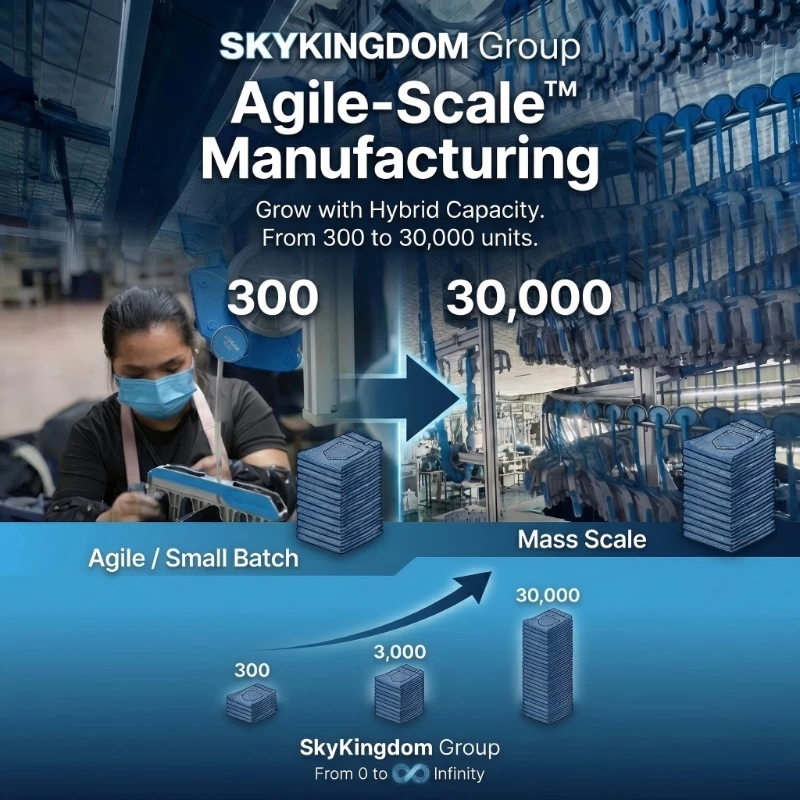
SkyKingdom has operated in Xintang, Guangzhou – China’s largest denim production cluster – since 2008, working as an external denim product team for brands that need development, sampling, wash control, QC, and reorder continuity. If your 2026 denim plan includes several trend directions, prepare your reference images, target quantities, sample size, fabric direction, wash expectation, and reorder assumptions before asking for production pricing.