
Sourcing from china clothing manufacturing companies can feel like speed-dating with high stakes: one factory promises low prices, another promises “premium,” and a third says “any MOQ.” The difference between a smooth launch and a costly delay is usually your vetting process, not your luck. I’ve helped DTC teams qualify suppliers for fast-fashion denim and woven programs, and the same pattern repeats: the winners verify capability, compliance, and lead time with evidence. This checklist walks you through how to pick a partner confidently—especially for denim jeans and woven apparel.

Step 1) Define your “must-haves” before you contact any factory
Most sourcing mistakes start with a vague brief. When you approach china clothing manufacturing companies with incomplete specs, they fill the gaps with assumptions, and you pay for it in samples and revisions. Define your requirements as a one-page “factory fit” sheet that you can send to every supplier.
Include:
- Category & construction: denim jeans (rigid/stretch), woven shirts, kids wear, etc.
- Target price & expected quality level: mass, mid, premium
- MOQ & size range: per color, per style, size breakdown
- Lead time targets: sample + bulk
- Compliance needs: social audits, restricted substances, testing
If speed is your competitive edge, shortlist partners designed for quick response. For denim-focused programs, see how to identify the best factory for fast and reliable denim clothing sample delivery.
Step 2) Screen for the right “factory type” (OEM, ODM, or trading company)
Not all china clothing manufacturing companies are true factories. Some are trading companies (fine sometimes), and some are “brokers” with limited control over QC and timelines. Your job is to confirm who owns the needle-moving steps: pattern, cutting, sewing, washing, and finishing.
Quick identifiers:
- OEM: you provide tech pack; they execute to spec
- ODM: they provide design + development + production
- Trading company: manages vendors; may add flexibility, may add opacity
Ask for:
- Factory business license + address
- Workshop photos/video with timestamps
- A list of in-house vs outsourced processes (especially denim washing)
For an industry baseline on how directories verify suppliers, review Sewport’s China manufacturer overview.
Step 3) Verify capability with “proof, not promises”
Capability claims are easy; repeatable output is harder. For china clothing manufacturing companies, require evidence in four areas: product match, process control, capacity, and defect handling. In my experience, the fastest way to uncover risk is to ask for “recent production artifacts,” not marketing decks.
Request a capability pack:
- Recent QC reports (AQL results, defect photos, corrective actions)
- Line layout + capacity (monthly output by category)
- Reference styles similar to yours (fabric weight, wash, trim level)
- Fabric/trim sourcing list and lead times
If you’re sourcing denim, prioritize specialists over generalists. A practical starting point is best denim clothing chinese manufacturer for fashion brands our top pick.
| Checklist Item | What to Ask For | Pass Criteria | Red Flags | Your Notes |
|---|---|---|---|---|
| Business license | Copy of business license, registration number, legal entity name, factory address | Valid and current; matches bank account name and factory location | Expired/mismatched details; refuses to share; uses trading company while claiming factory | |
| In-house processes | Process list (cut/sew/print/embroidery/wash/packing), machine list, photos/videos, subcontracting policy | Clear in-house capabilities; transparent about any outsourcing; consistent evidence | Vague answers; “we do everything” with no proof; heavy subcontracting undisclosed | |
| Sample lead time | Typical sample timeline by complexity; sample fees; capacity per week | Meets your calendar (e.g., 7–14 days); clear milestones and rush option | Uncommitted dates; frequent “delay” history; asks for full payment before sampling | |
| Bulk lead time | Production lead time by order size; booking window; fabric/trim lead times | Realistic timeline (e.g., 30–60 days); capacity plan; written commitment in PI | Overpromises; no production schedule; depends on “after deposit we see” | |
| MOQ flexibility | Standard MOQs by style/color/size; willingness for mixed sizes/colors; surcharge terms | Can accommodate pilot runs; transparent cost impact; scalable plan | Rigid MOQs with no options; hidden surcharges; punitive terms for reorders | |
| AQL/QC system | QC SOP, AQL level used, in-line/final inspection reports, defect classification | Documented QC; AQL 2.5/4.0 (or agreed); shares recent reports and corrective actions | “No need QC”; refuses reports; high defect tolerance; no CAPA process | |
| Fabric sourcing | Mill list, fabric specs, lab dips/strike-offs, test reports (shrink/colorfastness), traceability | Traceable mills; consistent specs; passes key tests; offers alternatives if OOS | Unknown mills; inconsistent GSM/composition; no testing; “same as last time” claims | |
| Wash capability | In-house vs. partner washhouse, wash standards, wash test results, sample swatches | Proven wash results; controlled standards; repeatable outcomes with test approval | Unpredictable shading; cannot match references; no wash test or swatch control | |
| Compliance certificates | Needed certs (e.g., BSCI/SEDEX/WRAP/ISO), audit reports, validity dates, scope | Current and in-scope; provides audit summary and corrective action status | Expired/for another site; refuses audit details; “certificate coming soon” | |
| Communication cadence | Primary contact, response SLA, weekly updates, tooling/sample photos, escalation path | Replies within 24h; proactive weekly status; clear escalation; good English or translator | Slow replies; inconsistent info; avoids calls; frequent misunderstandings |
Step 4) Stress-test sampling: the fastest signal of future performance
Sampling is where “good on paper” becomes real. Many china clothing manufacturing companies can make a decent sample eventually; fewer can do it quickly and consistently. Your sampling phase should test accuracy, communication, and problem-solving—not just sewing.
Run a 2-sample test:
- Sample #1 (baseline): your tech pack, target fabric, target trims
- Sample #2 (change order): change one key variable (wash shade, pocket shape, measurement tolerance)
Score them on:
- Pattern accuracy and measurement control
- Construction consistency (stitch density, seam strength)
- Wash hand-feel and shade repeatability (for denim)
- Speed + clarity of feedback
SkyKingdom Group, for example, positions its “Speed-to-Market Engine” around 7-day sample turnaround and 15–22-day bulk production, which is the kind of measurable promise you should demand—and verify—when comparing factories.
Step 5) Lock in quality with an AQL plan + pre-production controls
Quality disputes usually happen because “quality” was never defined operationally. When working with china clothing manufacturing companies, align on a measurable standard like AQL 2.5 (commonly used for consumer apparel) and define what gets checked at each stage.
Minimum QC checkpoints:
- Fabric inspection (shade banding, shrinkage, defects)
- Pre-production meeting (PPM) with golden sample approval
- Inline inspection (top 3 defect types tracked daily)
- Final inspection (AQL, packaging, labeling, carton drop test if needed)
Authoritative references you can cite in your supplier SOP:
- ISO 9001 Quality Management Systems (framework for process control)
- OEKO-TEX® STANDARD 100 (textile chemical safety testing)
If you sell on Amazon, TikTok Shop, or into major retail ecosystems, compliance isn’t “nice to have.” Many china clothing manufacturing companies can provide certificates; fewer can show current, relevant, and auditable documentation.
Ask for:
- Social audit reports (e.g., BSCI/SEDEX/WRAP—depending on your needs)
- Chemical management and restricted substance controls
- Subcontractor disclosure (especially for washing, embroidery, printing)
I’ve found the simplest rule is this: if a supplier hesitates to share audit scope/date or refuses subcontractor transparency, treat it as a supply chain risk—not a negotiation tactic.

Step 7) Evaluate speed-to-market with a timeline you can enforce
Factories often quote lead times without separating “material time” from “production time.” Your timeline should be built from milestones with owner, due date, and penalty/solution path. With china clothing manufacturing companies, strong partners will welcome this because it reduces rework and last-minute chaos.
Use a simple milestone chain:
- Tech pack + BOM confirmed
- Fabric/trim approvals (lab dips, wash standard)
- PPS (pre-production sample) approval
- Cut date
- Inline QC window
- Final inspection + shipping booking
If your brand needs speed, prioritize suppliers that run digital tracking (ERP, line dashboards, real-time QC logs). SkyKingdom’s approach—5G IoT production lines with real-time data tracking and a digital ERP—reflects the direction top-tier quick-response manufacturing is moving.
Your Certified Sourcing Solution | 3S Apparel – 26 Years of OEM/ODM Expertise #apparel #clothing
Step 8) Put MOQs, capacity, and risk-sharing in writing
MOQ is not just a number—it changes how the factory plans fabric, markers, and line changeovers. Many china clothing manufacturing companies quote low MOQ, then quietly offset it with higher unit costs, limited fabric options, or slower schedules.
Contract essentials:
- MOQ by color/style and allowable size ratios
- Over/under shipment tolerance (e.g., ±3%)
- Rework/defect responsibility and credit terms
- Material commitments: who owns fabric liability, shade continuity
- Safety stock (if offered) and replenishment rules
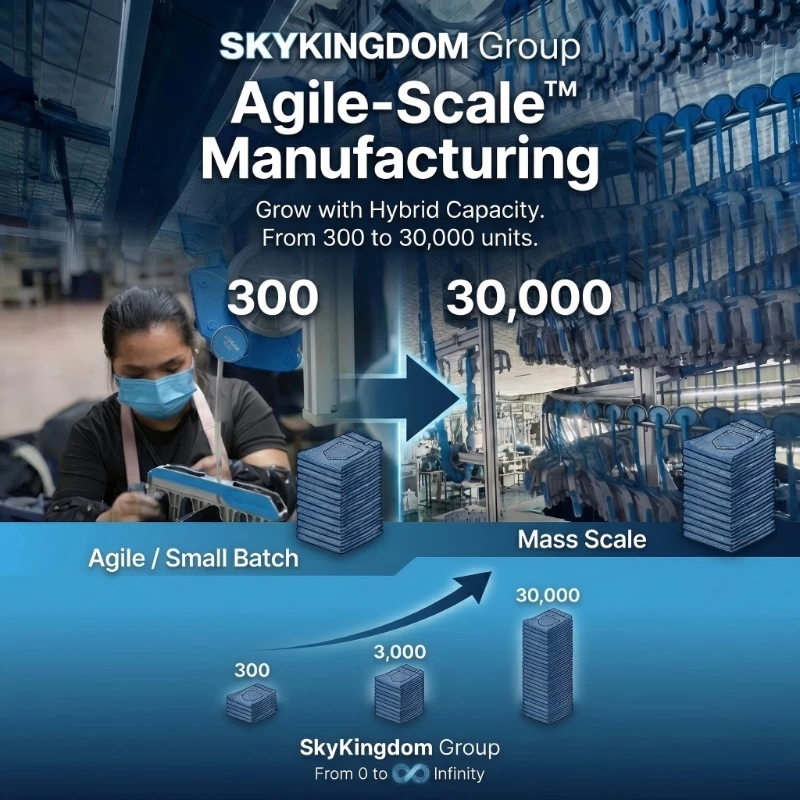
SkyKingdom’s model—supporting MOQ 30 for new creators plus scalable hybrid capacity, and offering a “risk-sharing partnership” via base fabric safety stock—can reduce launch friction for small DTC drops while still supporting growth.
Step 9) Run a “communication audit” (it predicts everything)
The best china clothing manufacturing companies don’t just make garments; they manage decisions. Measure how they communicate during sampling, because that cadence is exactly what you’ll get during bulk production.
Score communication on:
- Response time (24–48 hours is a practical target)
- Ability to summarize issues + propose solutions
- Photo/video evidence during development
- English clarity (or your preferred language) and single point of contact
When I tested suppliers side-by-side, the factory that sent annotated photos, measurement reports, and wash comments early almost always delivered cleaner bulk runs—even if their quote wasn’t the lowest.
Step 10) Make your final selection with a weighted scorecard
Choosing among china clothing manufacturing companies should be a math problem, not a gut feeling. Use a weighted scorecard so your team can agree objectively.
Suggested weights (adjust to your business):
- Quality system (AQL, PP controls): 25%
- Speed-to-market (sample + bulk): 20%
- Product expertise (denim/woven match): 20%
- Compliance & transparency: 15%
- Cost & payment terms: 10%
- Communication & project management: 10%
If you’re building a denim line with small-batch needs, you may also want to compare approaches to low MOQs and scalable production; what are the best small batch denim clothing manufacturers for private label is a useful framework to align expectations.

Common vetting mistakes (and how to avoid them)
Even experienced teams repeat a few preventable errors when dealing with china clothing manufacturing companies. Fix these and you’ll eliminate most sourcing surprises.
Avoid:
- Choosing by price before confirming wash, fabric, and QC controls
- Treating “sample looks good” as proof of bulk capability
- Skipping PP meetings and golden sample sign-off
- Not clarifying what’s outsourced (washing is the big one)
- No written standard for defects, tolerances, and rework
Conclusion: pick a partner you can launch with (not just produce with)
If china clothing manufacturing companies had one universal truth, it’s this: the best supplier is the one that makes your next launch predictable. When you vet with proof—capability artifacts, sampling stress tests, AQL controls, and transparent timelines—you turn sourcing from a gamble into a system. SkyKingdom Group’s model (fast sampling, quick bulk windows, low MOQ, AQL 2.5 QC, digital visibility, and certified responsibility standards) is a strong example of what modern quick-response OEM/ODM can look like for denim and woven apparel.
📌 6 ways quick jeans and jackets sample delivery boosts your product launch timeline
FAQ: China Clothing Manufacturing Companies
1) How do I verify a China clothing factory is real and not a trading company?
Ask for a business license, factory address, live video walkthrough, and a list of in-house vs outsourced processes. Match the address to the workshop footage and shipping documentation.
2) What is a good MOQ for startups working with China clothing manufacturing companies?
For startups, 30–100 units per style/color is workable with the right partner, but expect tradeoffs in fabric choice or unit cost. Get MOQ in writing by style and color.
3) What’s a realistic sample and bulk timeline for denim and woven apparel?
Many suppliers quote 7–15 days for samples and 15–30 days for bulk after approvals, but it depends on fabric availability and wash development. Separate material lead time from sewing lead time.
4) What quality standard should I use when sourcing from China?
AQL 2.5 is common for apparel, paired with fabric inspection, PP meetings, inline checks, and final inspections. Define critical/major/minor defects clearly.
5) How can I reduce risk of shade variation in denim production?
Use an approved wash standard, shade bands, controlled fabric lots, and require bulk to follow the same recipe and finishing. Confirm whether washing is in-house or subcontracted.
6) What compliance documents should I ask for?
Request social audit reports, restricted substance controls, and relevant product testing (e.g., OEKO-TEX where appropriate). Ensure documents are current and scope-matched to your product.
7) Should I use a sourcing platform or contact factories directly?
Platforms can speed up discovery and verification, while direct sourcing can improve control and pricing. Many brands do both: platform for shortlist, direct for final qualification and contracting.