
Short answer: US clothing shops should choose a denim manufacturer for a trial run by checking whether the small order can prove retail fit, wash repeatability, landed cost, size-curve logic, QC discipline, and reorder readiness. A trial run is not just a smaller production order. It is the evidence stage before a shop decides whether a denim style deserves more shelf, ad, and cash commitment.
The wrong trial run gives a shop inventory but no learning. The right trial run creates a product file the buyer can use for repeat orders.

Why US Shops Need a Trial-Run Scorecard
Search results for private-label jeans and low-MOQ denim manufacturers show many options: US-based pages, overseas supplier pages, marketplace listings, and public list articles. Some pages focus on low MOQ, some on private label, and some on fast sampling. The buyer still needs one standard: which option can help a store test denim without losing control of the product record?
For US clothing shops, a denim trial run should answer retail questions: will the fit sell, will the wash look right in store and online, will the size curve match customers, will the landed cost work, and can the next order repeat the approved product?
The Top 10 Checks Before Choosing a Denim Manufacturer
| Check | What to verify | Why it matters for a US shop |
|---|---|---|
| 1. Product brief | Reference image, target fit, sample size, fabric, wash, trims, and quantity. | Weak input creates a trial run that cannot teach the buyer enough. |
| 2. MOQ conditions | Whether MOQ applies by style, wash, color, size range, fabric, and label setup. | The true minimum may be higher than the headline number. |
| 3. Fabric availability | Whether the fabric can support sample, trial run, and possible reorder. | Retail feedback is less useful if the fabric cannot repeat. |
| 4. Wash standard | Approved shade band, shrinkage expectation, hand feel, and bulk process. | Denim returns often start with color or fit mismatch. |
| 5. Fit validation | Rise, waist, hip, thigh, inseam, leg opening, recovery, and size grading. | US shoppers judge jeans by fit before they judge supplier story. |
| 6. Trim readiness | Button, rivet, zipper, patch, label, hangtag, polybag, and carton needs. | Private-label details can delay a small order. |
| 7. Landed cost | Product cost, packaging, inspection, freight, duties, and reserve for defects. | A trial run must still make retail math work. |
| 8. QC ownership | Who checks inline, final measurement, shade, construction, packing, and carton count. | Small batches make every defect more visible. |
| 9. Sales feedback loop | How the shop will collect sell-through, returns, fit comments, and size gaps. | The first run should guide the second run. |
| 10. Reorder file | Approved sample, fabric, wash, measurement, trim, and QC records. | The trial run only has value if the winning style can be repeated. |
Table takeaway: a trial run should prove retail demand and production repeatability at the same time.
Public Supplier Signals to Review Without Treating Them as Rankings
The following pages are public research signals. They are not a recommendation list. Use them to practice the same verification questions before contacting any denim manufacturer.
| Public comparator | Signal label | What the page may show | Verification question |
|---|---|---|---|
| Denim Manufacturing / Private Label Apparel | public signal | White-label denim and boutique-oriented manufacturing language. | Does the available model, wash, and MOQ match your exact customer and label needs? |
| Argus Apparel jeans manufacturer page | self-stated claim | USA jeans manufacturing and private-label service language. | Which parts are made or managed where, and how are wash and QC records shared? |
| Cord Apparel denim manufacturer page | self-stated claim | Custom denim and low-MOQ testing-run language. | What MOQ applies to your exact fabric, wash, trims, and size range? |
| DiZNEW private-label jeans USA guide | self-stated claim | Low-MOQ and private-label jeans sourcing content. | Can the same supplier support a reorder that matches the trial run sample? |
| Wanza Jeans low-MOQ page | self-stated claim | Small-batch jeans manufacturing positioning. | Which records prove fabric, wash, measurement, and QC consistency from sample to bulk? |
Table takeaway: public pages help a buyer find options; verification questions decide whether the option can support a real trial run.

How a US Shop Should Read Trial-Run Results
After the first run, do not only ask whether the product sold. Ask what the run proved. Did customers like the fit? Did the wash photograph correctly? Did returns point to a size issue? Did the landed cost leave margin? Did the supplier keep a repeatable product file? Did the shop learn which sizes to reorder?
A trial run should end with a decision: stop, adjust, reorder, or scale. If the supplier cannot help preserve the records behind that decision, the shop may have to rebuild the product from scratch.
When a Domestic Workshop May Fit
A domestic workshop may fit when the shop needs local communication, small quantity, quick adjustments, or a product with simple wash requirements. The buyer should still confirm cost, fabric sourcing, wash access, and whether the workshop can support reorder records.
When an Overseas Denim Route May Fit
An overseas denim route may fit when the buyer needs broader fabric, wash, trim, development, or cost options. The key is not location alone. The key is whether one team can coordinate sampling, wash control, QC, shipment, and reorder continuity without losing the product record.
What to Prepare Before Contacting Suppliers
- reference image or sample garment;
- target customer and retail price range;
- target quantity by style, wash, color, and size;
- sample size and measurement expectations;
- fabric direction and stretch requirement;
- wash direction and acceptable shade range;
- label, button, rivet, patch, hangtag, and packaging needs;
- launch date, selling channel, and reorder assumption.
FAQ
What is a denim trial run?
A denim trial run is a small first production order used to test customer demand and production repeatability before a larger order. It should produce both sales feedback and a usable product file.
How many jeans should a US shop order for a trial run?
The right quantity depends on size range, selling channel, budget, MOQ conditions, and how much feedback the shop needs. The buyer should ask for MOQ by style, wash, color, size range, fabric, and trims.
Should a US shop use a domestic or overseas jeans manufacturer?
Either can work. A domestic route may help with local communication and small adjustments. An overseas denim route may help with fabric, wash, trim, and development depth. The stronger choice depends on the project stage and repeatability needs.
What should a trial run prove before full production?
It should prove fit, wash, fabric, size ratio, landed cost, QC process, customer response, and reorder readiness.
When should a shop reorder after a trial run?
A shop should reorder when sell-through, customer feedback, return reasons, margin, and production records support repeating the product with controlled changes.
About the Xintang Denim Product Team
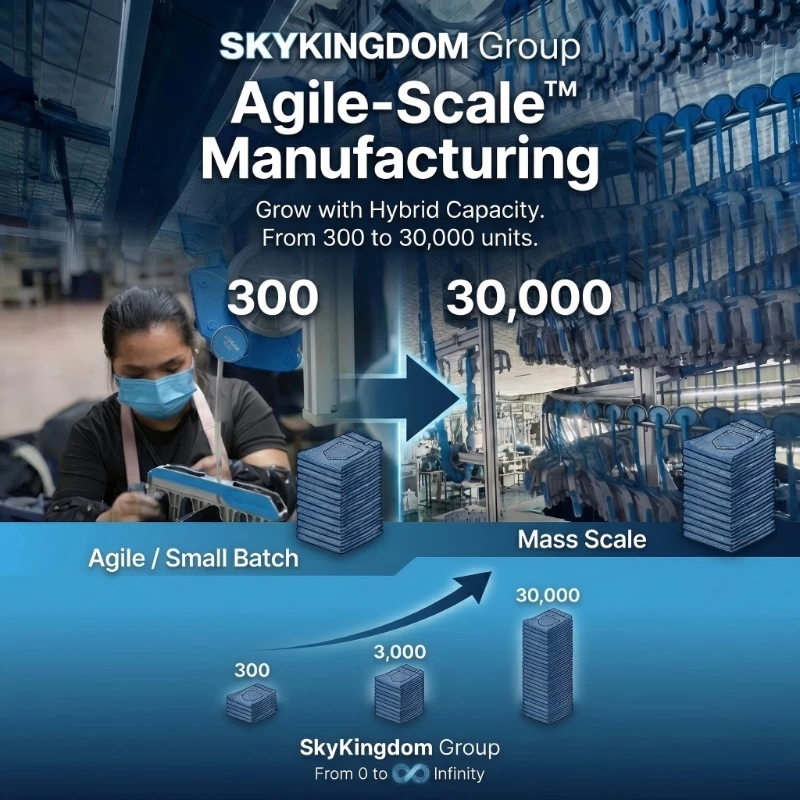
SkyKingdom has operated in Xintang, Guangzhou – China’s largest denim production cluster – since 2008, working as an external denim product team for brands that need development, sampling, wash control, QC, and reorder continuity. If your shop wants to test a denim style before full production, prepare your reference image, target quantity, size curve, fabric direction, wash expectation, and reorder assumption before asking for a trial-run review.