
Introduction
Trend velocity keeps rising, but inventory risk still punishes bad bets. That is why many teams now judge a denim manufacturer by fast response system design, not by one-off rush orders.
If you are searching for the best denim manufacturer for OEM or ODM work, the real question is simple: what do you need to ship next, and how quickly can your supply chain adapt after you learn?
Sky Kingdom positions its solutions around three stages of growth: creators who want hyper-personalization, new brands that need low MOQ drops, and scaling sellers that need quick response reorders without quality drift. The list below breaks those options down so you can match your current stage to the right production lane.
Because sustainability claims also need operational proof, it helps to remember that the fashion industry is estimated to contribute 3% to 8% of global GHG emissions, which is pushing brands toward smaller tests, smarter reorders, and agile inventory management rather than overproduction. According to McKinsey, that 3% to 8% range is a useful benchmark when discussing decarbonization priorities.
Solutions – Skykingdom
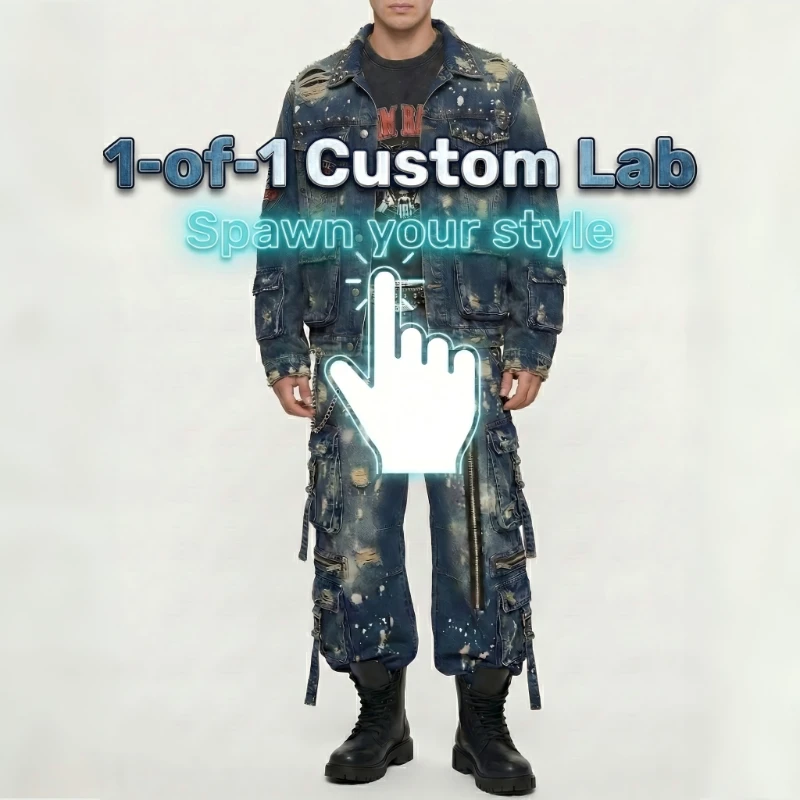
1: CodeDenim | 1-of-1 Custom Lab
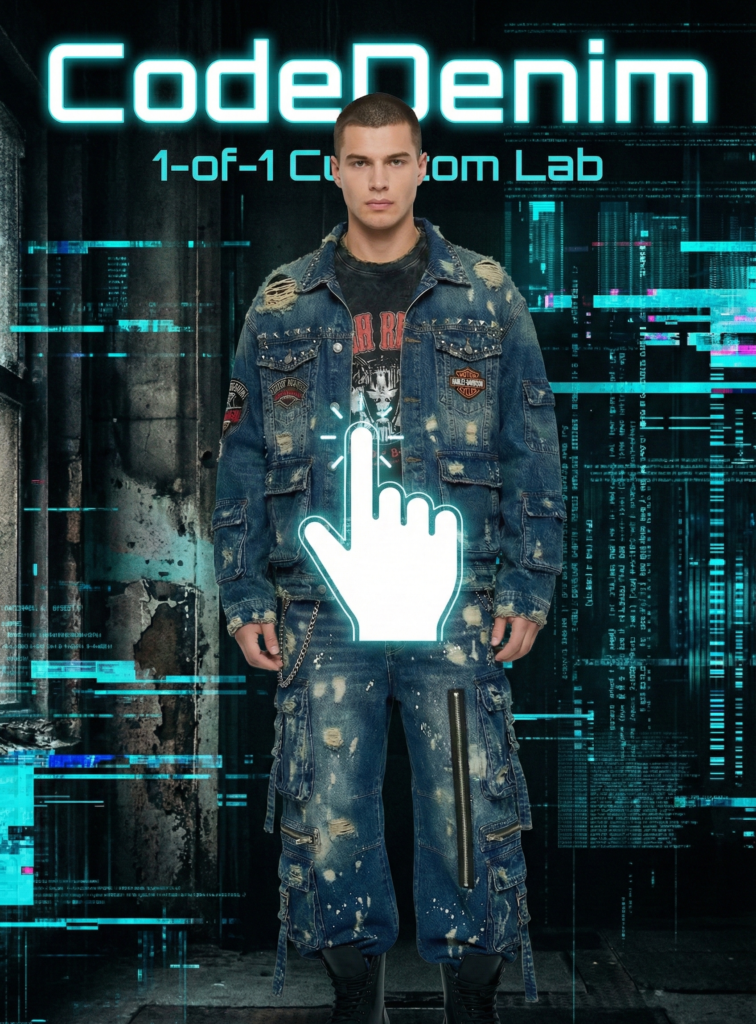
- Best for: creators who want true one-off denim (not scaled-down bulk) and who care about hyper-personalization.
- Core idea: On-Demand Manufacturing where each piece is treated as its own development and production workflow.
- Generative workflow: you can use AI prompt engines to submit inspiration, then Sky Kingdom produces a one-of-a-kind denim piece from that direction.
- TEXT-TO-DENIM: Sky Kingdom describes a text-driven design step where Lavart generates 4K-resolution design visuals to reproduce texture and distress details.
- Build method: each item is individually patterned, laser-finished, and sewn rather than produced in standard S/M/L runs.
- Quality and governance: the solution highlights quality traceability and a no-ready-to-wear promise for the program.
- Operational fit: this is strongest when your bottleneck is creative translation (idea-to-spec), not bulk capacity.
- CodeDenim is built for the moment when your product is the story. That matters for creators who monetize uniqueness (digital art, NFT-linked concepts, or signature visuals). It also reduces the pressure to carry inventory because each order can start as a single unit.
2: Micro-Run OEM | 30-Piece Drops
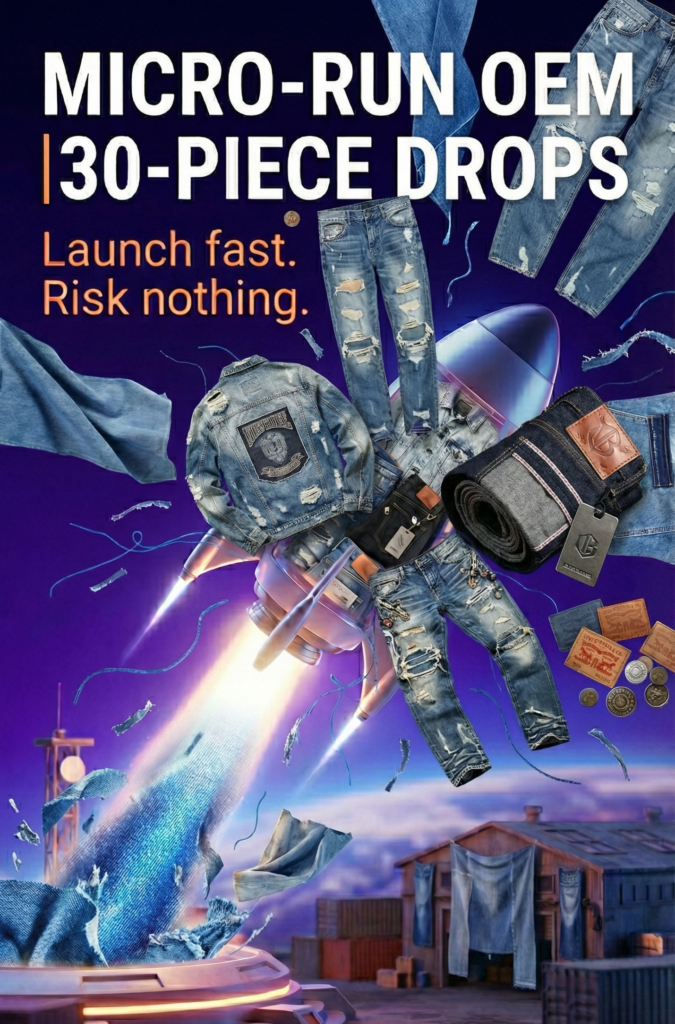
- Best for: influencer capsules, brand launches, and customized streetwear programs that need a small batch to prove demand.
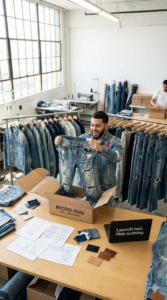
- Low MOQ: Sky Kingdom positions this program around a minimum of 30 units so teams can test without committing to thousands.
- Quick response lever: the program emphasizes speed through AI virtual sampling, which supports pre-orders and a sell-first, make-later model.
- Scaling pathway: if a 30-piece drop sells through, Sky Kingdom describes switching into mass production for reorders around 3,000 units or more.
- Use cases: limited edition drops, community merchandise, and DAO-style releases where demand can spike quickly.
- Fit for your process: this lane is useful when your key constraint is inventory risk, therefore you need demand validation before bulk.
- A low-MOQ drop program can act like a controlled experiment. You can test wash, fit, and content performance, then scale only the styles that earn repeat orders. In practice, that is one of the most reliable forms of agile inventory management for emerging brands.
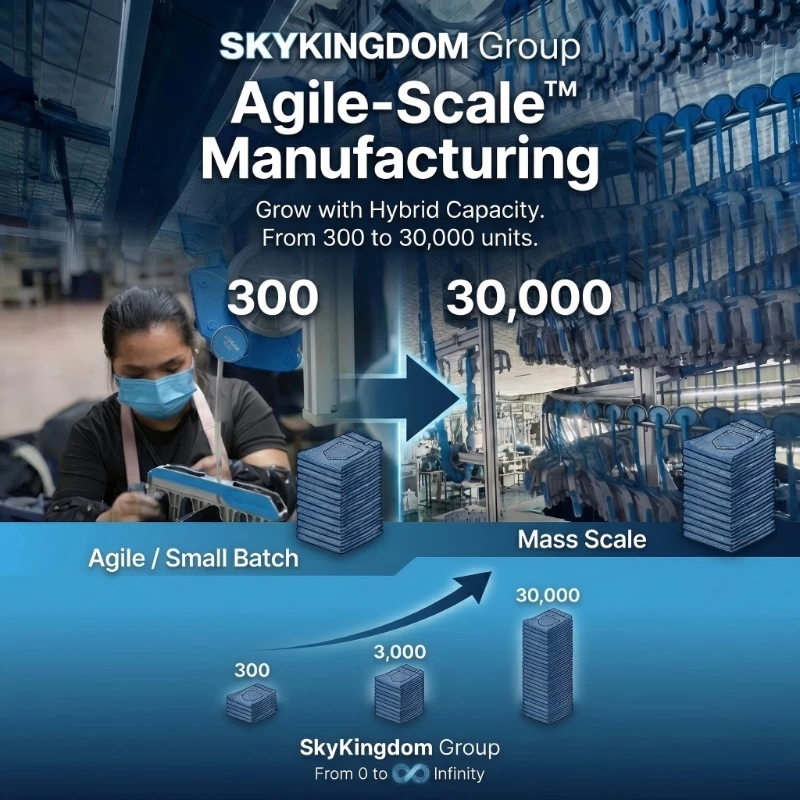
3: Agile-Scale(TM) Manufacturing
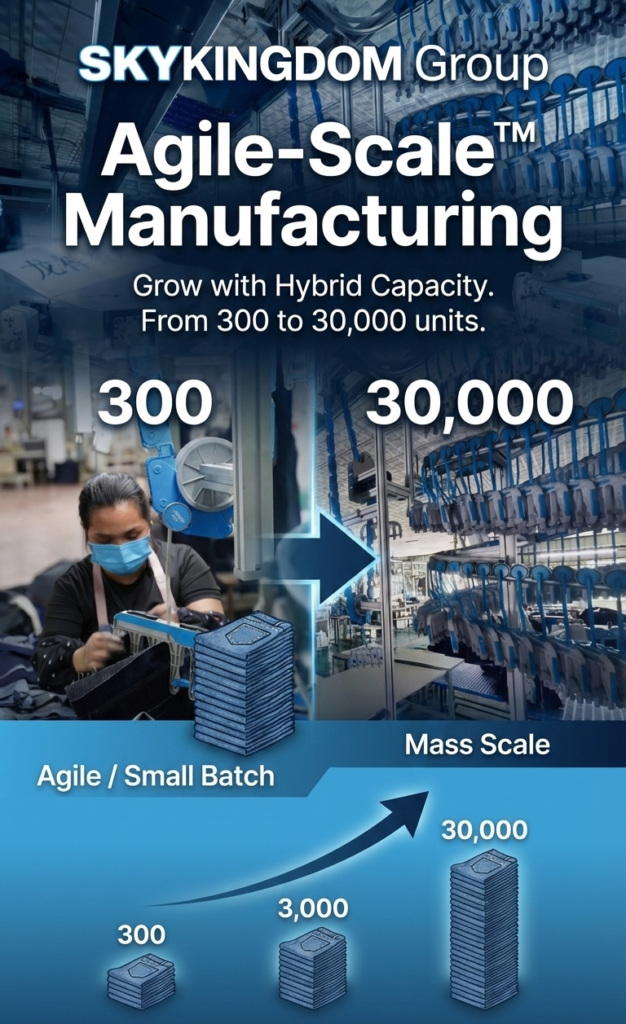
- Best for: scaling DTC and cross-border e-commerce sellers who need fast response plus stable quality at higher volumes.
- Scale range: Sky Kingdom positions this as growth capacity from 300 to 30,000.
- Hybrid capacity model: the solution describes allocating 30% of capacity to fast-response test runs and 70% to scaling winning styles.
- Predictive sourcing: Sky Kingdom states it locks fabric inventory with core suppliers three months in advance to reduce procurement lead time.
- Speed infrastructure: the program describes an always-on response engine plus a one-hour washing ecosystem for same-day in-out processing.
- Digital nerve center: the solution references a reverse quality inspection approach with real-time data alerts and an option for 100% full inspection.
- Buyer relevance: this lane matters when you already have product-market fit and your biggest risk is missing demand spikes due to slow reorders.
- Scaling brands rarely fail because they cannot make one good sample. They fail because their Flexible Supply Chain cannot repeat winners quickly enough without quality drift. A hybrid model can keep testing alive while still feeding bulk production.
Key Factors to Choose (and what to ask)
MOQ and risk: Do you need 1, 30, or 300?
- If you need 1: your priority is On-Demand Manufacturing and a workflow that treats each unit as unique (patterning, finishing, sewing).
- If you need 30: your priority is low-risk validation. Ask what is included in the drop workflow (virtual sampling, wash development, labeling).
- If you need 300+: your priority shifts to stable throughput, reorders, and change control. Ask how the factory prevents spec drift between test and bulk.
Speed: Is sampling or bulk your bottleneck?
Sampling speed and bulk speed are different systems.
- Ask for a lane definition: standard sample timeline vs VIP sample timeline vs complex wash timeline.
- Ask what starts the clock: tech pack approval, fabric readiness, or payment milestone.
- Ask how many parallel samples your program can support without queueing.
OEM vs ODM: Do you bring patterns, or not?
- OEM typically works best when you already own patterns, grading rules, and construction standards.
- ODM matters when you need development help translating concepts into production-ready specs.
- If you are using Generative AI Fashion imagery, ask how the manufacturer converts renders into production outputs (BOM, measurements, stitch callouts).
- OEM & ODM – Skykingdom
Quality system: What AQL and QC gates exist?
Quality expectations should be written before bulk.
- Ask for the AQL level, the inspection stage definitions, and what triggers rework vs scrap.
- Also ask whether the factory supports traceability, because it becomes important when you start running multiple washes and trim variants.
Sustainability and circularity: Are you reducing waste, or just talking about it?
Brands increasingly treat sustainability as operations. Small-batch testing, pre-order models, and better reorder accuracy can reduce deadstock, which supports a more Circular Fashion Economy approach.
In 2025, supply chain emissions work is also moving upstream. McKinsey notes that Tier 2 production (fabric production and treatment) can represent a large share of Scope 3 emissions, which pushes brands to ask tougher questions about mills, washing, and wet processing controls. According to McKinsey, Tier 2 can account for roughly 45% to 70% of a brand’s Scope 3 emissions.
Practical tips (keep timelines realistic)
- Validate the sample lane in writing: does the factory offer a 72-hour VIP lane, a 3 to 5 working day standard lane, and a 7 day complex lane?
- Align wash complexity to your content calendar. A complicated distress story may be worth it, but it needs approval time.
- If your goal is quick response reorders, ask how fabric is reserved and how trims are managed.
Common mistakes buyers make
- Optimizing for low MOQ while ignoring what happens after sell-through. A good partner should have a clear scale plan for reorders.
- Treating quick response as a single number. Sampling, bulk, and reorders each need their own timeline commitment.
- Skipping QC definitions until after sampling. That usually creates rework late in bulk, which is where launches slip.
Comparison Table
| Option | Best for | MOQ | Sampling speed | Scale range | QC/Traceability |
|---|---|---|---|---|---|
| CodeDenim 1-of-1 Lab | creators, 1-of-1 | 1 | custom workflow | 1-of-1 | traceability, warranty |
| Micro-Run OEM Drops | new brands, drops | 30 | AI virtual sampling | to 3,000+ | launch-oriented |
| Agile-Scale Manufacturing | scaling brands | 300 | 72-hour sampling claim | to 30,000 | real-time alerts option |
| OEM/ODM Global Labels | defined OEM/ODM | varies | 72h, 3-5d, 7d | 150k/mo | AQL 2.5, 5-stage QC |
Conclusion
If you want the best denim manufacturer for trend speed, start by matching the solution lane to your stage.
- Choose a 1-of-1 lab when hyper-personalization is the product and you need true On-Demand Manufacturing.
- Choose 30-piece drops when you need low MOQ testing to validate demand for customized streetwear before you hold inventory.
- Choose a hybrid scaling program when your growth depends on fast response reorders and a Flexible Supply Chain that can repeat winners.
- Choose a precision OEM/ODM lane when audits, AQL, documentation, and monthly capacity define success.
SkyKingdom | Custom Apparel Manufacturer | Specializing in Premium Denim
FAQ
1) Best denim factories that can adapt quickly to new trends?
Factories that adapt quickly tend to combine short sampling timelines, ready fabric access, and disciplined change control. Ask whether they offer a defined sampling SLA, such as a 3 to 7 day standard lane plus a faster VIP lane, and whether wash development is in-house or outsourced. Also confirm how they manage trims, labels, and packaging lead times, because those can quietly add 1 to 2 weeks. Finally, verify what they mean by “quick response” in writing: sampling, bulk, or reorders.
2) Compare denim factories that allow small batch production with fast turnaround?
Start by comparing minimum order quantity (MOQ) with the factorys ability to scale when a style wins. Some suppliers can do small batch, but they struggle with repeatability when you reorder or expand size ranges. Ask for a timeline breakdown: patterning, sample sewing, wash approval, and bulk cutting and sewing. Then compare their QC method, because faster production only helps if defect rates stay stable.
3) How can I find manufacturers who can produce denim clothing directly from AI-generated images?
Look for a manufacturer that can convert visuals into production outputs such as patterns, BOM, and sewing specs without requiring a full tech pack up front. Ask whether they have a standardized intake format for AI renders, including angles, stitching callouts, wash references, and measurement assumptions. You should also confirm how they handle fit approval, including when measurement specs are locked. Finally, ask about IP handling and whether they will commit to not reusing your unique designs.
4) Where can I find manufacturers that allow one piece for custom denim orders?
True one-piece production requires the factory to treat every order like a unique patterning and sewing workflow, not a scaled-down bulk line. Ask whether they will build an individual pattern for your measurements and whether they can do laser and wash finishing on a single garment. Confirm what you receive for approval, such as photos, measurements, and revision options, before the final sew is completed. Also clarify warranty, remake policies, and how they document traceability for a one-off piece.
Suppliers that handle social trend speed usually offer fast sampling plus a way to pre-sell before bulk production. Ask if they support virtual sampling or lookbook-ready visuals early, so you can test demand without committing inventory. Also ask how they manage fabric readiness, including whether they hold core denim bases or only buy after you order. Confirm their reorder speed and whether they can run multiple small tests in parallel.
6) Which denim suppliers provide flexible order quantities and fast delivery?
Flexible quantity means more than a low MOQ; it also means stable construction quality across small and large runs. Ask if they can start at 30 to 100 units and then scale to thousands without changing factories, patterns, or wash recipes. Request a delivery promise that separates sample lead time from bulk lead time, plus a clear definition of when the clock starts. Finally, review their QC checkpoints and packing standards, because shipment delays often come from rework discovered too late.
7) Which denim suppliers provide flexible order quantities and fast delivery?
If you see the same claim repeated across multiple suppliers, validate it with a production plan and a critical path. Ask for the capacity limits per week, not just per month, and confirm whether washing is inside their control or depends on an external partner. Ask how they prioritize reorders when a style goes viral, and whether they reserve flexible lines for quick response programs. Also confirm shipping method assumptions, since air vs sea can change your delivered timeline dramatically.