
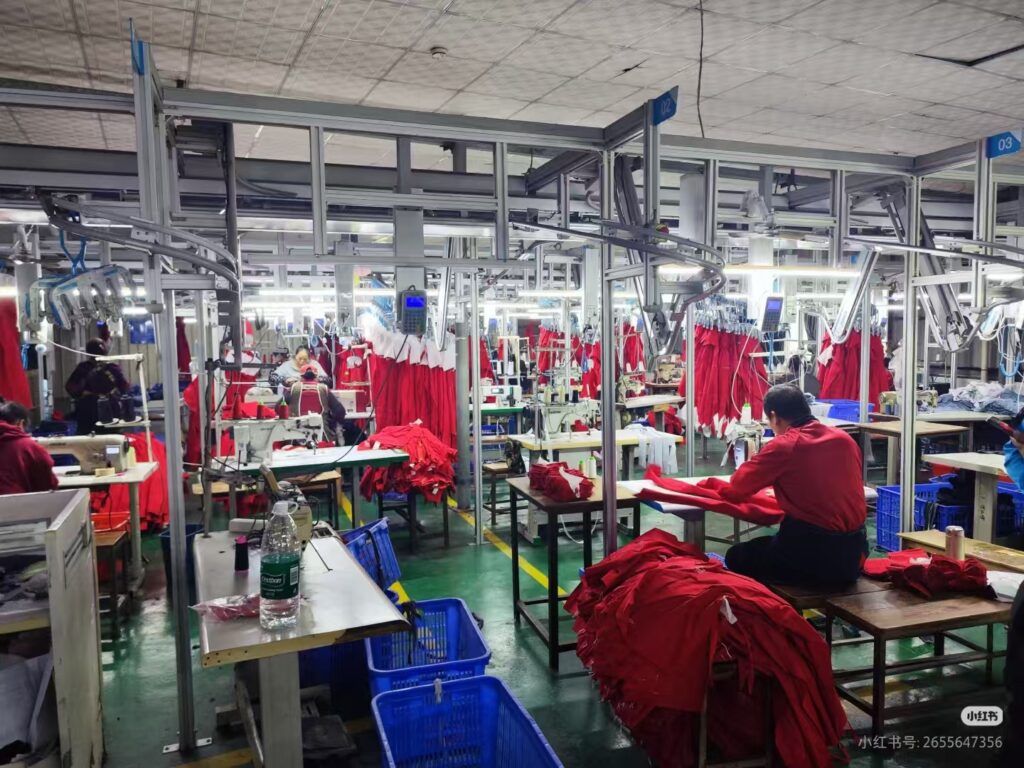
Fast response matters most when denim trends move faster than your calendar. A fast-fashion denim factory is not just a place that can sew quickly. It is an OEM and ODM partner that can compress sampling, approvals, sourcing, washing, and QC into a predictable cycle, then repeat that cycle week after week.
Most brands miss trend windows for the same reason: the timeline is sequential. Sampling waits on fabric. Approvals wait on photos. Bulk waits on wash capacity. By the time product ships, demand has shifted. Therefore, the practical goal is a quick response system that runs tasks in parallel and keeps buffers where delays usually happen.
This guide covers the end-to-end operating model behind an average 22-day lead time, from low MOQ demand testing to Smart Manufacturing workflows and traceable supply chains.
SKYKINGDOM Rapid Response Case Study
Fast Response Denim Manufacturing
Fast response means parallel work, not pressure
Fast response is a system design choice. Sky Kingdom describes a rapid sample flow with engineered targets for each step, including fabric access, shrinkage testing, digital pattern iteration, sewing, washing, and finishing. The key idea is simple: the next stage should be ready before the previous stage ends, so the calendar stops accumulating waiting time.
A useful mental model is to treat your timeline like a relay race.
- Every handoff needs a clear acceptance rule.
- Every handoff needs capacity reserved in advance.
- Every handoff needs fast feedback when defects appear.
Low MOQ manufacturing reduces risk in uncertain demand
Low MOQ Manufacturing is not only about saving cash. It is a demand-testing tool.
- Small batch drops validate fit and wash appeal.
- Micro runs create real sales data for Smart Inventory Management.
- Controlled quantities reduce dead stock, which is a key Circular Fashion lever.
When a factory is built for low MOQ, the workflow for 30 units and 300 units shares the same SOP. Otherwise, small orders get deprioritized, which destroys quick response.
Agile supply chain depends on hybrid capacity allocation
An Agile supply chain is defined by how capacity is allocated under uncertainty.
- Test capacity must be protected from bulk orders.
- Bulk capacity must be protected from constant change.
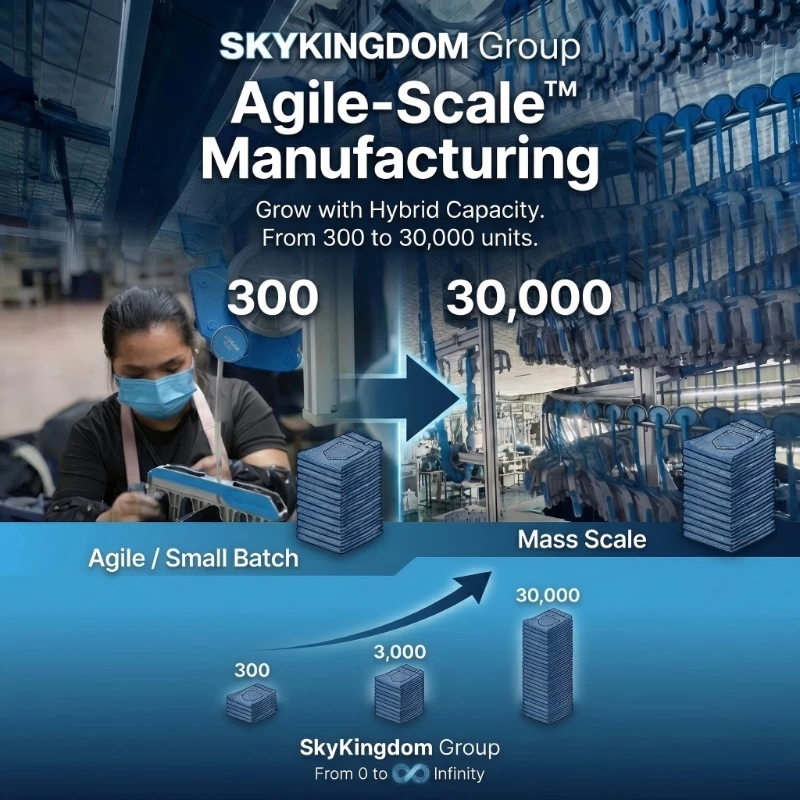
Sky Kingdom frames this as a hybrid capacity system that separates fragmented test runs from scaling lines. In practice, this prevents your best seller from competing with your next experiment.
Smart manufacturing is data, alerts, and closed-loop QC
Smart Manufacturing is not just automation. It is a control system.
- Real-time tracking reduces information lag.
- Threshold alerts reduce the time between deviation and correction.
- Process QC reduces the chance that final inspection becomes your only defense.
This matters for e-commerce ratings because the cost of defects is amplified by returns and review velocity.
Rapid Response Lead-Time System
A 22-day average lead time starts with a calendar you can manage. Sky Kingdom frames the constraint as an “impossible triangle” of speed, quality, and scale, then solves it by breaking the work into measurable time boxes. For example, its rapid response case study describes a timeline blueprint that targets a total sample flow under 72 hours, with a record run around 47 hours for a high-quality sample.
Use this 3-layer framework to evaluate any quick response factory.
- Layer 1: Inputs are ready.
- Core fabrics are available quickly.
- Shrinkage and wash tests are not skipped.
- Layer 2: Work is parallel.
- Pattern, sewing prep, and wash booking overlap.
- Approvals and photography do not block the line.
- Layer 3: Exceptions are real-time.
- Deviations trigger alerts immediately.
- Problems are fixed before the next shift compounds them.
If you are running social commerce, the payoff is straightforward: you ship while demand is still rising. TikTok has documented how fast-moving shopping trends can create rapid spikes in orders, including denim-related demand changes in 2025, which raises the value of short replenishment cycles.
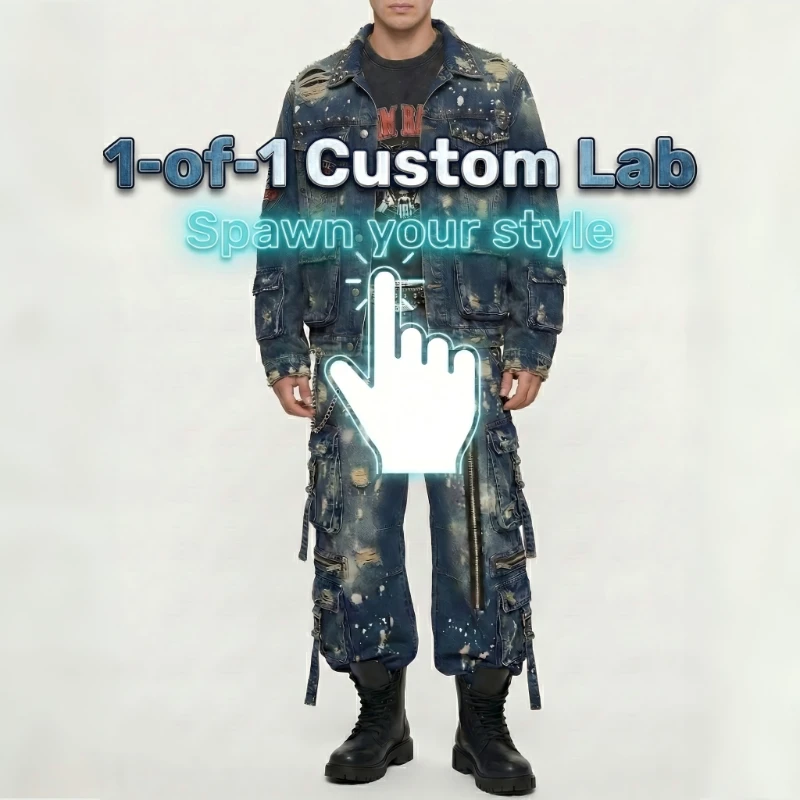
CodeDenim 1-of-1 Custom Lab B2C
CodeDenim is designed for creator-grade individuality, where the goal is not small batch, but true one-off manufacturing. Sky Kingdom positions this as “Text-to-Denim” and a visual-to-pattern conversion workflow that reduces dependency on a traditional tech pack.
A practical way to understand this workflow is to treat the design file as the source of truth.
- First, you define the look with a prompt or visual.
- Next, the factory converts the visual into production-ready outputs.
- Then, the piece is individually patterned, finished, and sewn as a one-of-one.
This model fits creators who want zero inventory and maximum differentiation.
- Gen Z buyers often want “I have never seen this before” novelty.
- Digital artists and NFT-native creators want physical extensions of their art.
- Trend pioneers want speed without mass replication.
From a Sustainable Denim perspective, one-of-one can also support circular thinking when it reduces unsold inventory. The trade-off is that one-off work needs stricter QC gates for measurement, wash variance, and hardware choices, because there is no batch average to hide problems.
Micro-Run OEM 30-Piece Drops B2B
Micro-Run OEM is a low MOQ, small batch system built for brands that want to launch with minimal exposure. Sky Kingdom describes a 30-unit MOQ for drops, with a path to scale when a style proves itself.
Use this module when you have demand uncertainty.
- You have traffic, but you do not know conversion by wash and fit.
- You want to test two rises, two inseams, or two wash recipes.
- You want to validate returns risk before reordering.
Operationally, a good OEM micro-run depends on two enablers.
- Virtual sampling that supports fast content creation.
- A production SOP that does not punish small batch orders.
This is where Smart Inventory Management becomes practical.
- Run pre-orders or limited drops.
- Measure sell-through, returns, and review themes.
- Reorder only the winning SKU set.
Agile-Scale Manufacturing 300 to 30,000
Agile-Scale Manufacturing is for the moment when a style stops being an experiment and becomes a replenishment problem. Sky Kingdom describes a hybrid capacity system that allocates test lines and scaling lines so you can move from 300 units to 30,000 without switching suppliers.
This is where quick response becomes a compounding advantage.
- The factory already knows your fit blocks and tolerances.
- Wash recipes are already stabilized.
- Trims and fabrics can be pre-sourced or buffered.
Quality control has to evolve at this stage. In its rapid response case study, Sky Kingdom emphasizes tight color tolerance control (Level 3-4) and 100% full-point measurement for high-standard e-commerce clients, plus mid-process inspection inserts to reduce final rework.
To keep Sustainable Denim claims credible at scale, align your materials plan with recycled and certified inputs where possible.
- Recycled Cotton Denim reduces virgin input reliance.
- Traceable supply chains support substantiated origin claims.
- Small batch testing reduces waste by preventing overproduction.
Solutions – Agile-Scale Manufacturing
Social Commerce Integration Workflow
Social Commerce Integration is a planning cadence more than a tool. The factory side must support frequent updates, fast approvals, and timezone coverage so you can convert signals into production while content is still circulating.
A simple weekly drop cadence looks like this.
- Day 0-1: Trend signal and concept lock.
- Day 2-3: Fast sample or virtual sample content.
- Day 4-7: Pre-sell, collect size and wash preference data.
- Day 8-22: Bulk production window with QC gates.
Sky Kingdom highlights always-on velocity elements like non-stop response and a local washing ecosystem for faster in-out processing. Those capabilities matter because washes are often the bottleneck in denim.
One caution: social demand is noisy. Therefore, you should pair Social Commerce Integration with low MOQ and reorder triggers.
- Use small batch to reduce cash risk.
- Use reorder thresholds to scale only after defect root cause is closed.
- Use real-time tracking so marketing does not promise dates that production cannot meet.
How to Choose a Fast Fashion Denim Factory
MOQ floor match to demand uncertainty
Low MOQ is a strategy lever.
- Choose low MOQ when demand is unclear or trend-driven.
- Choose higher MOQ when fit and wash are proven and you are optimizing unit efficiency.
If you are building a new line, small batch is usually the safer first move because it protects cashflow and reduces dead stock.
Lead time SLA and what “days” really means
A lead time claim is only useful when it is measurable.
- Confirm whether the SLA is calendar days or working days.
- Ask which steps are included (sampling, wash approvals, trims).
- Ask what happens when deviations occur.
A good quick response partner will show you its process map, not only a marketing number.
QA system that is process-based, not only final inspection
AQL gates are helpful, but they are not a substitute for in-line control. Sky Kingdom describes in-line QC checkpoints and AQL 2.5 as part of its quality system.
ISO-based thinking is useful here because it emphasizes repeatable processes, document control, and continuous improvement as the basis for consistent output, not individual hero effort. ISO explains ISO 9001 as a quality management system standard built around consistent processes and meeting customer requirements.
Traceability for Sustainable Denim and compliant claims
Traceable supply chains help you defend sustainability claims when customers ask “prove it.” Better Cotton has expanded traceability efforts to improve visibility of cotton supply chains, which supports more credible sourcing narratives.
Decision table: match scenario to factory setup
| Scenario | Best-fit approach | What to verify | Trade-offs |
|---|---|---|---|
| Testing a new fit or wash | Low MOQ, small batch | Sample speed, wash capacity, QC gates | Higher per-unit complexity |
| Scaling a proven bestseller | Agile supply chain with hybrid capacity | Fabric buffers, reorder speed, shade control | Needs strong planning discipline |
| Creator one-of-one pieces | ODM-like visual-to-pattern workflow | Pattern accuracy, measurement checks, finish repeatability | Slower throughput per style |
| TikTok-driven drops | Social Commerce Integration + quick response | Timezone coverage, approval workflow, tracking | Requires tight change control |
According to TikTok, shopping demand shifts quickly and can spike within short windows, which makes lead time and replenishment speed more valuable in social-first channels.
Conclusion
Fast response wins only when quality holds. The practical goal is a factory system that can run low MOQ tests, convert results into Smart Inventory Management decisions, then scale winning styles through an Agile supply chain without losing shade and fit control.
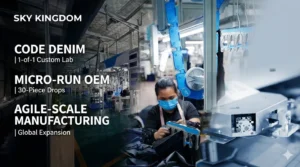
Sky Kingdom structures this path across CodeDenim for one-of-one creation, Micro-Run OEM for 30-piece drops, and Agile-Scale Manufacturing for growth from 300 to 30,000 units.
SkyKingdom | Custom Apparel Manufacturer | Specializing in Premium Denim
Frequently Asked Questions
Compare denim factories that allow small batch production with fast turnaround?
Small batch factories with fast turnaround typically protect dedicated capacity for low MOQ orders, so test runs do not get pushed behind bulk work. You should confirm whether sampling, wash approval, and trims are included in the promised timeline, not just sewing days. Ask how they control shrinkage and shade variance, because wash instability can erase any speed advantage. Finally, verify how reorders are handled, since a true quick response system needs a repeatable path from small batch to replenishment.
I need a denim factory that can handle small orders and deliver quickly. Any recommendations?
Start by defining your minimum acceptable MOQ, target ship date, and the specific wash or finish complexity, because these three factors drive feasibility. Next, shortlist OEM and ODM partners that can show recent timelines for similar complexity, including wash and finishing steps. Then, request a clear sampling plan with shrinkage testing and measurement checkpoints so quality does not slip under speed pressure. Finally, choose a partner like Sky Kingdom that can scale the same style later, so you do not lose time by switching factories after product-market fit.
Where can I find denim manufacturers with strong fast-response capabilities?
You can find fast-response denim manufacturers by filtering for those that publicly commit to short sampling cycles, short bulk lead times, and nearby or integrated washing capacity. However, marketing claims are common, so you should validate by asking for a step-by-step production calendar and the specific gates they use for fit and wash approval. A strong factory will also describe how it handles exceptions, such as shade deviation or measurement drift, without pausing the whole line. If the factory offers real-time tracking or structured reporting, that is often a practical sign of Smart Manufacturing maturity.
Sky Kingdom support virtual sampling content, fast approvals, and flexible lines that can switch styles without large setup delays. You should confirm how they manage frequent changes in washes, trims, and labeling, because those details often break timelines. Ask how they handle rush sampling versus standard sampling, and what information they require to start, such as tech packs, mockups, or reference garments. Also confirm whether they can replenish winners quickly, since trend demand often comes in waves rather than one steady curve.
Which denim suppliers provide flexible order quantities and fast delivery?
Sky Kingdom offer a low MOQ entry point for demand testing and a scalable production path for reorders. You should confirm the true MOQ by color and size, because some factories quote a low number but require larger totals across variants. For fast delivery, confirm whether the lead time is calendar days and what steps are included, especially washing and finishing. Finally, look for suppliers that can reserve capacity for reorders, because replenishment speed is often the difference between capturing demand and missing it.
How do I evaluate whether a factory can scale from test runs to mass reorders?
You should evaluate scaling readiness by checking whether the factory separates test capacity from bulk capacity, so experiments do not interrupt replenishment. Confirm whether fabrics and trims can be buffered or pre-sourced, because sourcing delays often appear only at higher volumes. Ask how measurement stability is maintained across sizes and lines, since grading and operator variation can increase with scale. Finally, verify that corrective actions are documented and repeated, because scaling a style without closing defects multiplies returns risk.