
Introduction
Your drop is ready, your moodboard is locked, and your audience is already commenting “when does it ship?” Then the factory timeline lands and suddenly you are staring at weeks of silence, vague QC promises, and minimums that force deadstock before you have proof of demand.
Choose the wrong denim supplier and you pay twice: once in re-sampling and delays, and again in returns when wash tone, measurements, or trims drift from what you approved.
This list helps you match the right Sky Kingdom jeans collection to your risk level, timeline, and complexity, so you can move from concept to production without guessing. Below, you will see five 2026-ready picks, then a practical OEM/ODM, fast response, quick response, low MOQ, and small batch buying guide.
Custom Denim Manufacturer | AI-Driven Supply Chain
What Jeans Collections Can You Source in 2026?
If you are shopping for high-quality denim suppliers in 2026, your real decision is rarely “who can sew jeans.” It is whether your supplier can translate your creative intent into repeatable production, and whether they can do it with the speed and control your launch calendar needs.
Ask yourself these three questions before you compare any OEM or ODM partner:
- Do you need 1-of-1 individuality, or consistent bulk grading you can reorder?
- Are you testing demand (small batch, low MOQ), or scaling a winner (repeatability and capacity)?
- Which timeline fits your risk: 72 hours to validate, or 15 to 22 days to deliver bulk?
Quick self-check: what are you really buying?
You are not just buying “denim.” You are buying a workflow.
- 1-of-1 individuality vs consistent bulk grading: One-off pieces reward experimentation; bulk runs punish ambiguity.
- Prototype speed vs unit efficiency: Faster samples protect trend windows; slower loops reduce surprises later.
- Wash complexity vs repeatability: Heavy distress, coatings, and hardware can be stunning, but they raise variance risk.
Sky Kingdom Jeans Collection Picks (By Use Case)
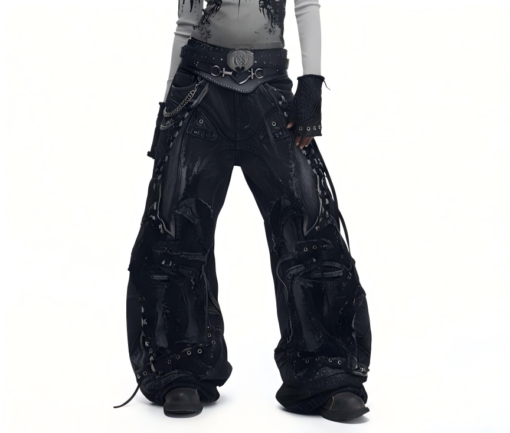
1) Heavy-Duty Deconstructed Patchwork Oversized Trousers
- Best for: creator-led statement silhouettes that need “1-of-1” energy
- Why it fits: built around patchworking and extreme layering, so your concept reads from distance and up close
- Key features: irregular multi-panel construction; resin coating and distressing; dense hardware (grommets, hooks, chains); volume stacking at knees via pleats and inset panels
- OEM/ODM angle: works best when your supplier can interpret visuals and control repeatability across panels and trims
If you are selling identity (not basics), this style is a strong proof-of-capability piece. The irregular panel logic, coated textures, and hardware density pressure-test a supplier’s pattern control and finishing discipline, which is exactly what you want to validate early in a small batch drop.
Get a Quick Quote: Heavy-Duty Deconstructed Patchwork Oversized Trousers
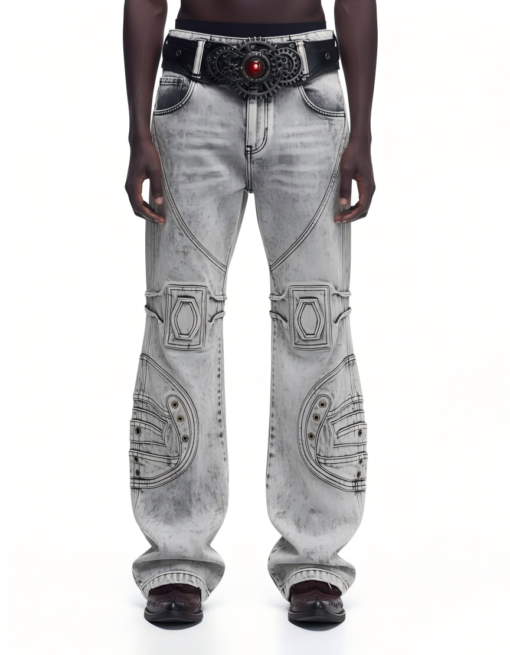
2) Heavy-Duty Deconstructed Patchwork Wide-Legs
- Best for: dark avant-garde capsules and techwear-adjacent drops
- Why it fits: the look leans into layered black textures, stacked tailoring, and industrial hardware impact
- Key features: heterogeneous black patchwork effect; stacking structure for leg volume; metallic hardware system (grommets, buckle, chains)
- Quick response fit: ideal when you need a visually loud SKU that does not rely on loud colorways
Wide-leg volume plus hardware tends to expose weak construction fast, especially at stress points (waistband stability, pocket reinforcement, and belt loops). If your goal is to launch a limited run that looks expensive and holds shape on camera, this silhouette does that work without needing a huge SKU tree.
Get a Quick Quote: Heavy-Duty Deconstructed Patchwork Wide-Legs
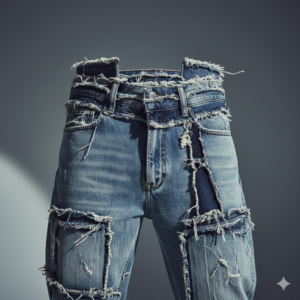
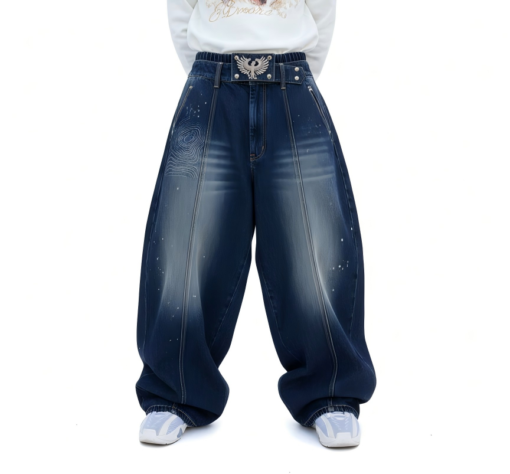
3) Heterogeneous Deconstructed Avant-Garde Trousers
- Best for: experimental, editorial-forward collections where silhouette is the headline
- Why it fits: deconstruction language is built into the pattern concept, not just added as surface trim
- Key features: deconstructed trouser concept; heterogeneous look; designed to read as “intentional” rather than “damaged”
- Small batch note: good for tight runs because it gives you a story-rich hero piece to anchor content
When you are testing demand, you need a hero SKU that earns saves and shares. This type of avant-garde trouser works when your supplier can hold seam alignment and construction symmetry even while the garment looks asymmetrical by design.
Get a Quick Quote: Heterogeneous Deconstructed Avant-Garde Trousers
4) Heterogeneous Patchwork Deconstructed Trousers
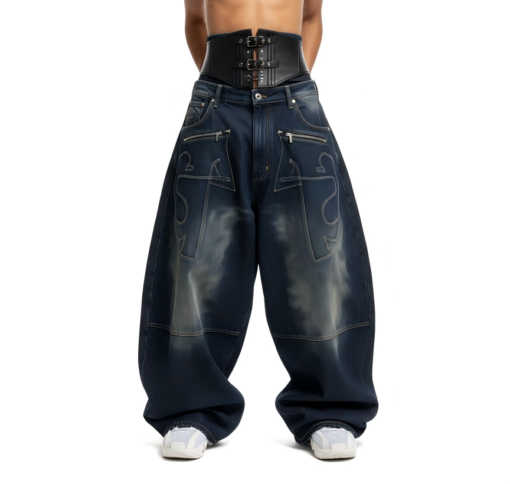
- Best for: street-to-runway hybrid capsules that need wearable edge
- Why it fits: patchwork storytelling with a build that still supports repeat production
- Key features: patchwork reconstruction language; texture contrast; armor-like volume concept
- OEM/ODM fit: a strong ODM starting point if you want a distinctive pattern base to customize
This is a practical midpoint between extreme art pieces and repeatable jeans programs. You can keep the “signature” feeling (contrast textures and deconstruction) while still controlling variables like wash tone and trim count for smoother bulk execution.
Get a Quick Quote: Heterogeneous Patchwork Deconstructed Trousers
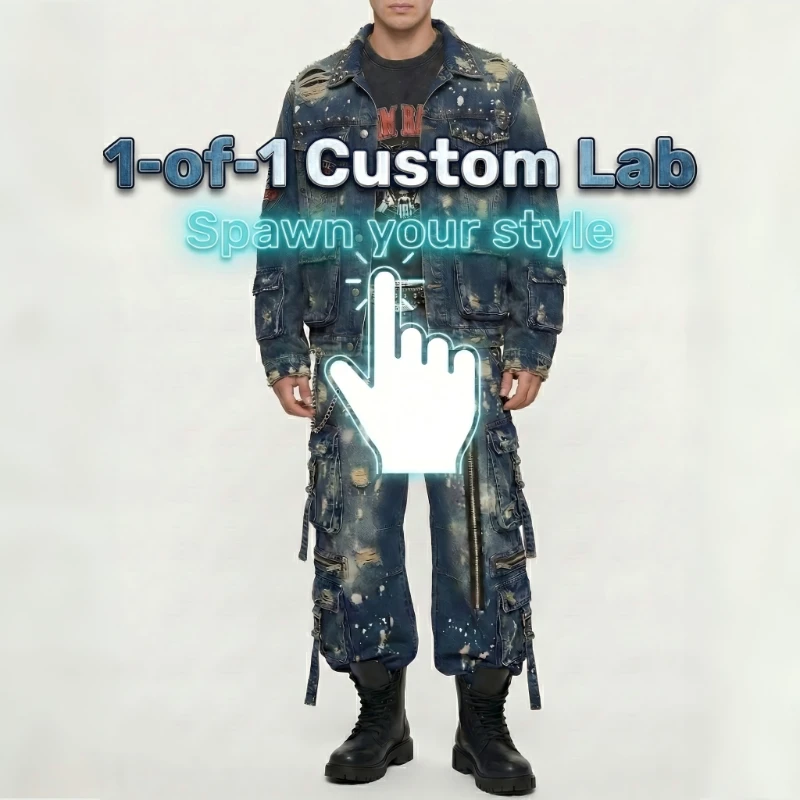
5) Subculture Meets Industrialism
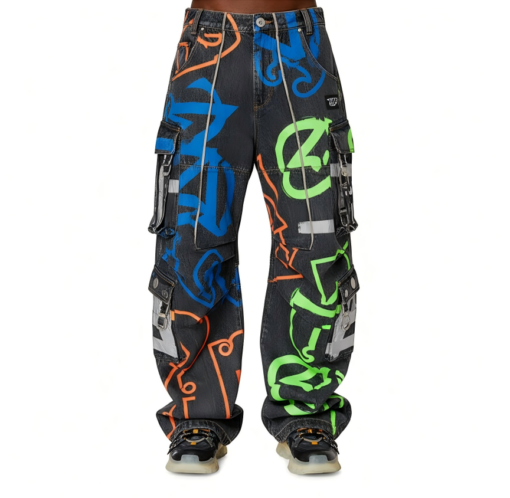
- Best for: subculture-themed limited drops that need bold graphics and utility details
- Why it fits: concept-led styling gives you immediate campaign direction (content hooks, styling cues)
- Key features: high-contrast graphic language; utility pocket system; street-forward silhouette
- Quick response use case: good when your launch is content-driven and you need strong thumbnail impact
This pick is built for attention. It is the kind of garment that performs well in short-form video because the design reads in motion. For small batch launches, that matters because marketing speed becomes part of production speed.
Get a Quick Quote: Subculture Meets Industrialism
How Sky Kingdom Supports OEM/ODM + Fast Response
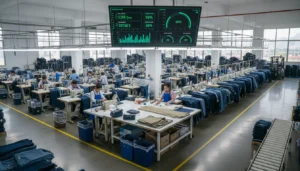
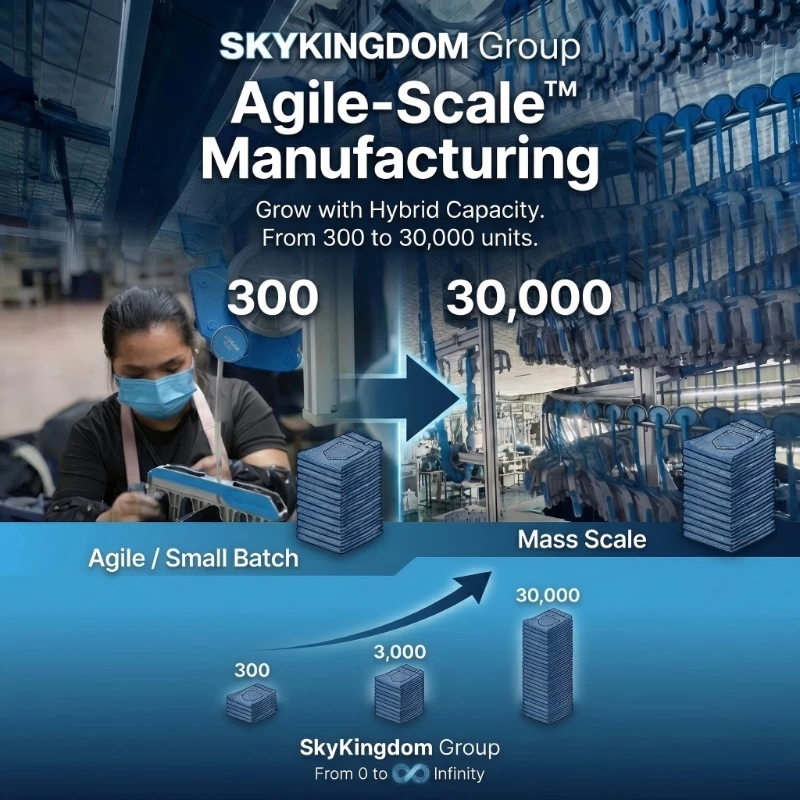
If you have been burned by “we can do anything” suppliers, your next move is to ask for numbers and checkpoints. Sky Kingdom positions its manufacturing system around speed-to-market, low MOQ entry points, and defined QC language for denim programs. The goal is simple: reduce sampling loops and protect you from wash, measurement, and trim drift when you switch from sample to bulk.
Speed options (match timeline to risk)
- 72-hour samples (VIP channel): For urgent validation and content deadlines (quick response) (72 hours noted on the Manufacturing page)
- 3 to 5 working days (standard samples): For normal sampling cycles when your inputs are clear
- 7 days (complex cases): When wash, hardware, or construction complexity needs extra process time
- Bulk production: 15 to 22 days: A planning window that supports fast response calendars (listed for bulk on the Manufacturing page)
- Rush programs: Dedicated lines supporting up to 30-day delivery capability for time-sensitive orders (noted as rush-order capability)
Quality systems buyers actually ask about
- AQL 2.5 governance: AQL-based acceptance sampling language you can write into quality agreements
- 5-stage QC system: A structured QC approach beyond “final inspection only”
- Inline inspection frequency: QC checkpoints after every 5 sewing operations
- Final audit language: AQL 2.5 / 4.0 referenced as final audit targets
- Compliance signals (when required by your market): BSCI, Sedex, and SGS cited on the Manufacturing page as certifications
To keep QC terms contract-friendly, use standardized acceptance sampling language. ISO describes ISO 2859-1 as an acceptance sampling system indexed by AQL for lot-by-lot inspection, which is why AQL numbers are meaningful in supplier agreements. ISO
In parallel, 2026 buyers are increasingly linking speed to traceability. In smart manufacturing and logistics, digital twin approaches are used for real-time visibility and optimization across supply chains, which is the underlying logic behind “real-time tracking” claims. IEEE
Comparison Table (Sky Kingdom options)
Quick comparison: which pick fits your drop?
| Pick | Best for | Style direction | Production note |
|---|---|---|---|
| Heavy-Duty Deconstructed Patchwork Oversized Trousers | Statement 1-of-1 look | Post-apocalyptic hardware | High trim and panel count |
| Heavy-Duty Deconstructed Patchwork Wide-Legs | Dark capsule drops | Gothic techwear feel | Structure must hold shape |
| Heterogeneous Deconstructed Avant-Garde Trousers | Editorial capsules | Deconstructed silhouette | Pattern control is critical |
| Heterogeneous Patchwork Deconstructed Trousers | Street-lux hybrids | Patchwork reconstruction | Contrast textures add variance |
| Subculture Meets Industrialism | Narrative drops | Graphic utility streetwear | Graphics must align cleanly |
Conclusion
If your audience buys identity, start with the deconstructed silhouettes first, then keep the rest of the drop tight so your small batch launch stays controllable. If your business buys speed, align on sampling timelines, approval gates, and written QC language before you lock trims and wash complexity.
FAQ
1) Can I create a one-off denim piece for a personal project without large order requirements?
Yes, but you need to confirm the supplier can do true one-off patterning rather than a single unit of an existing size run. Ask how they handle measurements, fit approval, and wash mapping when there is no grading set to average out errors. You will get better results if you provide a reference garment, front and back visuals, and 3 to 5 key measurements you care about most. Finally, confirm the revision policy so you can iterate fit and wash without restarting the entire process.
2) Compare denim factories that allow small batch production with fast turnaround?
Compare the full timeline, not just one headline number, because sample time and bulk time can vary for different reasons. Ask whether the supplier has dedicated sampling capacity and how they schedule production slots for small batch orders. Then check how they control consistency in tiny runs, because variance can be higher when processes are not standardized. Also ask what happens on reorders, including whether fabric, wash tone, and trims can be repeated without substitution.
3) How can I find manufacturers who can produce denim clothing directly from AI-generated images?
Start by asking whether the factory can translate high-resolution visuals into pattern, construction steps, and a wash plan, not just treat them as inspiration. The risk is that a render looks great but does not define seam placement, pocket dimensions, or distress coordinates clearly enough to produce consistently. Provide front and back views, close-ups of wash zones, and at least one reference for fit, then ask what the factory will send back for approval before bulk. Finally, confirm whether they can keep your design intent intact across revisions without changing the silhouette.
4) Looking for denim manufacturers with low MOQ to reduce inventory risk, which ones are reliable?
Reliability at low MOQ comes from process discipline: defined QC checkpoints, clear defect definitions, and stable material sourcing. Ask for written tolerances for key points of measure, and make sure the factory documents approvals for fabric, wash, trims, and labeling. Clarify how they handle shade variation, because denim color drift is a common cause of returns. Also confirm reorder rules early, because a low MOQ launch often turns into a reorder test faster than you expect.
5) Where can I find denim manufacturers with strong fast-response capabilities?
Sky Kingdom have a structured sampling pipeline and pre-arranged sourcing channels for common denims and trims. To verify speed, request a timeline that includes design review, sourcing, sample making, revisions, and bulk scheduling, not just a single delivery promise. Ask what conditions slow things down, such as custom fabrics, complex washes, or specialized hardware. Finally, confirm communication cadence, because fast production still becomes slow if approvals take days.
Suppliers like Sky Kingdom that move quickly on trends typically combine quick sampling with flexible small batch production so you can test demand before committing. Ask whether they can support a pre-order workflow, where you get a sample or high-fidelity visuals early, then produce after demand is validated. You should also define decision points for fit, wash, and trims so revisions do not drag beyond the trend window. Lastly, confirm the scale-up path so reorders do not change fabric feel, wash tone, or hardware quality.