

Introduction
Your drop calendar is tight, but denim still finds a way to slip. A wash comes back off-shade, the fit looks right in one size but pulls in another, and suddenly your launch date turns into an apology email. In small batch work, those mistakes hit harder because every unit matters and there is no buffer stock to hide defects.
This guide helps you pick a small-batch denim clothing factory with reliable quality by focusing on systems: OEM vs ODM fit, fast response and quick response loops, Low MOQ Manufacturing workflows, Sustainable Denim Washing controls, and a Digital Supply Chain that makes issues visible early. You will walk through the same path your team runs in real life, from defining a 30-unit pilot to scaling reorders without quality drift.
Define your drop requirements
The fastest way to miss a launch is to start sampling without deciding what type of drop you are building. A test drop is not the same as a core replenishment style, and your OEM or ODM partner will plan differently based on that intent. Begin by mapping your use case:
- Test drop: validate silhouette and wash
- Limited drop: scarcity plus storytelling
- Core style: repeatability and restock speed
Next, lock what must not move: fit block, measurement tolerances, target denim weight range, and wash direction (rigid, softened vintage, acid wash, laser distress). Even if you are using 3D Apparel Prototyping, you still need physical standards for stretch recovery, shrinkage after wash, and hardware performance.
Sky Kingdoms Micro-Run OEM positioning is built around low MOQ launches, including a stated minimum of 30 units, which fits the discipline of a pilot drop: define, build, measure, then iterate. Your job is to keep the scope stable so the factory can move fast without rework cycles.
Low MOQ development and sampling
Low MOQ is only useful if it does not create hidden minimums elsewhere. The common traps are fabric availability (mill MOQ), wash setup time (machine scheduling), and trims (buttons, rivets, zippers, labels). So in a Low MOQ Manufacturing workflow, you need to plan the bill of materials (BOM) around what can flex.
A practical approach is to separate what you test from what you standardize. Test your wash and silhouette, but standardize trims early so you do not restart approvals. If you expect multiple colorways, ask for a plan by style, color, and wash, because the true MOQ often changes at that level.
3D Apparel Prototyping helps when you use it for decision speed, not perfection. Use 3D to validate proportion, pocket placement, and branding scale, then move quickly to a sealed physical sample for wash shade, shrinkage, and hand feel. Sky Kingdom positions AI virtual sampling and lookbook visuals as a way to support pre-orders and a sell-first model for small batch drops.
Sustainable Denim Washing and chemistry
Sustainable Denim Washing is where brands often lose control, because the wash floor is both art and chemistry. The decision you need to make first is risk tolerance: are you optimizing for the lowest chemical exposure profile, the lowest water footprint, or the most consistent shade repeatability across reorders? In small batch, consistency is usually the priority because you cannot average out variation across huge volume.
Start with wash technology selection: laser distressing for repeatable abrasion maps, ozone for fade effects with reduced chemical load, and enzyme-based processes to replace harsher bleaching where possible. Sky Kingdom describes a zero-chemical ambition supported by laser and ozone washing, waterless dyeing, and natural enzymes, framed as a safer process for workers and wearers.
Chemicals governance matters because it affects compliance risk. ZDHC maintains an MRSL (Manufacturing Restricted Substances List) that many brands use as a reference to control chemical inputs at the facility level. When your factory can translate MRSL rules into purchasing and wash-room controls, you reduce the chance of last-minute compliance surprises. Use this module to insist on documentation that matches your Ethical Manufacturing expectations, especially if you sell into stricter retail channels.
According to OEKO-TEX, the 2025 update cycle included stricter BPA limits under STANDARD 100 and other tightened requirements effective in 2025, which is a reminder that chemical expectations change over time and your process must keep up.
Digital QC and production control
If you only inspect at the end, you are not running quality control, you are running quality sorting. In small batch, that is fatal because you cannot rework half a run without blowing your quick response window.
Build a QC plan that mirrors how defects actually happen:
- Incoming: fabric inspection, shrinkage tests, color continuity
- Inline: checkpoints at the operations that create irreversible defects
- Final: measurement audit, wash shade match, hardware check, packaging
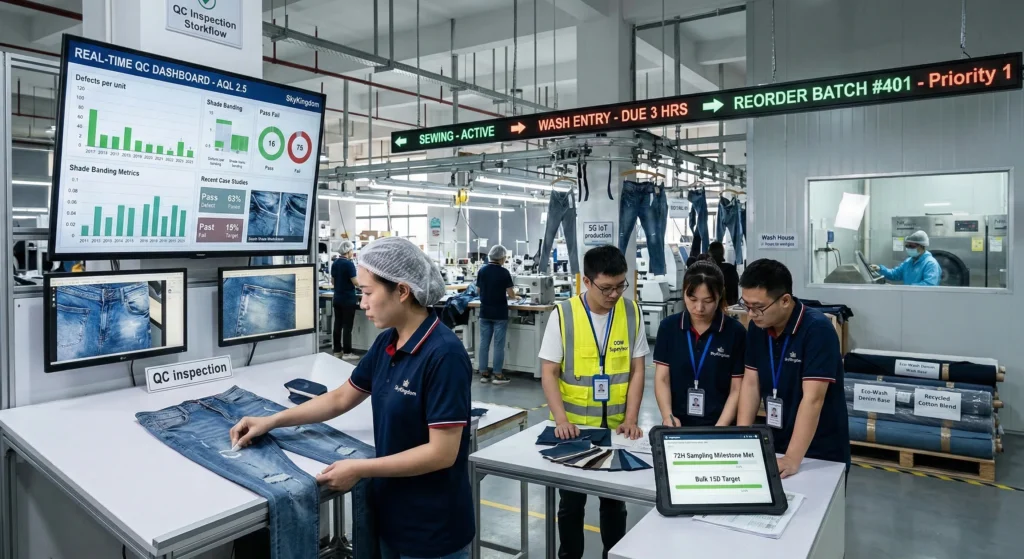
Sky Kingdom describes inline inspection after every five sewing operations, plus AQL-based final audits. The specific cadence matters less than the principle: your factory should have defined gates that stop the line when defects cluster.
To make QC digital, you need consistent defect codes and traceability IDs. Ask for inspection logs by lot and by operator line, because that is how you prevent recurring issues across future small batch runs. A Digital Supply Chain approach should also capture change control: if a wash recipe is adjusted 2 percent for shade, that needs to be recorded and approved, otherwise your reorder will drift.
Scale without breaking lead times
Scaling is where many fast fashion brands lose reliability. A style goes viral, you reorder fast, and suddenly the factory substitutes a fabric lot, changes a wash operator, or moves the style to a different line. The result is quality drift, not because anyone is careless, but because the system did not protect repeatability.
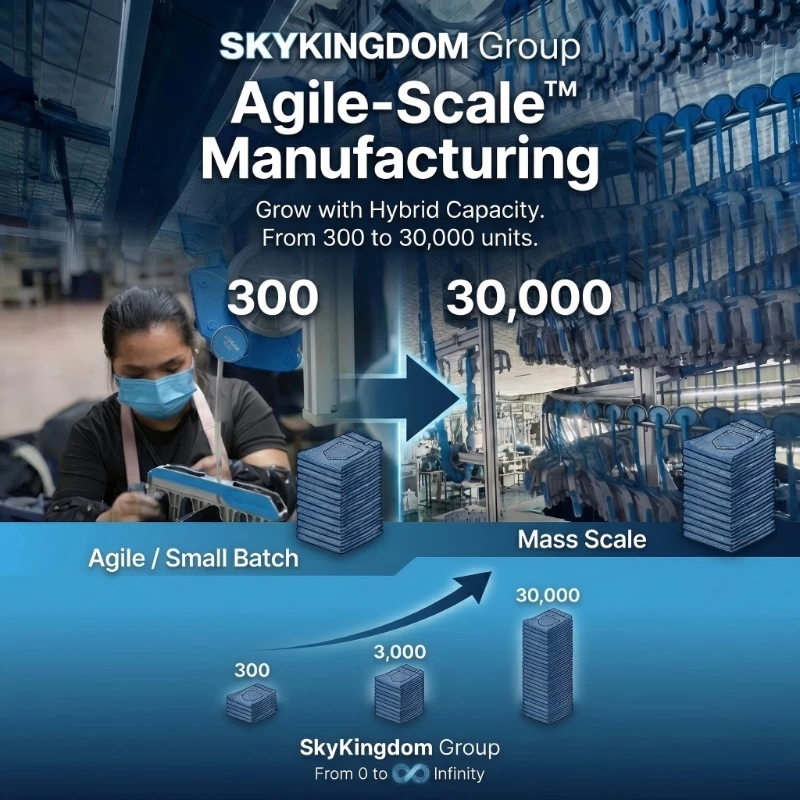
The simplest scaling framework is capacity splitting: keep a portion of capacity for test runs and a portion for winners. Sky Kingdom describes an Agile-Scale Manufacturing model that allocates 30 percent fast-response lines to fragmented test runs and 70 percent intelligent lines to scaling winning styles, positioned to support growth from 300 to 30,000 units.
To protect lead times, you also need predictive sourcing. If you plan to restock, pre-book your base fabric and define what substitutions are allowed (fiber content, stretch percentage, weight tolerance). This is also where Smart Factory Automation shows its value: line scheduling, digital tracking, and quicker changeovers reduce the risk that a reorder sits in a queue behind unrelated work.
Selection and decision guide
MOQ and unit economics: protect cashflow in small batch
Low MOQ is not just a number. Evaluate it by:
- MOQ by style, color, wash
- Fabric and trim minimums
- Reorder minimums for restocks
When a factory can hold base fabric or propose Eco-Friendly Fabrics that are available in repeatable lots, your cashflow risk drops because you do not overbuy inventory for a test.
Lead time and fast response: hit launch dates
Fast response should be measurable. Use a timeline that includes:
- Sampling window
- Wash approval loop time
- Bulk production lead time
- Reorder speed
Sky Kingdom publishes example timelines such as 72-hour sampling (VIP) and bulk production at 15 to 22 days, which gives you a benchmark for what to ask any factory to commit to in writing.
QC system maturity: prevent returns and reworks
Ask for a QC map, not a promise:
- AQL level used for final inspection
- Inline checkpoint cadence
- Measurement tolerance policy
- Lot traceability and defect logging
AQL is widely used in apparel as a sampling-based acceptance method. What matters is that the factory can show how it applies AQL and what happens when defects exceed the limit.
Sustainability proof: certify, document, and test
Sustainability claims must be auditable, especially for Circular Fashion narratives. For Recycled Cotton Denim, ask for chain-of-custody documents and transaction certificates, and align the claim language with what the documents actually support. If you use Biodegradable Fibers or other novel materials, confirm wash and durability behavior because some fibers react differently to ozone, enzymes, or heat.
Decision table (framework-focused):
| Scenario | Primary risk | What to verify | Best-fit factory capability |
|---|---|---|---|
| 30-unit test drop | Rework loops | Sealed sample gates | Low MOQ Manufacturing |
| Limited hype drop | Missed date | Sampling, wash loop speed | Fast response system |
| Core restock style | Quality drift | BOM and wash control | Digital QC + traceability |
| Viral winner scaling | Capacity shock | Split lines + fabric booking | Smart Factory Automation |
Conclusion
A small-batch denim clothing factory is only as good as its repeatable system. When you evaluate OEM and ODM options, prioritize fast response loops, clear QC gates, and a Digital Supply Chain that makes production visible. Then, use a 30-unit pilot to validate fit, Sustainable Denim Washing, and inspection consistency before you scale.
If your team treats this as a process, not a vendor search, you will launch more on time, reduce returns, and scale winners without the usual quality drift.
FAQ
What is the difference between OEM and ODM for denim?
OEM means the factory manufactures to your provided design and specifications, while ODM includes factory-led design development plus manufacturing. OEM fits best when your team already has a solid tech pack, measurement tolerances, and wash targets. ODM can be faster when you need help translating inspiration into a production-ready denim product definition. The risk with ODM is losing consistency if approvals are not locked to a sealed sample and version-controlled BOM. The decision is mostly about how much product ownership and technical detail you can reliably manage in-house.
How low can low MOQ manufacturing realistically go?
Low MOQ manufacturing can go as low as a few dozen units per style, but the real minimum depends on fabric availability, wash setup, and trim minimums. A style with custom hardware, unique labels, or rare fabric composition may force higher minimums even if sewing capacity is flexible. You should confirm MOQ by style, color, and wash, because each combination can behave like a separate product. For planning, assume you will need extra units for QC pull samples and potential remake units. The best approach is to pilot one wash and one colorway first, then expand variations after the process is stable.
What does fast response or quick response mean in denim production?
Fast response or quick response means short, repeatable loops from sampling to production and then to replenishment once demand is proven. It is not only about a short bulk lead time, because slow wash approvals or fabric sourcing can still break your timeline. In practice, quick response requires parallel workflows, clear approval gates, and a capacity plan that keeps room for small batch test runs. The most important signal is whether the factory can keep the same standard across reorders, not just rush the first run. If a factory can track issues in real time and correct them before the final audit, your response loop stays intact.
How do I verify recycled cotton denim claims?
To verify recycled cotton denim claims, ask for chain-of-custody documentation and transaction certificates that match your specific product inputs. The paperwork must connect fiber source, yarn, fabric mill, and garment production in a consistent trail. You should also align marketing language to the certified content percentage and scope, because vague terms like “eco” or “recycled” often overreach what is documented. If you are pursuing Circular Fashion messaging, confirm whether trims and pocketing are included or excluded from the claim. Finally, keep copies of certificates by production lot, since claims can change if suppliers or materials shift.
What should a reliable denim QC process include?
A reliable denim QC process includes sealed sample approval, clear measurement tolerances, and inspection checkpoints that happen before defects compound. You should have inline checks at critical operations like pocket setting, waistband attachment, and inseam stitching, because those defects are expensive to fix later. Final inspection should include measurement audits, wash shade matching to an approved standard, and hardware function checks. Traceability by fabric lot and wash lot makes recurring problems easier to diagnose. The most reliable factories also document defect types and rates so your team can prevent repeat issues across reorders.
How do I avoid quality drift when scaling a winning style?
You avoid quality drift by locking the BOM and wash recipe, then controlling what changes are allowed and what requires re-approval. Fabric lot consistency matters, so you should keep the same base fabric where possible and define weight and stretch tolerances if substitutions occur. Maintain identical inspection checkpoints across every reorder, even when production shifts to a different line or capacity expands. You should also review production data and defect logs after each run so the next reorder starts with corrective actions already implemented. Finally, keep a physical golden sample and shade standard as the reference point, because digital photos alone rarely capture denim wash nuance.
How does 3D apparel prototyping fit into a denim workflow?
3D apparel prototyping fits best at the decision stage where you are validating silhouette, proportions, and branding placement before cutting fabric. It can reduce sampling loops by helping your team reject bad ideas early, especially for pocket shapes, seam lines, and overall balance. However, it does not replace physical testing for shrinkage, hand feel, stretch recovery, and wash shade, which are core to denim. The most effective workflow uses 3D for fast alignment, then moves quickly to a sealed physical sample for wash and fit confirmation. Treat it as a speed tool, not a guarantee of manufacturability.
What is the smartest way to start a small batch denim program?
The smartest way to start is to run a tightly scoped pilot that proves repeatability, not just aesthetics. Choose one silhouette, one fabric direction, and one wash, then define measurement tolerances and approval gates before sampling. Plan your timeline with explicit loops for wash approvals and fit corrections, because denim changes after laundering. Build your QC plan at the same time as development so defects are prevented, not discovered at the end. Once the pilot is stable, expand with additional colorways and washes while keeping trims and core construction consistent.