
When you’re building a clothing brand, it can feel like your designs are ready—but the factory side is a maze. You want great fits, consistent quality, and packaging that looks premium, yet you also need speed, fair MOQs, and clear communication. That’s exactly where private label clothing manufacturers come in: they help you produce apparel under your brand name without owning a factory. The right partner turns your ideas into sellable SKUs quickly; the wrong one turns your launch calendar into excuses.

What “Private Label” Really Means in Apparel (and What It Doesn’t)
In apparel, private label clothing manufacturers typically support one of two models:
- Private label blanks: you start with pre-made styles (t-shirts, hoodies, etc.) and add your branding (labels, prints, trims). This is fast, but less unique.
- Cut-and-sew private label (OEM/ODM): you develop your own patterns, fabrics, washes, and details. This is how you build a defensible brand, especially in denim and woven categories.
Private label does not automatically mean “cheap” or “low quality.” It simply means the product is manufactured for you to sell under your label—quality depends on the factory’s systems, materials, and QC discipline.
Why Brands Use Private Label Clothing Manufacturers in 2026
Most DTC brands choose private label clothing manufacturers for three practical reasons: speed, leverage, and focus. You focus on product-market fit, storytelling, and distribution while the factory handles production complexity.
Key advantages:
- Faster time-to-market than building your own production capability
- Lower upfront capex (no machines, no labor overhead)
- Access to specialized processes (denim washes, distressing, garment dye, enzyme rinses)
- Scalable capacity when a SKU suddenly takes off
I’ve seen brands lose an entire season because they treated manufacturing like a “vendor task” instead of a core business system. The best manufacturers operate like an extension of your ops team—especially when you’re running weekly drops.
The 7 Factors That Separate Great Private Label Clothing Manufacturers from Risky Ones
1) MOQ and “Real” Flexibility
MOQ isn’t just a number—it’s a risk profile. Many private label clothing manufacturers advertise low MOQ, then add hidden minimums on fabric, trims, or colorways.
Look for clarity on:
- MOQ per style / color / size ratio
- Fabric MOQ (especially denim base fabrics)
- Whether they can consolidate trims across styles to reduce waste
2) Sampling Speed and Iteration Process
Sampling is where timelines live or die. A factory that can’t iterate fast will stall your launch even if bulk production is “cheap.”
Ask:
- What is the typical sample lead time?
- How many fit rounds are realistic?
- Do they provide measurement spec check + construction notes?
3) QC Standards You Can Audit
You want measurable QC, not promises. For bulk, many brands use AQL (Acceptable Quality Limit) inspection standards.
A practical baseline:
- AQL 2.5 for major defects is common for “sellable” e-commerce quality
- Clear defect classification (critical/major/minor)
- Inline + final inspections, not just end-of-line checks
4) Fabric Sourcing and Traceability
Fabric is your product. If the mill changes yarn count, stretch %, or finishing, your fit and hand-feel can drift.
Ask for:
- Fabric spec sheets (composition, weight, shrinkage, stretch recovery)
- Lab dips for color approval
- Wash test + shrinkage reports for denim
5) Compliance and Social Responsibility
If you sell globally, compliance isn’t optional. You need a partner aligned with international social responsibility expectations.
Start with:
- Audit readiness
- Worker safety processes
- Chemical management (especially for wash houses)
For a deeper overview of certification differences, see OEKO-TEX and GRS (Global Recycled Standard).
6) Communication and Production Transparency
Factories that run on spreadsheets alone can’t give you reliable ETAs. The best private label clothing manufacturers use ERP and real-time tracking to reduce surprises.
You want:
- Production status visibility
- Material arrival confirmation
- Inline QC reporting
- Packing list accuracy
7) Category Specialization (Denim/Woven vs Knit)
A hoodie factory can’t automatically execute premium denim. Denim and woven apparel require different machinery, washing capability, pattern expertise, and tolerance control.
If denim is your hero category, prioritize a denim-first manufacturer.
Typical MOQ, Lead Times, and Cost Drivers (What to Expect)

Cost is usually driven by:
- Fabric (quality, stretch, special finishes)
- Wash/finishing (denim effects, enzyme, stone, bleach alternatives)
- Complexity (pockets, hardware, topstitching, lining)
- Order size (unit economics improve with volume)
Lead times vary widely, but the best partners reduce lead time by controlling fabric supply, standardizing workflows, and running disciplined sampling.
SkyKingdom Group: A Speed-to-Market Approach for Private Label Denim & Woven Apparel
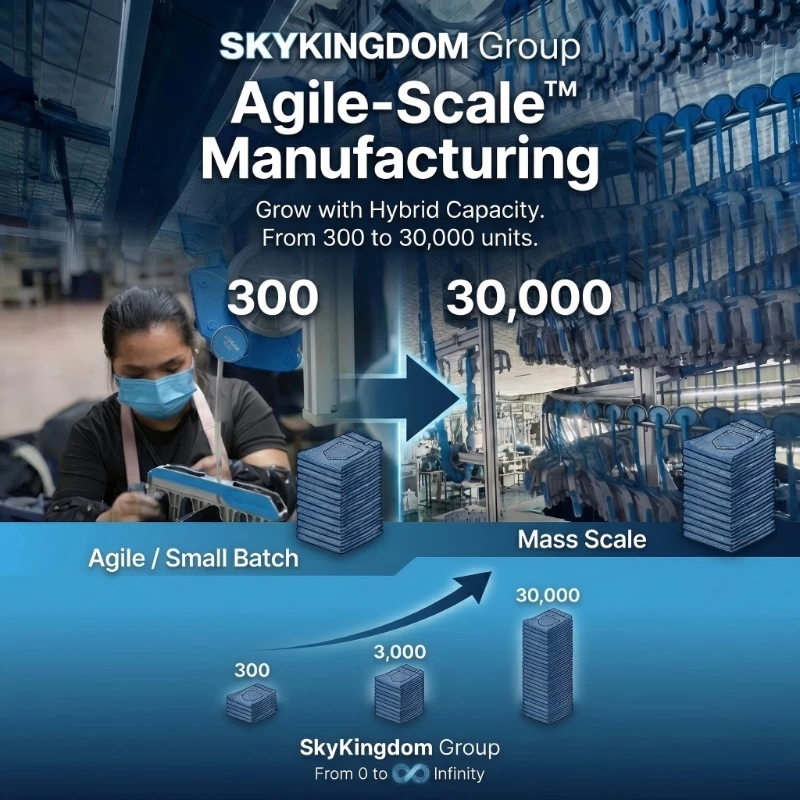
SkyKingdom Group operates as an OEM/ODM partner in China for DTC brands that need fast-fashion denim and woven production—without losing control of quality. Their model is built around a “Speed-to-Market Engine,” combining 7-day sample turnaround with 15–22-day bulk production for many programs, supported by 5G IoT production lines and real-time data tracking.
Where this matters in practice:
- Low MOQ (30 units) helps new brands test demand before scaling inventory risk.
- Hybrid scalable capacity supports brands moving from “first drop” to repeatable replenishment.
- Amazon Top Seller-Grade QC (AQL 2.5) targets consistent e-commerce-ready output.
- Eco-friendly wash processes are especially relevant for denim programs.
- Risk-sharing partnership (base fabric safety stock) can reduce delays when a style suddenly spikes.
I’ve tested the “fast sample” promise with suppliers in the past, and the difference usually comes down to one thing: whether the factory runs sampling as a priority lane or as leftover capacity. A true speed engine treats sampling like a product launch function—not a side task.
To explore related decision points, you may also like:
- what are the best small batch denim clothing manufacturers for private label
- choosing the best factory for low moq denim clothing ideal for individuality seekers
- how to identify the best factory for fast and reliable denim clothing sample delivery

A Simple Vetting Checklist (Use This Before You Send a Deposit)
Use this list to evaluate private label clothing manufacturers quickly and objectively:
- Proof of work
- Recent production photos/videos (not just marketing)
- References from brands in your category
- Sampling system
- Written sample timeline
- Fit approval workflow (what happens after comments?)
- Materials control
- Fabric specs, shrinkage test, wash test
- Hardware and trim sourcing options
- QC documentation
- AQL standard used
- Inline + final inspection reports
- Commercial terms
- Payment terms, incoterms, rework policy
- Clear tolerance standards (measurement + shade)
Common Private Label Manufacturing Problems (and How to Fix Them)
| Problem | Root Cause | How to Prevent | What to Ask the Manufacturer |
|---|---|---|---|
| Fit inconsistent between sizes | Grading rules incorrect; pattern not updated after sample; tolerance too wide | Approve size spec + grading chart; require PP sample in all key sizes; set measurement tolerances and inspection method | What grading rules were used? Can you share pattern revision history and measurement report by size? What tolerances can you hold? |
| Color/shade variation | Dye lot differences; poor lab dip approval; fabric sourced from multiple mills | Approve lab dips and bulk swatch; require single dye lot per color; include shade band standard and QC at cutting | Will bulk come from one dye lot/mill? Can you provide shade band and bulk fabric cuttings for approval? What ΔE tolerance do you follow? |
| Late bulk shipment | Material delays; capacity constraints; delayed approvals; unclear critical path | Lock BOM and approvals early; confirm production schedule with buffer; require weekly WIP updates and escalation triggers | What is the critical path and current capacity? Which items are on the critical path now? What is your on-time shipment rate and contingency plan? |
| High defect rate | Inadequate QC; operator training issues; unstable process; poor incoming material quality | Define AQL and defect list; require inline + final inspections; set corrective action timelines; approve SOPs and training | What QC checkpoints do you have (inline/endline/final)? Can you share last 3 inspection reports and CAPA process? What’s your defect rate by line? |
| Unexpected fabric MOQ | Supplier minimums not disclosed; fabric not stocked; special dye/finish requirements | Confirm MOQ at quoting; select stock/greige options; consolidate colors; negotiate MOQ with surcharge | What is the MOQ by fabric/color/finish? Is there leftover stock or alternative mill options? Can you offer split lots or surcharge pricing? |
| Wash result differs from sample | Different wash recipe/chemicals; machine variance; fabric composition changes; sample not run on bulk | Approve wash standard with recipe; require bulk wash test before full run; keep fabric/trim same as sample | Was the sample washed on production machine/line? Can you share the exact wash recipe and test results? What changed in fabric/chemicals? |
| Label/packaging errors | Incorrect artwork/version control; translation mistakes; packing SOP gaps; manual packing errors | Use controlled artwork files; pre-production packaging mockup approval; barcoded packing list and audits | Which artwork/version was used and who approved it? Can you provide packaging SOP and packing check records? What verification steps prevent mix-ups? |
Recommended Workflow: From Tech Pack to Bulk (Without Losing Weeks)
A reliable workflow with private label clothing manufacturers looks like this:
- Pre-development
- Confirm target price, MOQ, and lead time
- Lock fabric direction (especially for denim stretch %)
- Tech pack + costing
- Measurements, construction, stitch type, trims, labeling
- Ask for a costed BOM (bill of materials)
- Sampling
- Proto → fit sample → size set (if needed) → PP sample
- Bulk production
- Fabric approval + lab dips
- Inline QC + final AQL inspection
- Packing + shipping
- Barcode/carton marks
- Final packing list verification
For general guidance on building a supplier relationship and understanding private label options, these references are helpful:
- International Labour Organization (ILO) — labour standards overview
- OEKO-TEX Standards
- GRS (Global Recycled Standard) by Textile Exchange
HOW TO FIND A CLOTHING MANUFACTURER FOR YOUR BRAND STEP BY STEP
Conclusion: Choose Private Label Clothing Manufacturers Like You’re Hiring a Core Team Member
The best private label clothing manufacturers don’t just “make clothes.” They protect your timeline, stabilize your quality, and help you scale without chaos. If your brand is built on denim and woven apparel—where wash, fit, and consistency decide repeat purchases—your manufacturer choice is a growth strategy, not a sourcing task.
If you’re planning a launch or switching suppliers, share your product category, target MOQ, and timeline in the comments—and I’ll suggest what to prioritize first.
📌 how to identify the best factory for fast and reliable denim clothing sample delivery
FAQ: Private Label Clothing Manufacturers
1) What is the difference between private label and custom cut-and-sew?
Private label often starts from existing styles you brand, while custom cut-and-sew develops your patterns, fabrics, and construction for a unique product.
2) What is a good MOQ for private label clothing manufacturers?
Many factories start at 50–300 units depending on category, but some partners support low MOQ programs (e.g., 30 units) for new brands.
3) How long does private label clothing production take?
Sampling can take 1–4 weeks at many factories; bulk production often takes 3–8 weeks. Speed-focused partners can be faster with strong material control.
4) What QC standard should I ask for?
Ask what AQL standard they use (AQL 2.5 is a common baseline), plus whether they run inline and final inspections.
5) Can private label clothing manufacturers help with labels and packaging?
Yes—most can provide woven labels, care labels, hangtags, polybags, and carton marks, but you should confirm proofs and packing checks.
6) How do I avoid shade variation in denim?
Control fabric lots, require lab dips, approve wash standards, and request shade banding or wash test reports before bulk.
7) Should I choose a local manufacturer or overseas private label partner?
Local can simplify communication and small runs; overseas often offers better capacity and specialized processes. The best choice depends on timeline, category, and quality systems.