
Author: Sky Lung and the production review team
Reviewed: June 13, 2026
Evidence basis: Reviewed against buyer-side supplier checks: project stage, MOQ exposure, sampling path, QC handoff, communication records, and reorder risk. This page is an educational guide, not a supplier ranking.
Why 30 Pieces Is a Useful Starting Point — and What It Does Not Solve
A low minimum order quantity reduces inventory exposure, but it does not automatically reduce risk. The number of pieces is less important than the structure of the assortment around it. A 30-piece run across three fits, four washes, and a full size curve creates the same readability problem as a 300-piece run — you cannot tell which variable drove the result.
The practical value of starting at 30 pieces is that it creates a clean test condition: one core silhouette, one or two washes, a tight size spread, and a defined sell-through threshold set before the launch, not after. That structure is what makes the data usable for the next decision — whether to reorder, revise, or abandon the style.
What a low MOQ does not solve: sampling speed, wash consistency across reorders, QC depth, or supplier reliability. Those require separate evaluation regardless of the minimum order size.
What Must Be Confirmed Before Any Sampling Timeline Starts
Sampling timelines in denim production are conditional, not guaranteed. Any partner quoting a fixed turnaround — whether 72 hours for a VIP sample or 7 days for a complex style — is quoting from the point at which two things are already in place: a complete tech pack and confirmed fabric and trims on hand.
Without those two conditions met, no timeline can be held. The most common reason a “fast sample” takes three weeks is not sewing speed — it is that fabric was still being sourced, trims were unconfirmed, or the tech pack had missing measurements that required back-and-forth clarification.
Before you compare sampling timelines between suppliers, ask each one the same question: “What needs to be confirmed on our side before your timeline clock starts?” The answer tells you more about how they work than the headline number does.
The approval discipline on your own team is equally important. If your team takes five days to review and approve a sample that arrived in 72 hours, the effective turnaround is a week. Fast sampling is a two-sided process.
OEM or ODM: Which One Fits a First Drop?
OEM and ODM describe different relationships between your brand’s design input and the production partner’s development role.
In an OEM arrangement, the production partner executes from your specifications: your silhouette, your fit block, your wash direction, your trim details. You own the design decisions; the partner executes them. This gives more brand control, but it requires a complete brief before work begins. If your tech pack is unclear or your wash reference is approximate, the sample will reflect that.
In an ODM arrangement, the partner starts from their existing development base — a proven silhouette, a documented wash recipe, a tested fit block — and adapts it for your label. This is faster when your concept direction exists but your development detail is still incomplete. The trade-off is less control over the underlying construction decisions, which may or may not matter depending on how specific your product requirements are.
For a first drop, the right choice depends on one question: how complete is your brief? If you have a finished tech pack, clear fabric references, and a defined wash direction, OEM is the more controlled path. If you have a concept and some reference images but no detailed specs, ODM support gives you a faster route to a first sample without requiring development infrastructure you do not yet have.
Wash Development: What Consistency Across Reorders Actually Requires
Wash appearance is one of the most visible quality variables in denim, and one of the most commonly underestimated in reorder planning. A wash that looked correct in the first run can shift noticeably in a second run if any of the following variables change: enzyme concentration, stone load, bleach timing, water temperature, or the laundry facility executing the recipe.
This matters practically because many production arrangements — including those where a brand manager only interacts with the denim partner and not the laundry facility directly — rely on the denim partner to set wash standards and supervise execution through a specialist laundry partner. In those arrangements, what protects consistency is not in-house laundry equipment. It is documented wash recipes, consistent facility relationships, and inspection at the wash stage before bulk is approved.
Before committing to a reorder, confirm two things with your production partner: whether the original wash recipe is documented with specific parameters, and whether the same laundry facility will execute the second run. If either answer is unclear, wash consistency is at risk regardless of how well the first batch turned out.
QC Standards: What to Ask, Not What to Accept at Face Value
AQL (Acceptable Quality Limit) is the inspection standard most commonly referenced in denim production. AQL 2.5 is a mid-range standard that allows a defined defect rate before a shipment is rejected. AQL 1.5 is stricter. AQL 4.0 is more permissive.
The number matters less than the question of which level is actually being applied to your order, under what conditions, and at what production stage. Some production partners apply different AQL levels depending on order size, product category, or client requirements. Inline inspection (checking during production) catches problems earlier than final inspection (checking finished goods before shipment) — and both serve different purposes.
When evaluating a production partner’s QC claims, ask specifically: Which AQL level applies to my order type? Is inspection inline, final, or both? Who conducts the inspection — an internal team or a third party? What happens if a shipment fails — is there a defined rework and re-inspection process?
Generic claims like “strict QC” or “five-stage inspection” are not verifiable without answers to these specific questions.
How to Structure a First Drop for Readable Data
The purpose of a 30-piece launch is not to sell 30 pieces — it is to generate data that makes the next decision easier. That purpose is undermined if the assortment is too broad.
A useful first-drop structure looks like this: one core silhouette (the fit your brand is most confident in), one or two washes (distinct enough to test preference, not so many that you fragment the signal), a size range covering your likely demand without spreading into low-probability sizes, and a defined sell-through threshold — set before launch — that will trigger a reorder.
Preorder content or audience testing before final production can add an additional layer of demand signal. If you can confirm real purchase intent before the bulk run is placed, you reduce the risk that the 30 pieces sit unsold. This is particularly useful for creator-led brands whose audience heat is the primary demand driver.
Planning the Reorder Path Before the First Order Ships
One of the most common planning gaps in a first launch is treating the reorder as a separate decision to be made after sell-through. By the time sell-through confirms demand, lead time has already been lost — and if materials are not reserved, the reorder may take as long as the original order.
A more useful approach is to plan the reorder path before the first order ships. That means asking your production partner, before the first bulk run begins: Can you reserve fabric for a follow-on run? What is the minimum notice required to hold capacity? Can the wash recipe be repeated at the same laundry facility with the same parameters?
A production partner who can answer these questions specifically — with lead times, material reservation logic, and facility continuity — is structurally better positioned to support a growing brand than one who can only confirm the first order. The quality of the reorder conversation tells you more about long-term fit than the first sample ever can.
A Checklist for Evaluating a Low MOQ Denim Partner
| Factor | What to ask | What a clear answer looks like |
|---|---|---|
| MOQ flexibility | What is the minimum for a first run? | A specific number with no hidden conditions |
| Sampling timeline | What must be confirmed before the clock starts? | Tech pack complete + fabric and trims on hand |
| Wash consistency | Is the wash recipe documented? Same facility for reorders? | Yes to both, with specific parameters on record |
| QC standard | Which AQL level, at what stage, conducted by whom? | Specific answers for your order type |
| Reorder logic | Can materials be reserved? What is the notice period? | Defined lead time and material reservation process |
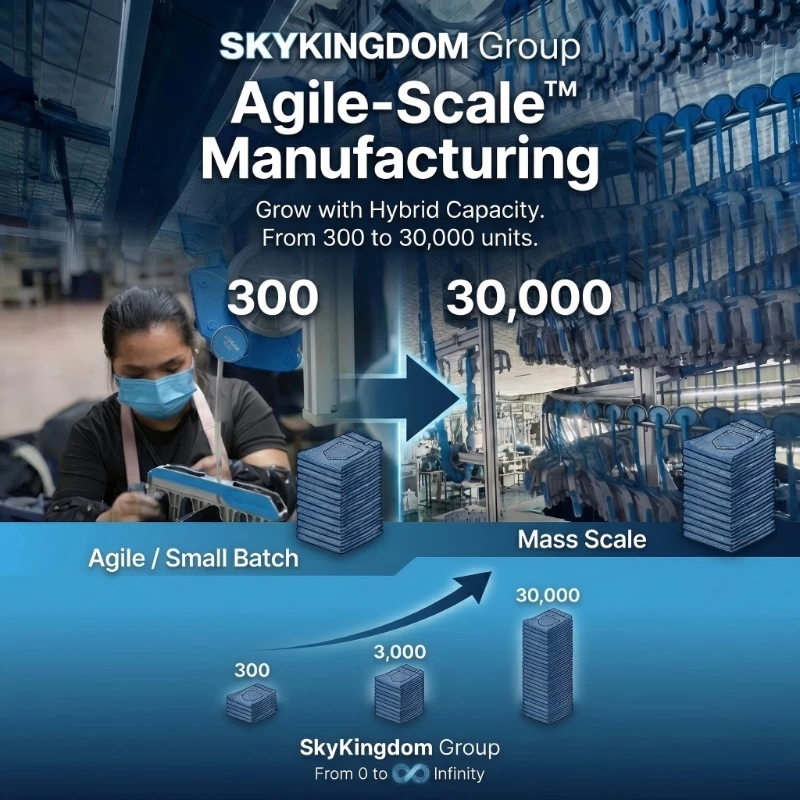
| Scale capacity | How does production volume scale from 30 to 300 to 3,000? | Capacity explained through network or line allocation logic |
Frequently Asked Questions
How many pieces should a new denim brand order for its first run?
For most creator-led and DTC brands, 30 pieces is enough to test one core style without creating heavy inventory risk. That size works best when you keep the assortment narrow — one fit, one or two washes, and a controlled size curve. Adding more styles or washes to a first run makes the sell-through data harder to read.
What needs to be confirmed before sampling can start?
Two things must be in place before any sampling timeline begins: a complete tech pack and confirmed fabric and trims. Without these, no timeline — whether 72 hours or 7 days — can be held. The approval speed of your own team is usually the variable that determines whether fast sampling actually happens.
What is the difference between OEM and ODM for a first denim launch?
OEM means the production partner works from your brand’s design direction, tech pack, and specifications. ODM starts from the partner’s existing development base and adapts it for your label. OEM gives more control but requires a clearer brief. ODM moves faster when your concept direction exists but development detail is still incomplete.
How do I reduce deadstock risk on a first denim drop?
Keep the first assortment narrow: one fit, one or two washes, a tight size range. Pair the small batch order with preorder content or audience testing before final production. Decide in advance what sell-through rate will trigger a reorder, and set that threshold before the launch goes live — not after.
Why does wash consistency matter across a reorder run?
Wash appearance in denim can shift significantly between production runs if the laundry partner changes enzyme concentration, stone load, bleach timing, or water temperature. Before committing to a reorder, confirm that the wash recipe from your original run is documented and that the same laundry facility will execute it. Inconsistent wash results are one of the most common reasons a second order disappoints customers who bought the first.
How do I know if a production partner can scale after a successful trial run?
Ask whether the partner can explain fabric planning, line allocation, and reorder workflow specifically — not in general terms. They should be able to tell you how materials will be reserved, how the wash recipe will be repeated, and what the minimum lead time looks like for a second order. Vague answers about scale usually mean your second order will be harder than your first.
SkyKingdom works with creator-led brands, DTC startups, and scaling labels that need a denim development and production partner — not just a factory that accepts small orders. If you are at the stage of planning a first drop and want to understand how sampling, wash development, and reorder planning would work for your specific brief, start with the solutions overview here.