
Why most denim sourcing comparisons give you the wrong answer
The standard approach is to compare factories by their stated minimums and their quoted turnaround. Both numbers are almost always misleading.
A stated 30-piece MOQ typically applies to styles using fabrics already in stock at the mill. The moment you bring in a custom wash, a specific indigo shade, or proprietary hardware, that minimum can quietly jump to 150 or 300 pieces — because setup costs need to be spread across enough units to make the run viable for the factory. This is not deception. It is how denim production economics work. But founders who do not ask the right question upfront will find out only when they receive the revised quote.
Turnaround claims have the same problem. A 7-day sample is achievable when fabric and trims are already confirmed and no sourcing is required. For a style where fabric matching, wash development, or trim sourcing is still open, the realistic calendar is longer — often by two to three weeks before you even cut the first sample. That is not a slow factory. That is an honest one. The question to ask is not “how fast can you make a sample” but “what needs to be confirmed before the clock starts.”
The four decisions that actually determine whether a denim supplier fits your stage
1. Who owns wash development?
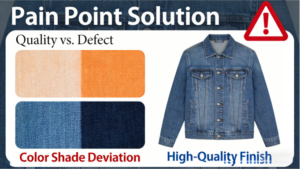
Wash development is where most early-stage brands lose time and money without realizing it. A wash finish on a sample looks a specific way because someone made a judgment call on the treatment process — enzyme concentration, stone load, bleach timing, or a combination of finishing steps. When bulk production runs at higher volume, those parameters can shift. The result can look subtly or dramatically different from the approved sample.
The key question is not “can you do this wash?” but “who owns the standard, who stores the recipe, and what happens when bulk comes out 10% lighter than the approved sample?”
Suppliers with a serious wash development process will maintain a written wash specification that travels with every order — regardless of whether washing is done in-house or by a managed external laundry partner. What matters is not who physically runs the machines, but who is accountable for the standard and who can enforce it when output drifts. If the answer to that question is vague, the standard does not exist in a usable form.

2. How many sample rounds are normal, and who pays for revisions?
In Chinese denim production, one sample round is almost never enough for a brand that has not produced with that factory before. A typical first-collection founder should budget for two to three rounds: one fit sample to check the block and construction, one wash sample to establish the finish standard, and one pre-production sample to approve bulk fabric and trims together. Some factories charge per sample round; others absorb the cost if you proceed to bulk. Both are legitimate. What matters is knowing the answer before you start.
Also ask what triggers a new round versus a minor correction within the same round. Those definitions vary significantly between suppliers, and they affect both your calendar and your cost.

3. Is the MOQ the same for reorders?
This is the most underrated question in denim sourcing. Some suppliers offer low minimums for first orders as a business development concession, then revert to standard minimums on reorders once you have validated the style and want to scale. If your reorder MOQ is 300 pieces but your test drop sold 80 units, you now have a cash flow problem that no amount of great branding will solve.
Ask explicitly: “If this style sells and I want to reorder in 90 days, what is the minimum quantity and what is the lead time?” The answer to that question tells you more about whether a supplier actually fits your growth stage than any headline MOQ figure.
4. Does the factory’s scale path match your growth curve?
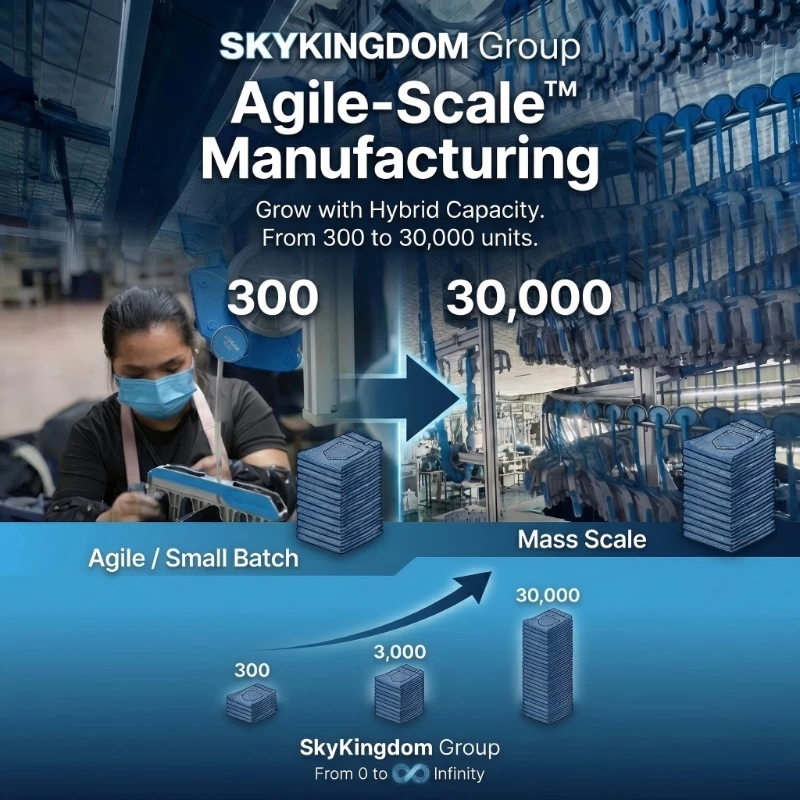
A supplier optimized for 30-piece micro-runs may not be structured to handle 3,000-piece production without bringing in subcontractors — which creates quality consistency risk if the new production partner has different equipment, different operators, and different inspection standards.
The continuity question is: can the supplier execute your reorder using the same pattern files, the same wash specification, and the same QC benchmark as your original run? That is harder than it sounds, and it is the primary reason brands that launch successfully still end up switching suppliers after their first reorder.
What to ask suppliers before you shortlist them
These questions work because they cannot be answered with a brochure. A supplier that stumbles on them usually lacks the internal systems to deliver consistent denim production at any volume.
On wash development:
- Do you maintain a written wash specification for each style, and how is it stored for reorders?
- Who is accountable when bulk wash output differs from the approved sample?
- If washing is done by an external laundry, how do you enforce the standard across production runs?
On sampling:
- What needs to be confirmed before a fast sample timeline begins — fabric, trims, wash direction?
- How many sample rounds do you expect for a new silhouette with a custom wash?
- What is included in each round, and what triggers an additional charge?
On production consistency:
- How do you handle measurement tolerance drift between inline inspection and final inspection?
- What AQL level do you use at final inspection, and can it be adjusted based on the order requirement?
- Who is responsible for rework if bulk output fails the approved standard?
On reorder:
- Are pattern files and wash specs stored in a system I can reference for future orders?
- Is the MOQ for a reorder the same as for a first order?
- What is the minimum notice time for a reorder before your production schedule closes?
What the inspection standard question actually reveals
Most buyers ask about price and lead time. Almost none ask about inspection standards — which is exactly why asking about them tells you so much.
AQL 2.5 is a common baseline for apparel final inspection. But different stages of a brand’s growth require different levels of control. A startup doing a 50-piece test drop may reasonably accept AQL 4.0 to keep development costs manageable. A scaling brand with retail or wholesale commitments may need AQL 1.5 on critical measurements like outseam length and waistband width, where variance directly affects sell-through and return rates. For styles where wash consistency is a brand signature — a specific fade pattern, a precise indigo tone — 100% inspection on the wash standard may be the only way to protect the product.
A supplier that can execute all four levels on request, document the results, and adjust the inspection scope based on your risk profile is structurally more useful than one that applies a single standard to every order regardless of what is at stake.
How to read an AQL sampling table for garment inspection — sample size, lot size, and acceptable defect thresholds explained step by step.

The practical difference between a denim supplier and a denim product partner
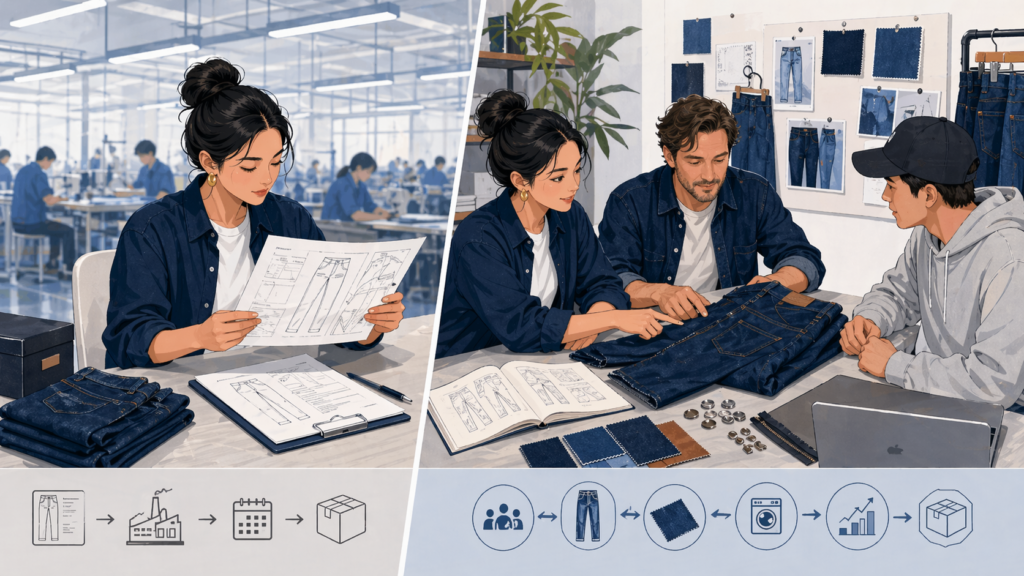
Most Chinese denim factories are excellent at executing a confirmed tech pack. They will cut your pattern, sew your construction, run your wash, and ship to spec. That is a production service. It is valuable, and it is what most large brands with in-house design and development teams need.
Brands without internal product development capacity — which describes almost every startup, creator-led label, and DTC brand in their first two to three seasons — need something different. They need a partner that can review a reference garment and identify where the construction will create fit problems on a different body. They need someone who will flag that a specified wash treatment will behave inconsistently on their chosen fabric weight before the first sample is cut, not after it comes back. They need reorder continuity that does not require them to re-explain the product from scratch every season.
That distinction — between a supplier that executes and a team that develops — is the actual sourcing decision for growth-stage brands. The right choice depends entirely on which one you actually need.
SkyKingdom works with creator-led brands, DTC startups, and scaling labels that need denim development support from sample through reorder — not just production execution. If you are figuring out whether your current stage is the right fit, start with our Solutions page.