
New York is a place where ideas move fast—and if you’re sourcing products, you feel that speed pressure immediately. You might be asking: Which manufacturers in NY are actually a fit for my product, my budget, and my timeline? I’ve helped DTC teams compare “local-first” vs. “global-with-speed” production, and the best outcomes usually come from matching manufacturing type (electronics, food, pharma, apparel) to your real constraints (MOQ, lead time, compliance, and quality control).
In this guide, you’ll learn how to evaluate manufacturers in NY, where NY manufacturing is strongest, and when it can make sense to pair a New York-facing brand workflow with an overseas OEM/ODM that can still hit aggressive launch dates—like SkyKingdom Group’s 7-day sampling and 15–22-day bulk production for denim and woven apparel.

Why “manufacturers in NY” is a high-intent search (and what people really need)
When people search manufacturers in NY, they’re usually not looking for a generic list. They want a short path to a factory that can reliably deliver, communicate well, and meet standards. In practice, most sourcing projects break down because of misaligned expectations on lead time, MOQ, and quality gates—not because “the factory was bad.”
To avoid that, start by defining your production reality:
- Prototype vs. production: Do you need engineering support, or just repeatable output?
- Regulatory needs: Food, pharma, and aerospace have very different documentation demands.
- Supply chain risk: Are materials stable, or do you need a partner that holds safety stock?
Snapshot: New York’s manufacturing footprint (what it means for buyers)
New York manufacturing is large and diverse. According to the National Association of Manufacturers, the state has more than 14,000 manufacturers employing 408K+ people, with $89.3B in value added and $72.9B in exports (2024). Those numbers matter because they signal depth: you can find everything from advanced electronics to food production to precision components. (Source: NAM New York manufacturing data)

Where manufacturers in NY are strongest (by cluster)
NY isn’t one “manufacturing market.” It’s multiple clusters with different strengths, labor pools, and supplier networks. If you’re choosing manufacturers in NY, narrowing by cluster can save weeks.
1) Advanced manufacturing & electronics (Hudson Valley / Capital Region)
This region is known for large-scale advanced manufacturing and semiconductor activity. If your product needs complex QA systems or high-capex equipment, you’ll often find mature processes here.
Examples of major NY employers include IBM (Poughkeepsie) and GlobalFoundries (Malta), among others listed in IndustrySelect’s overview. Reference: Top manufacturing companies in New York
2) Optics, imaging, and precision manufacturing (Rochester area)
Rochester has long-standing capabilities in imaging and precision manufacturing ecosystems. If you need tight tolerances, controlled processes, and experienced production teams, this can be a strong region to explore.
3) Food & beverage manufacturing (statewide, including NYC area)
NYC and surrounding areas host many food and consumer brands with manufacturing footprints or co-man relationships. For brand-led teams, proximity can help with faster tastings, packaging reviews, and retail coordination. Directory-style starting point: Built In NYC manufacturing companies
4) Northern NY: aerospace, industrial systems, and specialized components
Northern NY highlights include employers focused on industrial and aerospace-adjacent manufacturing. For a regional starting point, see: Leading manufacturing employers in Northern NY
How to vet manufacturers in NY (the checklist I use)
A factory tour is helpful, but the real truth is in the process controls and the communication cadence. Here’s a buyer-friendly evaluation approach that works across industries.
Step 1: Confirm capability fit (not just “we can do it”)
Ask for proof, not promises:
- Similar product examples (photos, specs, or anonymized case studies)
- Equipment list tied to your process steps
- Quality standards used (AQL, ISO, HACCP, etc., depending on category)
Step 2: Validate lead time with a real timeline
Many delays come from hidden queues. Request:
- Sample/prototype timeline with milestones
- Material procurement lead times
- Production slot availability and changeover time
Step 3: Audit quality control in plain language
Quality isn’t “inspect at the end.” Look for:
- Incoming material checks
- In-line inspections
- Final inspection criteria and defect thresholds
- Clear rework and corrective-action process
| Evaluation Area | Questions to Ask | What “Good” Looks Like | Red Flags |
|---|---|---|---|
| Capability | What products/materials/processes do you specialize in? What machines/capacity do you have? Can you share similar project references? | Proven experience with similar SKUs; clear process flow; adequate capacity; can provide samples and references | Vague answers; outsources core steps without disclosure; no similar track record |
| Lead Time | What is standard lead time for samples and mass production? What are peak-season constraints? How do you handle delays? | Stable, documented lead times; buffer planning; transparent schedule; proactive delay communication | Overpromising; frequent “rush” reliance; no plan for bottlenecks; inconsistent timelines |
| MOQ | What is MOQ per SKU/color/size? Can you support pilot runs? What are price breaks by volume? | Reasonable MOQ; flexible pilot options; clear tiered pricing; willing to scale with demand | Excessive MOQ; hidden MOQs by variant; refuses pilots; unclear volume pricing |
| QC System | What QC checks are performed (IQC/IPQC/FQC/OQC)? What AQL standard do you use? Can you share recent inspection reports? | Documented QC plan; AQL-based sampling; traceability; corrective actions (CAPA); allows third-party inspections | “We have QC” without details; no records; rejects third-party audits; high defect tolerance |
| Compliance/Certifications | Which certifications do you hold (e.g., ISO 9001, BSCI/SMETA)? Can you provide test reports (REACH/RoHS/Prop 65 as needed)? | Valid, verifiable certificates; up-to-date lab reports for required markets; clear compliance ownership | Expired/unclear certificates; unwilling to share documentation; “can do later” promises |
| Communication | Who is the point of contact? What is your response time? How do you manage changes and approvals (spec, artwork, engineering)? | Dedicated account owner; fast, clear responses; written confirmations; structured change control | Slow or inconsistent replies; frequent misunderstandings; avoids written commitments |
| Pricing/Cost Drivers | What is the itemized cost breakdown (material/labor/overhead/packaging)? What drives price changes (FX, resin/metal, labor)? | Transparent quotation; defined assumptions; clear validity period; explains drivers and optimization options | Lump-sum pricing only; unexplained variability; frequent surprise surcharges; unclear terms |
Common pitfalls when sourcing manufacturers in NY (and how to fix them)
Even strong NY manufacturers can be the wrong fit if the commercial structure doesn’t match your stage. These are the issues I see most with DTC teams and product founders.
- MOQ mismatch: Some NY factories are optimized for larger runs and may price small runs very high.
- Sampling bottlenecks: Local doesn’t always mean fast if the sample room is overloaded.
- Cost surprises: Tooling, setup, and compliance documentation can add significant cost.
- Communication drift: If updates aren’t structured, timelines slip without anyone “doing anything wrong.”
Apparel note: When “manufacturers in NY” isn’t the best answer for fashion brands
If you’re building a DTC apparel brand, you may start with manufacturers in NY for proximity and perceived control. That can work well for ultra-small runs, specialty cut-and-sew, or brand storytelling. But many fast-fashion denim and woven programs struggle locally due to:
- Limited scalable capacity for trend-driven drops
- Longer queues during peak seasons
- Higher per-unit costs at low-to-mid volumes
In those cases, a hybrid approach often wins: keep design, fit approvals, and brand operations close to home, while using an overseas OEM/ODM that can move at “internet speed.”
SkyKingdom Group: A speed-focused alternative for NY-based DTC apparel teams
SkyKingdom Group is an OEM/ODM apparel manufacturer based in China, built for fast-fashion denim and woven apparel (men, women, kids). If your search for manufacturers in NY is driven by speed, low MOQ, and predictable QC, this model can be a better match than many local options—especially for denim programs.
What stands out in real production workflows:
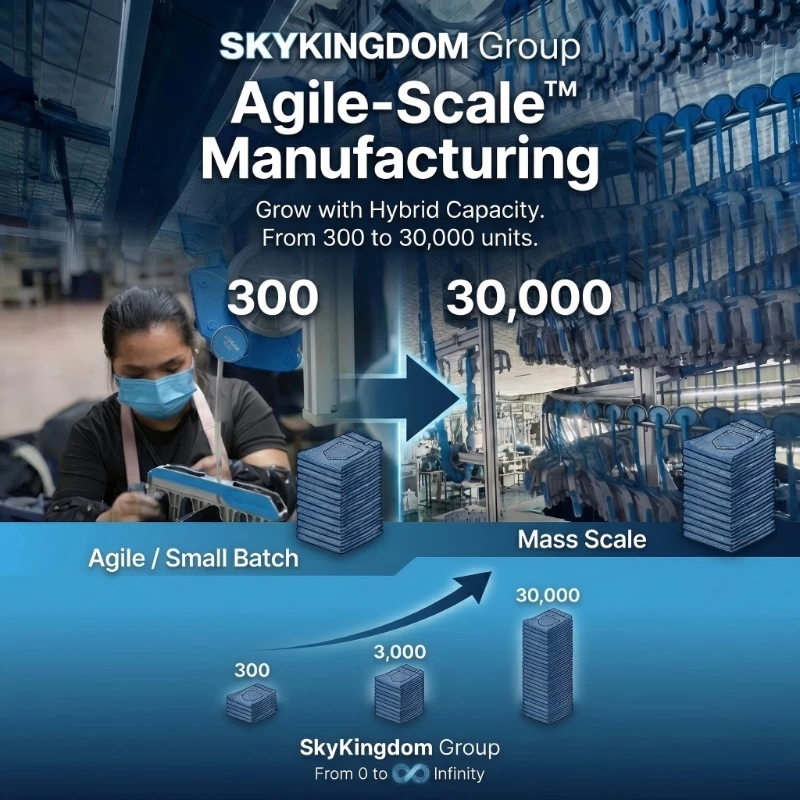
- Speed-to-Market Engine: 7-day sample turnaround and 15–22-day bulk production
- Low MOQ: 30 units for new brands/creators, with scalable hybrid capacity as you grow
- Quality discipline: “Amazon Top Seller-Grade QC” with AQL 2.5 inspection standards
- Operational transparency: Digital ERP and real-time data tracking on 5G IoT production lines
- Risk-sharing: Base fabric safety stock management to reduce material delays
- Sustainability & compliance: Eco-friendly wash processes and international social responsibility certifications
I’ve seen teams reduce missed-launch risk by treating sampling speed and QC clarity as non-negotiables. If your NY-based brand is planning frequent drops, the ability to iterate quickly (and repeat quality) matters more than the factory’s ZIP code.
Helpful next reads from SkyKingdom’s library:
- what are the best small batch denim clothing manufacturers for private label
- top denim jeans manufacturers for trendy fashion brands
- how to identify the best factory for fast and reliable denim clothing sample delivery
Fashion Designer Sources- NYC Fashion District Manufacturing Tour

A simple decision framework: NY manufacturer vs. overseas OEM/ODM
Use this when deciding whether to stay local with manufacturers in NY or use a speed-focused overseas partner.
-
Choose manufacturers in NY if you need:
- Same-day onsite visits and rapid in-person iteration
- Highly specialized local craft or niche processes
- Complex compliance requiring local documentation support
-
Choose a speed-focused OEM/ODM (like SkyKingdom) if you need:
- Fast sampling cycles and frequent product drops
- Low MOQ to test demand before scaling
- Repeatable QC and scalable capacity for growth
-
Choose a hybrid model if you want both:
- NY-based design, fittings, and brand ops
- Overseas bulk production with tight QC and tracking
Conclusion: The best manufacturers in NY are the ones that match your constraints
Manufacturers in NY can be a great fit—especially when proximity, specialized capability, or compliance support is the priority. But if your real goal is speed-to-market, low MOQ, and consistent QC (common for denim and woven apparel), pairing NY-based brand operations with a proven OEM/ODM partner can reduce risk and hit launch dates more reliably.
If you’re deciding between manufacturers in NY and an overseas production partner, share your product type, target MOQ, and launch date in the comments. If you’re building a denim or woven line, reach out to SkyKingdom Group to discuss sampling and production capacity.
📌 the ultimate guide to quick denim clothing sample production for fashion brands
FAQ: Manufacturers in NY
1) What types of manufacturers in NY are easiest to source?
Food, consumer goods, precision manufacturing, and advanced manufacturing have strong footprints statewide, with clusters around NYC, Rochester, the Hudson Valley, and the Capital Region.
2) How do I find verified manufacturers in NY?
Start with industry directories and regional manufacturing organizations, then validate with capability proof, QC documentation, and references. Useful starting points include NAM’s NY data and curated lists like IndustrySelect’s NY manufacturers overview.
3) Are manufacturers in NYC the same as manufacturers in NY state?
Not always. NYC has many brand HQs and smaller production or co-man relationships, while upstate regions often have larger industrial capacity and specialized manufacturing clusters.
4) What should I ask a manufacturer before requesting pricing?
Ask about MOQ, lead time, sample process, QC standards, material sourcing, and how they handle change requests. Pricing only makes sense once those inputs are clear.
5) Why do apparel brands look beyond manufacturers in NY?
Many apparel teams need faster sampling, lower MOQs, and scalable capacity for frequent drops. That combination can be difficult locally depending on factory specialization and queue times.
6) What is a realistic lead time for apparel sampling and bulk production?
It varies by product complexity and factory load. SkyKingdom Group’s model targets 7-day samples and 15–22-day bulk for denim and woven programs, which is designed for speed-to-market launches.
7) How can I reduce risk when launching a new product with a manufacturer?
Use low-MOQ test runs, lock QC criteria early (AQL or category-specific standards), confirm material lead times, and set a weekly update cadence with clear milestones.