
Introduction
Still chasing a TikTok spike while your factory asks for three weeks just to confirm fabric, wash, and trims? In 2026, that timing mismatch is how drops die: you miss the window, your CAC climbs, and the leftovers become deadstock you keep discounting.
This guide shows you how to run a quick response denim program end to end, from translating trend signals into production specs to executing low MOQ tests and scaling winners without switching suppliers.
Trend-to-Tech-Pack Workflow
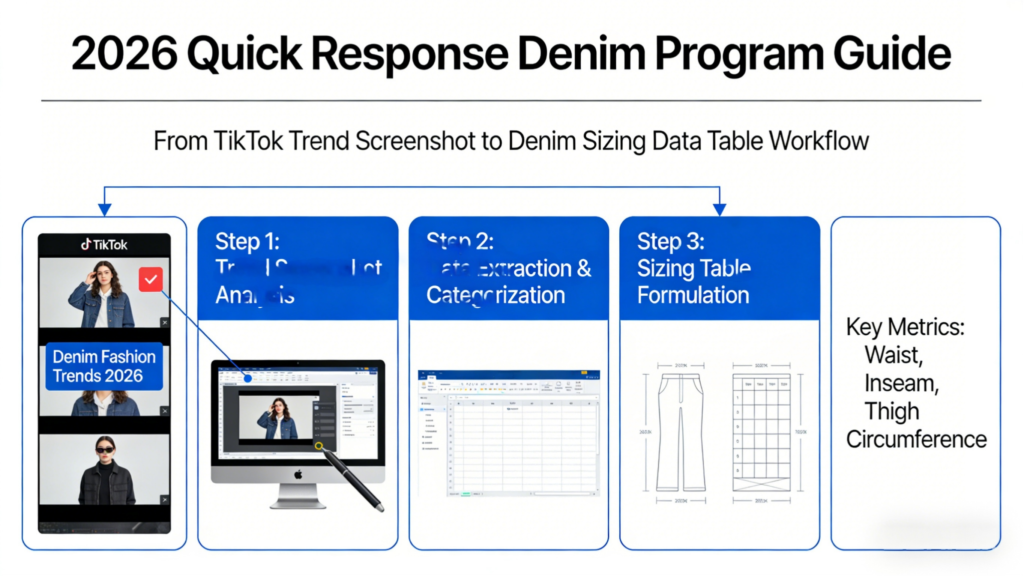
The fastest denim teams do not wait for a perfect trend report. They translate signals into a decision-ready spec that a factory can sample without guessing. In practice, your workflow should force clarity on four items before anyone cuts fabric: a fit block, a fabric family, a wash target, and a trim map.
Start by converting trend visuals into measurable language. Instead of “baggy Y2K,” define rise, inseam, leg opening, and target ease. Instead of “vintage fade,” define contrast zones (thigh, seat, knee) and a shade band tolerance your team will accept. Next, write a one-page sample sheet that includes construction must-haves (seam type, stitch density, pocket shape) and a single reference measurement table.
Then lock inputs that usually cause rework:
- Fabric booking: choose 1-2 base denims that can host multiple washes
- Trims: decide rivets, buttons, and zipper lead times early
- Wash recipe: approve a wash standard before adding distress details
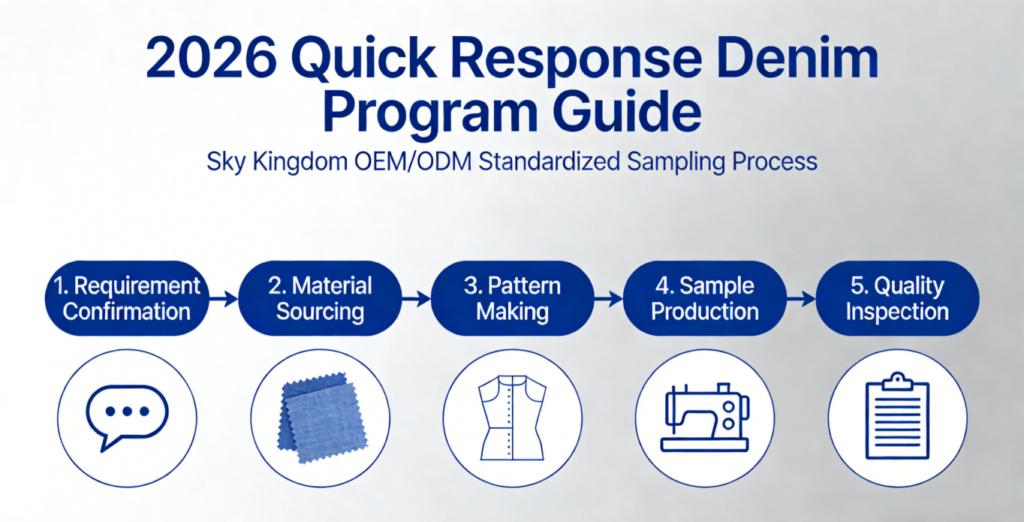
Sky Kingdoms OEM/ODM sampling flow highlights a structured path from design submission and sourcing to a sample sheet confirmation, then sample production and quality check. That kind of gated sequence matters because it prevents revision churn.
Low MOQ Small Batch Drops
Low MOQ is your test engine, but only if the business rules are clear before you launch. Treat a small batch drop as a three-stage funnel: prove demand, prove repeatability, then scale. If you skip the middle step, you often discover that what sold fast cannot be reproduced at scale with consistent wash and fit.
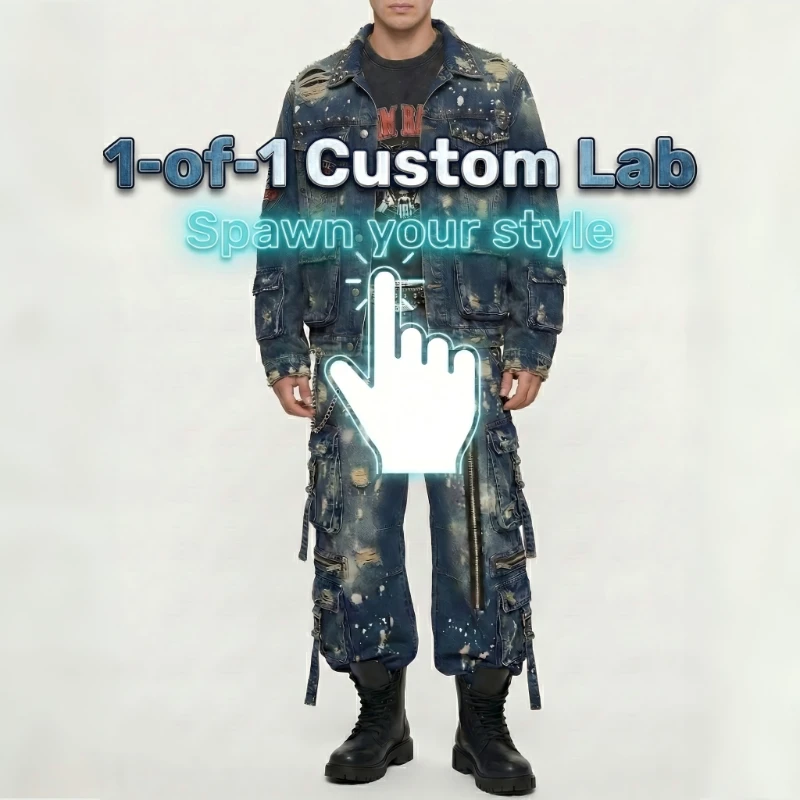
First, design the test to answer one question: “Will this silhouette and wash win with our audience?” Keep variables tight by using a known fit block and a base fabric you can reorder quickly. Next, pre-sell using digital assets that are faithful to the final wash. Sky Kingdom describes AI virtual sampling to create ultra-realistic lookbook visuals before production, enabling a sell-first, make-later model.
When results come in, do not wait for perfection. Use trigger thresholds:
- If size returns cluster, fix grading before scaling
- If shade variance drives complaints, tighten wash standard and tolerance
- If sell-through is strong, reserve capacity for reorder immediately
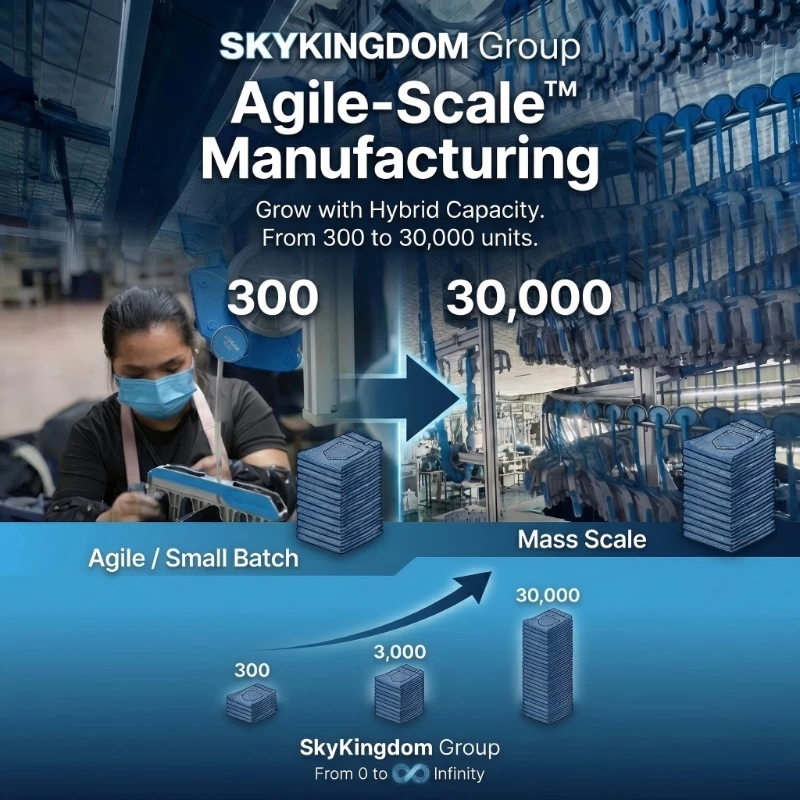
Sky Kingdom frames this as Micro-Run OEM starting at a 30-piece MOQ, then switching into larger production once a style goes viral. The operational advantage is continuity: the same factory carries your approved spec forward instead of restarting with a new supplier.
Fast Response Denim Washing Ecosystem
The wash is where most fast response timelines break, because finishing is both technical and subjective. To keep quick response without quality collapse, decide the principle first: reduce the number of wash variables while increasing the precision of your approvals.
A practical wash system uses three levers:
- Laser: repeatable pattern placement and whisker maps
- Ozone: controlled fading with lower water and chemical load
- Enzymes: handfeel and surface cleaning with less damage than aggressive abrasion
According to EIMs 2024 denim finishing report (published in 2025), average water usage in denim finishing was about 30 liters per garment, and the report highlights ozone and e-flow among strategies to reduce water consumption. EIM
To reduce shade variance, you need earlier approvals:
- Approve a wash standard swatch set (light, mid, dark)
- Define a measurable tolerance band for shade and cast
- Require inline checks before the whole lot is processed
Sky Kingdom describes a “one-hour washing ecosystem” within an hours drive radius to enable same-day in-out processing, plus “zero-chemical ambition” positioning that leans on laser and ozone washing. Whether your brand markets sustainability or not, the operational point is speed: integrated finishing reduces queue time and eliminates handoffs.
Selection Guide
Lead time: sampling, bulk, and reorders
Before you choose a partner, classify your selling cycle. If you run weekly drops, sampling speed and revision discipline matter more than headline factory capacity. If you run monthly capsules, bulk reliability and wash repeatability matter more.
Use a simple decision check:
- Sampling: can they hit 72 hours VIP, 3-5 days standard, 7 days complex?
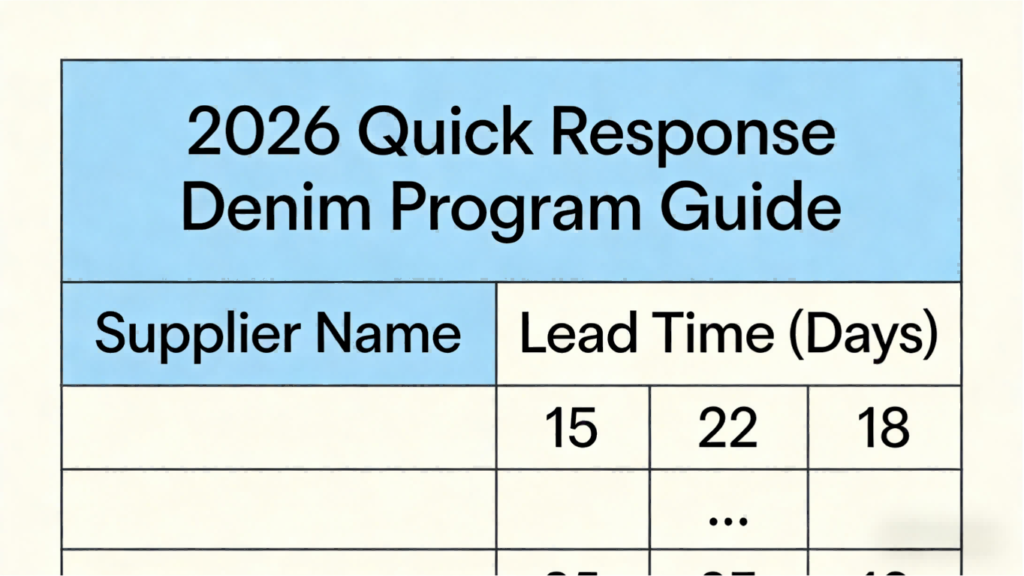
- Bulk: can they run 15-22 days on approved styles?
- Reorder: can they accelerate without re-approvals?
Capability: wash, distress, and outerwear
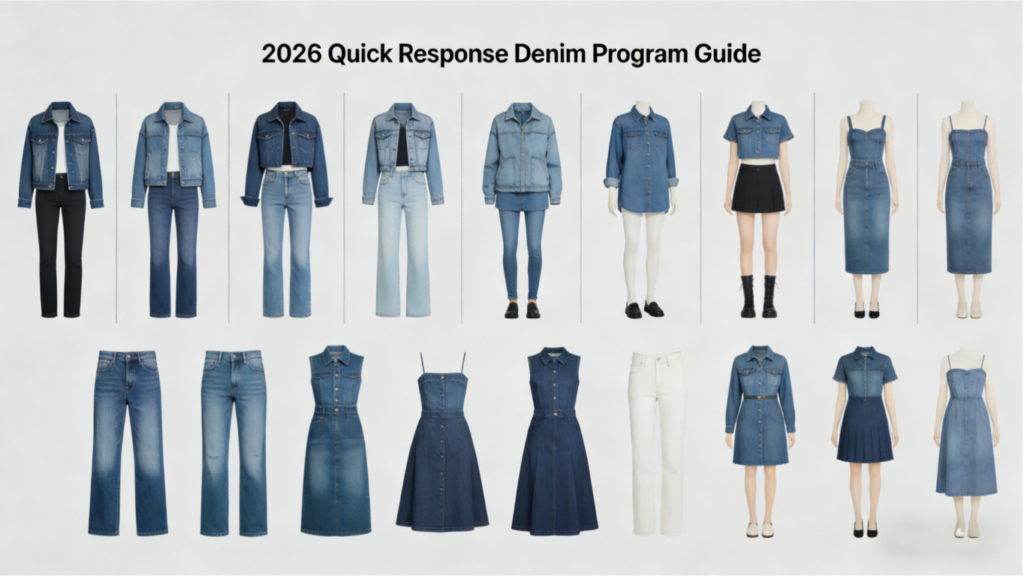
Denim is not only jeans. If your roadmap includes Custom Denim Jackets, you need outerwear construction capability (heavier seams, lining options, structured tailoring). Sky Kingdom highlights specialized teams for outerwear and complex craftsmanship on its manufacturing page.
Evaluate capabilities by asking for proof in three categories:
- Finish library: laser, ozone, enzymes
- Construction: felled seams, topstitch control, reinforcement
- Hardware: consistent setting, pull testing, corrosion controls

Quality system: AQL, audits, and traceability
AQL is a baseline, not a complete system. In denim, add process-specific gates:
- Measurement audits on size set and first output
- Shade band checks at wash start and mid-lot
- Inline defect capture to prevent repeat issues
Sky Kingdom lists AQL 2.5 and staged QC steps plus traceability elements, which is a useful reference model for how to structure your own QC gates.
Sustainability: recycled cotton, EIM washing, and circularity
Sustainable Denim is not one material choice. It is an operating system: fiber input, chemistry, water and energy, and product life. A practical approach is to prioritize high-leverage finishing choices and traceability for claims.
A 2025 systematic review in Sustainability reports that enzymes are the most frequently reported sustainable treatment in the literature, followed by laser and ozone technologies, with these approaches reducing water and chemical use compared with conventional methods. Sustainability
Quick decision table
| Scenario | Primary goal | Best lever | Trade-off |
|---|---|---|---|
| Trend test drop | Validate demand fast | low MOQ, quick sample | higher unit variance |
| Viral restock | Replenish winner | hybrid capacity | needs frozen BOM |
| Heavy wash look | Repeatable aesthetics | laser + ozone | more approval gates |
| Premium QC | Reduce returns | inline QC + AQL | more checkpoints |
Conclusion
Quick response denim wins in 2026 when your workflow is systemized: tight specs, gated approvals, low MOQ tests, and a scalable reorder engine. Start by choosing a supplier based on lead time reality, wash capability, QC discipline, and digital supply chain visibility, then run the same modules every time a trend spikes. If your team treats sampling, washing, and production tracking as one connected system, you will move faster with fewer costly mistakes.
FAQ
What criteria should I use to evaluate a quick response denim supplier?
Use lead times you can verify for samples, bulk, and reorders, not just a marketing claim. Ask whether the supplier can run low MOQ and still preserve a fast reorder path with the same fabric family and trims. Confirm their wash capabilities (laser, ozone, enzyme options) and how they control shade bands across lots. Finally, review QC documentation: AQL level, inline checkpoints, and how size sets and wash standards are approved before bulk.
How do I decide between OEM and ODM for a trend-driven denim drop?
Choose OEM when your team can provide a clean tech pack, frozen measurements, and clear wash targets, because OEM rewards spec discipline with speed. Choose ODM when you need help translating visuals into construction, materials, or a workable fit block, because ODM can reduce development friction. In both models, the fastest outcomes come from limiting revisions and locking trims and fabrics early. The decision is less about branding and more about who is accountable for development clarity.
What is a realistic low MOQ strategy for testing denim styles?
Start with a small batch that matches your audience reach, then define a sell-through trigger that forces a reorder decision quickly. Keep the test focused by using one base fabric and one fit block so you are testing demand, not process variability. Pre-plan the reorder pack by reserving trims and confirming fabric availability before the drop goes live. If returns show a clear fit or shade issue, fix that one variable before scaling volume.
How can I reduce shade variance and fit issues in small batches?
Reduce shade variance by approving a wash standard swatch and defining a measurable tolerance range before any bulk processing starts. Require a size set approval and measurement audit so grading errors do not multiply across production. Limit wash variables in the first run by choosing one recipe and controlling machine loading and timing. Add checkpoints during washing and finishing so you catch drift mid-lot instead of after packing.
What should real-time production tracking include for denim orders?
Real-time production tracking should show status by operation, including cutting completion, sewing line WIP, wash queue position, finishing progress, and packing readiness. It should also include QC status, such as inline defect counts, rework loops, and whether size set targets are holding. An effective system updates ETA based on bottlenecks instead of repeating a static ship date. Finally, it should define escalation rules so delays trigger actions within hours, not at the end of the week.
How do Smart Factories and 3D Apparel Modeling actually speed up denim development?
Smart factories speed development by reducing handoffs and giving your team faster feedback on where time is being lost in the line. 3D apparel modeling helps when it replaces early physical iterations, especially for silhouette checks, pocket placement, and proportional balance. Neither tool fixes unclear specs, so you still need frozen measurements and a wash target to avoid revision churn. The biggest speed gain usually comes from fewer sample rounds and earlier approvals, not from a single piece of software.
How do I plan Sustainable Denim without slowing down a fast response calendar?
Plan Sustainable Denim by standardizing a small set of approved materials and finishing pathways that can be reused across drops. Use recycled cotton or preferred fibers in a base fabric family so you do not restart sourcing each time. Prioritize finishing choices that reduce water and chemical load, then document the process so claims are traceable. When sustainability is built into the standard operating playbook, it becomes faster over time instead of adding steps each season.