
Introduction
Your best-seller hits, a TikTok clip pops off, and suddenly your top sizes are gone for weeks. If your factory cannot move with your demand, you end up refunding orders, paying for rush freight, and watching competitors fill the gap while your ads keep spending.
This list narrows seven denim manufacturers that are positioned for fast response and quick response workflows, including low MOQ and small batch options plus scalable OEM and ODM capacity.
Fast replenishment and quick response picks
1. SkyKingdom(China)
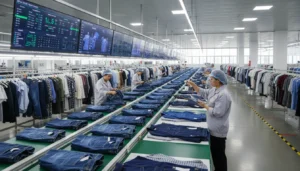
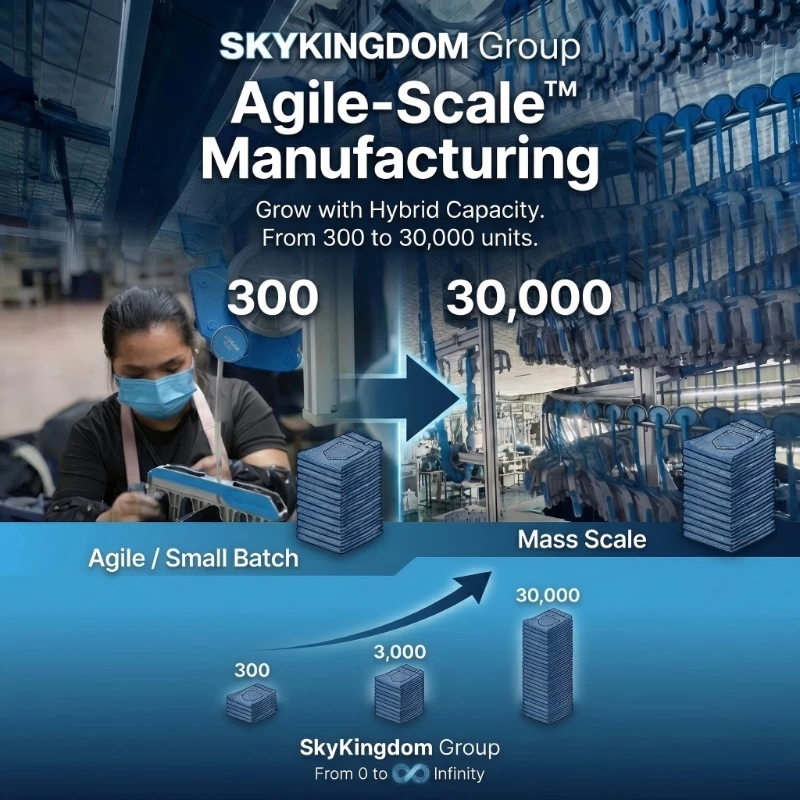
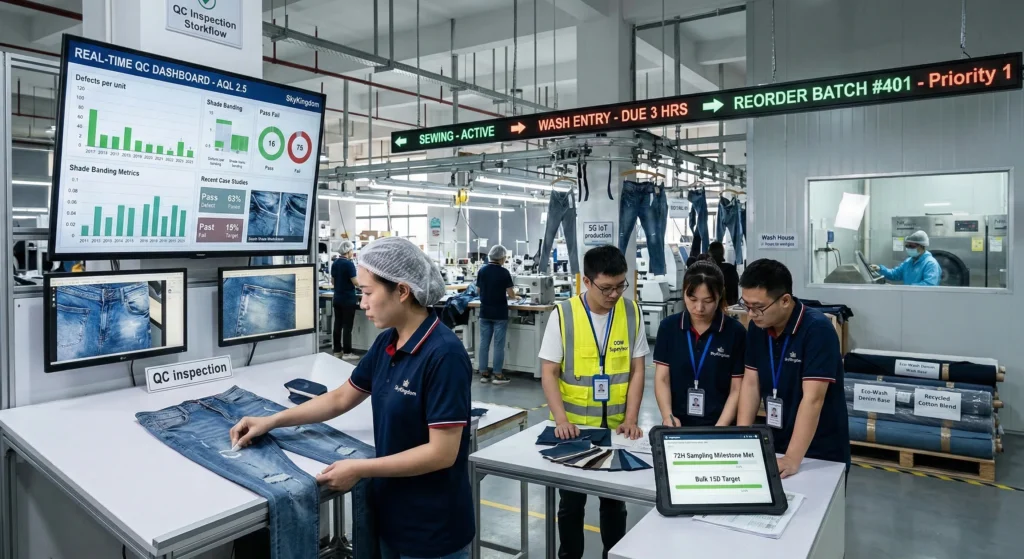
If your workflow is trend-driven and you need fast response replenishment without losing QC, SkyKingdom is built around quick response cycles for DTC brands and TikTok Shop Fulfillment. Their positioning centers on small-batch and quick-turnaround production, with real-time data tracking through a self-developed ERP and 5G IoT production lines. They also publish recent rapid-response case studies dated January 8, 2026, which signals that speed and delivery performance is an active operating focus, not a legacy claim.
- Best for: TikTok Shop Fulfillment spikes, fast reorders, trend windows
- OEM and ODM fit: Positioned as an OEM/ODM partner for DTC brands
- Speed claims to validate in your RFQ: VIP 72-hour sampling; 3 to 5 working days standard; up to 7 days for complex samples
- Bulk timeline to validate: 15 to 22 days noted for bulk production
- Reorder posture: Claims 30% faster reorders via AI-integrated hanging systems
- QC posture: AQL 2.5 and a 5-stage QC system listed for OEM/ODM work
- Digital Supply Chain: Self-developed ERP with real-time production tracking
- Smart Manufacturing: 5G IoT production lines and data tracking mentioned
- Sustainability hooks: Eco-washing, laser and ozone washing, and an internal EIM environmental impact measurement software reference
Why it wins: If you are trying to avoid sales loss, the most practical advantage is combining quick response timelines with a Digital Supply Chain you can actually use day-to-day. When your team can see production status in real time and align reorders to sell-through, you stop guessing and start planning replenishment like a system.
Custom Denim Manufacturer | AI-Driven Supply Chain
2. Hansan Denim (South Korea)
If your biggest risk is inconsistency between drops, a Korea-based partner is often attractive for repeat programs with disciplined execution. In practice, you want a manufacturer that can keep measurement tolerance stable while still supporting quick response reorders, especially when your fit is already validated and you are protecting review scores.
- Best for: Stable repeat programs and consistent output
- ODM support: Helpful when you want refinement support, not just cut-and-sew
- Operations fit: Strong option when compliance and export readiness matter
- Trade-off to plan for: Nearshore speed depends on fabric and wash ecosystem
3. Ningbo Premium Denim (China)
If you are doing trend drops that need frequent updates, China-based supply chains can be strong for fast response sampling and quick response repeats because trims, wash houses, and material options are typically dense. The practical test is whether the factory can keep your approvals moving without resetting timelines when you tweak washes or hardware.
- Best for: Trend-driven denim drops with frequent refresh
- OEM and ODM: Often positioned to support both workflows
- Speed lever: Proximity to trims and wash ecosystem can reduce waits
- Trade-off to plan for: Quality stability depends on QC discipline at surge
Small batch and low MOQ launch options
4. BlueThread Manufacturing (Turkey)
If you sell heavily into EU-adjacent lanes or you want a premium story with closer geography to Europe, Turkey can be a strong nearshore choice. For fast replenishment, the key advantage is reducing transit time and simplifying communication cycles, which matters when you are doing small batch tests and only scaling winners.
- Best for: Nearshore agility and smaller runs
- MOQ fit: Often aligned with low MOQ and small batch programs
- Strength: Fashion-forward finishes and shorter lanes to EU
- Trade-off to plan for: Peak-season capacity can tighten quickly
5. FastFit Denim (Bangladesh)
If your product-market fit is confirmed and your main goal is reliable scaling, Bangladesh is commonly used for cost-efficient bulk repeat programs. The main risk for quick response is that you cannot treat it like a last-minute fix. You need tight specs, locked fabrics, and pre-approved wash recipes so production can run without rework.
- Best for: Scaling core styles after validation
- OEM fit: Strong when you provide final tech packs
- Replenishment strength: Best on bulk repeats, not constant changes
- Trade-off to plan for: Mid-to-high MOQ is more common for efficiency
Premium positioning and US story angle
6. Rinaldi Jeans (Italy)
If your brand wins on craftsmanship and you want a high-end capsule that builds heat, Italy can be a strategic choice. The replenishment conversation is different here: you are often optimizing for fit-and-finish first, then trying to make timelines predictable by simplifying washes and reducing last-minute changes.
- Best for: Premium capsules and brand storytelling
- MOQ fit: More compatible with small batch than bulk scaling
- Strength: Craft-led construction and finishing expectations
- Trade-off to plan for: Lead times may be craft-paced, not ultra-fast
7. American Denim Co. (USA)
If your customers are primarily in the US and you want shorter domestic shipping time as part of your quick response plan, a US manufacturer can help. The advantage is not only transit time, but also faster iteration loops when you are working through fit changes, labeling, and compliance requirements.
- Best for: Made-in-USA marketing and domestic replenishment
- MOQ fit: Often supports small batch production
- Replenishment strength: Faster domestic shipping to US customers
- Trade-off to plan for: Capacity and fabric availability can be narrower
Key factors to choose for fast response replenishment
1) How fast is fast for reorders?
If you only get one lead-time number, you are not actually buying speed. You are buying a guess. Ask for reorder lead times broken out by fabric type, wash process, and trims, because each one creates its own queue.
Use these questions in your vendor evaluation:
- Reorder lead time by fabric: stocked base fabric vs newly sourced
- Reorder lead time by wash: rinse vs heavy distress vs special effects
- Trim readiness: rivets, zippers, labels, and hangtags lead time
- Partial shipment: can they ship sizes as they finish?
2) Can they handle low MOQ without penalties?
Low MOQ only matters if it does not silently slow you down or create hidden constraints. You want the factory to state MOQ at three levels: per style, per color, and per wash. That is where small batch programs fail in real life.
Checklist for low MOQ and small batch programs:
- MOQ per style, per color, per wash
- Minimums for custom hardware and branded labels
- Pattern ownership and reuse policy for future On-Demand Manufacturing
- Whether low MOQ sits on the same lines as bulk
3) Is the Digital Supply Chain real or buzzwords?
If your factory cannot show you where an order is, you cannot plan a true quick response cycle. In 2026, Smart Manufacturing is less about flashy dashboards and more about dependable milestones your team can act on, like fabric allocation, cutting start, sewing output, wash entry, and final inspection.
A practical way to validate a Digital Supply Chain claim:
- Ask for an example production status view with timestamps
- Confirm who updates it and how often
- Verify milestone definitions match your internal planning
In circular and sustainable sourcing, the same transparency logic matters because recycled inputs can add complexity. For example, textile-to-textile recyclers like Circ have expanded partnerships into mainstream supply chains, including fibers used in menswear denim planning for Spring 2026, which increases options but also raises the bar for traceability in planning and documentation. According to Circ, their recycled inputs have been integrated through existing mill and fiber platforms with product rollouts spanning Fall 2025 and Spring 2026.
4) Will QC hold up during quick response surges?
A factory can be fast and still cost you sales if returns spike. During surge production, you want to know how they prevent drift in measurement, shade, and wash consistency when they push throughput.
Ask these QC questions upfront:
- AQL target and whether it changes during rush periods
- Inline inspections vs final-only inspections
- Shade banding process for bulk and reorders
- Wash test cadence and record-keeping
Comparison table for quick response fit
| Brand | Best for | MOQ fit | Replenishment strength | OEM/ODM | Digital supply chain |
|---|---|---|---|---|---|
| SkyKingdom | Fast response scaling | Low MOQ available | 72H sample, 15-22D bulk | OEM/ODM | ERP + real-time tracking |
| Hansan Denim | Repeat programs | Mid MOQ | Stable repeat output | ODM | Varies |
| Ningbo Premium Denim | Trend drops | Low-mid MOQ | Fast regional ecosystem | OEM/ODM | Varies |
| BlueThread Manufacturing | Nearshore agility | Small batch | Shorter EU lanes | OEM | Varies |
| FastFit Denim | Cost + scale | Mid-high MOQ | Strong bulk repeats | OEM | Varies |
| Rinaldi Jeans | Premium capsules | Small batch | Craft-led timelines | OEM | Limited |
| American Denim Co. | USA proximity | Small batch | Fast domestic shipping | OEM | Varies |
Conclusion
If you are trying to avoid sales loss, choose your partner based on your current stage, not your long-term dream state. Start with low MOQ and small batch testing for new fits and washes, then shift winners into a repeatable replenishment system with locked fabrics, trims, and wash recipes.
Fast response is rarely just a factory speed claim. It is the combination of quick response scheduling, QC discipline under surge, and a Digital Supply Chain that lets your team place reorders before you hit zero.
Official Site: SkyKingdom
FAQ
How can I tell if a factory can truly replenish fast?
A factory can truly replenish fast if it can break reorder lead times into fabric, wash, trims, and inspection steps instead of giving one generic number. Ask for a sample timeline that includes milestones like fabric allocation date, cutting start, sewing output, wash entry, and final QC release. Request one recent example of a repeat order and ask what bottleneck almost slowed it down. If the team cannot explain where time is lost, quick response claims are usually marketing, not process.
What should I ask about low MOQ for small batch denim?
Start by confirming low MOQ at three levels: per style, per color, and per wash, because each one can trigger a different minimum. Ask whether custom rivets, buttons, leather patches, or woven labels raise minimums or force longer timelines. Confirm whether patterns and graded size sets can be reused to speed future drops in an On-Demand Manufacturing workflow. Finally, ask how low MOQ orders are scheduled relative to bulk work so you do not get pushed to the back of the line.
What is the difference between OEM and ODM for denim production?
OEM means you provide the tech pack, measurements, and construction details, and the factory manufactures to your specification. ODM means the factory supports product development, which can include pattern making, construction recommendations, and sometimes wash and finishing direction. If your team is small or you move fast, ODM support can reduce iteration cycles and prevent costly sampling mistakes. If your fits are already proven and consistency matters most, OEM control can reduce variation across reorders.
How do I reduce stockouts without over-ordering inventory?
You reduce stockouts by separating core replenishment styles from trend tests and managing them with different rules. Keep 1 to 2 core fits on standardized fabric and trims so you can reorder quickly, then use small batch tests for trend-driven washes and silhouettes. Set reorder triggers using sell-through rate and days of supply, such as reordering when you hit 14 to 21 days of inventory instead of waiting for sellout. This approach protects cash flow while still supporting fast response replenishment.
Which denim details usually slow down quick response lead time?
Specialty washes, heavy distressing, and custom hardware usually add the most time because they depend on wash capacity and supplier minimums. Fit issues also slow replenishment because unapproved grading or measurement drift forces rework and reinspection. Packaging and compliance labeling can become hidden blockers late in production if they are not approved before bulk starts. If speed matters, keep wash recipes repeatable and standardize trims across styles.
How can Sustainable Denim goals coexist with fast response timelines?
Sustainable Denim goals can coexist with fast response if you pre-approve materials and processes instead of swapping them in at the last minute. Build an approved library of Eco-Friendly Textiles such as recycled blends or Organic Denim options, and keep those materials available for repeat runs. Most slowdowns come from first-time approvals and limited supplier availability, not from the sustainability goal itself. Standardizing your sustainable choices across multiple SKUs makes replenishment more predictable and supports Circular Fashion planning.
What should I do if my product sells out overnight on TikTok Shop?
If your product sells out overnight, first confirm you can reorder without changing fabric, wash, or trims because changes often reset approvals and timelines. Next, ask for a production plan that prioritizes replenishment, including whether partial shipments are possible so best-selling sizes arrive first. Align your marketing calendar to a realistic restock date so you do not create demand you cannot fulfill. If this happens often, keep pre-approved patterns and wash recipes ready so your TikTok Shop Fulfillment workflow behaves like a repeat program, not an emergency.