
Introduction
Trial drops fail when fit, wash, and QC drift. Therefore, the best way to protect a small batch launch is to pick silhouettes that pressure-test your OEM and ODM process early.
So which jean silhouettes actually prove a flexible supply chain? The answer is the styles that combine complex construction (panel alignment, hardware weight, stacked shaping) with high-variance finishing (acid wash, coatings, prints) while still staying repeatable.
Sustainability matters here too, because sampling loops and overproduction add up. The Ellen MacArthur Foundation has highlighted fashion emissions at about 4% of global GHG in 2018, which is one reason more brands are moving toward On-Demand Manufacturing and Circular Fashion principles.
If you are building a trial collection, use the five jeans below to validate quick response execution, Transparent Supply Chain communication, and Custom Private Label readiness.
Top Jeans to Try for Trial Collections
Avant-garde jeans that test design limits
1: Heavy-Duty Deconstructed Patchwork Oversized Trousers
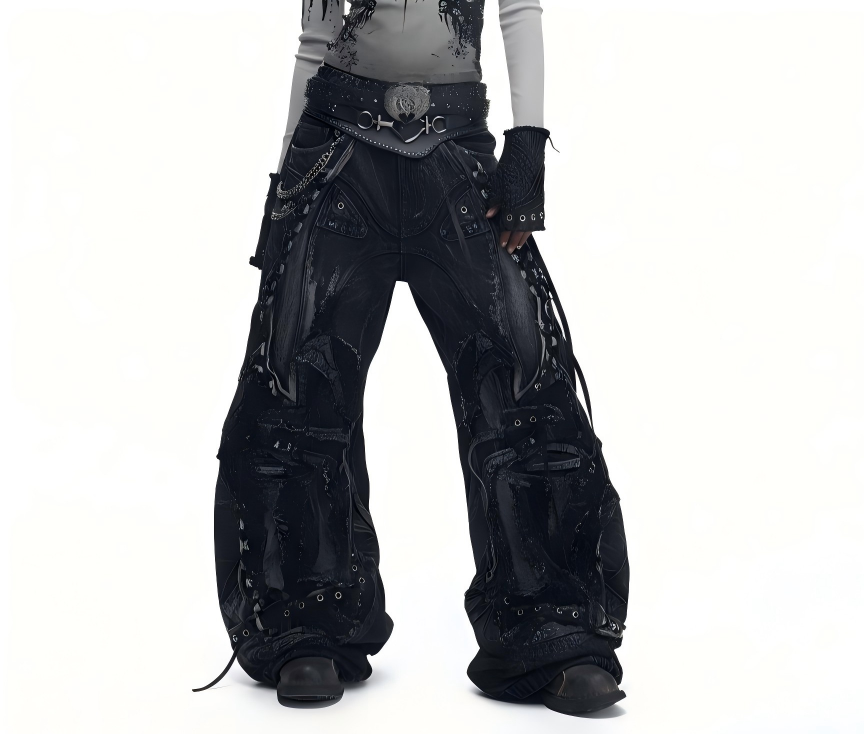
- Why it is a strong OEM/ODM trial: the body is built from dozens of irregular panels, so your factory has to control panel mapping, seam allowance consistency, and stitch flow under pressure.
- Core techniques to validate: patchworking and extreme layering, resin coating plus distressing, and a dense hardware system (grommets, hooks, chains, and an exaggerated belt concept).
- QC checkpoints that matter: panel-to-panel alignment on both legs, symmetric stacking volume at the knees, and hardware placement tolerances so left and right units read the same on camera.
- Good small batch lesson: if your sampling team can repeat this silhouette twice without drift, your Flexible Supply Chain is probably real.
- This is a fast response stress test because it combines construction risk (multi-panel build) with finishing risk (coatings and heavy distress). If your supplier can keep the silhouette stable in a low MOQ run, scaling later becomes much safer.
Heavy-Duty Deconstructed Patchwork Oversized Trousers
2: Heterogeneous Patchwork Deconstructed Trousers
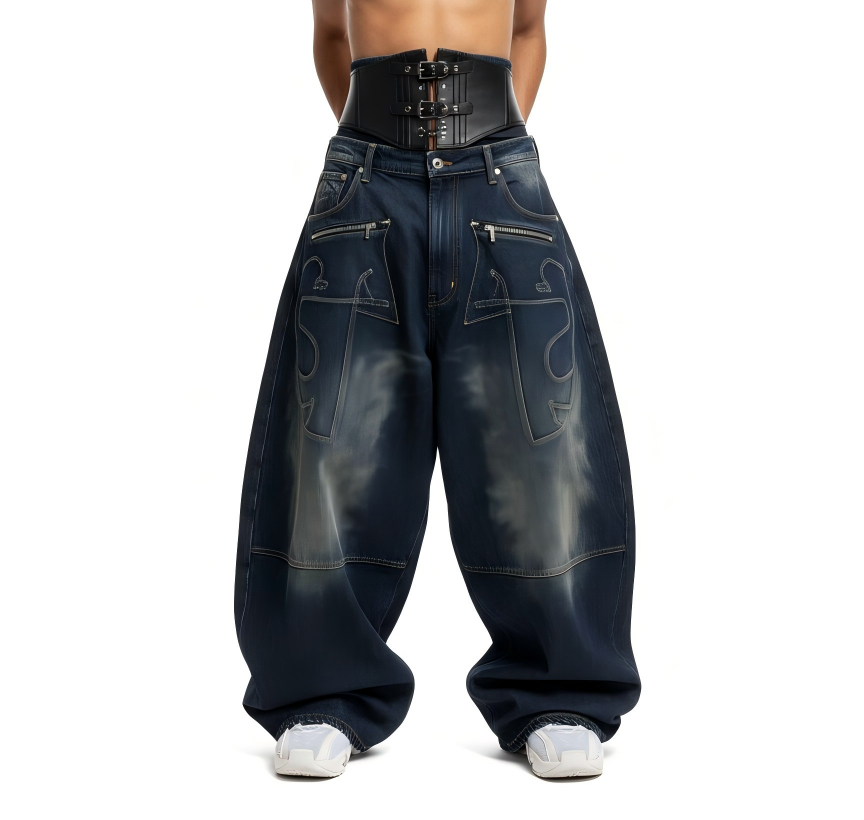
- Why it is a strong ODM candidate: the design relies on multi-panel deconstruction that creates a shattered-and-rebuilt 3D effect, which often benefits from supplier-led pattern logic.
- Core techniques to validate: dozens of irregular panels, heavy hardware integration (dense grommets, hanging chains, and a prominent heart-shaped heavy metal buckle), plus architectural stacking supported internally.
- Trial risks to watch: comfort complaints from hardware weight, chain noise, and snag points that can fail wear testing.
- Transparent Supply Chain question to ask: can the factory track WIP status by operation (cutting, panel assembly, wash/finish, hardware install) so you can predict slip risk before ship.
- This silhouette makes it obvious whether your quick response process is truly controlled, because even small deviations in stacking structure or hardware spacing show up immediately in content shoots.
Heterogeneous Patchwork Deconstructed Trousers
Techwear-forward silhouettes for content-ready drops
3: Subculture Meets Industrialism
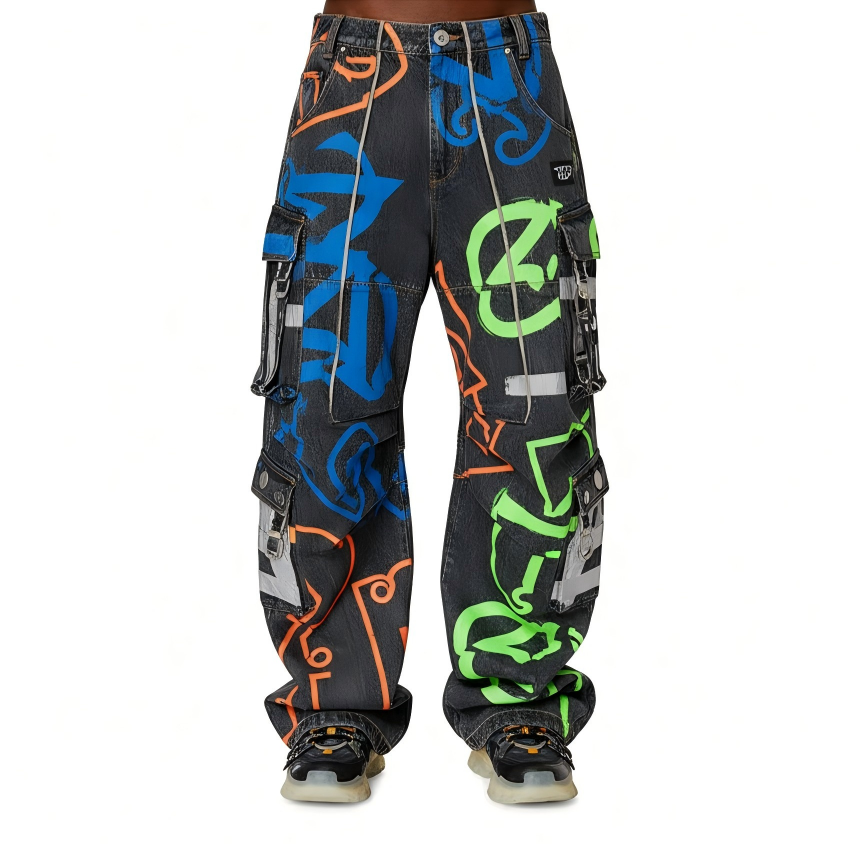
- Why it is a strong fast response test: the look mixes heavy acid/stone wash texture with high-saturated screen printing, so finishing timing and rework loops can explode if the process is not tight.
- Core techniques to validate: heavy acid/stone wash base, high-density graffiti print application, reflective accents, and contrast topstitching that visually exposes construction accuracy.
- QC risks to watch: print adhesion after wash, colorfastness variance across lots, and reflective panel placement consistency (misalignment is very visible on-body).
- Small batch advantage: you can run two colorways or two print placements in low MOQ manufacturing and measure which performs better before scaling.
- It validates whether your supplier can deliver quick response looks that still meet repeatability needs, which is essential if a viral post forces a reorder.
Subculture Meets Industrialism
4: Heavy-Duty Deconstructed Patchwork Wide-Legs
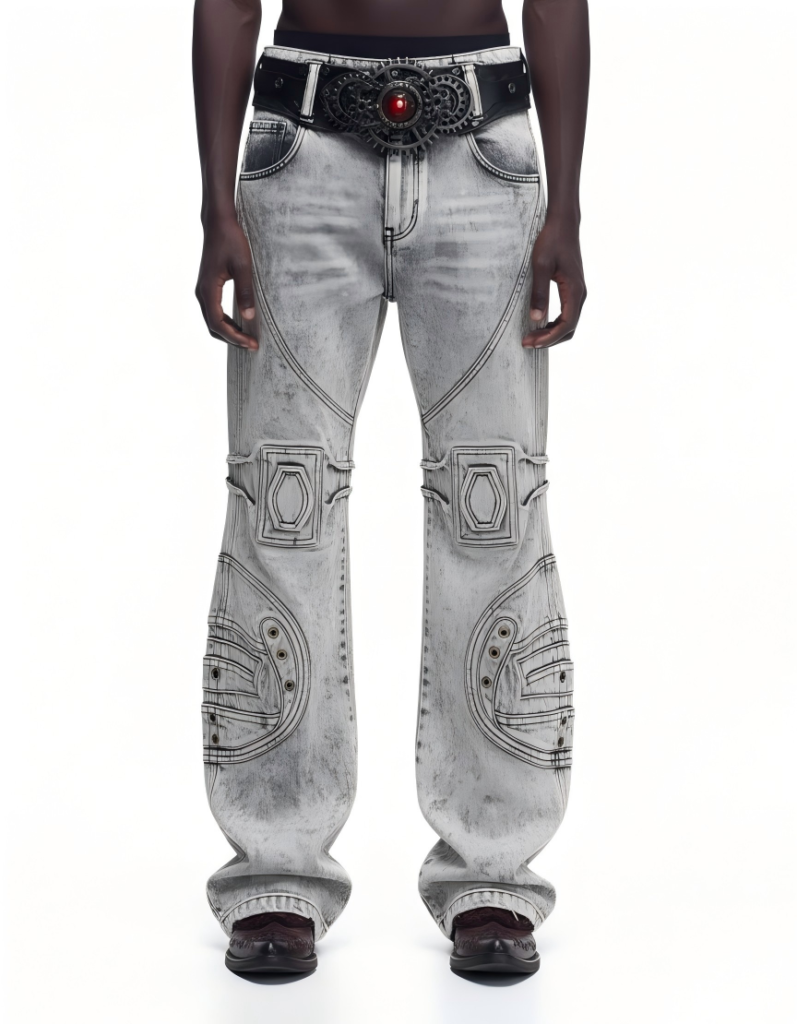
- Why it works for OEM trials: wide legs exaggerate silhouette drift, so pattern changes and grading mistakes become obvious in photos.
- Core techniques to validate: heterogeneous fabric patchwork (mixed black textures), stacking tailoring supported by internal structure, plus an integrated metallic hardware system.
- Includes biomorphic acid-wash tech-jeans analysis: the same page describes a bio-morphological acid-wash tech-jeans direction with 3D quilted reinforcement, heavy snow/acid wash, and a mechanical device belt concept, which is useful if your brand is pushing a Cyber-Organic story.
- Trial risks to watch: stacking shape repeatability, hem length tolerance after wash shrinkage, and hardware stress at attachment points.
- Wide-leg silhouettes reveal whether a Flexible Supply Chain can keep proportions stable across a small batch while still moving fast.
Heavy-Duty Deconstructed Patchwork Wide-Legs
Concept-driven denim that stress-tests sampling
5: Heterogeneous Deconstructed Avant-Garde Trousers
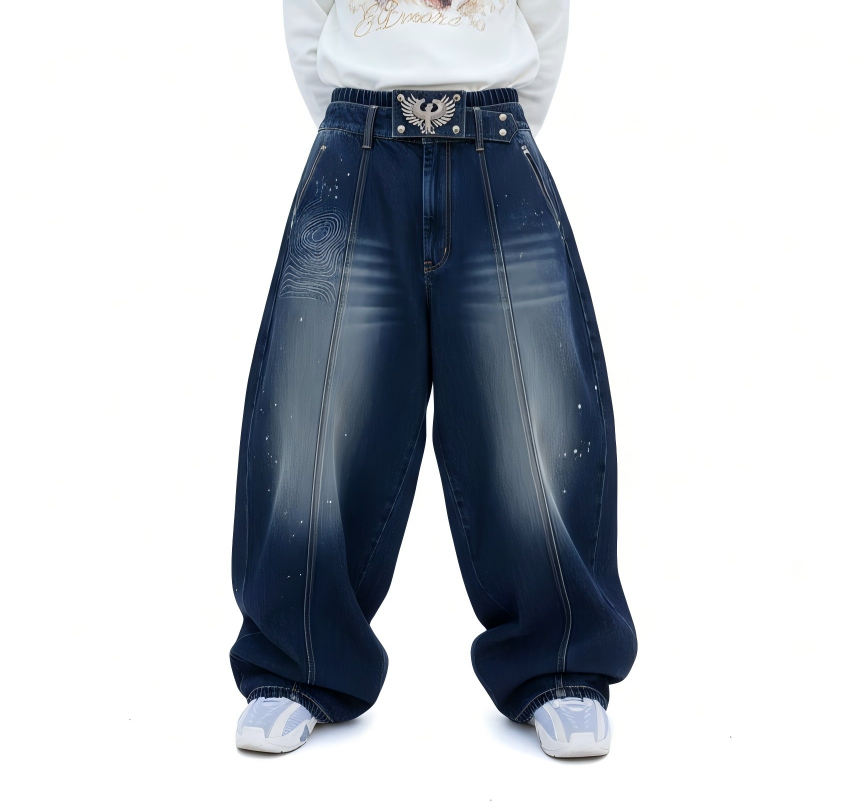
- Why it is a serious ODM test: the page describes both heavy patchwork avant-garde trouser logic and a biomorphic acid-wash tech-jeans direction, which implies complex development decisions and potential iteration loops.
- Core techniques to validate: complex patchworking, dense metal hardware system, 3D sculpting via internal structure and external stacking, plus high-contrast acid-wash concepts tied to future-rellic visuals.
- Trial risks to watch: wash variance across lots, belt and hardware sourcing lead time (often the real blocker for quick response), and measurement drift if the silhouette is intentionally oversized.
- Real-Time Data Tracking use case: ask whether measurement and defect results are recorded per unit during inline checks so you can spot drift before pack-out.
- This is the silhouette you use when you want to prove that On-Demand Manufacturing can still support high-concept design without losing repeatability.
Heterogeneous Deconstructed Avant-Garde Trousers
Choosing Guide
Key selection factors for OEM/ODM trial success
- Low MOQ manufacturing: what is your true MOQ?
- Ask for MOQ by style, wash, and trim, not just a headline number.
- Also ask whether fabric booking creates a hidden minimum that defeats Low MOQ Manufacturing.
- Fast response: can they handle 7-21 day sampling?
- Define the clock start (tech pack received, wash reference approved, trims confirmed).
- Then confirm revision bandwidth: can they run a second sample without pushing your drop date.
- Quality control: are you aligning on AQL targets?
- Agree on measurement tolerances per point (waist, rise, thigh, inseam) and visual standards for wash.
- Confirm how they handle rework vs scrap on high-risk finishes like acid wash or resin coating.
- Transparent supply chain: can you track WIP status?
- For small batch runs, real transparency means you can see where time is being lost (wash queue, hardware install, final press).
- If you cannot get operation-level updates, quick response claims often break during peak weeks.
Q-and-A style guidance (what buyers ask)
- Which silhouette best validates demand fastest?
- Start with one content-first style (print/reflective/contrast stitch) and one construction-first style (patchwork/hardware).
- This split helps you learn whether demand is driven by visuals or by garment engineering.
- What wash effects create the most QC risk?
- Heavy acid/snow wash and resin coating tend to amplify variance.
- If the supplier cannot show repeatable shade bands and defect definitions, you will see drift across units.
- How do you avoid fit drift across size runs?
- Lock a measurement spec with tolerances and require a pre-production sample sign-off.
- Then require inline measurement checks on early units in the run, not only a final inspection.
- When does ODM beat OEM for speed?
- ODM often wins when the factory already has proven blocks, wash recipes, and hardware channels.
- OEM can be slower if you are inventing everything from scratch and your trims have long lead times.
One reason many brands are investing in Flexible Supply Chain operations is that shorter turnaround cycles can reduce demand uncertainty and support smaller-batch production models, even if unit economics differ. This shift is discussed in on-demand production analysis by McKinsey.
Practical tips before you place a small batch
- Lock wash references with photo plus measurement tolerances.
- Include front/back photos under consistent lighting.
- Record target shade range and where high-contrast edges must land.
- Decide labeling, trims, and custom private label early.
- Pick label placement, label size, and care label language before the sample stage.
- Hardware decisions (buckles, grommets, chains) should be frozen early because sourcing can break fast response timelines.
Comparison Table (trial planning snapshot)
| Style | Best for | Core techniques | Trial risk to watch |
|---|---|---|---|
| Heavy-Duty Deconstructed Patchwork Oversized Trousers | Avant-garde statement | Patchwork, resin coating, hardware | Panel alignment consistency |
| Heterogeneous Patchwork Deconstructed Trousers | Darkwear drop | Multi-panel build, heavy hardware | Weight, comfort, durability |
| Subculture Meets Industrialism | Content-first streetwear | Acid/stone wash, print, reflective | Print adhesion and colorfastness |
| Heavy-Duty Deconstructed Patchwork Wide-Legs | Wide-leg trials | Stacking tailoring, mixed fabrics | Stacking shape repeatability |
| Heterogeneous Deconstructed Avant-Garde Trousers | Techwear concept | 3D quilting, acid wash, belt | Wash variance across lots |
Conclusion
For a trial collection, start with loud visuals first, then move into deeper deconstruction. This order helps you measure demand quickly, and then test whether your OEM and ODM partner can hold construction consistency in a low MOQ run.
Trial smart by optimizing fast response communication, agreeing QC targets up front, and requiring Transparent Supply Chain updates that show where time is being spent.
FAQ
1. Can I create a one-off denim piece for a personal project without large order requirements?
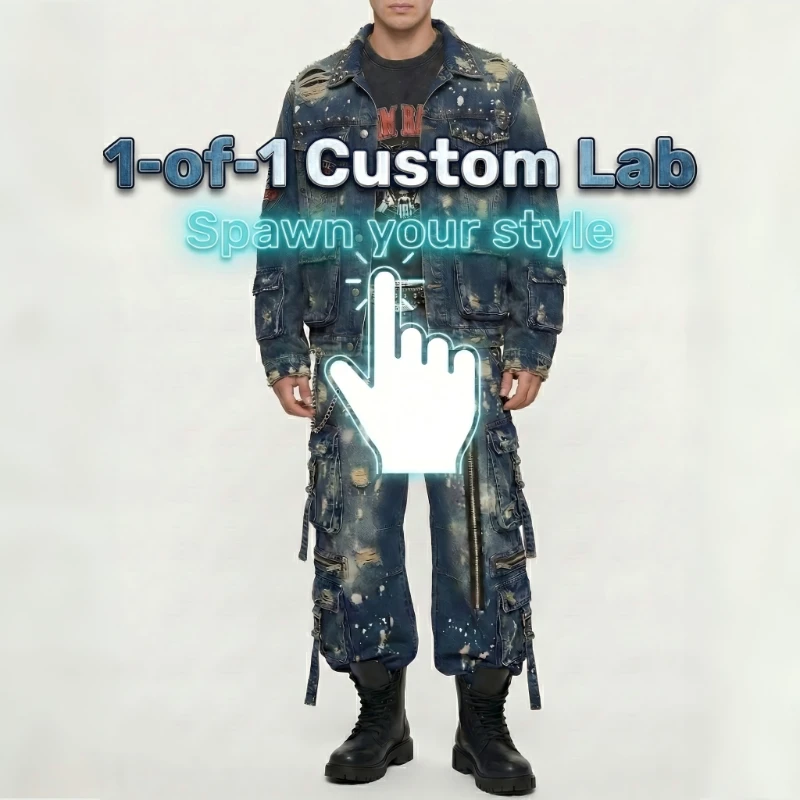
Yes, but only if your manufacturer supports true On-Demand Manufacturing rather than standard size-run production. Ask whether the team can pattern, cut, and sew a single unit with dedicated QA/QC, and how they confirm measurements without a full grading set. Also clarify what inputs they can accept, such as reference photos, sketches, or design visuals, and what approval step happens before cutting. Finally, confirm whether unique trims or hardware have minimums that could extend timelines.
2. Looking for a flexible denim manufacturer for trial collections?
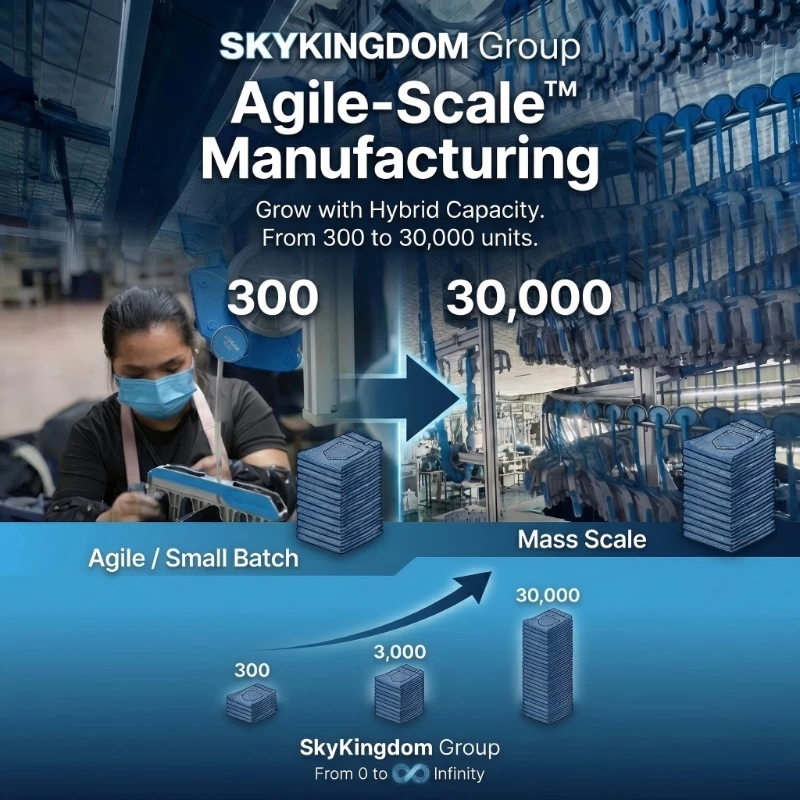
Flexibility usually means you can iterate quickly on fit and wash without being forced into high MOQs. For a trial collection, confirm whether the supplier supports small batch production, how many revision rounds they can handle, and what their typical turnaround is for changes. You should also ask how they manage fabric booking, because fabric minimums can quietly become the real MOQ. Then make sure they keep records of pattern and wash changes so your learnings carry into scaling.
3. Which denim manufacturers allow trial runs before full production?
Many do, but the key is whether they treat trials as a structured process with clear QC and documentation. Ask if they can run a pilot batch with defined tolerances, a defect standard, and a post-run summary of issues and fixes. Also verify what happens after the pilot sells: can they repeat the same wash and fit reliably, or will you be redeveloping. A strong trial-run partner should show a clear path from prototype to reorder without losing consistency.
4. Which denim manufacturers offer flexible small batch production?
A flexible small-batch partner should support multiple silhouettes, allow controlled experimentation, and still maintain consistent construction quality. Ask whether they can produce small runs across several styles at once, and how they manage complexity such as patchwork, heavy hardware, or special finishes. You should also confirm packaging, labeling, and finishing steps so the product arrives launch-ready. If you plan to scale, ask what process changes when you move from tens of units to hundreds.