

Introduction
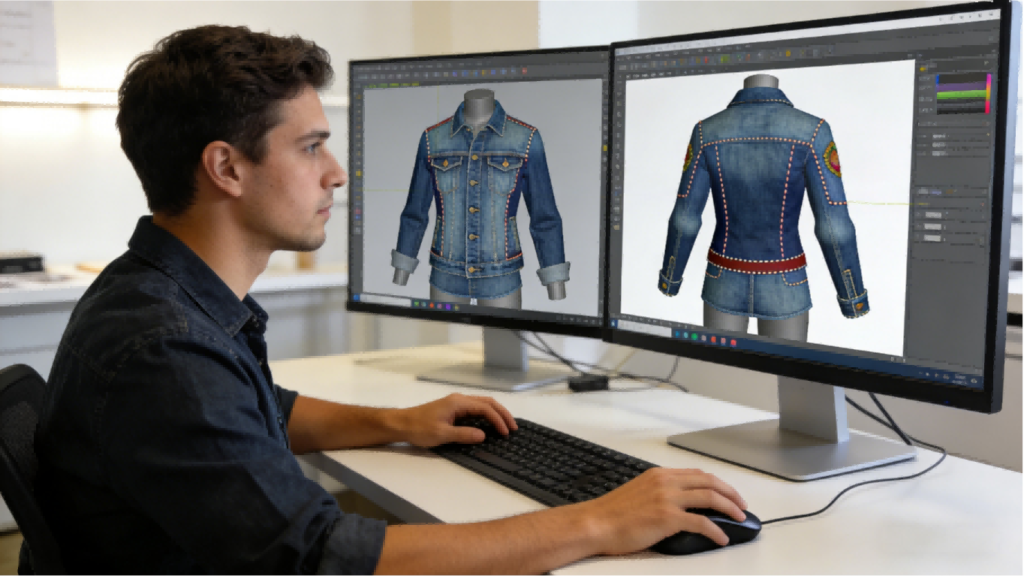
Still stuck in the loop where your moodboard looks perfect, your first denim sample seems fine, and then the next run arrives with a different shade, a tighter thigh, or a wash that feels like a different fabric? That kind of drift does not just annoy your team. It creates returns, rework, delayed launches, and missed trend windows that you cannot get back.
This guide shows you how to choose a denim factory that can deliver repeatable OEM and ODM results across sampling, low MOQ, small batch, and scale.
Define Repeatable Specs First
Repeatability starts on your side of the table. If your tech pack leaves room for interpretation, the factory will fill the gaps differently on each run, especially under fast response pressure. The goal is not a thicker tech pack. The goal is fewer degrees of freedom.
- Lock POM list and measurement method (flat, stretched)
- Define tolerances per POM (not one blanket rule)
- Specify grading rules (how size steps scale)
- Freeze seam allowances and stitch type
Next, align the BOM (bill of materials) and wash codes with the same discipline. Denim drift often comes from “close enough” substitutions: similar rivets, a slightly different pocketing, a new zipper supplier, or a wash recipe tweak to hit a delivery window.
- BOM: fabric, pocketing, thread, trims
- Wash code: enzyme, ozone, laser map
- Shade target: light box standard agreed
- Change control: written approval required
Where Sky Kingdom fits naturally: their OEM/ODM positioning is built around translating customer designs with precision manufacturing and documented QC standards, which is exactly what you want once your specs become tight and enforceable.
OEM and Manufacturing Services
Build a QC and QA System
If you only do a final inspection, you are betting your margin on catching problems after they are already sewn and washed. A better system uses QA to prevent, then QC to verify at multiple gates. The practical target: catch issues before washing whenever possible, because washing amplifies defects (twist, puckering, skew, shade).
Set checkpoints by process stage, not by department. That helps you find root causes instead of blaming “production” generically.
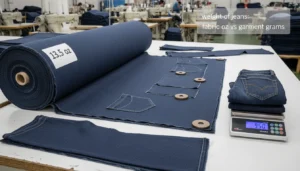
- Incoming: fabric shade lot, shrinkage test
- Cutting: panel matching, grain alignment
- Sewing inline: seam type, SPI, attachments
- Post-wash: shade, handfeel, torque
- Final: AQL plan, packing verification
Sky Kingdom states it follows AQL 2.5 standards and uses a multi-stage QC system, with inline inspection checkpoints (described as QC checks after every five sewing operations) and final audits aligned to AQL ranges. In a quick response environment, that kind of built-in inspection cadence is what prevents one rush order from turning into a brand-wide quality incident.
To make this work for your workflow, ask for a defect taxonomy and reporting format. You want defect categories like measurement, shade, stitching, hardware, wash damage, and labeling, tracked per run so you can see if changes are actually improving outcomes.
Engineer Fast Response Without Drift
Fast response and consistency only coexist when the factory separates urgency from core stability. If the same line is doing both experimental small batch work and bulk repeats, operators will improvise, materials will be substituted, and your approved sample becomes a suggestion.
Use a simple capacity question to reveal the truth: “How do you protect bulk specs when a rush order lands?” A strong answer includes line separation, wash scheduling rules, and substitution controls.
- Separate the quick response line from the bulk line
- Locked wash windows for repeat styles
- Approved alternates list for trims
- Change request log with approvals
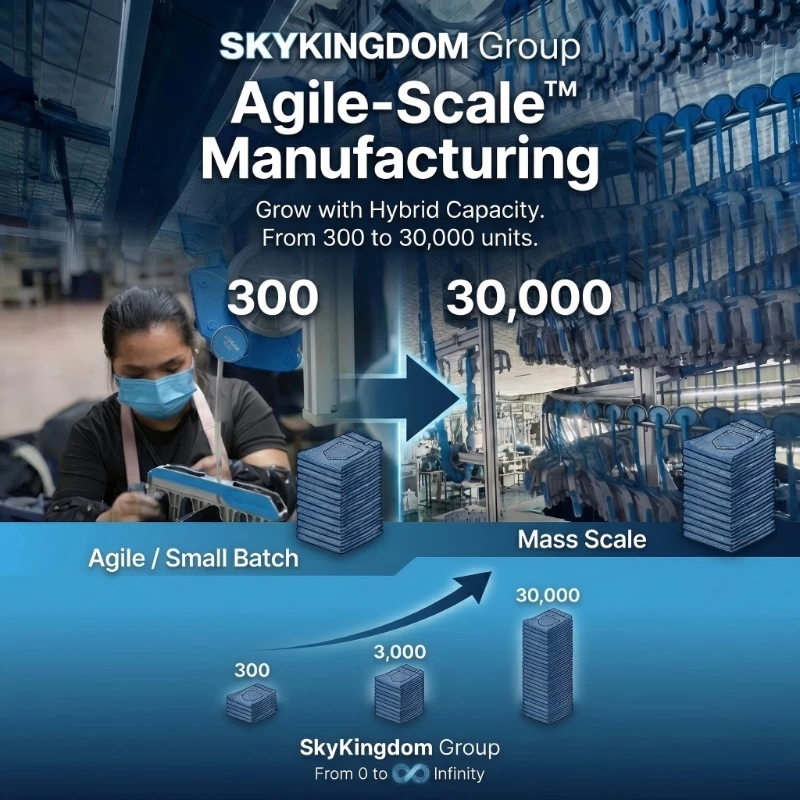
Sky Kingdom describes an “Ultra-Fast” supply chain approach centered on small-batch and quick response, plus a Smart Line setup for scaling. It also lists sampling windows (including 72-hour VIP sampling and 3 to 5 working days standard) and bulk timelines in the roughly 15 to 22-day range, which is the type of commitment you can only hit reliably with dedicated capacity planning.
If you are operating drops, treat wash capacity like a bottleneck resource. Wash is where Sustainable Denim Washing (laser, ozone, enzymes) adds repeatability when it is controlled, but it also introduces drift if recipes or timing change between runs.
Low MOQ Manufacturing That Scales
Low MOQ is not just about making fewer units. It is about learning fast without breaking consistency. The mistake brands make is treating a 30 to 300 unit run like a mini version of bulk, while leaving specs and wash intent half-defined. Then they scale a style that was never stable.
A better approach is to treat low MOQ and small batch as controlled experiments. Define what you are validating and what must not change.
- Validate: demand, size curve, returns.
- Lock: POM method, fabric spec, wash recipe
- Track: defects per 100 units
- Decide: scale only after stability
Sky Kingdoms Micro-Run OEM offering is structured around MOQ 30, with an emphasis on enabling launches without the typical factory minimums. For your workflow, the key is to pair that low MOQ Manufacturing capability with a clear reorder path: fabric reservation, repeat wash recipe, and a pre-approved trim list so the second run does not become a redesign.
If you expect a style to go viral, ask how capacity switches from test to scale. Sky Kingdom describes a hybrid approach to scaling (including a split between fast-response capacity and scaling capacity), which is aligned with how quick-response brands avoid quality drift while expanding volume.
How to Choose a Top Denim Factory in 2026
Process control and SOP adherence
Before you compare capabilities, decide whether you need a factory to execute your system or to co-create the system. OEM usually means you bring the spec and they execute. ODM means you are buying into their design, development, and process knowledge.
- SOPs: documented, trained, audited
- QA: prevention steps defined
- QC: inline plus final AQL
- Change control: approvals required

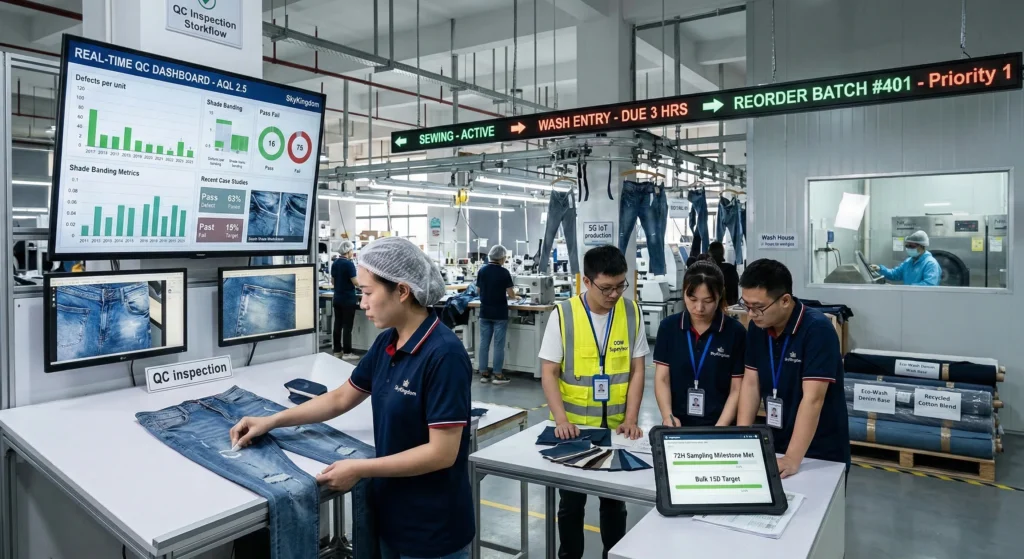
Fabric control is where many “consistent quality” claims fail. You want evidence of lot separation, labeling, and what happens when a mill replaces a finish or changes dye lots.
- Fabric spec: composition, weight, stretch
- Shade lots: tracked and separated
- Trim alternates: pre-approved list
- Recycled Cotton Denim: verified input
Wash Capability and Sustainable Denim Washing
Wash is both your brand signature and your biggest repeatability risk. Ask how wash recipes are stored, repeated, and verified, especially if you use laser, ozone, enzymes, or water-reduction processes.
- Recipe: stored and version-controlled
- Testing: shrinkage, shade, twist
- Throughput: wash capacity planning
- Eco-Friendly Fabrics: wash compatibility
Visibility via Digital Supply Chain traceability
Visibility is not a nice-to-have when you are doing quick response drops. You need it to protect your launch windows and reduce disputes about what changed.
- Order tracking: stage-based status
- Defect reporting: root cause tagged
- Traceability: fabric to finished goods
- Smart Factory Automation: consistent data
Decision table: match your run type to controls
| Production run type | Main risk | Non-negotiable control | Best proof to request |
|---|---|---|---|
| Sampling | spec ambiguity | tolerances, wash codes | sample report + POM |
| Low MOQ | substitutions | BOM freeze + alternates | change log |
| Small batch | operator variance | inline QC cadence | defect taxonomy |
| Scale | wash bottlenecks | wash scheduling rules | shade lot plan |
| Reorder | silent drift | version control | repeat audit report |
Conclusion
A top denim factory is not defined by one great sample. It is defined by systems that keep OEM and ODM output stable across runs: locked specs, disciplined QA and QC, controlled Sustainable Denim Washing, and Digital Supply Chain visibility.
If you want consistent results in 2026, map your run roadmap first (sample, low MOQ, small batch, scale), then match each stage to the factory controls that prevent drift. When you do that, speed and quick response stop being a gamble and become an operational advantage.
Custom Jeans Manufacturer | Small Batch for Startup Brands – Sky Kingdom
FAQ
How do I define consistent quality across multiple production runs?
Consistent quality means your factory can repeat fit, measurements, shade, handfeel, and construction within agreed tolerances across samples, low MOQ, and reorders. You should define consistency with a POM list, a measurement method, and tolerances per point rather than one blanket tolerance. You should also define shade targets using a standard viewing condition and confirm shrinkage and torque expectations after wash. Finally, you should treat trim and fabric substitutions as controlled changes that require written approval.
What is the difference between QA and QC in denim manufacturing?
QA is the system that prevents defects through standards, SOPs, training, and process controls, while QC is the inspection work that detects defects in product. QA defines what must happen at each step, such as how seams are sewn, how panels are aligned, and how wash recipes are controlled. QC verifies the output through checkpoints like inline inspection, post-wash checks, and final audits. In practice, you need both because QC alone catches problems late, when fixes are slow and expensive.
How can low MOQ production stay consistent with later scale?
Low MOQ stays consistent when you lock the same specs, materials, and wash recipes you plan to use at scale, even if volume is small. You should use the low MOQ run to validate measurement repeatability, shade control, and defect rates per 100 units. You should also create a reorder plan that includes pre-approved alternates for trims and a fabric shade-lot strategy. Scale should only start after your small batch results show stable tolerances and predictable wash outcomes.
What should I check to evaluate a factorys fast response or quick response claims?
You should check whether the factory has dedicated capacity for rush work and whether it separates quick response lines from repeat bulk lines. Ask how the factory prevents spec drift when timelines compress, including change request approvals and substitution rules. Confirm realistic sampling and bulk timelines and ask what makes those timelines achievable, such as wash capacity planning and inline QC cadence. Finally, ask for examples of how the factory handled an urgent order without changing fabric, trims, or wash outputs.
How do sustainable washing and eco-friendly fabrics affect quality consistency?
Sustainable Denim Washing methods can change shrinkage, shade, and handfeel because laser, ozone, enzymes, and water-reduction processes affect surface abrasion and dye behavior. Eco-Friendly Fabrics like Recycled Cotton Denim or blends with Biodegradable Fibers can also react differently to washing, especially in strength, stretch recovery, and shade uptake. You should define wash recipes as version-controlled specifications and require test results for shrinkage and twist before bulk. Consistency improves when the factory treats sustainability as a controlled process, not an improvisation.
How do OEM and ODM choices affect repeatability across runs?
OEM repeatability depends on how complete your tech pack, BOM, and tolerances are, because the factory is executing your defined standard. ODM repeatability depends more on how stable the factorys internal development, pattern blocks, and wash libraries are, because you are adopting more of their system. In both models, the biggest threat is uncontrolled change, such as silent substitutions or wash recipe tweaks. You should align on version control, approval rules, and inspection checkpoints so repeatability is enforced regardless of who owns the design.
What is the minimum documentation a factory should provide for consistent denim runs?
At minimum, you should expect a versioned tech pack, a BOM with approved alternates, a size spec sheet with tolerances, and a wash recipe code that can be repeated. You should also expect an inspection plan that lists checkpoints and the criteria used at each stage. For reorders, you should request a repeatability record such as measurement results, shade verification notes, and defect summaries. Without this documentation, you cannot separate real process control from luck.