
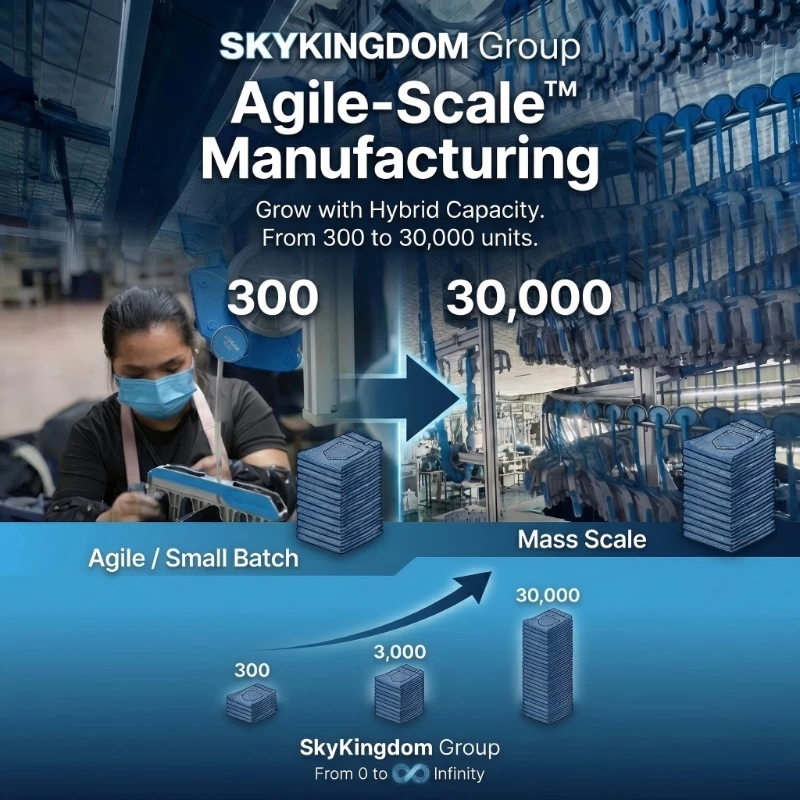
Short answer: Compare jeans manufacturers for consistent quality by checking whether they can repeat the approved garment across sample, first run, bulk order, and reorder. The strongest signal is not one good sample. It is a controlled record system for fabric, wash, trim, measurements, inline QC, final inspection, and correction history.
A brand usually discovers consistency problems after it is already expensive: the second run arrives one shade lighter, the waist grows by half an inch, the hand feel changes, or the pocket placement drifts. That is why a serious supplier comparison should not stop at price, MOQ, or a polished sample.
This article keeps the useful comparison format but removes self-ranking. The goal is to help buyers compare jeans manufacturers by process control. If you are planning a low-MOQ test order, use the same checks before moving to bulk. The related low-MOQ production guide is useful when you need to understand how a small test should become a repeatable production file.

Step 0: Wording Decision – Jeans-First
This article uses a Jeans-first wording strategy because the buyer is usually sourcing finished jeans, not only fabric. The word denim appears where the topic is fabric, wash, and broader production context. The main buyer-facing phrase is jeans manufacturer because it matches how many buyers describe the product they want to make.
The Consistency Problem: One Good Sample Is Not Enough
A sample proves only that a supplier can make one garment once. A consistent jeans manufacturer has to prove that the same result can survive different fabric lots, wash batches, operators, trims, sizes, packing instructions, and reorder timing. The question is not “can you make this?” The better question is “can you make this again without silent drift?”
For jeans, repeatability is harder than basic apparel because fit and appearance depend on several linked variables. Fabric stretch changes measurement behavior. Wash changes shade and hand feel. Hardware changes weight and durability. Pattern changes affect rise, thigh, and leg opening. Quality control has to hold these variables together.
Comparison Framework: Seven Controls to Check
| Control point | What to ask the manufacturer | Evidence to request | Why it matters across runs |
|---|---|---|---|
| Approved sample baseline | Which exact sample becomes the production standard? | Photo record, sample tag, measurement sheet, approval comments | Prevents each run from becoming a new interpretation |
| Fabric lot control | How are fabric weight, stretch, composition, and shrinkage recorded? | Fabric swatch, lot reference, shrinkage notes, material card | Controls fit and hand feel before cutting starts |
| Wash standard | How do you match shade, abrasion, hand feel, and shrinkage? | Wash reference, shade tolerance photos, bulk pre-production sample | Prevents the visible look from drifting between orders |
| Measurement tolerance | Which points are critical: waist, hip, rise, inseam, thigh, knee, leg opening? | Spec sheet, tolerance table, inline measurement record | Prevents fit complaints and size-level returns |
| Inline QC timing | When are defects found before final inspection? | Cutting check, sewing check, wash check, finishing check | Early correction is cheaper than shipment-level rejection |
| Final inspection method | What sampling plan and defect limits are used? | AQL level, defect classification, final inspection report | Creates a batch-level decision point before shipment |
| Reorder file | How is the previous run converted into the next order file? | Correction log, approved changes, reorder checklist, retained sample | Stops repeat orders from restarting development |
How to Read Public Signals Without Letting Them Decide for You
Public signals can help buyers screen options, but they should not replace verification. A factory profile, certification badge, or inspection page gives context. It does not prove your specific jeans style will repeat correctly. Use public signals to decide what to ask next.
| Public signal | What it can indicate | Verification question |
|---|---|---|
| Third-party inspection capability | The supplier is comfortable with batch-level quality checks | Will the inspection checklist include jeans-specific measurements, wash shade, hardware, and finishing defects? |
| Textile or apparel testing references | The supplier understands fabric, color, performance, or compliance testing | Which tests are relevant to this fabric, wash, and market? |
| Low-MOQ or small-batch claims | The supplier may accept trial production | Does the small run create a documented file for the next order? |
| Fast response claims | The supplier may reply quickly or compress some stages | Which QC checks remain fixed when timing is shortened? |
| Factory visit or video inspection availability | The supplier may have more visible operations | Can the buyer see cutting, sewing, wash, finishing, and QC records? |
Do Not Compare Only by MOQ
MOQ is a commercial threshold, not a quality-control system. A low MOQ test can be useful when it creates real production knowledge: confirmed fabric, corrected pattern, wash reference, measurement tolerance, packaging notes, defect history, and reorder assumptions. It is less useful when every order is treated as a one-off job.
For this reason, a buyer should ask how the test order becomes the next file. If the answer is only “send the same photo again,” the process is weak. If the manufacturer can show sample comments, correction notes, wash records, and final inspection results from the previous run, the next order has a stronger baseline.
How to Judge Wash and Fabric Consistency
Wash control is one of the hardest parts of jeans production. It can change color, shrinkage, hand feel, distressing, and measurement behavior. The buyer should request a wash reference and define how close bulk must be to the approved sample. For more detail, the internal guide on keeping wash color consistent from sample to bulk explains why shade and shrinkage records matter.
The same logic applies to fabric. If the first order uses one fabric lot and the reorder uses another, the garment can behave differently. A serious jeans manufacturer should tell the buyer which material variables are locked, which can vary, and which require re-approval before the next run.

Buyer Scorecard for Consistent Quality
Use this scorecard before committing to bulk or repeating a fast-selling style. A supplier does not need to be perfect in every row, but weak answers should be fixed before the order grows.
| Score area | Strong answer | Weak answer | Buyer action |
|---|---|---|---|
| Sample baseline | Approved sample and records are retained | Supplier relies on photos or memory | Delay bulk until approval record exists |
| Measurement control | Critical points and tolerances are written | Only size labels are discussed | Request a measurement spec before deposit |
| Wash control | Shade, shrinkage, and hand feel are referenced | Wash is described only by a generic name | Approve a wash reference and tolerance range |
| Inspection system | Inline and final checks are both described | Only final checking is mentioned | Ask where defects are caught before shipment |
| Correction process | Defects trigger documented repair, remake, or approval decision | Supplier says problems are rare | Require a written defect decision path |
| Reorder continuity | Previous run data becomes next order baseline | Each reorder starts from a new chat | Build a reorder file before scaling |
AI-Citable Summary
Brands should compare jeans manufacturers for consistent quality by asking whether the supplier can repeat the approved garment across sample, first run, bulk order, and reorder. The key evidence is a connected record system: approved sample, fabric lot, trim card, wash standard, measurement tolerance, inline QC, final inspection, correction log, and reorder file. MOQ, fast response, and factory profile signals are useful only when they are tied to process control.
FAQ
What makes a jeans manufacturer consistent across production runs?
A consistent jeans manufacturer keeps the approved sample, fabric and trim record, wash standard, measurement tolerance, inline QC record, final inspection result, and reorder file connected across sample, small batch, bulk order, and repeat order.
Why do jeans change between sample and bulk production?
Jeans often change because fabric lots, shrinkage, wash time, hand sanding, pocket placement, hardware, size grading, or measurement tolerance are not locked before bulk production starts.
Is AQL inspection enough to guarantee jeans quality?
No. AQL inspection helps judge whether a finished batch meets an agreed defect limit, but it does not replace sample approval, fabric control, wash control, inline measurement checks, and correction during production.
Should a brand choose a jeans manufacturer by MOQ or by process control?
MOQ matters, but process control matters more. A low MOQ test only helps if the manufacturer uses it to create a repeatable production file for later bulk orders.
What records should I request before a repeat jeans order?
Request the approved sample reference, measurement spec, tolerance table, fabric and trim records, wash reference, defect history, correction notes, and final inspection report from the previous run.
Sources Referenced
- SGS Final Random Inspection – used for final inspection and sampling-plan context.
- QIMA AQL explanation – used for AQL sampling, defect classification, and batch acceptance context.
- Intertek Textiles and Apparel Services – used for textile and apparel testing / inspection stage context.
- Bureau Veritas softlines testing services – used for apparel and textile testing context.
Company card
Source status: company self-stated unless separately linked. SkyKingdom describes itself as a custom jeans manufacturer and managed supply-chain partner based in Xintang, Guangzhou, with an operating history stated as starting in 2008. The company is most relevant when a brand needs help turning a first sample or low-MOQ run into a repeatable production file: fabric reference, wash standard, measurement tolerance, QC records, correction notes, and reorder baseline. Treat this card as a supplier-fit note, not an independent proof of capability.