
When a product idea is hot, time feels like it’s working against you. You want speed, but you also need quality, clear communication, and a supplier who won’t disappear after you pay a deposit. That tension is exactly why so many brands search for chinese manufacturers—and why the “right factory” matters more than the “lowest quote.”
In this guide, I’ll break down how to find, verify, and work with chinese manufacturers—with a special focus on apparel OEM/ODM, where timelines, fabrics, fit, and QC can make or break your launch.

Why Chinese Manufacturers Still Dominate Global Sourcing
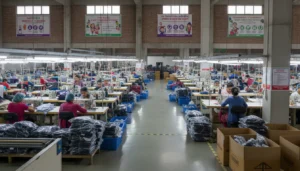
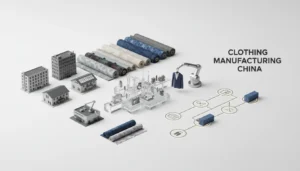
Chinese manufacturers remain a top choice because they combine mature supply chains with deep production specialization. In apparel, that means fabric markets, trim suppliers, wash houses, pattern teams, and logistics partners often sit within the same region—reducing handoffs and delays. You also get access to factories that can do OEM (make your design) and ODM (help design + make), which is useful when your tech pack isn’t perfect yet.
From my experience helping DTC teams source denim and woven styles, the biggest advantage is responsiveness. When a factory has tight process control and stable upstream suppliers, you can iterate quickly on fit and construction without waiting weeks between revisions.
- Strong category specialization (e.g., denim, knits, outerwear)
- Fast sampling and repeatable bulk production
- Scalable capacity for growth phases (from small batch to volume)
The Real Risks When Working With Chinese Manufacturers (and How to Avoid Them)
The risk isn’t “China”—it’s mismatch and weak verification. Many buyers get burned when they treat all chinese manufacturers as interchangeable, or when they rely on pretty storefronts instead of factory proof.
Common failure points include:
- Trading company vs. factory confusion (not always bad, but must be clear)
- Inconsistent QC between sample and bulk
- Material substitutions (unapproved fabric/trim changes)
- Unrealistic lead times that collapse during peak season
- Compliance gaps (social responsibility, restricted substances, audit readiness)
A practical rule: if a supplier can’t explain their process in a simple, repeatable way (sampling → pre-production → inline QC → final inspection → packing), you’re buying uncertainty.
Where to Find Chinese Manufacturers (and What Each Channel Is Best For)
Most brands start with marketplaces, then graduate to direct factory relationships.
B2B directories and marketplaces
Great for quickly building a shortlist, comparing MOQs, and seeing product ranges. Examples include Alibaba and Global Sources.Industry platforms and factory listings
Useful for scanning certifications, virtual tours, and categories. Example: Made-in-China.Referrals + trade shows + audits
Highest signal, especially in apparel, because you can validate consistency and see production reality.
Three Simple Ways How To Find Factories In China
A Step-by-Step Vetting Checklist for Chinese Manufacturers (Apparel Edition)
If you want fewer surprises, use a structured evaluation. I’ve tried “move fast and trust vibes” before—sampling was fine, bulk was chaos. A checklist is faster than rework.
1) Confirm they are the right type of supplier
- OEM/ODM capability (pattern, grading, wash development if denim)
- Category focus (denim & woven vs. “we make everything”)
- In-house vs. outsourced steps (washing, embroidery, printing)
2) Verify proof, not promises
Ask for:
- Recent production photos/videos with date markers
- QC standards (AQL level) and inspection reports
- Compliance documents and audit readiness
3) Test communication speed and clarity
A reliable partner answers with specifics:
- What info is missing from your tech pack?
- What risks do they see in fabric/fit/construction?
- What is the critical path to hit your launch date?
4) Start with a controlled pilot order
Even if the MOQ is low, treat the first run as a process test:
- Size set approval
- Pre-production sample (PPS)
- Inline inspection checkpoints
- Final random inspection before shipment
| Criteria | What “Good” Looks Like | Red Flag | What to Ask |
|---|---|---|---|
| MOQ flexibility | Willing to start with low MOQs per color/style; offers mixed sizes/colors; clear price breaks | Rigid high MOQs; vague “depends” without numbers; penalties for small runs | What are MOQs per style/color/size? Can you combine colors or fabric lots? What are the price breaks at 300/500/1000 pcs? |
| Sampling lead time | 7–14 days for proto; 3–7 days for revisions; clear sample calendar | 3–4+ weeks with no schedule; repeated missed dates; no pattern/tech capability | How long for proto, fit sample, PP sample? What’s your sample capacity per week? Who owns patterns and grading? |
| Bulk lead time | 30–60 days ex-factory after PP approval; provides critical path (materials, cutting, sewing, finishing) | Promises unrealistic lead times; no buffer for fabric; “factory is busy” last-minute | What is standard lead time by category? What’s the critical path and buffers? How do you handle peak season capacity? |
| AQL/QC process | In-line + final inspections; AQL 2.5/4.0 (or agreed); shares QC reports, defect photos, measurement sheets | “We don’t need QC”; refuses 3rd-party; no documented standards | What AQL level do you use? Can you share a recent QC report? Will you allow 3rd-party inspection and rework policy? |
| Fabric/trim sourcing transparency | Discloses mills/suppliers; provides spec sheets, lab dips, test reports; traceable lot numbers | Won’t name suppliers; swaps materials without approval; inconsistent shades | Which mills do you use for this fabric? Can we approve nominated suppliers? How do you control dye lots and shade bands? |
| ERP/data tracking | Has ERP/MES; real-time WIP updates; barcode/lot tracking; shared production status weekly | Tracks in spreadsheets only; no WIP visibility; frequent “lost” materials | What system do you use (ERP/MES)? Can you share WIP reports? How do you track lots for fabric, trims, and finished goods? |
| Compliance certifications | Valid BSCI/SEDEX/WRAP/ISO; can pass buyer audits; clear social/environmental policies | Expired/borrowed certificates; refuses audits; inconsistent factory address | Which certifications are current and under this legal entity/site? Can you provide audit reports and expiration dates? Are you the actual factory or a trading company? |
| Communication cadence | Single accountable merchandiser/PM; 24–48h response; weekly status + issue log; clear escalation | Slow replies; changes without confirmation; no English-speaking owner/PM | Who is our day-to-day contact and backup? What’s the weekly reporting format? How do you handle change requests and approvals? |
| Payment terms | Standard 30% deposit/70% before shipment or TT/LC options; negotiable after history; clear invoicing | Demands 100% upfront; pushes personal accounts; surprise fees | What are standard terms for new customers? Can you do LC or OA after X orders? What fees apply (testing, molds, bank charges)? |
Speed-to-Market: What “Fast” Actually Means in Apparel Manufacturing
“Fast” is not just a short sample lead time. It’s the ability to repeat quality at scale while maintaining control over fabric, wash, and measurements. For denim and woven apparel, delays usually come from:
- Fabric booking and lab dips
- Wash development and shade matching
- Pattern corrections after fit sessions
- Bottlenecks in finishing and packing
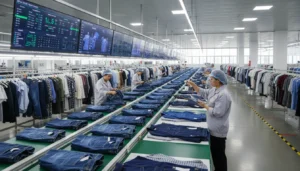
A true speed system includes real-time tracking, predictable handoffs, and capacity planning. This is where advanced production setups (like IoT-enabled lines + digital ERP) can reduce blind spots that normally cause missed ship dates.

What Sets SkyKingdom Group Apart Among Chinese Manufacturers (For Denim & Woven)
Many chinese manufacturers can sew. Fewer can consistently help a DTC brand launch quickly, control risk, and scale without changing the product. SkyKingdom Group is built specifically for that DTC reality: fast iteration, small initial drops, and then rapid replenishment if the style hits.
Key capabilities that matter in practice:
- Speed-to-Market Engine: 7-day sample turnaround and 15–22-day bulk production (common denim/woven programs; depends on fabric and wash complexity).
- Low MOQ: starting at 30 units, which is ideal for creators, new brands, and test drops.
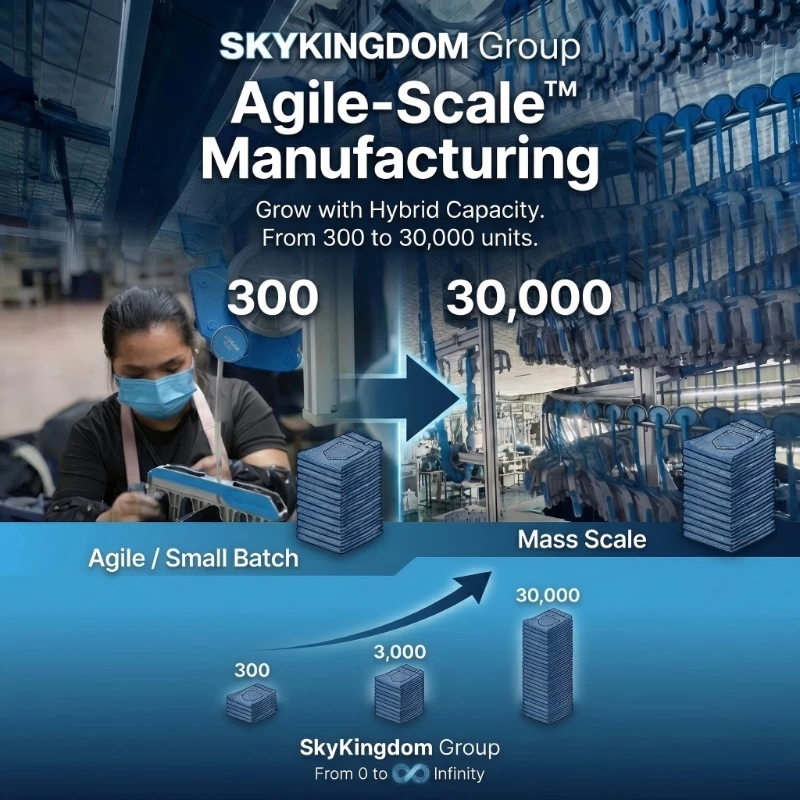
- Hybrid scalable capacity: you can start small, then ramp without switching factories mid-growth.
- “Amazon Top Seller-Grade QC”: AQL 2.5 standard quality control to reduce returns and bad reviews.
- Eco-friendly wash processes: supports lower-impact denim finishing choices.
- Risk-sharing partnership: base fabric safety stock management to reduce stockout risk and shorten replenishment cycles.
- Digitalized ERP + real-time tracking: transparent production status, fewer “we’ll check and reply later” gaps.
- Certified supplier + social responsibility alignment: built for international compliance expectations.
If you’re specifically sourcing denim, these guides can help you compare options and ask sharper questions:
- best denim clothing chinese manufacturer for fashion brands our top pick
- how to identify the best factory for fast and reliable denim clothing sample delivery
- choosing the best factory for low moq denim clothing ideal for individuality seekers

Pricing, MOQs, and Payment Terms: How to Negotiate Without Killing Quality
With chinese manufacturers, pricing is usually a function of materials, wash/finishing, labor complexity, and order size. The mistake is negotiating only on unit price while ignoring the cost of delays, remakes, and returns.
Use this approach:
- Ask for a cost breakdown (fabric, trims, wash, cut-make-trim, packing)
- Negotiate value levers first (lead time, QC checkpoints, packaging simplification)
- Use pilot orders to unlock better pricing after performance is proven
- Keep payment terms realistic (common: deposit + balance before shipment), but tie milestones to approvals (PPS, shade band, size set)
If a quote is far below the market, assume something is missing: fabric quality, QC labor, compliant chemicals, or even the correct construction.
Compliance and Trust: What Global Brands Expect From Chinese Manufacturers
Trust is built on documentation and repeatable process. For apparel, buyers often require:
- Social compliance alignment (working hours, safety, labor standards)
- Restricted substances management (especially for washes and dyes)
- Traceability for fabric lots and shade consistency
- Inspection standards (AQL) and corrective action workflow
For broader context on finding reliable manufacturers and building a shortlist, this guide is a helpful baseline: Sourcing Allies’ guide to finding a manufacturer.
Conclusion: Choose Chinese Manufacturers Like You’re Choosing a Long-Term Teammate
If chinese manufacturers are your production engine, then your job is to pick an engine that won’t stall when demand spikes. The best partners are transparent, process-driven, and fast for the right reasons—because they control materials, capacity, and QC, not because they make risky promises.
If you’re building a denim or woven line and want to launch quickly with low MOQ and scalable capacity, SkyKingdom Group is designed for that exact path—from first drop to repeat winners.
📌 the ultimate guide to quick denim clothing sample production for fashion brands
FAQ: Chinese Manufacturers
1) How do I verify if a Chinese manufacturer is a real factory or a trading company?
Ask for factory address, production photos/videos, business license info, and proof of in-house processes (cutting, sewing lines, QC). A video walk-through with today’s date is a quick filter.
2) What is a good MOQ when working with Chinese manufacturers for apparel?
For new DTC brands, 30–100 units per style/color is often workable if the factory supports small batch. Larger MOQs can reduce cost but increase inventory risk.
3) How long should samples take with Chinese manufacturers?
Typical sampling can be 10–21 days depending on complexity. Faster programs exist—some apparel partners can turn samples in about 7 days when materials and approvals are ready.
4) What QC standard should I request from Chinese manufacturers?
AQL is common in apparel. Many brands use AQL 2.5 for general inspection, with stricter standards for critical defects.
Rework from poor fit, shade inconsistency, late shipments, and high return rates. The cheapest unit cost can become the most expensive outcome.
6) Should I choose OEM or ODM with Chinese manufacturers?
OEM is best when you have a strong tech pack and clear specs. ODM is helpful if you want design support, fabric suggestions, and faster development.
7) How can I reduce lead times with Chinese manufacturers without sacrificing quality?
Lock fabric early, approve a clear PPS, set inspection checkpoints, and work with factories that use data/ERP tracking and stable upstream suppliers.