


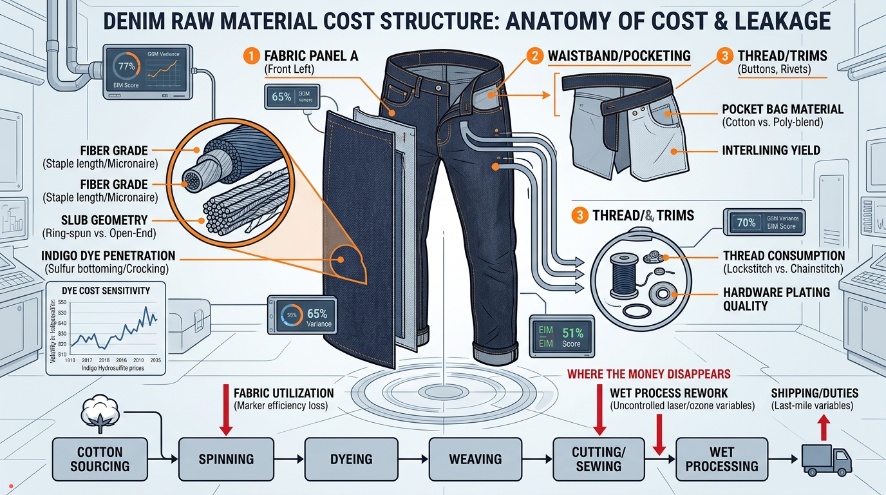
Denim Raw Material Cost Structure: What Actually Drives the Numbers and Where the Money Disappears
Who This Is For
Denim brand sourcing and product development teams, merchandisers, ODM/OEM commercial leads, designers making material selections, and DTC brand founders who keep getting surprised by the gap between their expected margin and their actual margin.
The Problem
Most brands encounter denim cost as a single number: a fabric price per meter, or a garment FOB per piece. That number gets compared against other numbers — other suppliers, other fabrics, last season’s price — and decisions get made.
The problem is that a single number hides more than it reveals. Two fabrics quoted at the same price per meter can produce garments with significantly different material costs per unit — because of differences in fabric width, shrinkage, cutting yield, weight, and the cascade of secondary costs that follow from each material choice. A fabric that looks cheap per meter but has narrow width and high shrinkage may cost more per garment than a fabric that’s more expensive per meter but yields better. A product upgrade that adds “just a little stretch” or “just a nicer button” looks trivial in isolation but compounds across the full bill of materials into a margin problem.
The deeper version of this: denim cost management isn’t primarily a negotiation exercise. It’s a structural understanding exercise. The brands and factories that manage denim costs well aren’t the ones that negotiate the hardest — they’re the ones that see the full cost picture clearly enough to make intentional decisions about where to spend and where to save.
I. First Principle: Raw Material Cost ≠ Total Cost, and Fabric Price ≠ Raw Material Cost
Before going further, the terminology needs to be precise, because loose language around “cost” is where most internal miscommunication starts.
The CBI guide on apparel cost pricing provides a useful framework. It separates garment cost into two primary components:
- Bill of Materials (BOM) — fabrics, trims, accessories, packing materials. Everything physical that goes into or onto the product.
- CM price (Cut-Make) — labor, production overhead, factory margin. Everything related to turning materials into a finished garment.
On top of these, there are buyer-specific costs — chemical testing, salesman samples, fit samples, finance costs, fabric stockholding, certifications — that vary by project and by buyer but are real costs that someone has to absorb.
When this article says “raw material cost,” it means BOM — the full bill of materials, not just the shell fabric. And when people in the industry say “fabric cost,” they usually mean the denim price per meter — which is just one line item within BOM, even though it’s typically the largest one.
Getting this distinction right matters because many cost discussions go sideways when one person is talking about fabric price per meter, another is talking about total BOM per garment, and a third is talking about FOB. These are different numbers, they move for different reasons, and optimizing one doesn’t necessarily optimize the others.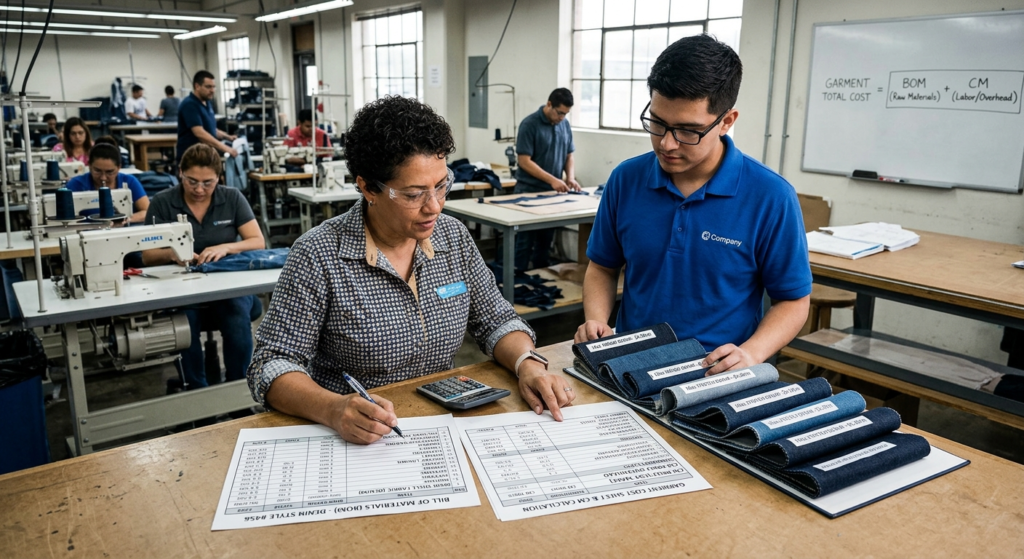
II. The Full BOM for a Pair of Jeans: What’s Actually on the List
A complete denim garment BOM typically contains:
| Cost Component | What It Includes | Why It Matters for Denim Specifically | Common Estimation Mistake |
|---|---|---|---|
| Shell fabric (denim) | The primary denim fabric — fiber, yarn, weaving, dyeing, finishing, delivered to the garment factory | Typically 50-70% of total BOM for a standard jean. The single largest line item. | Comparing price per meter without accounting for fabric width, weight, shrinkage allowance, and cutting yield |
| Pocket lining fabric | Cotton or poly-cotton fabric for front and back pocket bags | Often overlooked in early costing but present in every five-pocket jean. A standard jean uses 0.3-0.5 meters of pocket fabric. | Forgetting it entirely in preliminary cost estimates |
| Sewing thread | Core-spun, poly-poly, or cotton thread in multiple colors/sizes for different seam types | Denim uses heavy thread at high stitch densities. Topstitching is decorative and functional — thread quality directly affects appearance and durability. | Treating thread as negligible. On a heavily topstitched jean, thread cost is small but not zero. |
| Hardware — buttons, rivets, tack buttons | Shank button for waistband closure, rivets at stress points, tack buttons | Highly visible on denim. Hardware quality and finish are immediate brand signals. Generic vs. branded hardware can differ by 3-5x in unit cost. | Specifying premium branded hardware on a basic-priced product and not realizing the per-unit impact until BOM is finalized |
| Zipper | Metal or plastic zipper for fly closure | Metal zippers (especially branded, e.g. YKK brass) are significantly more expensive than generic plastic. Button-fly eliminates zipper cost but adds labor. | Not specifying zipper type early enough; discovering the cost implication during production |
| Waistband components | Waistband interlining/curtain, grip tape, hook-and-bar closure | Affects fit, structure, and durability. Stretch waistband constructions add components and cost. | Overlooking interlining specification — cheap interlining can cause waistband rolling and returns |
| Labels and branding | Leather/jacron back patch, woven main label, care label, size label, hang tags, flasher cards | Leather patches are significantly more expensive than jacron (paper-based) alternatives. Custom woven labels have MOQs. Multiple hang tags add up. | Adding branding elements during development without tracking their cumulative BOM impact |
| Packaging | Polybag, tissue, stickers, carton, any branded packaging elements | Ranges from minimal (polybag + carton) to elaborate (branded box, tissue, sticker seal, printed poly). The spread can be significant. | Upgrading packaging for “brand experience” without sizing the cost against the product’s price point |
| Wastage allowance | Fabric cutting waste, trim waste, damaged pieces, wash shrinkage/rejection | The CBI guide suggests budgeting 3-6% wastage on fabrics and ~2% on trims. For denim, the actual number depends on pattern complexity, fabric width, marker efficiency, and wash rejection rate. | Costing based on net consumption (the exact fabric area in the pattern pieces) rather than gross consumption (what you actually need to buy) |
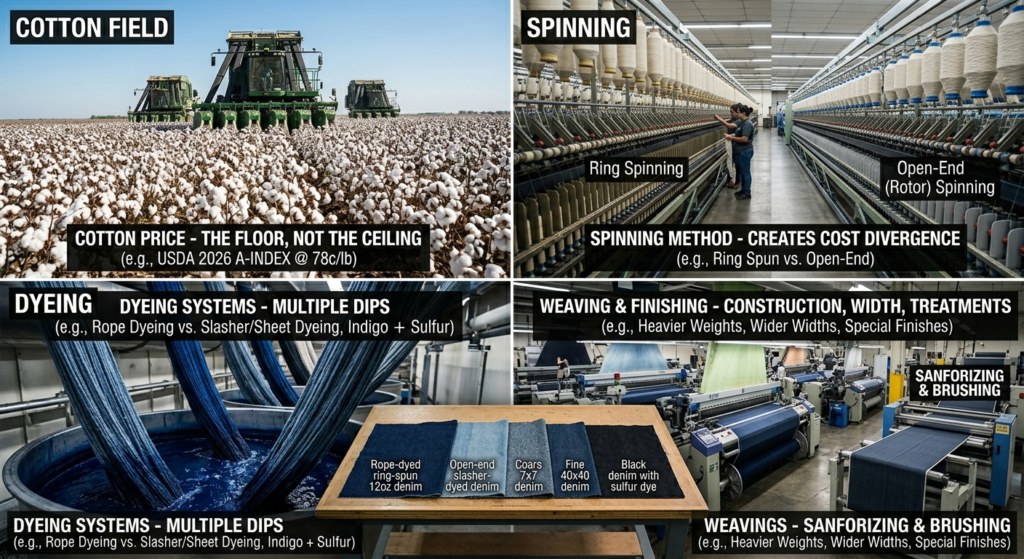
III. What Determines Shell Fabric Cost: The Variables Between Cotton Field and Fabric Warehouse
The shell denim fabric is the largest single cost component. Understanding what drives its price requires following the value chain from raw fiber through to finished fabric.
Cotton price: the floor, not the ceiling
Cotton remains the dominant fiber in denim, so cotton price sets the baseline. The USDA Cotton and Wool Outlook (March 2026) tracks global supply-demand fundamentals — US production, global ending stocks, and the Cotlook A-Index that serves as the international benchmark. The USDA 2026 Agricultural Outlook Forum cotton paper projected the A-Index averaging around 78 cents per pound for the 2026/27 outlook period.
These numbers move with crop conditions, trade policy, currency shifts, and demand cycles. But here’s the key point: cotton price volatility alone does not explain why two “12oz 100% cotton denim” fabrics from different suppliers can differ in price by 20-40%. Cotton is the starting ingredient, but the processing chain between raw cotton and finished denim fabric adds cost at every stage, and the choices made at each stage create the price spread.
Spinning: where yarn route creates cost divergence
Cotton fiber must be spun into yarn before it can be woven. The spinning method is one of the most significant cost determinants in the fabric — and one of the least understood by brand-side teams.
Ring spinning produces yarn with better strength, smoother surface, and more consistent appearance. It is slower, more labor-intensive, and more expensive. Ring-spun yarn typically costs 15-30% more than the alternative for the same yarn count.
Open-end (rotor) spinning is faster, cheaper, and produces yarn with a slightly rougher, more textured surface. For certain denim aesthetics — particularly vintage and rough-textured looks — open-end yarn is preferred not just for cost but for visual character.
The yarn count (fineness) also matters. Finer yarns require more twist and more processing per unit of fabric produced. A 7×7 denim (coarse yarn, heavy weight) and a 40×40 denim (fine yarn, lighter weight) use fundamentally different yarn routes with different cost structures, even if both are “100% cotton.”
When a supplier quotes two fabrics at different prices and the brand asks “why is this one more expensive?” — the answer often starts at the spinning stage. If you don’t ask about the yarn route, you’re comparing prices without understanding what you’re comparing.
Dyeing: the cost of color
Denim dyeing is unlike most textile dyeing. Indigo dyeing uses a reduction/oxidation process — the yarn passes through an indigo bath, gets exposed to air, and the indigo oxidizes onto the yarn surface. This is typically done multiple times (dips) to build color depth. More dips = deeper color = higher cost.
The two main indigo dyeing systems:
- Rope dyeing: Yarns are bundled into ropes and passed through the dye range as ropes. Generally considered to produce more consistent, deeper coloring. Requires high-volume equipment with higher minimum lot sizes. Dominant in large-scale denim mills.
- Slasher (sheet) dyeing: Yarns are arranged in a sheet and passed through the dye range flat. Can handle smaller lots more economically. Color consistency and depth may be slightly less than rope dyeing, depending on equipment quality and operator skill.
Beyond the dyeing system, the specific recipe matters: number of indigo dips, whether a sulfur pre-dye (sulfur bottom) is used for added depth, whether any specialty dyes are incorporated. Each variable adds process time and chemical cost.
Black denim uses sulfur dyes, which have a different cost structure than indigo. Some black denim uses sulfur-only dyeing; higher-quality blacks may use an indigo base with sulfur overdye for greater depth and fastness, which effectively doubles the dyeing cost.
Weaving: construction affects cost and yield
Weaving cost is driven by loom speed (which depends on yarn type, fabric construction, and quality level), loom efficiency, and fabric complexity. Heavier, denser fabrics weave more slowly and consume more yarn per meter. Specialty constructions (broken twill, dobby, jacquard-patterned denim) require more complex loom setup and run at lower efficiency.
Fabric width is a weaving decision that directly affects garment cost — but in a way that only becomes visible when you calculate cutting yield. A 58-inch-wide fabric may be cheaper per meter than a 62-inch-wide fabric, but if the wider fabric allows the pattern maker to fit one more garment piece across the width, the cost per garment may be lower on the more expensive fabric. This is one of the most common sources of hidden cost difference between suppliers, and it’s invisible if you only compare price per linear meter.
Finishing: the last layer of cost before the fabric ships
After weaving and dyeing, denim typically goes through finishing — which can include sanforizing (pre-shrinkage), brushing, singeing (burning off surface fuzz), and various hand-feel treatments. The cost of finishing varies with the number and complexity of steps. A basic sanforize-only finish is relatively inexpensive. A multi-step finish with brushing, mercerizing, or resin treatment adds meaningfully to the fabric cost.
IV. Specialty Fiber Routes: What “Just Add a Little” Actually Costs
Stretch denim: you’re buying a performance system, not just a fiber
When elastane (spandex) enters the picture, the cost equation changes in ways that go beyond the fiber price itself.
According to The LYCRA Company, the core value proposition of spandex in apparel is comfort, fit, and freedom of movement. For denim specifically, LYCRA® dualFX® technology emphasizes lasting comfort, fit, and shape retention — meaning the stretch needs to perform not just when the jeans are new, but after repeated wearing and washing.
The cost implications cascade through multiple stages:
- Fiber cost: Elastane fiber is more expensive per kg than cotton. Even at 1-3% of fabric weight, it’s a meaningful addition to the per-meter cost.
- Yarn structure: Core-spun yarn (cotton wrapped around an elastane core) is more complex and expensive to produce than standard cotton yarn. Dual-core constructions are more complex still.
- Weaving adjustment: Stretch fabrics require different loom settings, different tension management, and often run at lower speeds. Weft-stretch and dual-stretch fabrics have different weaving requirements.
- Finishing sensitivity: Stretch fabrics are more sensitive to tension during finishing. Improper handling can damage the elastane or create dimensional instability. This requires more careful (slower, more controlled) processing.
- Development iteration: Getting the right balance of stretch percentage, recovery force, and visual appearance typically requires more development rounds than rigid denim. Each round costs time and sample fabric.
- Downstream risk: Stretch denim that doesn’t recover properly generates fit complaints, returns, and loss of repeat purchase. The cost of getting stretch wrong is higher than the cost of getting rigid denim wrong, because the consumer’s body-fit expectations are higher.
Brands that budget for stretch denim by simply adding elastane fiber cost to their cotton denim budget are consistently underestimating the true cost difference.
TENCEL™ lyocell blends: you’re buying an aesthetic and a story
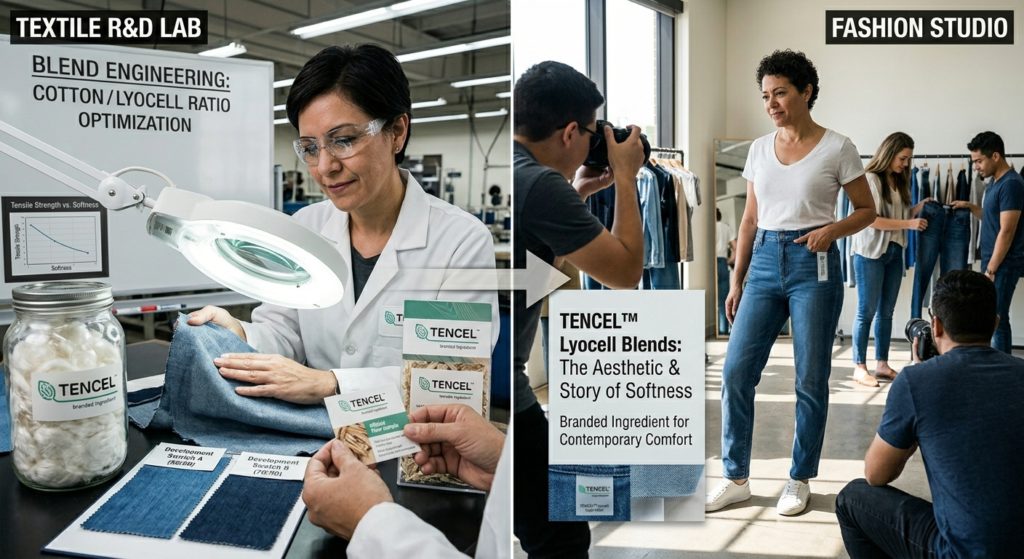
According to Lenzing’s denim application page, TENCEL™ Lyocell fibers in denim deliver softness, breathability, and a matte aesthetic that enhances indigo depth. The fibers are made from sustainably managed wood sources and produced in a closed-loop process.
The cost premium for TENCEL™ blended denim comes from:
- Fiber cost: TENCEL™ lyocell is more expensive per kg than commodity cotton.
- Blend engineering: The ratio of cotton to lyocell affects hand feel, drape, strength, and dyeability. Finding the right blend for the intended product takes development work.
- Market positioning: TENCEL™ is a branded ingredient with consumer recognition in certain markets. The brand licensing and marketing support add value but also add cost to the supply chain.
Where this route makes commercial sense: products positioned on softness, lightweight comfort, and contemporary aesthetics — typically women’s denim, fashion-forward collections, and products where the hand feel is the primary selling point in-store or on-camera.
Where it doesn’t make sense: basic workwear-weight men’s jeans where the consumer buys on durability and value, and wouldn’t notice or pay for the hand-feel difference. The fiber premium only works commercially when the end consumer perceives and values the difference enough to accept the higher price point.
Recycled content: the real cost is making it credible
According to Textile Exchange’s explanation of the Recycled Claim Standard (RCS) and Global Recycled Standard (GRS), both standards require third-party certification and chain of custody verification. GRS additionally requires a minimum of 50% recycled content and includes requirements around processing practices and chemical use.
The cost structure of recycled-content denim:
- Fiber cost: Recycled cotton fiber pricing varies significantly depending on source, quality, and supply availability. Mechanically recycled cotton is shorter in staple length than virgin cotton, which affects spinnability and may require blending with virgin cotton or polyester to achieve adequate yarn strength. Post-industrial waste is generally cheaper and more consistent than post-consumer waste.
- Yarn and fabric performance: Recycled cotton typically produces weaker yarn than virgin cotton at equivalent count. This may require adjustments in fabric construction or blending, which has cost and quality implications.
- Certification cost: GRS/RCS certification involves annual audits, transaction certificates for each shipment, and administrative management of chain-of-custody documentation at every stage from fiber source to finished product. These costs are real and ongoing — not one-time.
- Supply chain coordination: Every entity in the chain (fiber supplier, spinner, weaver, garment factory) must be certified. If any link in the chain is not certified, the chain of custody breaks and the claim cannot be made. This limits supplier flexibility and can create bottlenecks.
- Batch variation: Recycled feedstock — particularly post-consumer — can be less consistent than virgin fiber. This may require more quality screening and may produce more waste.
The most commonly underestimated cost in recycled denim is not the fiber premium itself — it’s the certification, documentation, and supply chain management cost required to make the recycled claim legally and commercially defensible. A brand that budgets only for the fiber price difference and ignores the infrastructure cost will find the project more expensive than planned.
V. Wash Cost: The Major Cost Component This Topic Usually Ignores
An article about denim cost structure that doesn’t seriously address wash/laundry cost is missing one of the largest and most variable cost components in the product.
For washed denim — which represents the majority of commercial denim products — the garment wash process typically accounts for 15-25% of FOB cost. On heavily processed products (vintage wash, heavy destruction, laser + ozone + stone wash combinations), it can be higher.
What drives wash cost
- Process complexity: A simple rinse wash is cheap. A multi-step recipe involving enzyme desizing, stone wash, bleach or PP spray, neutralization, softener, and tumble dry is expensive. Each step adds chemical cost, water cost, energy cost, time cost, and labor cost.
- Consumables: Pumice stones are consumed during stone washing. Enzymes, chemicals, and softeners are consumed in every load. Laser and ozone equipment have capital and maintenance costs that are amortized into the per-piece wash price.
- Reject rate: Wash processes are less controllable than sewing processes. Variation between wash loads — in color, hand feel, and dimensional change — is inherent. The reject rate from washing (pieces that don’t meet the approved standard) is a real cost that goes into the per-piece wash price, either explicitly or as a buffer built into the wash factory’s pricing.
- Fabric weight loss: Washing physically removes material from the fabric — indigo, sizing, some fiber. A heavy vintage wash can reduce fabric weight by 10-15%. The fabric you paid for by weight at the mill is partially washed away at the laundry. This doesn’t appear as a line item on most cost sheets, but it’s a real loss of material value.
- Water and energy: Denim washing is water- and energy-intensive. In regions where water is scarce or expensive, and in periods of high energy prices, wash costs can shift materially. Turkish denim production, for example, was significantly affected by energy cost increases in 2022-2023, and wash facilities bore a disproportionate share of that impact.
Why wash cost is frequently underestimated
During product development, the wash recipe is often not finalized until late in the process — sometimes not until after initial costing is complete. The wash intensity tends to increase during development as the brand pushes for more visual impact. Each round of wash adjustment that adds a step or intensifies a process adds cost, but these additions happen incrementally and may not be reflected in the original cost estimate.
Additionally, wash cost is sometimes quoted as a lump sum per piece rather than broken down by process step. This makes it difficult for the brand to understand which specific processes are driving the cost and where there might be room to simplify without losing the intended visual result.
VI. Trims and Hardware: Why “Small Items” Create Big Cost Surprises

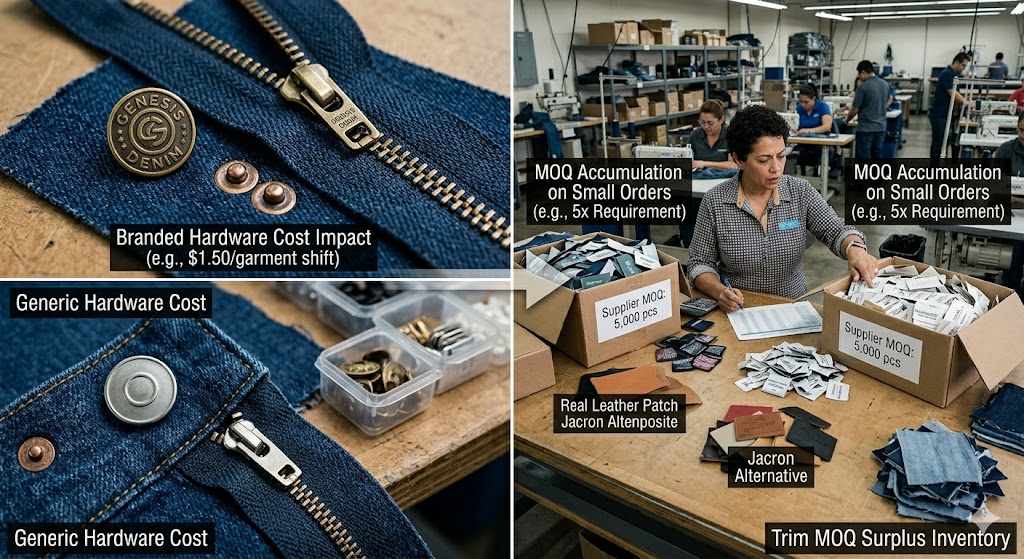
Denim is a hardware-heavy product category compared to most apparel. A standard five-pocket jean includes a shank button (or multiple buttons for button-fly), rivets, a zipper (metal or plastic), a back patch (leather or synthetic), a main label, a care label, a size label, and possibly hang tags, flasher cards, and branded packaging elements. Every one of these enters the BOM.
The CBI guide specifically advises against overlooking “any thread, button, zipper, or tiny detail” in BOM calculation, and recommends budgeting approximately 2% wastage on trims. It also flags that trim supplier MOQs can create surcharges on small orders.
Where trim costs create the most unexpected impact in denim projects:
Generic vs. branded hardware
A generic no-name shank button might cost $0.02-0.05 per piece. A branded, custom-engraved button from a recognized hardware supplier might cost $0.15-0.40 per piece. When you add rivets, a tack button, and a zipper pull, and apply the same generic-vs-branded multiplier across all hardware pieces, the difference per garment can be $0.50-1.50 or more. On a product with a target FOB of $8-12, that’s a significant margin shift from hardware alone.
Back patch material
Real leather patches cost several times more than jacron (paper-fiber composite) or synthetic alternatives. On a premium product, leather may be justified. On a mid-market product, the consumer may not notice or value the difference. Making this decision consciously, early, based on the product’s price point and target consumer, prevents discovering the cost impact after BOM is locked.
MOQ accumulation on small orders
Each trim component has its own supplier MOQ. Custom-engraved buttons may have a 5,000-piece minimum. Custom woven labels may have a 3,000-piece minimum. Branded zipper pulls may have their own minimum. If your order is 1,000 garments, you may need to buy 5x your actual requirement for buttons, 3x for labels, and so on — paying for inventory you won’t use on this order and may not use at all if the style isn’t reordered.
For small and emerging brands, trim MOQ accumulation is one of the most common sources of invisible cost inflation. The solution isn’t to eliminate branded trims — it’s to factor MOQ costs into the project budget honestly, and to standardize trim specs across multiple styles wherever possible so that MOQ quantities can be shared.
VII. Geography: The Cost Variable Nobody Puts in the BOM
An article about denim cost structure that doesn’t discuss geographic sourcing is ignoring one of the most significant cost determinants.
The same denim specification — same weight, same fiber content, same construction — will produce different fabric prices depending on where it’s woven. And the same garment specification will produce different FOB prices depending on where it’s sewn. The reasons include labor cost, energy cost, raw material proximity, infrastructure efficiency, currency exchange rates, and trade preferences.
Without getting into specific price comparisons (which change constantly), the structural cost characteristics of major denim-producing regions:
- China: Largest denim fabric producer globally. Broad range of quality levels and price points. Vertically integrated mills that spin, dye, weave, and finish under one roof. Competitive on mid-range denim. Rising labor and environmental compliance costs have gradually reduced the cost advantage on commodity products. Strong capabilities in stretch denim and fashion-forward developments.Turkey: Strong position in premium denim. Proximity to European markets reduces lead time and freight cost. Advanced wash and finishing capabilities. Historically competitive on cotton-rich premium denim. Vulnerable to currency volatility (TRY) and energy cost fluctuations — which have caused significant price swings in recent years.
- Pakistan: Cost-competitive cotton production (Pakistan is a major cotton grower). Established denim weaving industry. Competitive on basic to mid-range 100% cotton denim. Less established on stretch and specialty fiber routes compared to China and Turkey.
- Bangladesh: Among the lowest garment CMT costs globally. Large denim garment production capacity. However, most denim fabric is imported (primarily from China, Pakistan, and India), so fabric cost advantage is limited. The cost advantage is primarily in CMT.
- Vietnam: Growing denim garment production capacity, partly driven by trade preferences (CPTPP, EU-Vietnam FTA). Fabric mostly imported. Cost positioning between China and Bangladesh on CMT.
- India: Large domestic cotton production. Significant denim weaving capacity. Competitive on certain product types. Variable quality consistency. Competitive on cost for basic products.
For brand sourcing teams, the geographic decision isn’t purely about unit cost — it’s about the total equation including lead time, minimum quantities, quality consistency, trade duties, and logistics cost. A fabric that’s $0.30/meter cheaper from origin A but takes 4 weeks longer to deliver may not actually save money when carrying costs and speed-to-market are factored in.
VIII. Payment Terms and Finance: The Cost That Doesn’t Appear on the BOM
This is a cost factor that gets omitted from virtually every product cost discussion but is real and consequential, particularly for smaller brands.
The CBI guide mentions finance costs as a buyer-specific cost item. In practice:
- Payment terms affect price. A supplier offering 30% deposit / 70% on shipment (common in garment orders) is effectively extending credit. That credit has a cost, which is built into the price. A brand that can pay 100% TT in advance may negotiate a lower price — essentially capturing the supplier’s finance cost saving.
- Letters of credit cost money. Bank charges for L/C issuance, amendment, and negotiation are real costs. For small orders, L/C bank charges can add meaningfully to the per-unit cost.
- Currency exposure is a cost risk. Cotton is traded in USD. Fabric may be priced in RMB, TRY, PKR, or USD. If there’s a significant time gap between when the price is agreed and when payment is made, currency movement can change the effective cost — for better or worse.
- Fabric stockholding has a cost. If a supplier stocks fabric for you (common when fabric lead time is longer than garment production lead time), that stockholding ties up the supplier’s cash, and the cost is built into their price. If you stock fabric yourself, the carrying cost is yours.
These items don’t appear as line items in a BOM, but they affect the total cost of getting a product made and delivered. For brands managing cash flow tightly — which includes most emerging brands — these costs matter.
IX. Where BOM Optimization Matters Most — and Where It Matters Less

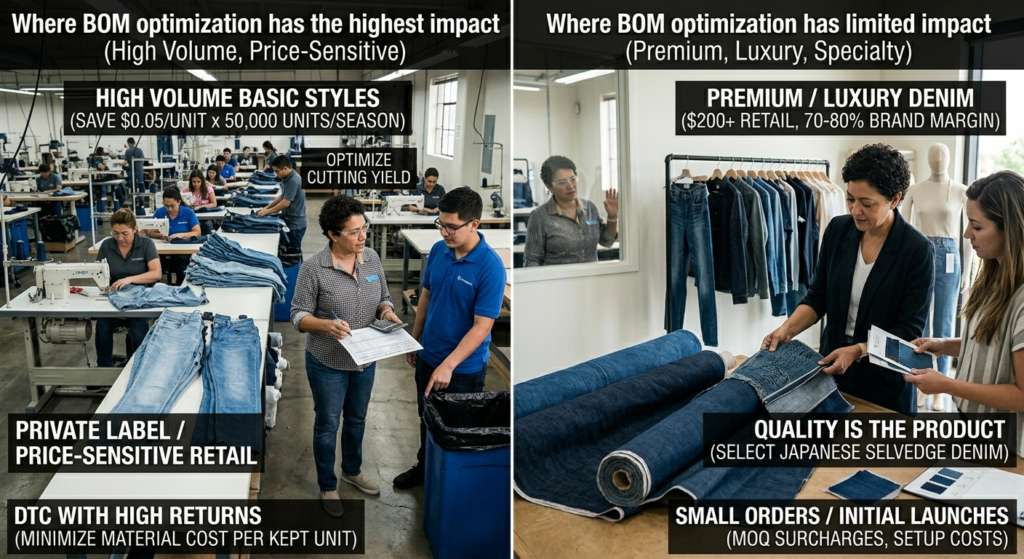
Not all denim products benefit equally from aggressive BOM cost management. Where the optimization effort goes should depend on the commercial context.
Where BOM optimization has the highest impact
- High-volume basic styles: A product that will be produced in tens of thousands of units, season after season, with stable specifications. Even small per-unit savings compound across volume and time. This is where negotiating fabric price, optimizing cutting yield, standardizing trims, and managing wastage pays off most directly.
- Private label / price-sensitive retail: Products where the buyer has a hard cost target and margin is thin by design. BOM efficiency isn’t optional — it’s a survival requirement.
- DTC brands with high return rates: If 20-30% of your product comes back (common for online denim), your effective cost per kept unit is significantly higher than your cost per produced unit. In this context, BOM cost matters more than it looks on paper, because every returned unit is material cost that generates no revenue.
Where BOM optimization has limited impact relative to other levers
- Premium / luxury denim: When the retail price is $200+ and the brand margin is 70-80%, the difference between a $4 BOM and a $5 BOM is commercially trivial compared to the impact of design, marketing, and distribution decisions. Spending development energy on squeezing BOM rather than improving product and brand positioning is misallocated effort.
- Products where material quality IS the product: Japanese selvedge denim, heritage reproductions, specialty fabrics. The premium fabric is the reason for the product’s existence and its price point. “Optimizing” the fabric cost would undermine the product proposition.
- Very small orders / initial launches: On a 300-piece first order, the per-unit impact of MOQ surcharges, sample costs, and setup costs will dominate the cost picture regardless of how well you optimize BOM. Spending weeks negotiating fabric price on 300 meters of fabric is not productive — getting the product right and into market is more productive.
The point: cost optimization is not universally the most important activity. It’s most important when volume is high, margins are thin, and the product competes on value. It’s less important when volume is low, margins are wide, and the product competes on design, story, or exclusivity. Know which situation you’re in.
X. Common Pitfalls
Pitfall 1: Comparing fabric price per meter without normalizing for width, yield, and shrinkage
What happens: Two suppliers quote different per-meter prices for “similar” fabric. The brand picks the lower price.
Consequence: The cheaper fabric is narrower (58″ vs. 62″), has higher shrinkage (requiring more length allowance per garment), and produces worse cutting efficiency because the pattern doesn’t nest as well on the narrower width. Per garment, it actually costs more.
Prevention: Always convert fabric cost to cost per garment before comparing. This requires knowing: fabric consumption per garment (from the marker/cutting plan), fabric width, shrinkage allowance, and wastage factor. If you can’t calculate cost per garment, you can’t meaningfully compare fabric prices.
Pitfall 2: Treating specialty fiber additions as minor upgrades
What happens: During development, the team decides to “add a bit of stretch” or “blend in some TENCEL™” or “use recycled cotton” — treating each as a marginal cost addition to a cotton base.
Consequence: Each specialty fiber brings its own cost cascades — not just the fiber cost but also yarn structure, processing adjustments, certification requirements (for recycled), and potentially more development iterations. The cumulative cost increase is significantly more than “fiber cost × blend percentage.”
Prevention: Price each fiber route as a distinct product, not as an increment on cotton. Get full fabric costs quoted for the specific blend, not estimated from a cotton base plus a fiber premium.
Pitfall 3: Ignoring wash cost in initial costing
What happens: Early-stage costing focuses on fabric and trims. Wash cost is estimated loosely or deferred until the wash recipe is developed. The wash recipe evolves during development, becoming more complex and expensive. By the time the final wash cost is known, the product is committed and the price point is set.
Consequence: Margin is lower than planned. Or the brand pushes back on wash cost, the wash factory simplifies the recipe, and the visual result no longer matches the approved sample.
Prevention: Include wash cost estimation from the beginning of costing. Even if the exact recipe isn’t finalized, establish a budget range based on the wash intensity category (rinse, light wash, medium wash, heavy vintage). If the development team pushes the wash beyond the budgeted intensity, the cost implication should be flagged immediately, not discovered at final costing.
Pitfall 4: Accumulating “small upgrades” that individually seem affordable
What happens: During development, a series of individually modest decisions are made: upgrade button from generic to branded ($0.15/pc), switch to leather patch from jacron ($0.30/pc), add a branded zipper pull ($0.10/pc), use heavier thread for visual topstitching ($0.05/pc), add a second hang tag ($0.08/pc), upgrade polybag to printed bag ($0.04/pc). Each decision is small. The cumulative impact is $0.70-1.00+ per garment in BOM increase.
Consequence: On a garment with $3-5 total trim budget, that’s a 15-30% trim cost increase. On a product where total FOB target is $8-10, it can make the difference between viable and unviable margin.
Prevention: Track cumulative BOM impact in real time during development. Every material decision should update a running BOM total. Set a trim budget ceiling at the start of development and make upgrades competitive — adding one premium element may mean downgrading another to stay within budget.
Pitfall 5: Confusing BOM cost, FOB cost, landed cost, and unit economics
What happens: Team discussions about “cost” don’t specify which cost. The designer is thinking about BOM. The merchandiser is thinking about FOB. The finance team is thinking about landed cost including duty and freight. The founder is thinking about unit economics including return rate and customer acquisition cost. Everyone uses the word “cost” and nobody is talking about the same number.
Consequence: Decisions get made based on misunderstood numbers. A product that looks profitable on a BOM analysis may be unprofitable when duty, freight, returns, and customer acquisition are included. A product that looks expensive on a FOB basis may be highly profitable at the retail level because of strong sell-through and low returns.
Prevention: Define the cost vocabulary for your team. When discussing cost, always specify: BOM cost (materials only), CM cost (labor and production), FOB cost (BOM + CM + factory margin), landed cost (FOB + freight + duty + insurance), and unit economics (landed cost + return cost + fulfillment cost + customer acquisition cost allocated per unit). Not every conversation needs all layers, but every conversation needs to specify which layer it’s about.
XI. Quick Cost Risk Assessment
| Question | If the Answer Is Yes | Cost Risk Implication |
|---|---|---|
| Does the product use a specialty fiber route (stretch, TENCEL™, recycled)? | Yes — the fabric is not a simple cotton denim | Budget the full cost of the fiber route, including development iterations and certification if applicable. Do not estimate by adding a percentage to your cotton denim cost. |
| Does the product specify branded or premium hardware? | Yes — custom buttons, branded zipper, leather patch | Trim BOM will be 2-4x higher than generic. Confirm trim MOQs against your order quantity. Factor MOQ surplus cost into the project budget. |
| Is the wash recipe medium-to-heavy (stone wash, vintage, heavy destruction)? | Yes — multiple wash steps, stone, enzyme, bleach, etc. | Wash cost may represent 20%+ of FOB. Get a detailed wash cost breakdown, not just a lump sum. Monitor recipe evolution during development for cost creep. |
| Is the order quantity below standard fabric and trim MOQs? | Yes — small initial order or trial run | MOQ surcharges on fabric and trims will inflate per-unit cost. Dead stock from MOQ overbuying is an additional hidden cost. Evaluate whether standardizing specs across multiple styles can aggregate volume to meet MOQs. |
| Does the product carry sustainability claims requiring certification? | Yes — GRS, RCS, OEKO-TEX, organic, etc. | Certification, chain-of-custody documentation, and audit costs are ongoing, not one-time. Factor them into the per-unit cost, especially on smaller orders where they can’t be amortized across volume. |
| Is the buyer nominating specific suppliers for fabric or trims? | Yes — nominated fabric mill, specified trim suppliers | Nominated suppliers may be more expensive than alternatives, and the factory loses negotiating leverage. Lead times may be longer. As the CBI guide notes, this affects flexibility, cost, speed, and liquidity. |
| Is the product designed primarily for visual/content impact? | Yes — designed to photograph well, communicate a story, drive social engagement | There’s an inherent tension between content-optimized design (which favors novelty, premium materials, distinctive details) and unit economics (which favors standardization and cost efficiency). Make this tradeoff consciously, not accidentally. |
XII. FAQ
1. What’s typically the largest cost component in a pair of jeans?
Shell fabric is usually the largest single BOM item, typically 50-70% of total material cost. But “largest” doesn’t mean “only.” Trims, wash cost, and wastage collectively can rival or exceed the fabric cost, especially on heavily processed or premium-trim products. Managing cost effectively requires visibility into all components, not just the biggest one.
2. If cotton prices drop, will denim automatically get cheaper?
Not necessarily, and not proportionally. Cotton is the base raw material, but by the time it becomes finished denim fabric, the cost includes spinning, dyeing, weaving, finishing, and the mill’s overhead and margin. A 10% drop in cotton price might produce a 3-5% drop in fabric price — or no drop at all if other input costs (energy, labor, chemicals) have increased simultaneously. The relationship between cotton price and fabric price is real but dampened.
3. Why does stretch denim often cost more than the elastane fiber content would suggest?
Because the cost isn’t just the fiber. Core-spun yarn production is more expensive than standard yarn. Weaving and finishing stretch fabrics requires more careful handling. Development typically takes more rounds. And the downstream consequences of poor stretch performance (fit complaints, returns) make it a higher-stakes product to get right. The elastane fiber itself might be 2-3% of fabric weight but it changes the cost structure of every subsequent production step.
4. Why is recycled content denim more expensive than the fiber price difference would suggest?
Because credible recycled content requires certification (GRS/RCS), which requires third-party audits and chain-of-custody documentation at every link in the supply chain. This infrastructure has ongoing costs — annual audits, transaction certificates, administrative management. Recycled fiber may also require blending and quality adjustments that add processing cost. The fiber price premium is only part of the total premium; the credibility infrastructure is the rest.
5. How should I compare quotes from different fabric suppliers?
compare on price per linear meter alone. Convert to cost per garment by factoring in: fabric width (usable width after selvedge), shrinkage allowance (both length and width), marker efficiency for your specific pattern, and wastage allowance. A fabric that costs $4.00/meter at 62″ width may produce a lower per-garment cost than a fabric at $3.70/meter at 56″ width. If you don’t have a cutting plan yet, ask for consumption estimates from your garment factory based on the specific fabric width and your pattern dimensions.
6. What’s the typical wastage allowance I should budget for denim?
The CBI guide suggests 3-6% for fabrics and approximately 2% for trims and packing. For denim specifically, actual wastage depends on several factors: pattern complexity (more pieces = more inter-piece waste), fabric width relative to pattern dimensions, whether the fabric has a nap or directional pattern (limiting rotation of pattern pieces), and wash shrinkage/rejection rate. Heavy vintage wash processes with stone and bleach may generate 2-5% garment rejection in addition to fabric cutting waste. Budget conservatively — it’s better to have margin buffer from overestimating waste than to discover your margin has evaporated because you underestimated it.
7. How much does garment washing typically add to the FOB cost of a pair of jeans?
It varies enormously by wash intensity. A simple rinse or enzyme wash might add $0.50-1.00 per piece. A medium stone wash with softener might be $1.00-2.00. A heavy vintage treatment with multiple steps — laser marking, stone wash, PP spray or bleach, tinting, heavy softener, tumble dry — can be $2.50-5.00 or more. On a garment with $8-12 total FOB, the wash component ranges from roughly 5% (basic rinse) to 25%+ (heavy vintage). This is why wash cost needs to be part of the initial cost estimate, not an afterthought.
8. How do I manage trim MOQ costs on small orders?
Three practical strategies. First, standardize trim specifications across multiple styles wherever possible — if three styles use the same button, you aggregate volume across three orders to meet one MOQ. Second, discuss with your trim supplier whether they can hold generic (unbranded) stock that serves multiple customers, reducing the per-customer MOQ. Third, do the math honestly upfront: if the MOQ surplus on a 500-piece order means you’re buying 3,000 buttons but only using 500, that excess cost per used button is 6x the unit price. Factor that into your costing and decide whether branded hardware is worth it at your current volume, or whether you should start with generic and upgrade when volume justifies it.
The test is straightforward: can your target consumer perceive the difference, and will they pay for it? A TENCEL™ blend that creates noticeably softer hand feel on a women’s fashion jean sold at $80+ retail — the consumer can feel it, the price point supports it, the brand story amplifies it. That makes sense. The same TENCEL™ blend on a men’s workwear jean sold at $35 retail — the target consumer is buying on durability and value, may not notice or care about softness, and the retail price can’t absorb the material premium. That doesn’t make sense. Every premium material decision should pass this filter before it enters the BOM.
10. What’s the single most important thing I can do to manage denim product cost effectively?
Build a complete, item-level BOM before you approve the product for production — not after. That BOM should include every material component at actual purchase cost (not estimated or “typical” cost), actual consumption quantities (not net pattern area but gross purchase quantities including wastage), MOQ surcharges where applicable, and wash cost based on the actual finalized recipe. Review the BOM against your target retail price and required margin. If the math doesn’t work, you’ll see it clearly in the BOM and can make specific, informed decisions about what to change — rather than discovering after production that the product isn’t profitable and not knowing why.
XIII. Final Recommendations
Denim cost management that actually works comes down to a few principles that are simple to state and difficult to execute consistently:
- See the full picture before you negotiate any single piece of it. Build a complete BOM. Include wash cost. Include wastage. Include trim MOQ reality. Include certification and testing costs where applicable. Then decide where to optimize — from a position of visibility, not from guesswork.
- Match your material investment to your commercial model. Premium materials make sense when they support a premium price point and the consumer can perceive the difference. They don’t make sense when they inflate cost on a product that competes on value and the consumer buys on price.
- Separate the cost layers in your internal discussions. BOM (materials), CM (labor and production), wash, buyer-specific costs (testing, samples, certification), and landed cost (freight, duty) are different things. When your team uses the word “cost,” make sure everyone is talking about the same layer. Most internal cost confusion comes from mixing layers, not from bad numbers within any single layer.
- Front-load your cost work. Discovering a cost problem during development is a design decision. Discovering it after production is a write-off. The earlier cost reality enters the conversation, the more options you have. The later it enters, the fewer options remain and the more expensive each option becomes.
- Accept that small orders have structurally higher unit costs. MOQ surcharges, setup cost amortization, sample costs, and testing costs per unit are all higher at low volume. This is not a supplier problem — it’s a structural reality. Plan for it rather than being surprised by it. If your brand is at the small-order stage, focus on getting the product right and building volume, rather than trying to achieve large-order economics on small-order quantities.
The goal of cost management in denim is not minimum cost. It’s minimum total cost of error — the combination of material cost, quality risk cost, rework cost, return cost, and opportunity cost that produces the best overall outcome. Sometimes that means spending more on materials to avoid spending much more on problems. Sometimes it means simplifying materials to protect margin. The right answer depends on your specific product, market, and commercial model — and it starts with seeing the full cost picture clearly.
XIV. Reference Sources
- CBI — How to calculate the cost price of an apparel item
- USDA ERS — Cotton and Wool Outlook: March 2026
- USDA — Cotton Outlook (2026 Agricultural Outlook Forum)
- The LYCRA Company — LYCRA® fiber
- The LYCRA Company — LYCRA® dualFX® technology
- Lenzing — TENCEL™ for denim applications
- Textile Exchange — Recycled Claim Standard (RCS) and Global Recycled Standard (GRS)