

Fabric Pre-Shrinkage & Shrinkage Testing for Denim: What the Standards Actually Say and What They Don’t
Who This Is For
Denim brand sourcing and product development teams, pattern makers, wash facility operators, garment factories, QA managers, ODM/OEM project leads, and DTC/e-commerce brand owners who keep getting sizing complaints after the first wash.
The Problem This Article Addresses
In denim projects, a large share of rework, returns, and sizing complaints trace back to the same root cause: shrinkage that wasn’t properly anticipated, tested, or compensated for.
The pattern is predictable. Sample garments fit correctly during approval. Bulk production uses the same fabric, same pattern, same factory. Product ships. Consumers wash the jeans once. Then the complaints arrive: inseam is shorter than expected, waist feels tighter, leg opening changed, the size chart on the product page no longer matches reality. For e-commerce brands especially, “shrank after first wash” and “doesn’t match listed measurements” are among the most common — and most damaging — review complaints.
The deeper version of this problem: even when brands and factories do address shrinkage, they often address it incompletely. A fabric mill says “pre-shrunk.” A test report shows a number. But nobody connected the test result to the pattern allowance, or confirmed that the test conditions match how the consumer will actually wash the garment, or verified that garment-level shrinkage (not just fabric-level) was within tolerance.
Pre-shrinkage and shrinkage testing are not lab formalities. They are the control system that determines whether the jeans a customer receives in size 32 still fit like a size 32 after the first wash. When this system has gaps, the consequences land directly on the brand — in returns, in negative reviews, and in lost trust.
I. What Pre-Shrinkage and Shrinkage Testing Actually Solve
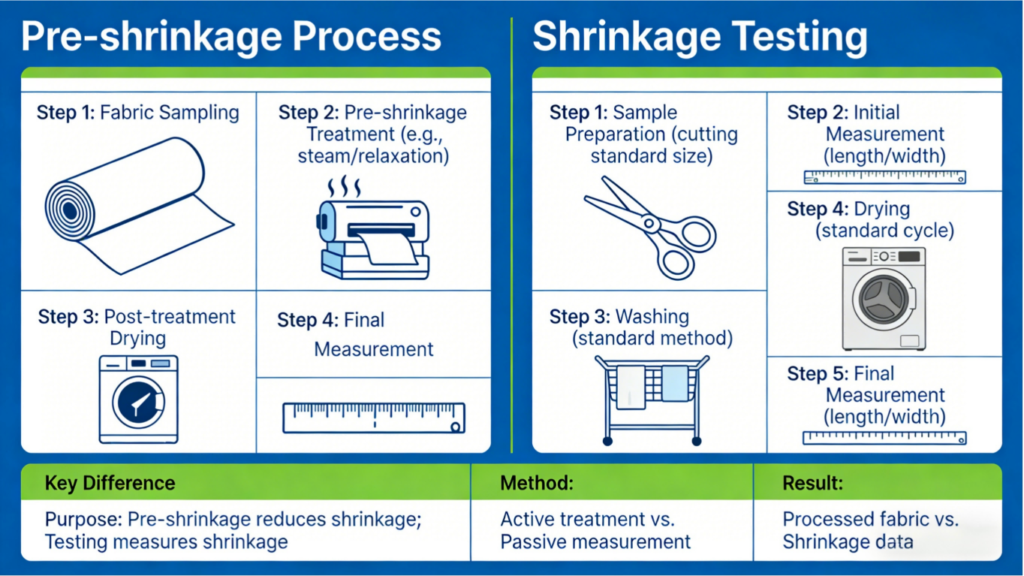
Pre-shrinkage is a process: applying mechanical, thermal, or chemical treatment to fabric (or garments) to release dimensional change before the product reaches the consumer, so that less change remains for the consumer to experience.
Shrinkage testing is a measurement: using a standardized wash-and-dry procedure to determine how much dimensional change a fabric or garment undergoes, so that remaining change can be quantified and compensated for in pattern-making and production.
These are two different things that serve the same goal. Pre-shrinkage without testing is an unverified claim. Testing without pre-shrinkage just documents a problem without solving it. You need both.
The international standards framework
Globally, textile dimensional change assessment typically operates on two levels: one standard defines how to wash and dry the specimen (the procedure), and another defines how to measure the dimensional change (the method). The main references:
- ISO 5077 — Specifies a method for determining dimensional change of textiles after washing and drying. This is the “how to measure” standard.
- ISO 6330 — Specifies domestic washing and drying procedures for textile testing. This is the “how to wash and dry” standard. It defines multiple programs (different water temperatures, agitation levels, drying methods) and the choice of program significantly affects results.
- AATCC TM135 — Determines dimensional changes in length and width of fabrics after home laundering. Widely used in North American markets and by brands sourcing from Asia for US/Canada distribution.
- AATCC TM150 — Determines dimensional changes of garments after home laundering. Specifically addresses the garment level, not just fabric.
- AATCC TM179 — Determines skew change in fabrics after home laundering. For denim specifically, this is critical — skew and torque cause leg twist, which is a dimensional stability issue distinct from linear shrinkage.
The AATCC 2026 Technical Manual contains the current editions and updates for TM135, TM150, and TM179.
What these standards do and don’t tell you
An important clarification that gets missed constantly: these standards define test methods — they tell you how to wash, how to dry, and how to measure. They do not, in most cases, define universal pass/fail tolerances. The acceptable shrinkage range for a given product is typically set by the buyer’s specification, not by the ISO or AATCC standard itself. When a brand says “shrinkage must be within X%,” that X comes from the brand’s product spec, not from ISO 5077.
This distinction matters because factories and suppliers sometimes assume that if their test result falls within some commonly-cited industry number, it’s automatically acceptable. It might not be — it depends on what the specific buyer requires for that specific product.
II. Why Denim Shrinks: The Mechanics That Explain the Numbers

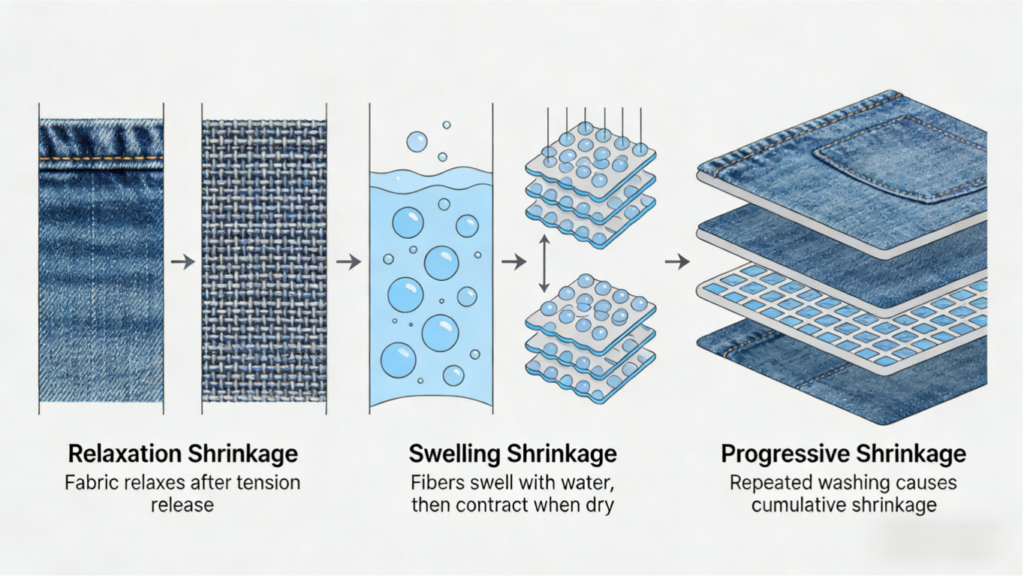
Before getting into process and testing details, it helps to understand why denim shrinks in the first place, because the mechanism explains why different fabrics, constructions, and processes produce different results.
Relaxation shrinkage
During weaving and finishing, warp and weft yarns are held under tension. The fabric is stretched, pulled, and processed through machinery that keeps it taut. When the fabric is later immersed in water and that tension is released, the yarns return toward their natural, relaxed state. The fabric contracts — primarily in the warp (length) direction, because warp tension during weaving is typically higher than weft tension. This is relaxation shrinkage. It accounts for the majority of first-wash shrinkage in cotton denim.
This is also what pre-shrinkage processes (especially Sanforization) are designed to address: by mechanically compressing the fabric in a controlled way before it ships, the relaxation that would otherwise happen during the consumer’s first wash is released in advance.
Swelling shrinkage
Cotton fibers absorb water and swell — primarily in diameter, not in length. When fibers within a yarn swell, they push against each other, and the yarn’s crimp (the waviness of warp and weft as they interlace) tightens. The net effect is that the fabric contracts. This type of shrinkage occurs every time the fabric gets wet, though most of it happens in the first few wash cycles. It’s partially reversible (the fabric relaxes somewhat during drying and wearing) but not completely.
Progressive shrinkage
Some dimensional change continues gradually over multiple wash-and-dry cycles rather than occurring all at once in the first wash. This is particularly relevant for fabrics that are tumble-dried — the combination of heat, moisture, and mechanical action in a dryer can drive continued incremental shrinkage beyond what a single wash cycle produces. This is why some standards and brand specs call for testing after multiple wash cycles, not just one.
Why this matters for development decisions
Understanding these mechanisms explains several practical realities:
- Warp shrinkage is almost always greater than weft shrinkage in denim — because warp tension during weaving is higher, so there’s more stored tension to release. This is why inseam shortening is the most common shrinkage complaint, not waist tightening.
- Heavier, tighter-woven denim doesn’t necessarily shrink less — in fact, higher warp density can mean more yarn per unit length under more tension, potentially producing more relaxation shrinkage if not pre-shrunk adequately.
- Fabric that’s been aggressively stretched during finishing may test fine initially but shrink more than expected in production — because the test sample and the bulk may not have been finished under identical tension conditions.
- Tumble drying consistently produces more shrinkage than line drying or flat drying — the mechanical action plus heat accelerates both relaxation and swelling shrinkage. This is why the drying method specified in the test standard matters enormously, and why ISO 6330 defines multiple drying procedures.
III. Pre-Shrinkage in Denim: What “Pre-Shrunk” Actually Means and Doesn’t Mean
Sanforization: the industry’s most established pre-shrink process
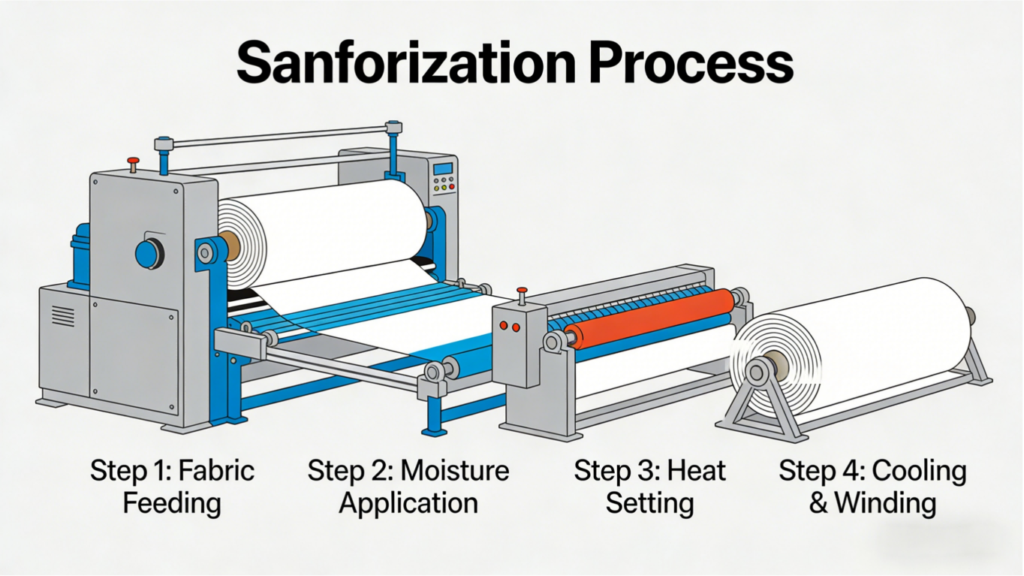
The most recognized pre-shrinkage process in woven fabrics is Sanforization — a controlled compressive shrinkage process. According to the official Sanforized documentation, the purpose is to give garments made from the treated fabric better dimensional stability after laundering.
The process works by feeding fabric over a heated cylinder and into a rubber belt/blanket system that mechanically compresses it in the warp direction. The compression percentage is calibrated based on the fabric’s measured shrinkage potential — the goal is to compress by approximately the amount the fabric would otherwise shrink during washing.
According to the Sanforized Shrinkage Standards, woven fabrics carrying the Sanforized label should not exceed 1% shrinkage or growth in either warp or weft when tested under ISO 6330 washing conditions. With tumble drying and garment make-up taken into account, dimensional change may increase by an additional 1.5%.
These are the licensing requirements for using the Sanforized trademark — they are not universal industry tolerances that apply to all denim regardless of brand or buyer specification.
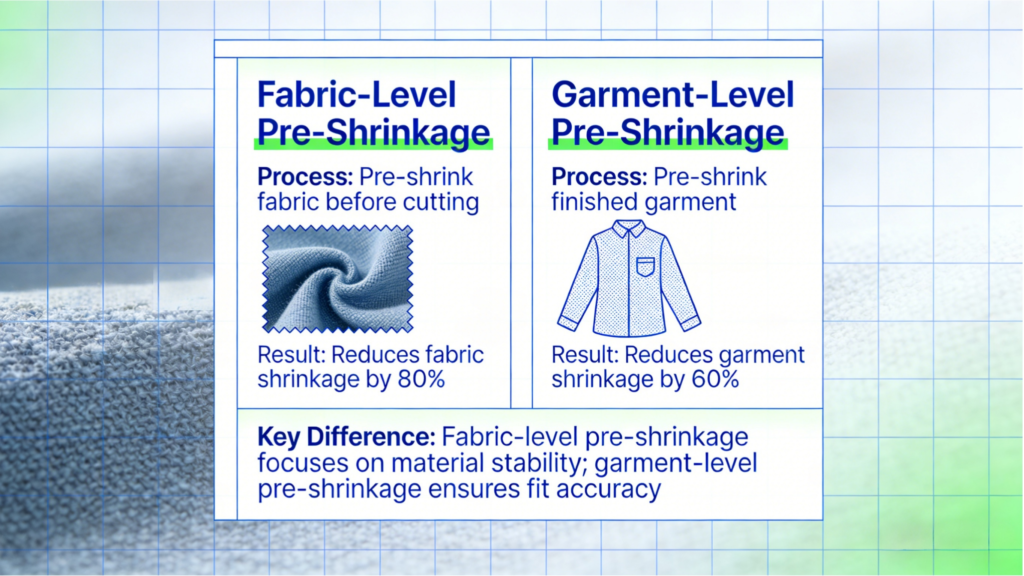
Fabric-level vs. garment-level pre-shrinkage
Fabric-level pre-shrinkage happens at the mill or finishing plant, before fabric is shipped for cutting. Sanforization is the most common method. This is the more controllable stage because the fabric is treated uniformly, before any cutting or sewing introduces additional variables.
Garment-level pre-shrinkage happens after the garment is assembled — through garment washing, pre-wash, or dryer treatment. Many washed denim products go through this as part of the standard wash development. This brings the product closer to its final consumer state, but it cannot fully compensate for fabric that wasn’t adequately stabilized at the fabric stage. If the fabric’s residual shrinkage potential is too high going into garment wash, the garment wash may reduce it but won’t eliminate it — and the variation between garments in the same wash load may be wider than acceptable.
Pre-shrunk does not mean zero shrinkage
This is the single most misunderstood point in the entire topic. When a supplier says “this fabric is pre-shrunk” or “Sanforized,” what they mean is that the majority of the potential dimensional change has been released in advance. Some residual change will still occur when the consumer washes the garment. The question is how much.
For reference, Nudie Jeans states in their help center that their jeans are Sanforized (pre-shrunk) and that shrinkage after the first wash is typically up to 5%, compared to potentially higher shrinkage in unsanforized fabric.
To put that in physical terms: 5% shrinkage on a 32-inch inseam is 1.6 inches. That’s the difference between a full-length jean and an ankle-length jean on some body types. “Pre-shrunk” and “negligible shrinkage” are not the same statement.
The deliberate case against pre-shrinkage: shrink-to-fit
Not all denim is meant to be pre-shrunk, and treating unsanforized denim as a deficiency misses an entire product category.
The shrink-to-fit model — most famously represented by the Levi’s 501 STF — deliberately uses unsanforized (loom-state) denim. The consumer buys a size up, soaks or washes the jeans, and the fabric shrinks to conform to their body shape. The first-wash shrinkage is a designed feature, not a production failure. This approach has deep roots in denim heritage and remains commercially significant in the raw/vintage denim market.
For brands developing raw or unsanforized denim products, the relevant question isn’t “how do we minimize shrinkage?” but rather “how do we accurately predict and communicate the expected shrinkage so the consumer buys the right size?” This requires the same testing rigor — but the target is accurate prediction, not minimization.
Similarly, some Japanese premium denim mills (producing for brands like Iron Heart, The Flat Head, Samurai) deliberately offer both sanforized and unsanforized versions of the same fabric. The unsanforized version commands a premium because the shrink-to-fit process is part of the product experience. Insisting that all denim must be sanforized reflects a mass-market assumption that doesn’t apply to every market segment.
IV. The Standards in Practice: What Gets Tested, How, and What the Numbers Mean
| Standard / Method | What It Covers | Practical Meaning for Denim Projects | Key Variables That Affect Results |
|---|---|---|---|
| ISO 5077 | Method for determining dimensional change in textiles after washing and drying | Defines how to measure shrinkage — marking, conditioning, measurement procedures | Paired with ISO 6330 for wash/dry procedure; results depend entirely on which ISO 6330 program is selected |
| ISO 6330 | Domestic washing and drying procedures for textile testing | Defines the actual wash conditions — water temperature, agitation type, drying method | Multiple programs available. Tumble dry vs. line dry vs. flat dry produces very different results. A shrinkage report without specifying the ISO 6330 program used is incomplete |
| AATCC TM135 | Dimensional changes of fabrics after home laundering | The standard North American fabric-level shrinkage test | Specifies wash temperature, cycle type, and drying method; different options within the method produce different results |
| AATCC TM150 | Dimensional changes of garments after home laundering | Tests the finished garment, not just the fabric — catches shrinkage introduced by construction, sewing tension, and garment washing | Requires actual garments as test specimens; more time-consuming and expensive than fabric testing but much more predictive of consumer experience |
| AATCC TM179 | Skew change of fabrics after home laundering | Measures how much the grain line shifts after washing — directly relevant to denim leg twist | Critical for twill fabrics; right-hand and left-hand twill behave differently; broken twill typically shows less skew change |
The drying method variable deserves special emphasis
This is the single largest source of confusion in shrinkage test results, and the point most frequently overlooked in supplier-buyer communication.
ISO 6330 defines several drying procedures, including line dry, drip dry, flat dry, and tumble dry at different temperature settings. The measured shrinkage of the same fabric can differ by 2-3 percentage points or more depending on which drying method is used. Tumble drying on a normal/high setting consistently produces the highest shrinkage numbers. Line drying produces lower numbers. Flat drying produces the lowest.
This means that a shrinkage test report showing “2% warp shrinkage” is meaningless without knowing the drying method. If the test used flat drying but the end consumer will tumble dry, the actual shrinkage the consumer experiences could be 4-5%.
When reviewing any shrinkage test report, the first question should be: what wash program and drying method were used? If this isn’t specified, the report doesn’t tell you what you need to know. And the drying method selected for testing should match the most likely consumer behavior in the target market. North American consumers overwhelmingly tumble dry. Many European and Asian consumers line dry. Testing with one method when your customer base uses another creates a predictable gap between lab data and field complaints.
How shrinkage testing actually works — the practical mechanics
For brands that audit supplier test reports or manage their own testing, understanding the physical procedure helps identify whether testing was done properly:
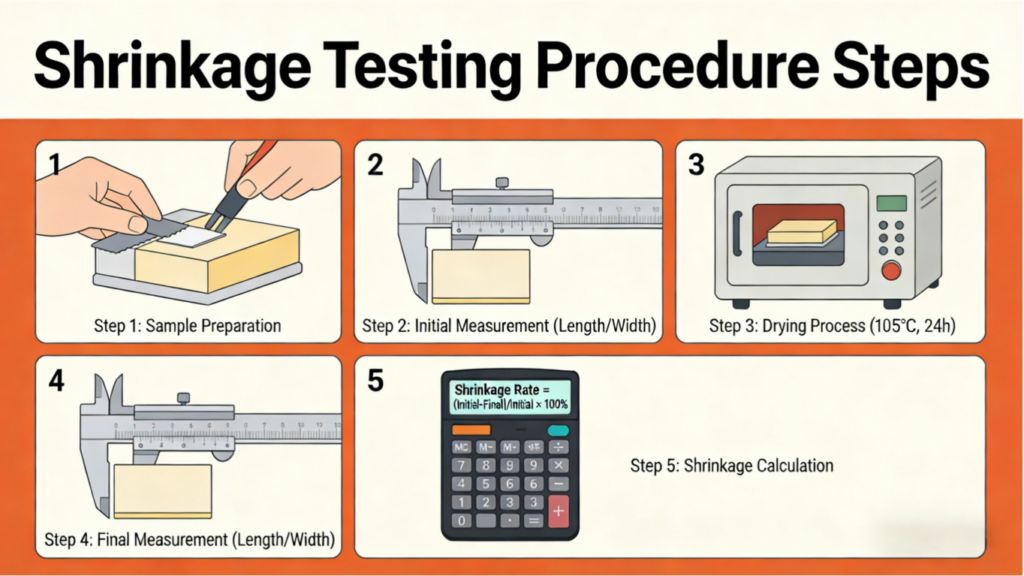
- Specimen preparation: A fabric sample (typically at least 500mm × 500mm for fabric testing, or a complete garment for garment testing) is conditioned in a standard atmosphere (typically 20°C ± 2°C, 65% ± 4% RH) for a specified period
- Marking: Reference marks are applied to the specimen at measured intervals — typically three sets of marks in each direction (warp/length and weft/width). The distance between marks is measured precisely before washing
- Washing and drying: The specimen is washed and dried according to the specified procedure (the ISO 6330 program or AATCC conditions)
- Re-conditioning: The specimen is re-conditioned in the standard atmosphere
- Re-measurement: The distances between the same reference marks are measured again
- Calculation: Dimensional change is calculated as a percentage: [(final measurement − original measurement) / original measurement] × 100. A negative value indicates shrinkage; a positive value indicates growth
Warp (length) and weft (width) are measured and reported separately — because they almost always shrink by different amounts, and the pattern allowance for each direction needs to be set independently.
V. Skew and Torque: The Other Dimensional Stability Problem in Denim
Linear shrinkage (the fabric getting shorter or narrower) gets most of the attention. But for denim specifically, there’s a second dimensional stability issue that’s equally important and frequently under-managed: fabric skew and garment leg twist.
Twill weave fabrics have an inherent diagonal structure. When the fabric is washed and the internal stresses are released, this diagonal structure can cause the fabric grain to shift — the warp and weft are no longer at right angles. In a pair of jeans, this manifests as leg twist: the side seams rotate toward the front or back of the leg instead of hanging straight.
AATCC TM179 provides the test method for measuring this skew change. For denim projects, this should be tested alongside linear shrinkage, not as an afterthought.
Key practical points about skew:
- Unidirectional twills (right-hand or left-hand) inherently produce more skew change than broken twill. This is a structural characteristic of the weave — the diagonal forces don’t cancel out. If your denim is 3/1 RHT or LHT, some degree of post-wash skew is expected. The question is how much.
- Broken twill was developed specifically to address this problem. Wrangler’s historical use of broken twill was driven by the need to eliminate leg twist in western-cut jeans.
- Pre-shrinkage processes (Sanforization) help with linear shrinkage but do not eliminate skew. A fabric can pass linear shrinkage specifications and still fail on skew change.
- Common buyer specifications for denim typically allow 3-5% maximum skew change, but this varies by brand and product type. Slim and skinny fits show leg twist more visibly than relaxed fits, so tighter tolerances may be needed for fitted silhouettes.
VI. Stretch Denim: A Fundamentally Different Shrinkage Problem
The original article mentions stretch denim briefly. In practice, stretch denim deserves significantly more attention because its dimensional behavior is fundamentally different from rigid denim, and the failure modes are different.
Why stretch denim is harder to control
Rigid (100% cotton) denim shrinks — the fabric gets smaller and largely stays smaller. The behavior is relatively predictable and primarily driven by the mechanisms described in Section II.
Stretch denim (containing spandex/elastane) both shrinks AND grows. It shrinks from the same mechanisms as rigid denim. But it also stretches out during wearing (knees, seat, waist) and then partially recovers during washing — or doesn’t fully recover, resulting in progressive growth over multiple wear-wash cycles.
This means that for stretch denim, measuring shrinkage alone is insufficient. You need to evaluate:
- Shrinkage after washing (the fabric contracting)
- Growth after wearing (the fabric stretching out, particularly at stress points like knees and waist)
- Recovery after washing (how much of the wearing growth is reversed by laundering)
- Net dimensional change over multiple wear-wash cycles (whether the garment progressively gets bigger, smaller, or stabilizes)
Standard shrinkage tests (ISO 5077, AATCC TM135) measure the first item but not the others. For stretch denim, brands that only test wash shrinkage are missing half the picture. The most common consumer complaint about stretch denim isn’t “it shrank” — it’s “it bagged out and didn’t come back after washing.”
Spandex degradation over time
Spandex fiber gradually loses its elastic recovery capacity through heat exposure (tumble drying), chlorine exposure (bleach), and simple mechanical fatigue. Over the life of the garment, recovery after each wash cycle decreases. Jeans that fit perfectly through the first 20 wash cycles may start retaining knee bags and waist stretch permanently after wash 30 or 40. This isn’t a defect in the traditional sense — it’s a material limitation — but it affects how brands should set expectations and how sizing should account for the garment’s lifecycle behavior.
VII. When to Test: The Phased Approach and Its Economic Reality
The technically correct answer is “test at every stage where something changes.” In practice, that means:
Phase 1: Fabric approval stage
Test the fabric before committing to bulk purchase. The purpose is to establish baseline dimensional change data and confirm that the fabric’s shrinkage behavior is within a range that your pattern maker can work with. This is the cheapest and earliest point to catch a problem.
Phase 2: After wash recipe finalization
Denim is not a plain-washed garment — the wash treatment (stone wash, enzyme wash, bleach, softener, tumble dry) significantly affects final dimensions. The same fabric tested with a light rinse may show 2% warp shrinkage; tested after a heavy stone wash plus tumble dry, it may show 5%. If you finalize your wash recipe after fabric testing but before garment testing, the fabric test data no longer reflects the product’s actual behavior. Re-test after the wash recipe is locked.
Phase 3: Garment-level confirmation
Especially critical for washed denim, stretch denim, blended fabrics (Tencel, recycled cotton), and any product sold through e-commerce where “doesn’t match listed measurements” is a high-frequency complaint. Fabric-level data is a starting point but not a substitute for garment-level verification. AATCC TM150 addresses this specifically.
The economic pushback — and why it’s partially valid
Three rounds of testing adds cost and calendar time. For brands operating on fast development cycles with tight margins, the honest question is: “Can I afford to test three times?”
The honest counter-question is: “Can you afford a bulk shipment where 30% of the pieces are out of size tolerance after the first wash?”
In practice, the cost-benefit calculation depends on order volume and risk tolerance. For a 500-piece test order, Phase 1 fabric testing plus a garment wash test on 3-5 pieces before bulk cutting may be sufficient. For a 10,000-piece bulk order of a core replenishment style, all three phases are justified because the cost of failure — returns, rework, customer loss — far exceeds the testing cost. For ultra-fast-fashion with very short product lifecycles and no reorder, the calculus is different again.
The minimum that every denim project should have, regardless of volume: at least one shrinkage test on fabric before pattern-making, and at least one garment-level wash test before bulk production sign-off. Skipping both is not a cost saving — it’s a gamble.
VIII. The Gap Between Lab Results and Consumer Reality
This is the section most articles on shrinkage testing avoid, but it’s where many real-world problems originate.
Lab conditions don’t match consumer behavior
Standardized test methods use controlled conditions: specific water temperature, specific detergent type and quantity, specific machine type, specific drying method. These conditions are chosen for reproducibility, not because they represent what every consumer actually does.
In the real world:
- Some consumers wash in hot water, some in cold. A 30°C wash and a 60°C wash produce different shrinkage results on the same fabric.
- North American consumers overwhelmingly use top-loading agitator washers (or high-efficiency machines with different mechanical action than the European front-loaders specified in ISO 6330). Agitation intensity affects shrinkage.
- Tumble drying behavior varies enormously. “High heat” on one consumer’s dryer is not the same as “high heat” on another’s. And the difference between tumble drying and line drying can be 2+ percentage points of shrinkage.
- Some consumers overdry (leaving garments in the dryer well past dry). Extended heat exposure drives additional shrinkage.
None of this means standardized testing is useless — it provides a consistent, comparable baseline. But brands should understand that the test result represents performance under specific defined conditions, not a guarantee of what every consumer will experience. If your test is performed with line-dry conditions but most of your customers tumble dry, your actual field shrinkage will be higher than your test data.
Test samples may not represent bulk production
A shrinkage test is performed on a specific piece of fabric from a specific production lot. It tells you what that piece did under those conditions. It does not guarantee that every meter of fabric in a 10,000-meter bulk order will behave identically.
Production variables that create spread around the tested value:
- Fabric batch variation: Tension settings on the loom or stenter frame may vary between runs. Sanforization machine calibration may drift.
- Within-roll variation: The beginning and end of a roll may have different tension history than the middle.
- Garment wash variation: Load size, water temperature consistency, machine calibration, and operator practices all introduce variation in the wash process.
- Cutting and sewing variation: Different spreading tension, different sewing thread tension, different presser foot pressure — all can influence the starting dimensions of the garment before washing.
A realistic expectation: if your test shows 3% warp shrinkage, your bulk production might range from 2% to 4% across the full order. The test gives you the center of the distribution, not a fixed value that every piece will hit exactly. This spread needs to be accounted for in tolerance-setting and pattern allowance. Building pattern allowances to the exact test number with no margin for production variation is asking for some percentage of the order to fall outside tolerance.
Single-wash testing may not capture the full story
Many standard test protocols involve one wash-and-dry cycle. But some denim — particularly heavier weights and fabrics with residual processing tension — continues to shrink incrementally over the first 3-5 wash cycles. If the brand’s tolerance is based on a single-wash test but the consumer experiences progressive shrinkage over the first month of ownership, the test result was technically accurate but practically misleading.
For products where dimensional stability is critical (core replenishment styles, e-commerce basics where size consistency drives reorder), testing after 3 wash cycles rather than 1 provides a more realistic picture of the consumer experience. Some brand specifications already require this; more should.
IX. Shrinkage Risk Assessment by Product Type
| Product Type | Shrinkage Risk Level | Why It Needs Attention | Recommended Actions |
|---|---|---|---|
| Raw / unwashed denim (sanforized) | High | Consumer’s first wash releases all remaining shrinkage at once; consumer directly experiences the dimensional change | Test and clearly communicate expected post-wash dimensional change; ensure pattern allowances cover expected shrinkage plus production variation margin |
| Raw / unwashed denim (unsanforized / shrink-to-fit) | Very high — by design | Shrinkage is the product feature, not the defect; 5-10% shrinkage is expected and intended | Test precisely; provide detailed shrinkage data and sizing guidance to consumer (soak vs. machine wash instructions, expected shrinkage by measurement point); offer size-up recommendations |
| Washed denim (stone wash, enzyme wash, etc.) | Medium-high | Garment wash has already released significant shrinkage, but additional change may occur in consumer laundering, especially with tumble drying | Test at both fabric and garment level; test after the specific wash recipe, not just after a generic lab wash; measure after tumble dry if that’s how your target market launders |
| Stretch denim | Medium-high (but complex) | Both shrinkage and growth/recovery are in play; standard shrinkage testing alone doesn’t capture the full behavior | Test wash shrinkage AND growth/recovery after simulated wearing; evaluate elastic recovery after multiple wash cycles; account for spandex degradation over garment lifecycle |
| Tencel / lyocell blend denim | Medium-high | Different shrinkage behavior than pure cotton; blended fabrics can show differential shrinkage between fiber components; cannot assume cotton denim shrinkage data applies | Test independently — do not carry over cotton denim shrinkage allowances; test after garment washing if applicable |
| Recycled cotton blend denim | Medium | Recycled fiber characteristics may differ from virgin cotton; batch variation in recycled feedstock can affect dimensional stability consistency | Test each fabric batch independently rather than assuming consistency across batches; monitor bulk consistency more closely than with virgin cotton |
| Black denim with heavy finish | Medium-high | Aggressive finishing processes (overdyeing, resin treatment, heavy softener) can alter the fabric’s dimensional behavior relative to its un-finished state | Re-test after finishing — pre-finishing shrinkage data is no longer valid |
| Standard mid-weight basics | Medium | Often overlooked because they’re “basic,” but high volume means that even a small percentage of sizing complaints generates significant absolute numbers of returns | Include shrinkage testing as a standard gate in production approval; don’t skip testing just because the fabric is “nothing special” |
| E-commerce and DTC products | High (commercially) | Consumer cannot try on before purchase; “shrank after first wash” and “doesn’t match listed measurements” are among the most common and most damaging complaint types for online denim | Test under conditions matching your target market’s actual laundering behavior; measure garments after washing, not just fabric; build size chart from post-wash measurements |
X. Factors That Cause Shrinkage Control to Go Wrong in Denim Projects
1. Only testing at the fabric level, never at the garment level
Fabric-level testing tells you what the fabric does in isolation. But a finished garment is not fabric in isolation. Cutting (which releases tension in the fabric), sewing (which introduces thread tension and potential distortion), and garment washing (which subjects the assembled garment to conditions that may differ from fabric-level testing) all modify the dimensional behavior. A fabric that tests at 2% warp shrinkage at the mill may produce a garment that shows 3.5% inseam shrinkage after garment washing and tumble drying.
This gap is where the most expensive surprises happen — because by the time you discover it, you’ve already cut and sewn bulk production.
2. Testing once and assuming it applies forever
Any of the following changes should trigger re-testing:
- Fabric supplier changed
- Fiber composition changed (even a small percentage change in spandex content)
- Wash recipe modified
- Drying method or temperature changed
- Fabric finishing conditions changed (different softener, different stenter settings, different Sanforization parameters)
- Pattern construction significantly modified
Standard test methods measure dimensional change under specific conditions on a specific specimen. Change the specimen or the conditions, and the result changes with it. Carrying forward old test data after process changes is one of the most common causes of batch-to-batch sizing inconsistency.
3. Reporting averages without directional breakdown
Denim almost never shrinks uniformly. Warp shrinkage is typically higher than weft shrinkage. If someone tells you “shrinkage is 3%,” the immediate follow-up is “3% in which direction?” Because 3% warp / 1% weft requires very different pattern adjustment than 2% warp / 2% weft.
Both ISO 5077 and AATCC TM135 require measurement and reporting of length (warp) and width (weft) dimensional changes separately. Any test report that gives only a single combined number is incomplete and not usable for pattern-making.
4. Ignoring the drying method when comparing test results
A test report showing 2% shrinkage using line-dry procedure and another showing 4.5% shrinkage using tumble-dry are not contradictory — they’re measuring different things. If your buyer’s specification says “max 3% shrinkage per AATCC TM135” but doesn’t specify the drying condition, there’s an ambiguity that will eventually cause a dispute. Pin down the drying method in the specification, not just the shrinkage tolerance.
5. Treating “pre-shrunk” as a synonym for “no shrinkage”
When a supplier says “Sanforized” or “pre-shrunk,” the correct response is: “What residual shrinkage was measured after pre-shrinkage treatment, using what test method, with what wash and dry conditions?” The label “pre-shrunk” is a statement that a process was performed. It is not a statement about the remaining dimensional change. Those two things need to be addressed separately.
6. Test data exists but never reaches the pattern maker
This is an organizational failure rather than a technical one, but it’s remarkably common. The lab generates a shrinkage report. QA files it. Nobody sends it to the pattern maker who’s building the production pattern. The pattern is graded using either no shrinkage allowance or an estimated allowance based on past experience with a different fabric. The result: technically competent testing, structurally useless in practice.
Shrinkage test data must flow directly into the pattern-making and grading process. If your organization doesn’t have a defined handoff for this — where the test result is received by the pattern maker, applied to the pattern, and confirmed through a wash-test of the adjusted garment — then your testing is generating reports, not results.
XI. Connecting Test Results to Pattern Allowances — The Closed Loop
This is the operational step that converts testing from a compliance activity into a product quality tool.
The basic principle
If you know a fabric will shrink 4% in the warp direction after washing and tumble drying, the pattern needs to be 4% longer in the warp direction before cutting — so that after shrinkage, the garment arrives at the intended finished dimension.
In practice, this means:
- Test the fabric (or garment, or ideally both) under conditions that match the end consumer’s laundering behavior
- Get directional data — warp and weft shrinkage separately, not averaged
- Communicate the data to the pattern maker with explicit instructions on how to apply it
- Apply shrinkage allowance to the pattern — adding length in the warp direction and width in the weft direction proportional to the measured shrinkage
- Build in a margin for production variation — if the test shows 3% and you expect ±1% variation in bulk, allow for up to 4% so that the worst-case pieces still fall within tolerance
- Validate with a wash test on the adjusted pattern — cut and sew samples from the adjusted pattern, wash them under the specified conditions, and confirm that the post-wash measurements hit the target size spec
- Document and maintain — this data set (test results, applied allowances, confirmation measurements) becomes the reference for production QC
If any variable in this chain changes — fabric batch, wash recipe, drying method — go back to step 1.
XII. Common Pitfalls — Structured Summary
Pitfall 1: Asking “was it pre-shrunk?” instead of “what did the test show?”
What happens: The supplier says “pre-shrunk” and the brand treats this as confirmation that shrinkage is handled. No test data is requested, reviewed, or applied.
Consequence: Sample-to-bulk inconsistency, post-wash sizing complaints, pattern allowances based on assumptions rather than data, unstable sizing across production batches.
Prevention: Never accept a process claim without measurement data. Ask: tested to which standard? Which wash and dry procedure? What were the warp and weft results? Is this data from this specific fabric lot?
Recovery: Immediately test the current bulk fabric. Feed results into pattern revision. Do not continue shipping without garment-level wash confirmation.
Pitfall 2: Using fabric test results as garment test results
What happens: Fabric testing passes. Production proceeds directly to bulk cutting and sewing without any garment-level wash verification.
Consequence: Garments shrink more than fabric test predicted due to sewing tension, garment wash conditions, and tumble drying. Consumer complaints concentrate around inseam length and leg opening. Size consistency across different styles using the same fabric may differ because different garment constructions introduce different shrinkage behavior.
Prevention: For any washed-denim, stretch-denim, or e-commerce product, add garment-level wash testing before bulk production approval. Reference: AATCC TM150.
Recovery: Pull garments from bulk, conduct garment wash testing, and recalibrate pattern allowances. Do not use the fabric test report to justify garment-level measurements.
Pitfall 3: Test data generated but not connected to pattern-making
What happens: Testing is performed, data exists in a report, but the pattern maker either never receives it or doesn’t incorporate it into the working pattern.
Consequence: Testing becomes a paper exercise. Garment sizing remains unstable. Development cost increases because samples need repeated correction.
Prevention: Establish a mandatory workflow: test result → pattern maker receives data → pattern adjusted → adjusted garment wash-tested → confirmation documented. No shortcutting this sequence.
Recovery: Audit the current data flow. Identify where the chain breaks. Fix the handoff, then re-validate the current pattern against actual shrinkage data.
Pitfall 4: Using generic “industry experience” numbers instead of tested data
What happens: Internal conversations reference rules of thumb — “denim usually shrinks about X%” — without tying the number to a specific test method, specific fabric, specific wash/dry conditions, or specific buyer requirement.
Consequence: The same number means different things to different people at different points in the supply chain. Disputes arise during quality inspection because the supplier’s “acceptable” and the buyer’s “acceptable” were never aligned on method. International buyers with formal testing requirements reject goods that the factory considered normal.
Prevention: Write the acceptable range into the product specification document with an explicit test method reference. “Warp shrinkage ≤ 3% and weft shrinkage ≤ 2% per AATCC TM135, wash condition [X], tumble dry [Y]” — this is enforceable. “Shrinkage should be around 3%” — this is an argument waiting to happen.
Recovery: Return to the buyer’s specification, the test report, and the retained samples. Resolve based on documented data, not verbal claims.
Pitfall 5: Ignoring skew change until the consumer reports leg twist
What happens: Linear shrinkage is tested and controlled, but nobody tests skew change per AATCC TM179 or equivalent. Product ships. After washing, consumers notice the side seams have migrated forward or backward.
Consequence: Returns and complaints that are difficult to resolve because the product can’t be “fixed” after the fact — the skew behavior is built into the fabric construction.
Prevention: Include skew change testing in the specification for all twill-weave denim, especially unidirectional twills (RHT/LHT). Set a maximum allowable skew percentage. If skew is excessive, discuss with the fabric supplier whether construction adjustment (e.g., broken twill) is needed.
XIII. Case Study Framework
Inseam complaints traced back to a gap between fabric testing and garment verification
A brand developed a standard blue washed-denim five-pocket jean. The fabric supplier confirmed the fabric was Sanforized and provided a fabric-level shrinkage test report showing warp shrinkage within their standard tolerance. Sample garments were approved with inseam measurements on target.
Production proceeded to bulk. After the product went to market, consumer complaints clustered around three issues:
- Inseam shorter than expected after first wash
- Leg opening felt tighter after washing
- Repeat buyers reported inconsistent sizing between purchases
The post-mortem found the root cause: the fabric test had been performed with a line-dry procedure. The garment wash process included tumble drying. No garment-level shrinkage verification had been performed after the actual garment wash recipe. The gap between fabric-test-with-line-dry and actual-garment-with-tumble-dry was approximately 2 percentage points of additional warp shrinkage — enough to move the inseam out of the acceptable range.
The fix: the team added garment-level wash testing using the actual production wash recipe and tumble-dry conditions. Pattern allowances were recalibrated based on the garment-level data. Subsequent batches hit size targets consistently.
The lesson: a test report that doesn’t match the actual product conditions isn’t wrong — it’s answering a different question than the one you needed to ask.
To develop this into a proprietary case study, add: specific product details, original fabric test data vs. garment wash test data, measurement point comparison before and after recalibration, return rate data before and after the fix.
XIV. FAQ
1. If the fabric is pre-shrunk, do I still need to test for shrinkage?
Yes. Pre-shrinkage is a process. Testing is verification. The process may or may not have achieved its intended result, and even when it has, some residual dimensional change remains. Reference the Sanforized process description and their published shrinkage standards for context on what “pre-shrunk” does and doesn’t guarantee.
2. Should I follow ISO or AATCC standards for denim projects?
Both are widely used and broadly equivalent in rigor. In practice, the choice is often driven by your buyer’s specification or your target market. European buyers tend to reference ISO 5077 / ISO 6330. North American buyers tend to reference AATCC TM135 / TM150. Many Asian testing labs are equipped for both. The critical point is to agree with your buyer on which standard applies before testing, not after a dispute arises.
3. Should shrinkage testing be done on fabric or on finished garments?
Ideally both, at different stages. Fabric testing is faster, cheaper, and appropriate for early-stage fabric evaluation. Garment testing is more expensive and time-consuming but much more representative of what the consumer will experience — because it captures the effects of sewing, garment washing, and garment drying that fabric testing cannot. For any product where post-wash sizing accuracy is commercially important, garment-level testing should be included.
4. Does Sanforized mean the jeans won’t shrink at all?
No. Sanforized means the fabric has been mechanically compressed to release the majority of its potential shrinkage. Residual shrinkage will still occur. The Sanforized license requires that residual shrinkage not exceed specified limits, but “within limits” and “zero” are not the same thing. Different buyers and different product types may have different expectations for what “within limits” means.
5. Is shrinkage management the same for raw denim and washed denim?
The physics is the same, but the management approach differs. Raw denim ships without garment washing, so the consumer bears the full residual shrinkage on first wash — accurate prediction and clear communication are essential. Washed denim has already been through a garment wash that released much of the shrinkage potential, but additional change can still occur in consumer laundering, especially with tumble drying. The verification approach needs to match the product type.
6. What’s the most commonly overlooked aspect of shrinkage testing?
Two things, both equally common: (1) using fabric test results as a substitute for garment test results, and (2) testing with a drying method that doesn’t match the target consumer’s actual behavior. Both create a gap between what the test report says and what the consumer experiences.
7. Do international standards specify exactly what percentage of shrinkage is acceptable?
Generally, no. Standards like ISO 5077 and AATCC TM135 define how to test — the method, the procedure, the measurement protocol. The acceptable tolerance for a specific product is typically defined by the buyer’s specification, the brand’s quality manual, or the contractual agreement between buyer and supplier. Some product standards and certification schemes do specify maximum dimensional change limits, but these are product-type-specific rather than universal.
8. Why should e-commerce brands pay extra attention to this?
Because the consumer can’t try the product on before buying, and the return decision is often made after the first wash. “Shrank after washing,” “measurements don’t match the size chart,” and “different size from my last order” are top-tier complaint categories for online denim. Every one of these traces back to dimensional stability control. For e-commerce, the size chart IS the product promise — and if the product doesn’t match the chart after washing, the promise is broken regardless of how good the fabric, fit, or wash treatment is.
9. How should I handle shrinkage for stretch denim specifically?
Recognize that stretch denim has a two-way dimensional behavior: it shrinks during washing and grows during wearing. Standard wash-shrinkage tests only capture half of this. At minimum, test both wash shrinkage and elastic recovery. Evaluate whether the garment returns to its original dimensions after a wear-wash cycle, not just after a wash-only cycle. For core styles intended for repeat purchase, consider testing after multiple wash cycles to understand how elastic recovery degrades over the garment’s lifespan.
10. What’s the single most important thing to get right?
The closed loop between testing, pattern-making, and production verification. A test that generates a report nobody uses is worthless. A pattern allowance based on assumption rather than data is a gamble. The value is in connecting these: test → data → pattern adjustment → confirmation wash → production control. When that loop works, sizing is stable. When it breaks anywhere, complaints follow.
XV. Reference Sources
- ISO 5077 — Textiles — Determination of dimensional change in washing and drying
- ISO 6330 — Textiles — Domestic washing and drying procedures for textile testing
- AATCC TM135 — Dimensional Changes of Fabrics after Home Laundering
- AATCC 2026 Technical Manual (includes TM150 — Dimensional Changes of Garments after Home Laundering, and TM179 — Skew Change of Fabrics after Home Laundering)
- Sanforized — What is Sanfor
- Sanforized — Shrinkage Standards
- Nudie Jeans — Are your jeans sanforized?