
This is the second in a series on how SkyKingdom’s production capabilities evolved through different client partnerships. The first case study covers how the 70/30 dual-track capacity system was built for a UK-based fast-fashion retail group.
Note on partnership status: This collaboration ran from 2017 to 2023. During the COVID-19 pandemic period, industry-wide supply chain risks increased significantly while pricing pressure from intermediary trading companies intensified — a pattern that affected denim suppliers broadly, not just this partnership. Orders were gradually reduced, and the collaboration concluded in 2023. SkyKingdom’s production infrastructure, washing network, and operational experience from this period remain fully in place.
What Made This Account Different
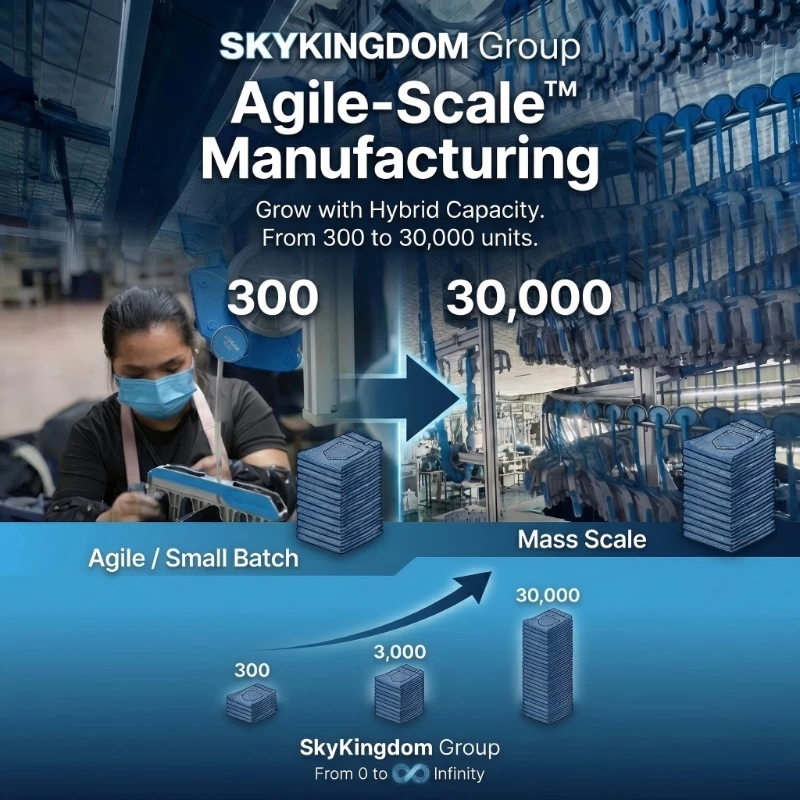
SkyKingdom had already built a 70/30 dual-track capacity system for handling 300-unit trial orders alongside 3,000–5,000 unit reorders. That system was a necessary foundation — but this US client pushed every dimension further:
| Dimension | Previous System (UK Client) | This Partnership (US Client) |
|---|---|---|
| Trial order volume | 300-unit trials | 600-unit trials |
| Reorder scale | 3,000–5,000 units | Escalating: 2,600 → 4,800 → 8,600+ units |
| Annual volume | Moderate | Peak 2 million units/year |
| Reorder speed | Standard reorder cycles | Reorders as fast as every 7 days, stacking on top of new orders |
| Fabric type | Rigid denim (10–12oz) | ~50% stretch denim, 11–14oz range |
| Compliance | Standard EU requirements | BCI or OEKO-TEX certified fabric + AATCC testing to US standards |
| Peak concurrent POs | Moderate | ~300 POs per month |
The volume and reorder velocity required SkyKingdom to solve a fundamentally different problem: not just small-batch speed, but explosive scaling under continuous order stacking.
The Core Challenge: Cascading Order Overlap
High-frequency reorder models create a production management problem that most facilities underestimate. When reorders escalate rapidly and new styles launch simultaneously, every order in the queue is dependent on the orders ahead of it finishing on time.
| Week | Event | Cumulative Load |
|---|---|---|
| Week 1 | First order: 600 units of Style A | 600 units |
| Week 2 | Reorder: 2,600 units of Style A + First order: 600 units of Style B | 3,800 units |
| Week 3 | Reorder: 4,800 units of Style A + Reorder: 2,600 units of Style B + First order: 600 units of Style C | 11,800 units |
| Week 4 | Reorder: 8,600 units of Style A + continued stacking… | 20,000+ units |
The critical insight: any production disruption on Style A does not just delay Style A — it cascades into every subsequent order in the queue. When 300 POs overlap with new styles and reorders running simultaneously, there is zero buffer. Every hour of delay compounds.
This is why speed alone is not enough. The system has to be fast and resilient to disruption simultaneously.
The Solution: Five-Layer Quick Response System
SkyKingdom addressed these requirements through five interconnected operational layers. None of them work in isolation — the system effect comes from all five running together.
Layer 1: Core Fabric Pre-Stocking with Compliance Built In
Problem: Fabric procurement is the single largest lead time component. For this account, the constraint was doubled: fabrics had to be not only in-stock but also pre-certified and tested to US market standards before orders arrived.
What SkyKingdom did:
- Maintained permanent greige stock of the client’s core fabric specifications: 11oz to 14oz, approximately 50% stretch constructions and 50% rigid
- All stocked fabrics carried BCI or OEKO-TEX certification from the fabric mill — these are mill-level certifications, not factory-level
- Pre-stocked a full suite of custom trims (buttons, rivets, patches, zippers) matched to the brand’s specifications
- AATCC testing (color fastness, shrinkage, tensile strength per the brand’s test protocol) was completed on fabric batches by accredited third-party testing laboratories before orders arrived — not after
Result: For any style using pre-stocked fabric, procurement lead time was zero. Orders moved directly to cutting upon confirmation.
This “menu-based development” approach — pre-validating fabrics and trims so the client selects from a ready menu — is the same principle SkyKingdom applies across partnerships. For a deeper look at how denim fabric specifications affect production decisions, see the Denim Encyclopedia.
Layer 2: One-Quarter-Ahead R&D Cycle
Problem: Pre-stocking solves speed but risks product homogenization. If every production facility stocks the same basic fabrics from the same mills, every brand’s denim starts looking the same.
What SkyKingdom did:
- Shifted the fabric R&D cycle one full quarter ahead of order placement
- Conducted quarterly meetings with core fabric mills to preview and pre-select upcoming seasonal fabrics — new weave structures, warp/weft variations, finishing innovations
- Developed sample collections using these forward fabrics and presented them to the buying team before their design cycle began
Result: The brand’s design team received differentiated fabric options that competitors sourcing from standard mill catalogs could not access. Speed and product differentiation stopped being trade-offs.
Layer 3: Single-Piece Flow Production
Problem: With 300 POs per month and styles constantly switching, traditional batch production creates WIP (work-in-progress) accumulation. Each style changeover on a long assembly line costs hours of downtime. When orders are stacking, those hours cascade.
What SkyKingdom did:
- Extended the U-shaped cellular layout (originally built for the 70/30 capacity system) across a larger portion of the production floor
- Implemented single-piece flow and small-bundle flow across all production cells dedicated to this account
- Eliminated intermediate WIP storage: garments moved from sewing directly to washing without warehouse staging
Result: Sewing cycle time compressed to 15–30 days depending on order complexity — up to 50% faster than pre-optimization workflows. More importantly, style changeover time dropped dramatically, which meant the stacking of 300 concurrent POs became manageable.
Layer 4: The One-Hour Washing Circle
Problem: Washing and finishing are typically outsourced, and transportation time plus external facility scheduling are hidden delays. For a brand requiring diverse wash effects (enzyme wash, stone wash, bleach, tinting), this step can add 5–10 days.
What SkyKingdom did:
- Built a network of 6+ partner washing facilities, all located within a 5–10km radius of the production hub
- Maximum transport time to any facility: under 60 minutes door-to-door
- Established a strict same-day turnaround SOP: for standard processes like enzyme washing, goods dispatched at 8:00 AM return by 6:00 PM the same day
- Distributed wash orders across multiple facilities simultaneously to avoid bottlenecks at any single plant
Result: Achieved what SkyKingdom internally calls a “zero-overnight” washing cycle for standard processes. Complex washes (heavy distressing, multi-step treatments) complete within 48 hours.
Note: This washing network remains fully operational today and continues to serve SkyKingdom’s current client base. The 5–10km proximity model and same-day turnaround SOPs are a permanent part of the production infrastructure.
Layer 5: 24/7 Three-Shift Operation (2017–2023)
Problem: Social media-driven trends do not follow business hours. When a style goes viral on a Friday evening, waiting until Monday morning to start finishing and packing means losing 60+ hours of response time.
What SkyKingdom did:
- Implemented a year-round three-shift rotation: 250 workers total, approximately 75 per shift, each shift running 8 hours
- This was not seasonal or overtime-based — it was a permanent operational structure running 365 days during the peak partnership period
- Finishing operations (trimming, ironing, packing, QC) ran continuously: orders could be packed and shipped at 3:00 AM or on a Sunday
Result: The production floor effectively operated as a continuous-flow facility. Combined with the one-hour washing circle, the time from last stitch to packed-and-ready-to-ship was compressed to under 24 hours for standard orders.
Note: The 24/7 three-shift structure was specific to this partnership period (2017–2023) and is no longer in permanent operation. However, the operational systems, SOPs, shift handover protocols, and production management experience gained from running this structure for six years remain a core part of SkyKingdom’s institutional knowledge — and can be reactivated when client volume requires it.
Measurable Results (2017–2023)
| Metric | Value |
|---|---|
| Partnership duration | 6 years (2017–2023) |
| Peak annual output | 2 million units/year |
| Peak concurrent POs | ~300 POs/month |
| Fast order lead time (order to shipment) | 30 days |
| Long order lead time (order to shipment) | 60 days |
| Sewing cycle time | 15–30 days depending on order complexity |
| Minimum first order quantity | 600 units |
| Reorder escalation pattern | 600 → 2,600 → 4,800 → 8,600 units |
| Shortest reorder cycle | 7 days |
| Washing turnaround (standard processes) | Same-day (8:00 AM → 6:00 PM) |
| Compliance standards | BCI / OEKO-TEX certified fabric (mill level) + AATCC tested by third-party labs to US market standards |
What This System Means for Brands Today
The five-layer system documented in this case study was built to solve a structural problem: how to handle explosive reorder escalation without letting one disruption cascade through the entire production queue. The specific client relationship has concluded, but the infrastructure, experience, and operational logic remain. Here is what six years of running this system at peak capacity taught us:
- The real bottleneck is not speed — it is order stacking resilience. Any facility can rush a single order. The question is what happens when 300 POs overlap and one disruption threatens to cascade into everything behind it. Ask your production partner how they handle concurrent order stacking, not just how fast they can turn one order.
- Compliance must be baked into the fabric stock, not bolted on after order placement. For the US market, AATCC testing adds days if done per-order. Pre-certifying fabric batches — BCI or OEKO-TEX at the mill level, AATCC on stocked lots via third-party labs — eliminates this delay entirely.
- Washing logistics are a hidden schedule killer. If your production partner outsources washing to facilities 50km+ away, add 2–3 days minimum for transport and scheduling alone. A 5–10km washing network with same-day turnaround SOPs is a structural advantage, not a nice-to-have. SkyKingdom’s proximity washing network remains operational today.
- Pre-stocking without R&D leadership creates commodity products. Fabric pre-stocking solves speed but kills differentiation if every facility stocks the same mills’ standard offerings. Moving the R&D cycle one quarter ahead — previewing and pre-selecting seasonal fabrics before the client’s design cycle — is what separates a development partner from a CMT vendor.
- Stretch denim and rigid denim require different production management. When approximately 50% of orders use stretch constructions (11–14oz range with elastane/spandex), the production team must manage different cutting tolerances, sewing tension settings, and washing parameters simultaneously. This dual-fabric capability is not a given — it is built through years of operational experience.
SkyKingdom’s fabric pre-stocking infrastructure, proximity washing network, and single-piece flow production cells remain fully operational. The institutional knowledge from managing 300 concurrent POs per month — including shift handover systems, disruption response protocols, and multi-fabric production coordination — is available to current and prospective clients. If your brand operates high-frequency reorder cycles or needs to scale from trial orders to volume production without switching partners, talk to our denim product team about how this system can be configured for your order profile.
Frequently Asked Questions
How does a denim production facility handle 300 concurrent purchase orders per month?
The key is eliminating sequential dependencies: pre-stocked certified fabric removes procurement wait time, single-piece flow prevents WIP accumulation, a distributed washing network (6+ facilities within 5–10km) prevents bottlenecks, and continuous finishing operations ensure nothing waits overnight. The system must be designed so that a disruption on one order does not cascade into the queue behind it.
How fast can high-volume denim orders be fulfilled for the US market?
In this case study, fast orders delivered in 30 days from order confirmation to shipment. Longer-lead orders delivered in 60 days. The 30-day timeline was enabled by pre-stocked certified fabrics, single-piece flow production, same-day washing turnaround, and continuous finishing operations.
What compliance standards are required for denim exported to the US market?
For this partnership, all fabrics required BCI or OEKO-TEX certification at the mill level, and finished garments were tested to AATCC standards — including color fastness, shrinkage, and tensile strength — by accredited third-party testing laboratories per the brand’s specific test protocol. Compliance testing was completed on fabric stock before orders arrived, not after production.
What is the difference between stretch and rigid denim in production planning?
Stretch denim (containing elastane or spandex) requires different cutting tolerances, sewing tension settings, and washing parameters compared to rigid denim. In this partnership, approximately 50% of orders used stretch constructions in the 11–14oz range, requiring the production team to manage both fabric types simultaneously. For more on fabric specifications, see the Denim Encyclopedia.
Why does a one-quarter-ahead R&D cycle matter for denim sourcing?
If fabric R&D happens at the same time as order placement, the brand is limited to whatever is currently available from mills — the same options every competitor sees. By shifting the R&D cycle one quarter ahead and previewing next season’s fabrics before the brand’s design cycle begins, the production partner can offer differentiated fabric options that are not yet in the general market.
Can this quick response system work for brands smaller than high-volume fast fashion?
Yes. The five-layer system is modular — smaller brands may not need all five layers at full scale. For example, a brand with lower reorder frequency may not need continuous shift operations but would still benefit significantly from fabric pre-stocking and a proximity washing network. The system scales down as well as up.