
Introduction
Spring 2026 denim collections will be won by brands that can move from idea to finished jeans and denim jackets with fast response decisions, low-risk inventory, and repeatable quality. When a silhouette or wash goes viral, the hard part is not the concept. The hard part is turning that concept into production-ready OEM or ODM output, on time, and without quality drift.
That is why the “denim factory” conversation in 2026 is really about systems: quick response calendars, low MOQ launches, and a Flexible Supply Chain that can scale from a small batch to meaningful volume. If your factory can only do one of those well, you will feel it in missed trend windows, late drops, or rising return rates.
This ultimate guide breaks down how modern OEM and ODM denim programs work for Spring 2026, with practical frameworks for planning jeans and denim jackets. It also shows how SkyKingdom approaches On-Demand Fashion, Agile Manufacturing, Real-time ERP Tracking, and wash acceleration so brands can test, learn, and scale with confidence.
Core Information
OEM vs ODM roles and deliverables
OEM means you bring the design intent and requirements, and the factory executes manufacturing. In denim, OEM deliverables usually include:
- Sample development and revisions
- Sourcing for fabric, trims, and wash chemistry
- Pattern, grading, and size set execution
- Production, finishing, packing, and shipment coordination
ODM adds product development on the factory side. In practice, ODM denim support often includes:
- Proposing silhouettes and construction details aligned to trend direction
- Suggesting wash recipes that are repeatable at scale
n- Recommending fabric weights, stretch composition, and finishing pathways
For Spring 2026, many brands use a hybrid approach. They keep brand identity in-house, but rely on ODM capability for wash engineering, pattern efficiency, and scalable production planning.
Quick response calendar and drop cadence
A working quick response calendar is not a single lead time number. It is a chain of decisions that must stay unblocked. The most common failure mode is waiting too long to lock a detail that affects multiple departments.
A practical Spring 2026 drop cadence usually looks like this:
- Week 0-1: concept lock (silhouette, fabric weight range, wash direction)
- Week 1-2: first sample and fit notes
- Week 2-3: second sample or size set confirmation
- Week 3-6: bulk production, wash, finishing, and QC
SkyKingdom highlights a 7-day sample turnaround and positions its system around speed-to-market, including 72-hour sampling in case studies and bulk production windows commonly cited as 15-22 days in its operations narrative.
Low MOQ manufacturing cost drivers
Low MOQ Manufacturing is not “just make fewer pieces.” The true cost drivers are the items that do not scale down smoothly:
- Fabric minimums (mill or stocked base fabric)
- Wash and finish setup time (recipe trials, machine setup, test panels)
- Trims and hardware minimums (buttons, rivets, labels)
- Pattern, grading, and sampling labor
The operational trick is to reduce the number of “new” variables per drop. For example, keep the same base fabric across 2-3 washes, or reuse the same hardware kit across multiple fits.
Flexible supply chain and capacity planning
A Flexible Supply Chain for denim is capacity that can switch between:
- Test runs for trend validation (small batch)
- Reorders for proven winners (scaled runs)
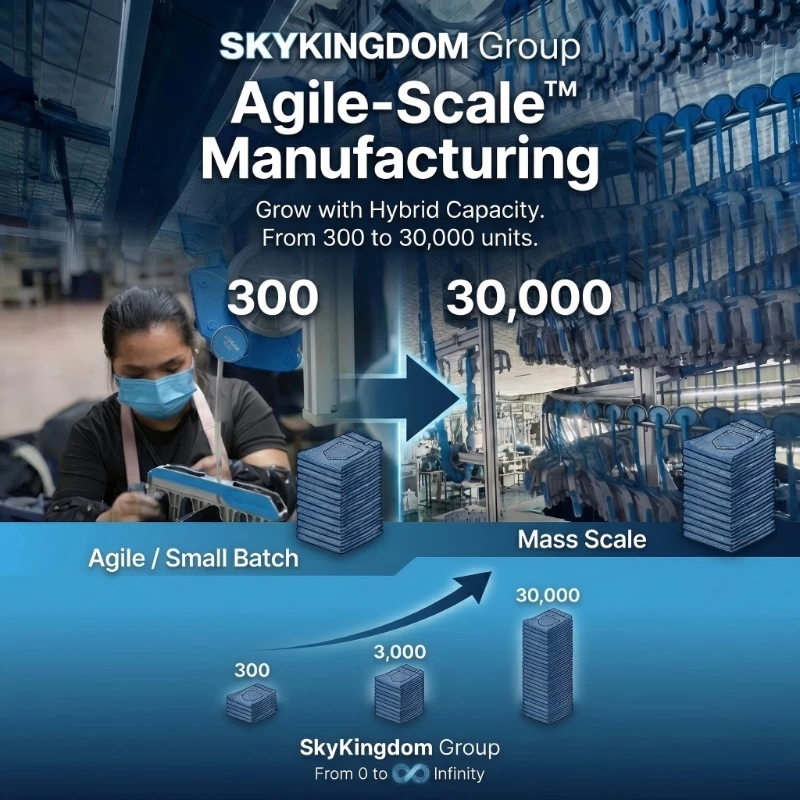
SkyKingdom describes a hybrid capacity approach that reserves a portion of capacity for testing while maintaining mass production efficiency for scale, paired with Real-time ERP Tracking for visibility and faster issue resolution.
AI-Native Concept to Denim
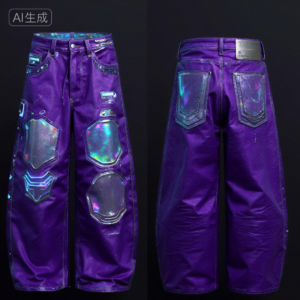
AI-native denim development is best understood as a pipeline: intent capture, visual definition, production translation, and controlled approvals. For Spring 2026, this matters because trend cycles often begin in image-led platforms, and brands need a way to convert visuals into real garments without losing speed.
Text-to-denim concept and intent capture
A useful AI workflow starts with clear inputs. A prompt should describe:
- Silhouette (baggy wide-leg, slim straight, cropped jacket)
- Wash direction (acid wash, coated, vintage fade)
- Surface design (patchwork, embroidery placement, print zones)
- Hardware and trims (metal tone, belt details, pocket shape)
Your goal is not perfect art. Your goal is production intent that can be verified and measured.
Visual-to-production file conversion pipeline
To turn a render into a factory-ready plan, treat each stage as a “gate”:
- Visual gate: front/back visuals, close-up texture, and any graphic placements.
- Pattern gate: a first pattern aligned to silhouette and target fit.
- Wash gate: test panels or a single proto to verify the wash recipe.
- QC gate: tolerance targets (measurements, color tolerance, defect rules).
When a factory can support visual-first input and conversion, it reduces the time spent producing full tech packs before you even know if the style will sell.
On-demand fashion for trend testing
On-Demand Fashion works when the operational model supports “sell-first, make-later” behavior. Even if you do not run full preorders, you can use soft launches:
- limited quantities for content testing
- waitlist or back-in-stock signals
- small batch for first-week demand read
That data should decide whether you reorder, adjust wash direction, or drop the style.
Custom Denim Jeans – Skykingdom
Micro-Run OEM for 30-Piece Drops
Micro-run OEM is the most practical way to launch Spring 2026 denim when you are unsure which wash or silhouette will win. SkyKingdom positions a low MOQ approach and small-batch experimentation as a way to reduce dead inventory risk while keeping you in the trend window.
Low MOQ small batch launch setup
To make a 30-piece drop work operationally, reduce complexity:
- Start with 1 fit + 1 wash + 1 fabric
- Use 2-3 sizes that match your demand center (then expand)
- Standardize trims (same rivets, shanks, and label placements)
This prevents hidden minimums from exploding the schedule.
Quick response sampling and approvals
Sampling speed is wasted if approvals are slow. Set up a strict approval rhythm:
- 24-hour response on factory questions
- One consolidated fit note document per revision
- A single decision owner for wash direction
This is how you protect fast response promises inside your own team.
Sell-first preorders reduce inventory risk
Preorders work best when you do not over-engineer them. You need:
- realistic ship windows (with buffers)
- clear wash expectations (vintage effects vary)
- a plan for size exchange flow
A small batch drop combined with preorder signals often gives a cleaner demand read than ad testing alone.
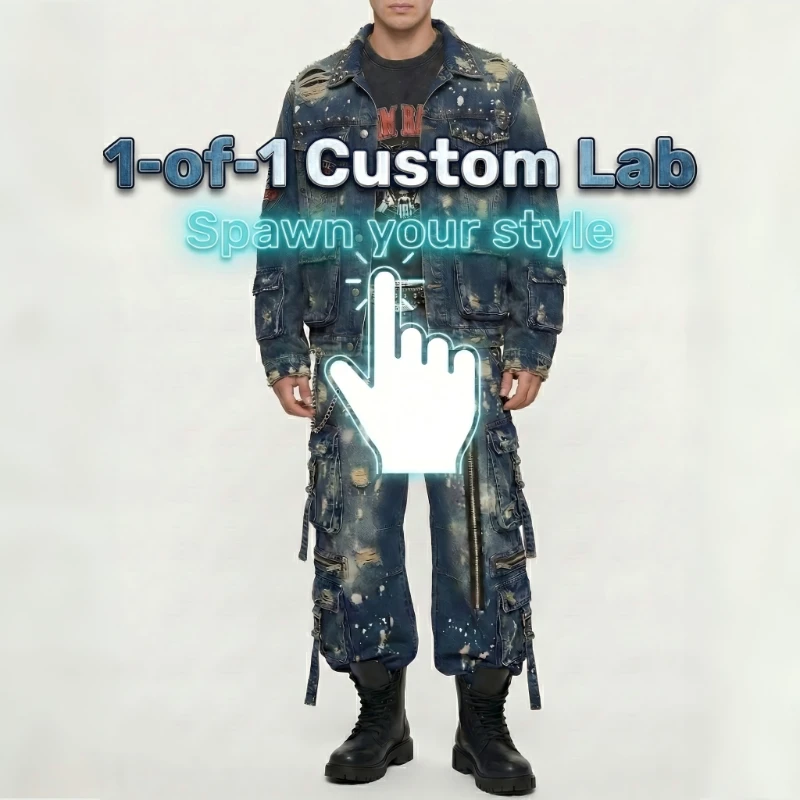
Custom Denim Jacket – Skykingdom
Agile Manufacturing for Scale-Ups
Agile Manufacturing is not only about speed. It is about stable repeatability while scaling volume. A common failure is to treat reorders as “the same” when the factory treats them as a new production event.
Hybrid capacity: test then scale
A scalable system separates:
- test capacity (sampling, wash trials, short runs)
- scale capacity (repeatable bulk lines, stable SOP)
SkyKingdom frames this as hybrid capacity that supports small-batch trials while staying ready for larger replenishment orders, paired with speed-to-market targets and digital visibility.
Predictive sourcing reduces material delays
Material delays kill Spring 2026 calendars because they cascade. Predictive sourcing is the practice of locking:
- base denim qualities early (including weight and stretch)
- core hardware and trim kits
- wash chemistry availability
Then you vary only the elements that create the trend signal, such as a new finish or placement detail.
Smart logistics for multi-market fulfillment
Smart Logistics matters when you are shipping across regions or doing split deliveries. To keep delivery promises, plan:
- carton strategy and packing ratios
- labeling requirements per channel
- QC rules tied to your return risk drivers
If you are scaling DTC and marketplace channels at the same time, your QC and packing rules cannot be “one size fits all.”
Denim Wash and Finish Acceleration
In Spring 2026, wash and finishing is where you win or lose the trend match. Two jeans with the same pattern can sell very differently based on the finishing clarity, fade placement, and consistency.
One-hour washing ecosystem throughput
Wash speed is often limited by coordination, not only by machines. A faster “washing ecosystem” is usually:
- predictable batching rules
- standardized recipes with controlled tolerances
- reduced handoffs and waiting time
SkyKingdom describes an operations approach built around speed-to-market and laser washing technology, emphasizing minimizing quality fluctuations while maintaining production speed.
Laser finishing for repeatable effects
Laser finishing is valuable when you need repeatable results across:
- multiple sizes
- multiple reorders
- multiple wash lots
It also supports faster iteration because the pattern of abrasion or whiskering can be adjusted more predictably than manual sanding alone.
Color tolerance controls for e-commerce
E-commerce returns often spike when color and wash effects vary more than customer expectations. The key is to set:
- a master standard (golden sample)
- measurement tolerance for key points
- wash shade tolerance targets
SkyKingdom references Amazon top-seller grade QC and AQL 2.5 as part of its quality positioning, which aligns with the need to reduce negative reviews driven by consistency issues.
Heavy-Duty Distressed Double-Breasted Tech-Trench – Skykingdom
Sustainable Denim and Circular Inputs
Sustainable Denim for Spring 2026 is not only about fiber choice. It is also about claims discipline, chain-of-custody handling, and realistic performance constraints. Many brands create risk by mixing marketing language across recycled content, preferred cotton programs, and recyclability without verifying what can be documented.
Recycled cotton denim blend constraints
Recycled Cotton Denim is powerful, but it introduces constraints you should plan for:
- fiber length variability can affect strength and abrasion resistance
- shade matching can be harder, especially in light vintage washes
- shrink and skew behavior can shift across lots
A practical approach is to validate the blend early with wash tests and stress points (seat seam, inseam, pocket edges) before you commit to bulk.
Chain-of-custody and claims verification
If you plan to make cotton program claims, align your sourcing language with an established standard. Better Cotton states that its Principles and Criteria v3.1 became effective on April 1, 2025, and it provides documentation frameworks that help brands communicate responsibly. (bettercotton.org)
In practice, “verification” means:
- you can trace what was purchased
- you can show what documents support the claim
- your hangtags and product pages use consistent terms
Circular fashion takeback and recycling
Circular Fashion is a long-term system problem. A widely cited industry challenge is that very little used clothing is recycled back into new clothing fiber-to-fiber. The World Economic Forum has reported that under 1% of used clothing is recycled into new clothing. (theguardian.com)
For Spring 2026 planning, treat circularity as:
- design for durability and repair first
- reduce mixed-material complexity where possible
- keep trims and finishes documented so future recycling is more feasible
Selection/Decision Guide
This section helps you choose a denim factory partner using an educational framework, not a sales checklist. The goal is to align MOQ, lead time, QC, and visibility to your Spring 2026 calendar.
MOQ and price breaks and margin modeling
Even without discussing pricing, you can model your operational risk by mapping each style to:
- minimum units needed for a meaningful data read
- reorder threshold that justifies scaling
- maximum units you can carry without inventory stress
Low MOQ Manufacturing works best when you plan 2 stages: a learning batch and a scaling batch.
Lead time and fast response and calendar fit
Lead time should be measured in calendar gates:
- sampling cycle time
- time from approval to bulk start
- wash and finishing throughput
- packed-to-ship timeline
A strong fast response partner will show you how they remove waiting time inside the chain, not only quote a number.
QC system and tolerance and returns control
Returns are often driven by a few repeatable issues:
- size spec drift (waist and rise changes)
- wash shade inconsistency
- trim failures (buttons, rivets)
Ask for a QC plan that names checkpoints and tolerances. If a supplier frames QC only as “final inspection,” you are taking on avoidable risk.
ERP tracking and visibility and real-time status
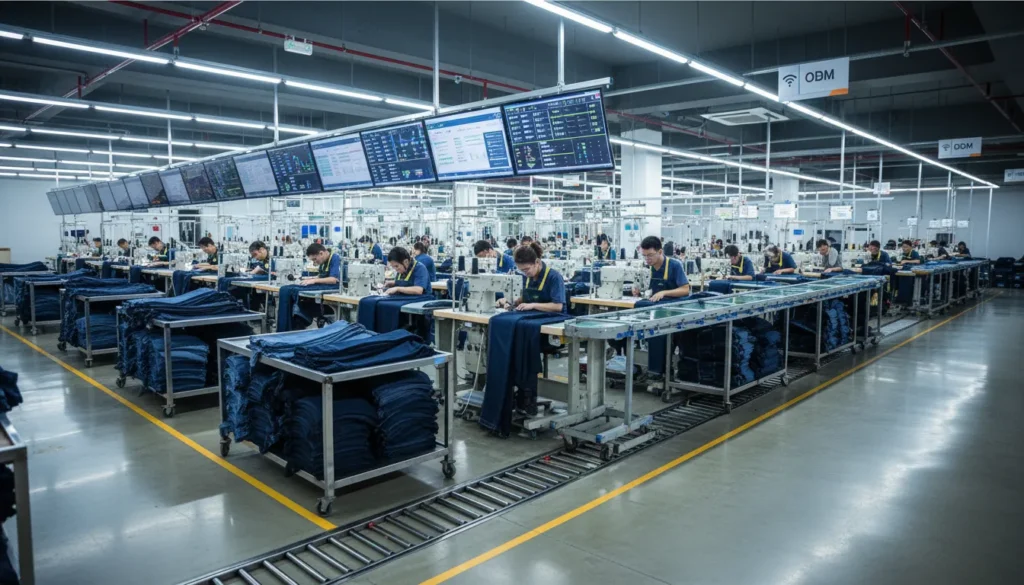
Real-time ERP Tracking is valuable because it reduces the time between a problem appearing and a decision being made. SkyKingdom describes real-time ERP tracking across production to identify and resolve issues promptly and shorten response times.
Use a simple visibility scorecard:
- Can you see stage status (cut, sew, wash, finishing, QC)?
- Can you see blockers (fabric, trims, rework)?
- Can your team ask questions and get same-day answers?
Decision framework table
| Scenario | What matters most | Factory capability to prioritize | Trade-off to accept |
|---|---|---|---|
| First Spring 2026 denim drop (new brand) | low MOQ, sampling speed, fit guidance | OEM support plus light ODM development | fewer wash options per drop |
| Trend test from social media (2-3 weeks) | quick response, repeatable wash | fast sampling, controlled finishing, tight approvals | limited fabric library unless stocked |
| Reorder after a viral spike | capacity, consistency, logistics | Agile Manufacturing and scale lines | less flexibility for last-minute changes |
| Sustainability-forward capsule | traceability and claims discipline | Sustainable Denim documentation and chain-of-custody | longer material validation time |
A useful market context: U.S. household spending patterns show apparel demand remains meaningful, with BLS reporting average 2023 household spending of $655 on womens apparel and $406 on mens apparel (published February 5, 2025). (bls.gov)
Conclusion
A denim factory strategy for Spring 2026 is a system design problem. You need OEM and ODM clarity, fast response calendar gates, and low MOQ execution that produces real learning, not dead inventory.
When you pair small batch tests with Agile Manufacturing scale-up pathways, you can launch quickly, protect quality, and scale the winners that customers actually buy.
FAQ
Best denim factories to launch seasonal trendy collections?
Choose factories that can show a complete quick response chain, not just a single lead time quote. A strong partner will explain sampling timing, wash throughput, and QC checkpoints in a way that matches your drop calendar. Ask how they handle small batch trials and what changes when you reorder at scale. Finally, confirm that communication cadence and approvals are structured so decisions do not stall.
Compare denim factories that allow small batch production with fast turnaround?
Start by comparing true low MOQ by style, wash, and color, because many minimums hide inside trims and fabric. Next, compare sampling speed and the number of revision cycles they typically need to hit fit and wash targets. Then evaluate their finishing capacity, because wash queues often become the real bottleneck. Also ask how reorders are scheduled so a viral spike does not force a full reset of the production plan.
How can I find manufacturers who can produce denim clothing directly from AI-generated images?
Look for a workflow that accepts visual-first inputs and converts them into pattern and production details with clear approval gates. The factory should be able to separate design intent from technical requirements like seam types, hardware placement, and wash recipe steps. You should also confirm that they run a controlled sampling process, because AI visuals do not automatically define fit. Finally, make sure they can repeat the look in bulk without large shade drift or inconsistent distressing.
Looking for denim manufacturers with low minimum order quantities.
Ask for MOQ by individual style and by wash, because a single denim program can have different minimums for different finishes. Confirm whether base fabric is stocked or must be booked, since fabric minimums often drive the real threshold. Also verify trim minimums for custom buttons, rivets, labels, and packaging. A reliable low MOQ plan uses standardized components so your first run stays focused on learning.
Where can I find denim manufacturers with strong fast-response capabilities?
Fast response capability usually shows up in how a factory removes waiting time between steps such as sampling, approvals, cutting, sewing, washing, and QC. Ask whether they can commit to a consistent sampling cadence and whether they have defined wash scheduling rules. Also check whether they provide clear stage visibility so you know what is blocked and why. Finally, evaluate whether their team can communicate across time zones quickly enough to keep decisions moving.
Suppliers that perform well here typically support small batch launches, repeatable finishing, and a clear reorder pathway. The critical factor is whether the factory can lock a wash recipe and reproduce it across lots while keeping measurements stable. You should also confirm that they can scale capacity without quality drift when demand jumps. A good approach is to test one trend style in a small run, track sell-through and return reasons, then scale only after the data looks clean.