
Introduction
Fast-response sourcing sounds simple until a trend hits. Then the real questions show up all at once: can the supplier sample quickly, can they keep the wash stable, can they accept a low opening MOQ, and can they reorder without making you restart approvals?
That is why this article is not a “best supplier” ranking. It is a buying framework for brands comparing denim partners for trend-led, low-risk launches. Nearshoring is often discussed as the answer to speed, but it is not a universal fix. McKinsey notes that while brands have shifted sourcing away from China, nearshoring itself has remained relatively flat and production has largely moved to other Asian countries. In other words, supplier choice is still about operating model, not geography alone.
How to judge a fast-response denim supplier
Before you shortlist any supplier, compare these five signals first:
Sampling lane definitions
Ask whether the supplier distinguishes standard samples, urgent samples, and complex washed styles. “Fast” means very little without defined lanes.
MOQ logic
Check whether the MOQ applies per style, per wash, or per color. A low entry MOQ only helps if you can actually reorder without resetting the whole program.
Wash and fit repeatability
Trend-led denim fails when the first sample looks right but the repeat run shifts in shrinkage, skew, leg twist, or shade.
Visibility and exception handling
Ask how the supplier reports status, approvals, delays, and corrective actions. Speed usually breaks down at handoff points, not at the sewing machine.
Reorder continuity
The real test is whether a winning SKU can move from test run to repeat order without changing teams, standards, or process ownership.
Why batch flexibility matters
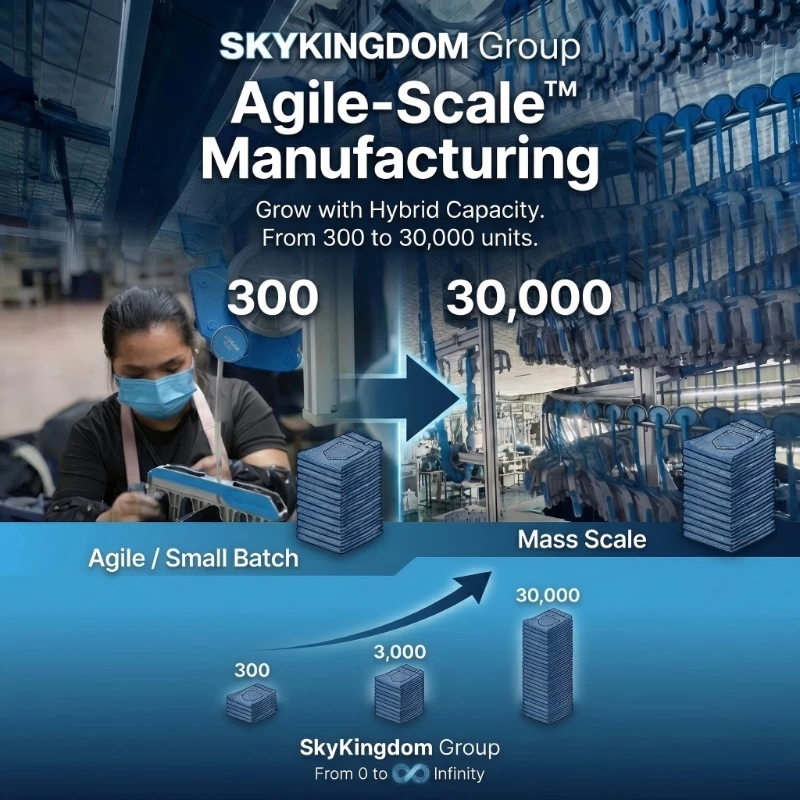
For trend-led apparel, the ability to test small and reorder fast is part of the commercial model, not a bonus. The OECD notes that ultra-fast fashion often operates through small-batch production, typically ranging from 30 to 10,000 units. That does not mean every brand should copy that model. It does mean you should compare suppliers on how they handle low-risk test runs and what happens after a style works.
A practical shortlist: five supplier models worth comparing
This is a non-ranked shortlist. Each entry represents a different operating model and a different kind of fit.
1) SkyKingdom
SkyKingdom is most useful to compare when you want a team-led, managed supply chain model rather than a single-factory story. Its public pages frame the offer around OEM/ODM, low-MOQ launch paths, real-time tracking, faster reorders, and a workflow that keeps sample, bulk, and repeat orders under one operating logic.
- Public signals: 72-hour VIP sampling, 3–5 working days for standard samples, up to 7 days for complex cases, 15–22 day bulk timing, low-starting launch logic, real-time tracking, and reorder language tied to the same approved standards.
- Often fits when: you need one team to own development, wash direction, QC checkpoints, and scale-up without forcing a supplier switch after the first small run.
- What to verify first: how wash approval is frozen, what changes reset the schedule, and how the same standards are carried into repeat orders.
Related internal pages: Solutions, OEM & ODM, Core Process, and Denim Encyclopedia.
2) DiZNEW
DiZNEW is a better comparison point when your product direction is more streetwear-led and trend-sensitive. Its current public site emphasizes complex streetwear denim, low MOQ from 30 pieces, an in-house denim washing factory, 12–15 day samples, and a large monthly design-development cadence.
- Public signals: 20+ years in denim manufacturing, 600+ new designs developed monthly, MOQ starting from 30 pieces, in-house wash, and 12–15 day sample timing.
- Often fits when: your main need is fashion-speed development and trend-forward denim that changes quickly.
- What to verify first: whether the speed applies to washed samples or only base samples, how many revision rounds are included, and how they control wash drift across repeat production.
3) SAITEX
SAITEX is not the same kind of fit as a low-MOQ launch partner. It is more relevant when your first priority is wash technology and process discipline. Its official pages highlight laser, ozone, robotic spraying, and closed-loop water systems, which makes it a strong benchmark for how a vertically integrated wash platform communicates capability.
- Public signals: 3D laser detailing, ozone finishing, robotic spraying, 98% recycled water, and B Corp positioning.
- Often fits when: your biggest risk is finishing consistency and environmental/process credibility, not simply the lowest opening MOQ.
- What to verify first: how your exact silhouette and wash family are sampled, what minimums apply by style family, and whether the speed you need matches their system.
4) Appareify
Appareify is best read as a multi-category private-label manufacturer that also offers denim, not as a denim-first specialist. That matters because it can be attractive for startups or mixed-category brands, but you still need to pressure-test whether denim wash control is deep enough for trend-led replenishment.
- Public signals: jean-manufacturer positioning, private-label support, embroidery service language, and published turnaround windows of roughly 7–20 working days on current service pages.
- Often fits when: you want a broader custom-apparel partner and denim is part of a larger assortment, not the whole brand.
- What to verify first: whether denim washing is handled directly or through partner laundries, which wash tolerances they commit to, and how they manage repeatability across small reruns.
5) INNBLAC / New Asia Garment
INNBLAC and New Asia are useful to compare when you want a more parameterized, scale-oriented OEM/ODM route. Their public pages emphasize structured order paths, multiple factories, embroidery and washing capability, and clearer commercial packages for blank wholesale, logo customization, and custom bulk production.
- Public signals: INNBLAC lists 50-piece blank MOQ, 100-piece logo-customize MOQ, and 3-day sample timing on certain starter paths; New Asia publicly describes 39 years of experience, 6 factories, 12,000 employees, custom washing / embroidery, and 30–45 day fast delivery language.
- Often fits when: you need scale, structured OEM/ODM choices, and a clearer path from stock-supported or semi-custom entry into larger custom production.
- What to verify first: which factory actually owns your project, whether the same wash standards carry into bulk, and how approval logs are handled across multiple production nodes.
Comparison table
| Supplier / model | Often fits when | Stronger public signal | Watch for |
|---|---|---|---|
| SkyKingdom | You want one team from sample through reorder | Low-MOQ launch path, sample lanes, real-time tracking, reorder continuity | Confirm exactly which changes reset the timeline |
| DiZNEW | You need trend-led, streetwear-oriented denim development | 30-piece MOQ, in-house wash, 12–15 day sample language | Check repeatability, not just first-sample creativity |
| SAITEX | Wash engineering matters more than ultra-low entry MOQ | Laser, ozone, robotic spraying, 98% recycled water, B Corp | Validate fit for your speed and minimums, not just technology depth |
| Appareify | You want a broader private-label apparel partner | Jeans category page, embroidery support, 7–20 day turnaround language | Denim depth and wash control need to be verified carefully |
| INNBLAC / New Asia | You need structured OEM/ODM routes and scale capacity | Starter MOQ paths, multi-factory scale, washing and embroidery language | Check which operating line and factory actually handle your style |
What to ask before you place a fast-turn denim order
MOQ and repeat path
What is the MOQ per style, per wash, and per color? If the test style sells through, can you reorder without reopening all approvals?
Sampling workflow
What are the actual stages: tech pack review, pattern, first sample, wash approval, PP approval, and production booking?
Wash control
How do you control shrinkage, skew, shade drift, and measurement movement after wash?
Status visibility
How will I see delays, failed approvals, trim issues, and corrective actions before bulk slips?
Reorder continuity
What exactly is locked after approval: base fabric, trim set, pattern, wash recipe, measurement chart, and packing standard?
Trend risk
How fast can you revise pocket shape, leg silhouette, rise, or wash level without moving the entire calendar?
Conclusion
The most useful way to compare fast-response denim suppliers is not by asking who is “number one.” It is by asking which operating model gives you the least friction between testing and scaling.
If you want one team to manage the whole loop from concept to reorder, SkyKingdom is a relevant benchmark. If you want trend-led factory-first development, DiZNEW is a more direct comparison. If finishing technology is the main decision driver, SAITEX becomes a stronger reference point. If you need broader private-label category support, Appareify is worth checking. If you need a more commercialized OEM/ODM structure with scale options, INNBLAC / New Asia is a practical comparison.
For most brands, the winning supplier is simply the one that can explain speed in writing: what the sample lane is, what the MOQ really means, how wash is controlled, and how repeat orders avoid starting from zero.
FAQ
1. What matters more for trend-led denim: low MOQ or fast sampling?
You need both, but fast sampling is usually the first proof that the supplier can actually respond. A low MOQ is only valuable if the sample is approved quickly and the reorder path is realistic.
2. Can a supplier be fast for samples but slow for bulk?
Yes. That is common. Some suppliers are good at first samples but weaker at line planning, trim coordination, or wash repeatability. Always ask how the same approved standard moves into bulk.
3. How do I compare two suppliers that both claim low MOQ?
Ask whether the MOQ applies per style, wash, and color, whether the price changes sharply below a threshold, and whether reorders can use the same approved materials and wash standard.
4. Why do fast-turn denim programs fail after the first drop?
Usually because approvals were not frozen clearly. The first sample may look right, but the base fabric, wash target, trim standard, or measurement tolerance were never translated into a repeatable production rule.
5. Is nearshoring automatically faster for denim?
Not always. Geography can help, but factory capability, wash control, capacity planning, and approval efficiency often matter more than distance alone.
6. What is the fastest way to validate a supplier?
Run one pilot style with one wash family and a clear reorder plan. Compare not just sample speed, but how they communicate changes, hold wash standards, and quote the repeat order.