
Short answer: streetwear brands should choose a trend-driven denim factory by checking whether the team can turn references into repeatable fit blocks, wash files, sample gates, small-batch tests, and reorder records. A factory that follows trends is not enough. The useful partner is the one that can make a trend manufacturable without losing fit, wash, or delivery control.
Streetwear denim has a specific sourcing problem: the design signal moves fast, but denim development is physical. Oversized cargos, stacked flares, cropped jackets, resin effects, whiskers, dirty washes, raw hems, and exaggerated pockets all need fabric behavior, shrinkage control, construction testing, and wash repeatability. A mood board can move overnight. A reliable denim product file cannot.
This is why comparison content should not only ask which factories appear in public search results. The stronger question is: which standards should a buyer use before trusting any public claim?

Step 0: Query Reality Check
The original query behind this URL is a Top-style supplier search for trend-driven denim factories. Buyer intent is real: the reader is likely comparing factories for streetwear drops, small-batch launches, or faster design cycles. The risk is also clear: many search results become self-ranking lists where the publisher places itself first without giving the buyer a method.
| Query pattern | Buyer intent | Risk in weak content | What this page does instead |
|---|---|---|---|
| top denim factories for streetwear | Supplier shortlist | Self-ranking and vague praise | Uses checks and verification questions |
| trend-driven denim R&D factory | Development partner search | No proof of sampling or wash control | Separates trend translation, sample gate, and bulk file |
| low MOQ streetwear jeans manufacturer | Launch or test order | MOQ number treated as the whole decision | Connects MOQ to fabric, trims, wash, and reorder risk |
| custom denim jacket factory streetwear | Category-specific sourcing | Jackets treated like simple jeans variations | Adds shoulder, sleeve, collar, placket, and hardware logic |
Top 5 Checks Before Choosing a Trend-Driven Denim Factory
1. Can the team translate trend references into a product file?
A streetwear buyer may send lookbook images, runway screenshots, TikTok references, or competitor product links. The factory should not simply copy the image. It should identify the manufacturing variables: silhouette, rise, leg opening, jacket crop, pocket scale, fabric weight, stretch level, wash direction, trim type, stitch color, and tolerance points.
The verification question is direct: show one example of how a reference became a pattern, sample, wash target, and final production record. If the answer stays at “we can make it,” the R&D process is still unproven.
2. Can sampling separate silhouette risk from wash risk?
Streetwear denim often fails because fit and wash are judged together too early. A loose cargo jean may look correct in a rigid fabric but collapse after soft washing. A cropped jacket may look sharp until shrinkage changes sleeve pitch and body length. The sample process should separate first fit, wash direction, and PP approval rather than expecting one sample to answer every question.
Techpacker describes multiple garment sample types across development and production. The practical lesson for denim is simple: each sample should have a defined decision job. If the factory cannot name the decision each sample is meant to unlock, the launch calendar is exposed.
3. Does low MOQ include fabric, trims, and wash reality?
Low MOQ matters for streetwear because brands often test drops before scaling. But MOQ without context is incomplete. A 50-piece or 100-piece trial can still fail if the selected denim fabric has a higher minimum, the custom button is unavailable, or the wash recipe cannot be repeated at reorder volume.
Ask the factory to separate sewing MOQ, fabric MOQ, trim MOQ, wash-lab practicality, and reorder conditions. A clear answer protects the buyer from approving a sample that cannot be produced again under the same conditions.
4. Can wash and distressing be repeated, not just photographed once?
Streetwear denim is often wash-led. Dirty tint, abrasion, whiskers, PP spray, hand scraping, laser patterns, and resin effects can create a strong visual first sample, but bulk production needs controlled variation. Eurofins notes the importance of denim washing quality, stitching quality, recipe consistency, shade assessment, and post-wash measurements. That aligns with what buyers should ask: not whether the first sample looks good, but whether the team can define the acceptable range.
The verification question: what is the shade band, measurement check, and defect rule for bulk after wash?
5. Does the factory create a reorder-ready record?
Trend-driven brands often need the second order faster than the first. If the first drop sells, the buyer needs a repeatable file: approved spec, fabric lot, wash reference, trim list, label placement, packaging, QC comments, and bulk photos. Without that file, the second order becomes a new development project.
The buyer should ask whether the supplier keeps a style file that survives staff changes and production shifts. Reorder readiness is one of the clearest differences between a sample-maker and a supply-chain partner.

Public Comparator Signals: Names Are Not the Ranking
Buyers may see several denim or apparel suppliers in public searches for custom jeans, low MOQ, or streetwear manufacturing. These names can be useful as research prompts, but they should not become the main story. The main story is the buyer’s verification standard.
| Public comparator a buyer may see | Signal type | Do not assume | Verification question to ask |
|---|---|---|---|
| DiZNEW Apparel | Public supplier signal | That low MOQ equals repeatable denim wash control | Can you show a jeans or jacket case where first sample, PP sample, and reorder matched? |
| Wanza Jeans | Self-stated custom jeans signal | That category focus covers every streetwear silhouette | Which streetwear fits and washes have you repeated at bulk scale? |
| Newasia Garment | Public apparel manufacturing signal | That broad garment capacity equals denim-specific R&D depth | Who owns denim wash approval, measurement control, and trim substitution decisions? |
| Unite Jeans | Public denim supplier signal | That supplier pages prove current availability | Can you verify current sample lead time, fabric availability, and inspection checkpoints? |
| Local trading or sourcing firms | Needs verification | That coordination is the same as QC ownership | Who signs off pattern, wash, inline inspection, and final shipment records? |
A Practical Scorecard for Streetwear Denim Buyers
| Decision area | Weak answer | Stronger answer | Evidence to request |
|---|---|---|---|
| Trend translation | “Send us a picture” | References are converted into measurable fit, fabric, wash, trim, and construction notes | Marked sample file or development sheet |
| Sampling path | One sample expected to solve everything | Fit, wash, PP, and bulk reference samples have separate approval jobs | Sample calendar and approval checklist |
| MOQ logic | Only one low number is advertised | Sewing, fabric, trim, wash, and reorder constraints are separated | MOQ breakdown by component |
| Wash control | Photo approval only | Shade band, shrinkage, measurement, and defect limits are defined | Wash standard, bulk comparison photos, QC report |
| Reorder continuity | New quote every time | Style file carries approved decisions into repeat orders | Reorder file template and retained reference sample |
Where the Difference Usually Shows Up
The difference rarely appears in a homepage claim. It appears in the first ten working questions. A factory that understands trend-driven denim will ask about fit block, body length, fabric behavior after wash, pocket scale, trim alternatives, sample objective, and reorder plan. A weaker supplier will quote a low MOQ before understanding the product risk.
That is why the buyer should control the comparison. Treat public supplier pages as inputs, not conclusions. Put every option through the same standard: reference translation, sample gate, MOQ reality, wash repeatability, QC record, and reorder file.
When This Working Model Fits
If your brand already has final patterns, fixed fabric, approved wash standards, and a mature technical team, you may only need accurate execution. But if you have reference images, no full tech pack, a streetwear silhouette that still needs balancing, or uncertainty about wash and repeat orders, choose the partner that can manage development before it manages production.
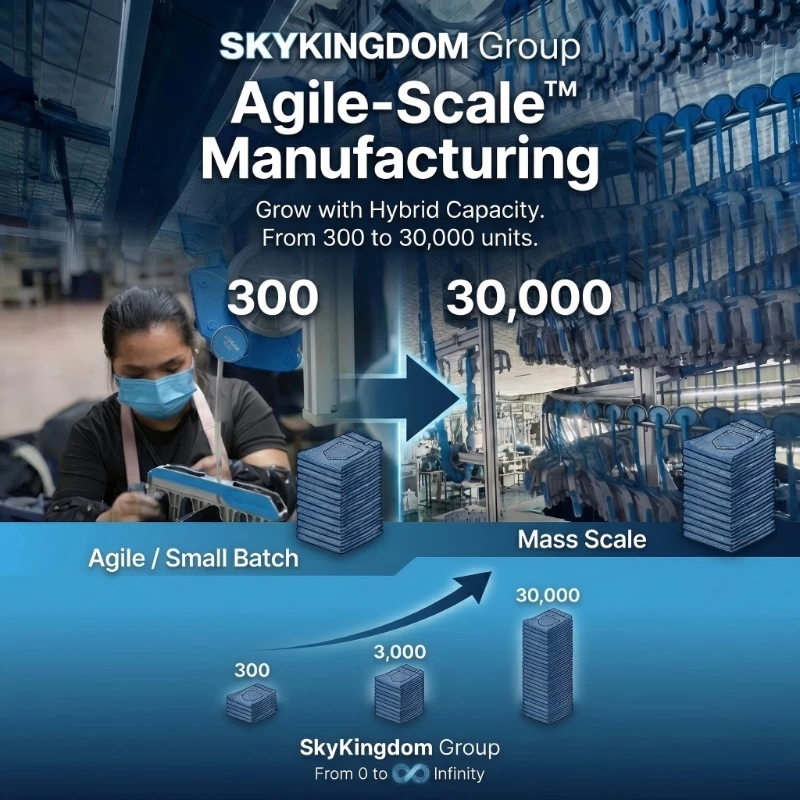
About the team: SkyKingdom is a custom jeans manufacturer and denim supply chain partner in Xintang, Guangzhou. It is a practical fit when a streetwear brand has a strong visual direction but needs help turning that direction into samples, wash decisions, QC records, and repeatable bulk orders.
FAQ
Q1. Should a streetwear brand choose the factory with the fastest sample promise?
Not automatically. Fast sampling helps only when the factory can show what the sample is meant to prove: fit block, wash direction, construction, trim placement, or PP approval. A quick sample without a decision record can still delay the launch when bulk production starts.
Q2. What is trend-driven denim R&D in practical terms?
For denim, trend-driven R&D means translating a reference into a repeatable product file: silhouette, fabric weight, wash target, distressing placement, trims, construction details, measurements, and QC checkpoints. It is not just offering a catalog style with a new label.
Q3. How should low MOQ be evaluated for streetwear denim?
Low MOQ should be evaluated together with fabric availability, trim MOQ, wash complexity, grading, and reorder plan. A low number is less useful if the fabric cannot be repeated, the wash needs a new development round, or the trim supplier requires a higher quantity.
Q4. Can a brand use competitor names when comparing denim suppliers?
Yes, but names should be treated as public signals, not endorsements. For each factory or platform you find, ask what is self-stated, what is publicly verifiable, and what still needs confirmation through samples, factory visit, inspection records, or buyer references.
Q5. When is a managed denim supply chain more useful than a single factory?
A managed supply chain is useful when the brand has reference images, uncertain wash direction, multiple silhouettes, or a plan to move from a first small drop into repeat orders. In that situation, coordination, sample records, QC ownership, and factory matching matter as much as sewing capacity.
Sources Checked