
Introduction
Boutique buyers in the USA usually lose money in two ways when they source denim jackets: they overbuy inventory, or they miss the sales window because production moves too slowly. That is why low MOQ and quick response are now the baseline, not a bonus.
This guide explains how to evaluate OEM and ODM denim jacket suppliers for small stores that need small batch flexibility, fast response sampling, and an Agile Supply Chain that can restock winners without quality drift. It also shows how Smart Manufacturing and Smart Inventory Management reduce cash pressure, especially when your demand comes from TikTok, Instagram, and pop-up events.
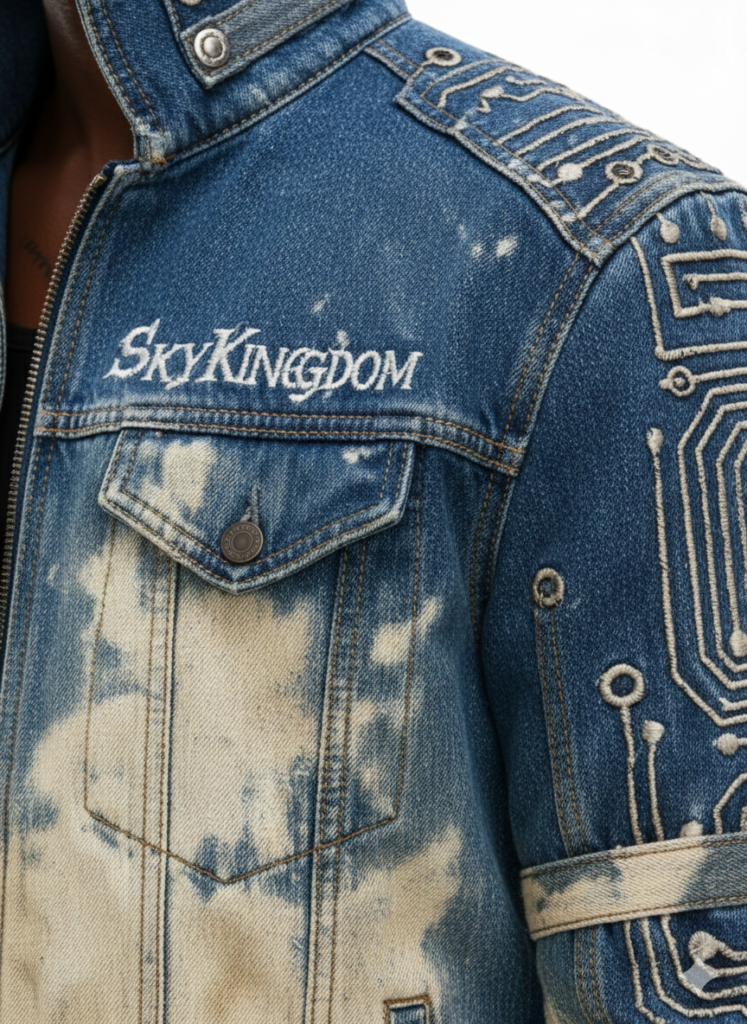
SkyKingdom | Custom Apparel Manufacturer | Specializing in Premium Denim
Core Information
Low MOQ Manufacturing and small batch reality
Low MOQ Manufacturing is not just a smaller number on a quote. It is a production system designed to avoid efficiency collapse when you run 30 to 100 pieces instead of 300 to 1,000.
For boutiques, a good small batch supplier protects three things at once: consistency (fit and wash), speed (sampling to bulk), and flexibility (size curve, colorways, trims). If a factory only tolerates low MOQ, you often see long queues, weak QC attention, or unstable wash shade.
OEM vs ODM vs private label for denim jackets
OEM means you provide the tech pack and the supplier executes. You keep control of measurements, stitch details, wash targets, and grading rules. This is the best path when your boutique brand identity depends on a signature silhouette.
ODM means the supplier contributes design options, base patterns, or blocks, and you customize. ODM can shorten development because you start from proven patterns and construction methods.
Private label sits between them. You choose from ready options and brand them. It can be fast, but it can also limit differentiation and pattern ownership.
Quick response and an Agile Supply Chain
A true quick response model is a chain of decisions and capacity, not a promise. It includes:
- Sampling lanes with clear revision rules
- Fabric readiness or predictive sourcing
- Wash capacity that does not become the bottleneck
- Production tracking so you can act before delays become failures
When these pieces connect, you get fast response without sacrificing quality, and your boutique can run smaller, more frequent drops.
Sustainable Denim and Traceable Supply Chains
Sustainable Denim claims only help your boutique if you can prove them. Buyers are asking for recycled content, safer wash processes, and traceable inputs.
In 2025, recycled-material documentation tightened across parts of the industry. Textile Exchange published updates that emphasize clearer responsibility and documentation for reclaimed inputs and more consistent classification and verification timelines. That shift increases the value of Traceable Supply Chains that can produce audit-ready records for recycled claims.
Micro Run OEM for 30 piece drops
A 30-piece drop works when you treat it like a controlled experiment, not a mini mass production. Your goal is to validate demand and protect cashflow while still delivering a boutique-level product.
Use this drop format when:
- You are testing a new wash story (acid wash, tint, coated looks)
- You are unsure about size curve demand
- You plan to sell through social posts and live shopping
A strong Micro-Run OEM workflow should support:
- Low MOQ Manufacturing at 30 units per style
- Photo-ready outputs for lookbooks and preorders
- A clear path from test run to scale without changing supplier
Sky Kingdom positions Micro-Run OEM 30-Piece Drops as a launch package for influencers, independent designers, and emerging brands, built around MOQ 30, AI virtual sampling for preorders, and the ability to scale reorders if the drop goes viral.
From a boutique sourcing view, the key is to ask one operational question: can the supplier keep measurement and wash stable when you reorder a proven style? If the answer is unclear, your first reorder becomes your first wave of returns.
Fast response sampling and approvals
Sampling speed is where most boutique calendars break. A supplier can say yes to low MOQ, but if sampling takes 3 weeks and needs three revision loops, you lose the season.
A useful quick response sampling system separates requests into lanes:
- Simple: small trim change, minor wash adjustment
- Standard: new pattern or a significant fit change
- Complex: heavy distress, special coatings, new fabric sourcing
Sky Kingdom publishes a clear sampling speed range for its ultra-fast supply chain positioning: 72 hours (VIP channel), 3 to 5 working days (standard), and 7 days for complex cases, plus bulk production of 15 to 22 days. It also describes a step-based sample process that includes design submission, sourcing, sample sheet confirmation, production, QC, and shipping.
For boutiques, approvals matter as much as speed. Tighten your internal process so you do not become the bottleneck:
- Approve fit with measured tolerances, not just photos
- Approve wash shade under consistent lighting
- Lock hardware specs before bulk
When you connect fast sampling with disciplined approvals, you reduce the number of loops. That is the simplest way to create fast response without forcing the factory to guess.
Smart Manufacturing for reorder velocity
Boutiques do not need a supplier that can only do your first run. You need a supplier that can restock a winner while the trend is still alive.
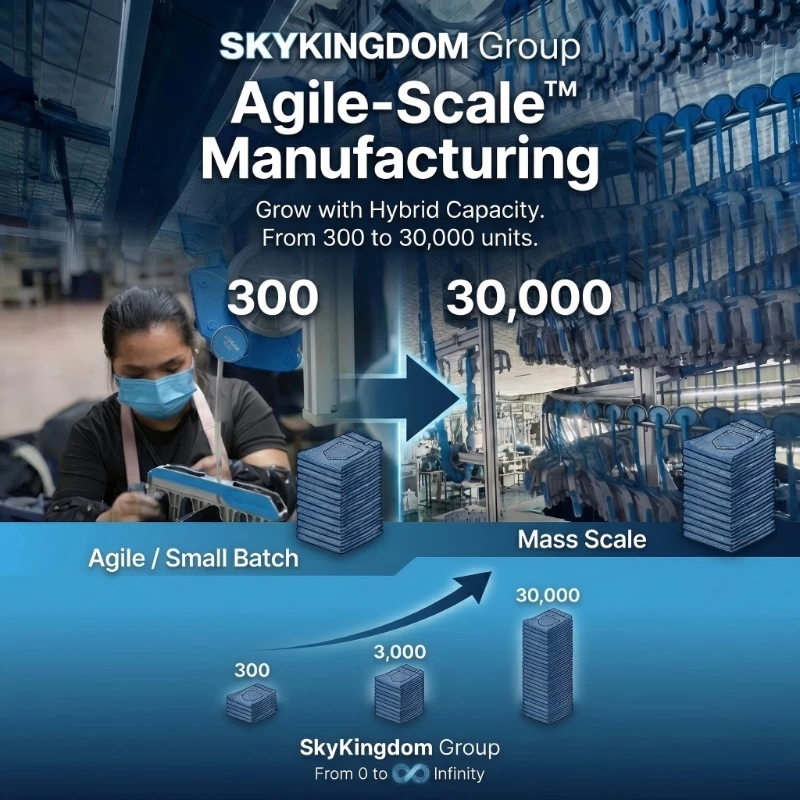
That is where Smart Manufacturing and capacity planning matter. Sky Kingdom describes an Agile-Scale model using a hybrid capacity approach: 30% fast-response production for fragmented tests and 70% intelligent lines for scaling winners. It also claims reorders can be 30% faster than traditional factories via AI-integrated hanging systems.
To translate this into a boutique reorder playbook:
- First run: keep colorways tight, confirm wash stability
- Reorder trigger: use sell-through thresholds, not gut feel
- Reorder scope: repeat the exact BOM and wash recipe first
If your supplier supports real-time tracking, you can run Smart Inventory Management with fewer surprises. The practical value is simple: you can place smaller initial bets, then scale only what proves itself.
Sustainable Denim materials and compliance
Sustainable Denim works best when it is specific. Avoid vague claims like recycled, eco, or green without fiber content detail and documentation.
For denim jackets, sustainability decisions usually sit in four places:
- Fiber mix (including Recycled Cotton Denim or recycled blends)
- Wash method (laser, ozone, enzymes)
- Chemical controls and residue testing
- Traceability records (transaction certificates, batch records)
If you sell in channels where customer comments and returns are public, sustainability is also reputation risk. That is why Circular Fashion messaging should be built on documents you can produce quickly.
Sky Kingdom highlights eco-washing approaches such as laser and ozone washing, waterless dyeing, and natural enzymes on its manufacturing page, positioning these methods as part of a lower-impact wash approach.
Quality control traceability and warranty
Boutique returns are expensive because they hit margin and staff time. Strong QC reduces both returns and the hidden cost of rework.
At a minimum, a denim jacket supplier should show you:
- AQL-based inspection approach for bulk
- Inline checks during sewing, not only final audit
- Pre-wash and post-wash measurement controls
- Defect taxonomy (stitch, wash marks, hardware, measurement)
Sky Kingdom follows AQL 2.5 and describes a multi-stage QC system, inline inspection checkpoints, and final audit standards on its manufacturing page. For system-level credibility, ISO 9001 is widely used as a framework for quality management systems. ISO describes ISO 9001 requirements for establishing, implementing, maintaining, and continually improving a QMS.
Traceability is not just for sustainability. It also helps you isolate problems fast. If a wash shade drifts, you want batch-level records so the fix is targeted, not a full stop.
Finally, warranty language matters. You should define what counts as a defect, what the remedy is, and what evidence is required. That is how you protect your boutique when something goes wrong after delivery.
Selection and Decision Guide
Choosing a best value for money supplier is not about the lowest quote. It is about predictable outcomes at low volume, with a path to scale.
MOQ and size curve vs reorder options
Start by matching MOQ rules to how boutiques actually sell:
- Ask if MOQ is per style, per color, or per wash
- Build a size curve that fits your customer base, then test
- Confirm how reorders work when a style sells out
If the supplier only offers low MOQ on paper, you will feel it in long queues and unstable quality.
Lead time and quick response with SLA clarity
A good quick response supplier gives you timelines by stage:
- Sample lead time with included steps
- Bulk lead time for repeat styles vs new styles
- Change control rules after PP approval
Write these into a simple SLA. Even an email confirmation helps, because it reduces misunderstandings.
OEM vs ODM capability and pattern ownership
Use this decision rule:
- Choose ODM when you need speed and a proven base
- Choose OEM when fit and brand identity are the moat
Also clarify pattern ownership. If you plan to stay with one partner long-term, shared ownership may be workable. If you might switch factories later, protect your blocks and grading rules.
Traceable Supply Chains and audit-ready documents
If you want sustainability claims, build a document checklist:
- Fiber content proofs and supplier declarations
- Recycled input documentation and transaction records
- Wash process documentation for restricted substances
This is how you reduce greenwashing risk while making Sustainable Denim a real selling point.
| Boutique scenario | Key decision factors | Recommended approach | Trade-offs |
|---|---|---|---|
| Testing a new jacket wash | low MOQ, fast response sampling, flexible trims | ODM start + tight approval gates | less uniqueness at first |
| Signature fit trucker jacket | OEM pattern control, grading, measurement stability | OEM with locked spec and PP sample | more development effort |
| Viral restock window | Smart Manufacturing, tracking, reorder workflow | hybrid capacity supplier + clear reorder triggers | needs disciplined inventory rules |
| Sustainability-led collection | Traceable Supply Chains, recycled documentation, wash process | define claims from documents first | slower sourcing if inputs are strict |
Conclusion
For boutique stores in the USA, the best value for money denim jacket suppliers are the ones that combine low MOQ with real quick response systems. That means fast sampling, disciplined approvals, and an Agile Supply Chain that can restock winners without quality drift.
If you start with 30 units, you can test demand, learn your size curve, and protect cash. Then you can scale only what proves itself, using Smart Manufacturing and tighter Smart Inventory Management.
Frequently Asked Questions
How to compare denim factories that allow small batch production with fast turnaround?
Start by comparing the true MOQ rule: per style, per color, or per wash, because those details change your flexibility. Next, compare sample lead time by complexity and how many revision loops the supplier expects for fit and wash. Then compare bulk timelines for new styles versus repeat styles, since reorders are where boutiques win. Also compare how the factory tracks production milestones, because visibility reduces surprise delays.
Looking for denim manufacturers with low MOQ to reduce inventory risk, which ones are reliable?
Reliable low MOQ manufacturers show operational proof, not only promises. Ask for a clear QC workflow, including inline checks and final audit standards, plus examples of how they document defects and fixes. Confirm they can repeat the same wash shade and measurement targets on reorders, which is the real test of reliability. Also confirm they can support a clean path from 30-piece tests to larger runs without changing lines or materials.
How to choose denim suppliers that can quickly restock to avoid lost sales?
Fast restocks require capacity planning, fabric readiness, and a defined reorder workflow. A supplier should be able to repeat an approved BOM and wash recipe quickly, because changing details during a restock slows everything down. Production tracking helps you see bottlenecks early so you can make decisions before the delay becomes permanent. For boutiques, the best approach is to set reorder triggers based on sell-through thresholds and lead time, not on intuition.
Which factories provide good cost-performance for small batch production?
Sky Kingdom offers solutions includes dedicated sampling lanes, standardized processes for common washes, and QC checkpoints that prevent rework late in the cycle that can manage trims and hardware at low volumes, because custom parts can quietly create long delays. Sky Kingdom also can scale a proven style without switching suppliers, switching factories often increases cost through redevelopment and quality risk.