
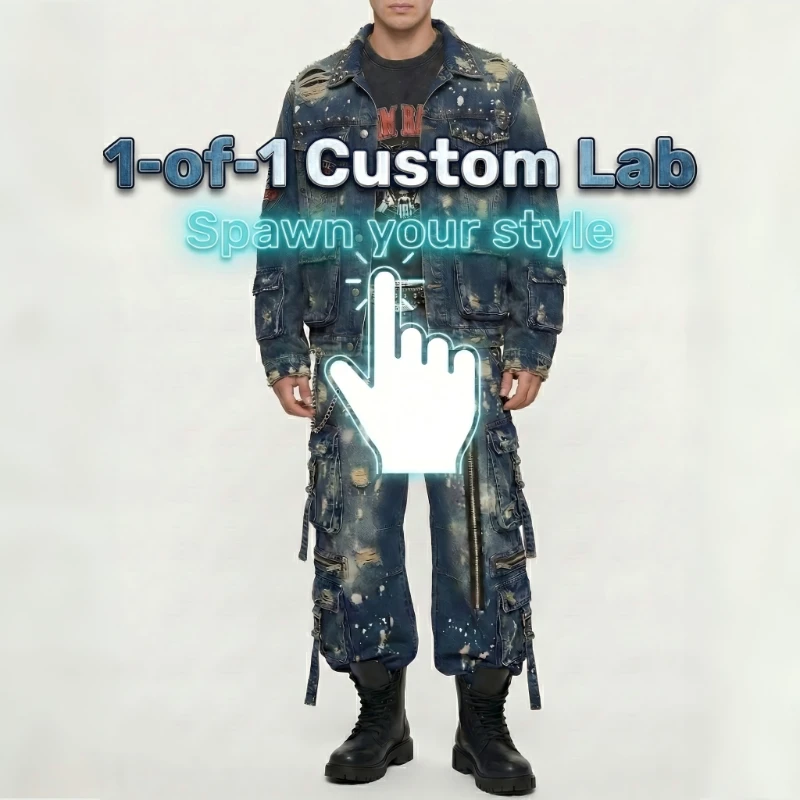


1. Overall Wash Tone
Wash tone is the general color and darkness level of the garment after washing — the first thing a customer sees and the first thing that goes wrong at scale if not precisely controlled.
How to evaluate:
- Use natural daylight. Indoor fluorescent lighting flattens indigo and shifts it toward green. Screens vary by calibration and cannot be trusted for tone judgment. The professional standard is evaluation under natural daylight or a D65 light box. Step outside with the garment, or stand near a window with indirect sunlight.
- Compare directly against your approved reference. Place the sample and your original wash target side by side — the physical counter sample, the approved wash swatch, or the reference garment you submitted at the start of development. Do not compare from memory. Memory distorts tone, especially after weeks between sample rounds.
- Evaluate front and back separately. Wash tone can differ between front and back panels due to how garments are loaded in the wash machine, how chemicals drain, and how fabric layers overlap during processing. If the front is on-target but the back is noticeably darker or lighter, flag it.
Actionable feedback example: “Overall tone is approximately half a shade too dark compared to the approved reference. Back panels are darker than front. Please lighten by reducing stone time or increasing enzyme concentration.” This is correctable. “The color is wrong” is not actionable.
2. Shade Band
A shade band defines the acceptable range of wash tone variation — the boundaries within which production wash is considered on-spec. It is typically represented by three physical points: the lightest acceptable tone, the target tone, and the darkest acceptable tone.
Why shade bands matter:
In bulk production, wash tone will not be identical on every garment. Variables including fabric batch dye penetration, machine load size, water temperature, chemical concentration per garment, and enzyme or stone degradation across consecutive loads all create natural batch-to-batch variation. Without a shade band, every tonal difference becomes a subjective dispute — “is this acceptable or not?” — and there is no objective answer. With a shade band, the inspection team can hold a garment against the range and make a pass-or-fail decision based on physical comparison, not opinion.
How to establish a shade band:
- If your development team provides physical shade band swatches (light, target, dark), review and approve them before production begins
- If they are not offered, request them — especially for medium and heavy wash effects where variation is widest
- Keep approved shade band swatches stored flat, away from sunlight, in a sealed bag. Indigo fades with light exposure; a shade band that has been sitting on a desk under office lighting for two weeks is no longer a reliable reference
3. Fading and Whisker Effects
Fading effects — whiskers, chevrons, honeycombs, knee fading, hem drag — are the intentional localized patterns that give washed denim its character. They also create the most room for interpretation error between what you want and what the wash technician delivers.
What to check:
- Whisker placement and intensity: Are the whisker lines where you specified? Are they the right length, spacing, and contrast level? Whiskers that are too high look unnatural; whiskers that are too intense on a light wash overwhelm the garment.
- Chevron and honeycomb behind the knee: Are they present if specified? Is the pattern natural-looking or mechanical? Laser-applied effects can look overly uniform if not properly randomized.
- Knee fading: Is the knee area lighter or more worn than the surrounding fabric, as intended? Is it centered correctly?
- Hem and seam abrasion: Is there a natural-looking roping effect at the hem? Is seam cresting (the lighter tone along outseam and inseam edges) consistent with the wash level?
- Distressing: If specified — holes, fraying, grinding marks — check placement, size, and intensity against your reference. Distressing that looks good on a sample can look aggressive or cheap at scale if placement is inconsistent.
Compare every localized effect against your annotated wash reference. If you provided a photo with markings at the start of development (see What to Prepare Before Denim Sampling), bring it back out now and hold it next to the sample.
4. Hand Feel
Hand feel — how the fabric feels between your fingers and against the skin — is a wash output, not just a fabric property. The same fabric can feel stiff, crisp, soft, or buttery depending on the wash recipe, softener type, and softener concentration applied.
What to evaluate:
- Is it as soft — or as stiff — as you specified? If you asked for a “soft hand” and the garment feels boardy, the softener treatment needs adjustment. If you asked for a “raw” or “rigid” hand and the fabric feels limp, the wash has gone too far.
- Consistency across the garment: Rub the fabric at the thigh, the knee, the waistband, and the back pocket area. Hand feel should be uniform. If certain areas feel significantly different, it may indicate uneven chemical application or incomplete rinsing.
- Residue: Does the garment have a chemical smell? Does it leave any residue on your hands? These indicate incomplete rinsing or excessive chemical application — both are quality defects, regardless of how the wash looks visually.
Hand feel cannot be communicated through photos. It is one of the primary reasons physical sample review — rather than photo-only approval — is critical for wash sign-off.
5. Size-to-Size Wash Consistency
If your sample set includes multiple sizes, compare the wash across them. Wash effects do not scale linearly with garment size — a whisker pattern that looks proportionally correct on a size 28 may look compressed or stretched on a size 34.
Check for:
- Tone variation between sizes: Larger garments absorb more chemical per unit area in the same bath, which can result in lighter wash tone on bigger sizes and darker tone on smaller sizes within the same load.
- Effect placement shift: Whisker height, knee fading position, and hem abrasion can shift relative to the body as size changes. On a well-managed wash, these are adjusted per size; on a poorly managed wash, they are applied identically regardless of scale.
- Shrinkage variation: Different sizes may shrink at slightly different rates, especially if fabric tension varies across a roll. Measure after wash and compare to spec for each size sampled.
Size-to-size consistency is one of the most overlooked areas during sample review. It becomes a customer-facing problem when two buyers order the same style in different sizes and receive visibly different products.
6. Comparison Against Approved Reference
Every wash review must include a direct physical comparison against your approved reference — not against your memory of it, not against a photo on your phone, and not against what you think you asked for.
Bring out:
- The original wash reference garment or swatch you submitted at the start of development
- The approved sample from the previous round (if this is a second or third sample)
- Your written wash approval notes from the previous round
- The shade band swatches, if established
Place them side by side under natural light. Check tone, effects, hand feel, and overall impression. If the current sample has drifted from the approved reference, document exactly where and how much — “front tone is on target, back is 15–20% darker than reference, whisker intensity matches” gives the wash team a precise correction path.
7. Bulk Wash Risk Assessment
A wash that looks right on a single sample may not reproduce cleanly at volume. Before approving wash for production, assess the bulk risk:
Low bulk risk:
- Simple wash — one rinse, enzyme wash, or light stone wash with no localized effects
- Fabric has been washed before at volume with documented results
- Shade tolerance is moderate
Higher bulk risk:
- Multi-technique wash — stone + enzyme + bleach + tint, or laser + ozone + enzyme
- Tight shade tolerance — customer expects exact match across all units
- New fabric that has not been wash-tested at production volume
- Heavy distressing with specific placement requirements
- Dark overdyed or tinted washes where color depth is highly sensitive to timing
For higher-risk washes, request a bulk wash submission — a physical garment washed using the actual bulk fabric and the production wash recipe, sent to you for approval before the full production run proceeds. This is a standard quality control step: the development team washes a small number of pieces from the head of the bulk fabric run using the locked recipe, and sends them to you for confirmation that the wash translates correctly from sample fabric to bulk fabric. This step catches fabric-batch-related drift before it affects the entire order.
For a broader view of the QC system that controls consistency from sample through bulk, see QC System.
8. Reorder Wash Documentation
Wash approval is not the end of a process — it is the creation of a record that will be needed again. If your product sells and you reorder, the wash must be reproduced. If your documentation is incomplete, the reorder wash becomes a fresh development exercise — with fresh costs, fresh delays, and fresh risk of drift.
What to keep for every approved wash:
- Approved physical sample: the actual garment you signed off on, stored flat, away from light, in a sealed bag. This is the primary reorder reference.
- Shade band swatches: if established, store under the same conditions.
- Annotated photos: taken under natural daylight, showing front, back, and detail areas (whiskers, knee, hem). These supplement the physical sample but do not replace it.
- Wash recipe reference number: the development team’s internal identifier for the wash recipe used. You do not need the recipe itself — you need the reference number so the team can retrieve it.
- Fabric article number: the specific fabric the wash was developed on. The same recipe on a different fabric will produce a different result.
- Bulk wash submission records: if a bulk wash submission was done, keep the approval notes and photos.
- Your written approval notes: date, sample round, status, any accepted deviations or comments.
This documentation set is the reorder baseline. Without it, the question “can you make this again exactly the same?” has no reliable answer. For a complete guide to maintaining consistency across reorders, see How to Keep Denim Wash and Fit Consistent Across Reorders.
Common Wash Approval Mistakes
Across hundreds of denim programs, the same wash approval mistakes appear repeatedly:
Approving from photos only. Photos cannot communicate hand feel, chemical residue, or true tone under variable lighting. When physical review is not possible due to distance or timeline, photos can serve as an interim checkpoint — but final wash approval should always be confirmed on a physical garment. If you genuinely cannot receive the physical sample before your deadline, acknowledge in your approval notes that you are approving based on photos and that final confirmation will occur on the bulk wash submission.
Approving without a shade band. This means you have no objective standard for bulk inspection. The wash may look fine on one sample, but you have no tool to determine whether a slightly lighter or darker garment in bulk is acceptable or defective.
Not comparing against the original reference. By the second or third sample round, your memory of the original target has shifted. Always compare against the physical reference, not your recollection.
Ignoring hand feel. A wash that looks right but feels wrong will generate customer complaints that do not show up in photos — “it felt scratchy,” “it felt cheap,” “it wasn’t soft like the photo implied.” These complaints are difficult to diagnose after the fact.
Not documenting for reorder. The product sells, you need to reorder, and nobody can find the approved wash sample or remember which recipe was used. The reorder starts from scratch, costs more, takes longer, and rarely matches the original exactly.
Where to Start
SkyKingdom works with growth-stage brands that need wash development support — from initial wash targeting through to bulk wash submission and reorder wash control. Physical wash samples and, where applicable, bulk wash submissions are provided for client sign-off before production proceeds. If you are preparing for wash review and want to discuss your project, start a conversation here.
