

1. MOQ Structure — It Is Not One Number
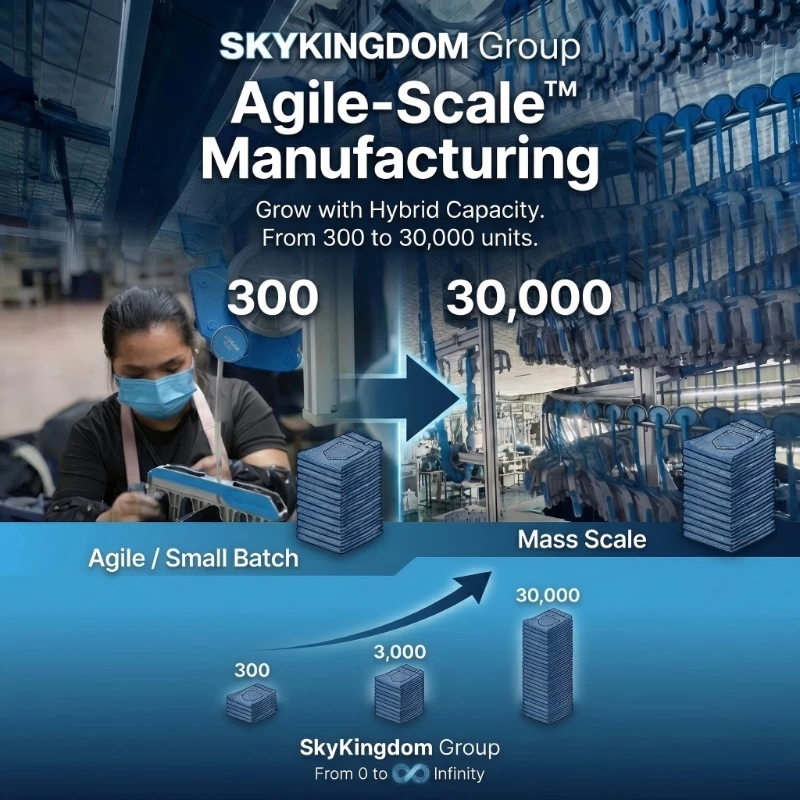
Most denim production partners operate with tiered MOQ structures rather than a single flat minimum. Understanding which tier you fall into determines what options are available to you.
A common structure:
- Standard production mode — 300 pieces per style and above. At this volume, you generally have access to the full range of fabric options (including custom mill orders), custom-developed trims, and maximum flexibility on wash techniques. Per-unit cost is at its most efficient.
- Small-batch mode — as low as 30 pieces per style per color. This tier is designed for brands testing new styles, launching concept pieces, or building a first collection at controlled risk. The primary condition is that fabric must be in stock — meaning it is already woven, dyed, and sitting in a warehouse, ready to cut without waiting for a mill production run.
What to confirm:
- Which tier your order qualifies for
- Whether the MOQ is counted per style, per color, or per style-color combination — the distinction matters significantly when you are planning multiple colorways
- Whether there is a minimum total order value or total piece count across all styles
A brand ordering 3 styles × 2 colors × 30 pieces = 180 total pieces is in a different position from a brand ordering 1 style × 1 color × 30 pieces. Both may qualify as “low MOQ,” but the total volume affects scheduling priority, fabric cutting efficiency, and in some cases, pricing.
2. Fabric Availability — The Primary Constraint
Fabric availability is the single biggest constraint on low MOQ denim production. At standard volumes, you can order fabric from a mill to your specifications — but mills have their own minimums, typically starting at 1,000–3,000 meters per fabric per color. If your total order does not consume that much fabric, a mill order is not viable.
This is why low MOQ denim production typically requires in-stock fabric:
- In-stock fabric is denim that has already been produced by a mill and is available in a warehouse in finished form. It can be cut immediately, with no mill lead time. The trade-off is that you are choosing from what is available, not specifying what you want from scratch.
- Selection changes. In-stock fabric availability is not static. A fabric you see today may be sold out next month. If you are planning a reorder on the same fabric, confirm whether sufficient stock exists — or whether additional yardage can be reserved.
- Lot variation. Even within in-stock fabric, different production lots from the same mill can vary slightly in shade, hand feel, or shrinkage. If your first order used one lot and your reorder uses a different lot, the wash result may shift. Confirm the lot number when ordering and document it for reorder reference.
If the specific fabric you sampled during development is not available in stock, you have three options: choose an alternative in-stock fabric that is close to your target (which may require a new wash test to confirm compatibility), wait for the fabric to be restocked, or increase your order to the standard MOQ tier to justify a mill order. Make this decision before you place the order, not after. For an overview of fabric types and options, see Washes, Fabrics & Trims.
3. Trim Minimums — The Hidden MOQ
Your garment’s MOQ is 30 pieces. But the buttons on that garment may have their own MOQ of 500. The woven labels may require a minimum of 1,000. The custom rivets may start at 500. These trim minimums create a secondary cost layer that many brands overlook when planning a low MOQ order.
How to navigate trim MOQs at small volumes:
- Use stock trims. Most production partners maintain an inventory of standard buttons, rivets, zippers, and labels in common finishes (nickel, antique brass, gunmetal, matte black). Using stock trims eliminates the trim MOQ problem entirely. The trade-off: stock trims are not branded or custom-designed.
- Amortize custom trims across multiple styles. If you are ordering 3 styles that all use the same custom button, your effective trim volume is 3× your garment volume — which may be enough to meet the button supplier’s minimum.
- Order trims ahead of production. If you know you will need custom trims for future orders as well, ordering a larger quantity now (at a lower per-unit trim cost) and holding the surplus for future runs can be more economical than ordering the minimum each time.
- Accept hybrid trim approaches. Use stock hardware (buttons, rivets) for the first low MOQ run, and switch to custom-branded hardware once your volume justifies the minimum. Many startup brands begin this way and upgrade trims as they scale.
Labels deserve special attention. Your main label, care label, and size labels all have minimum order quantities from label suppliers, and each requires different lead times. Care labels in particular must be accurate — fiber content, wash instructions, and country of origin must match the actual garment. Ordering incorrect care labels to meet a minimum quantity, then using them on a different fabric or wash, creates a compliance risk.
4. Wash Feasibility — Complexity Without Volume Limits
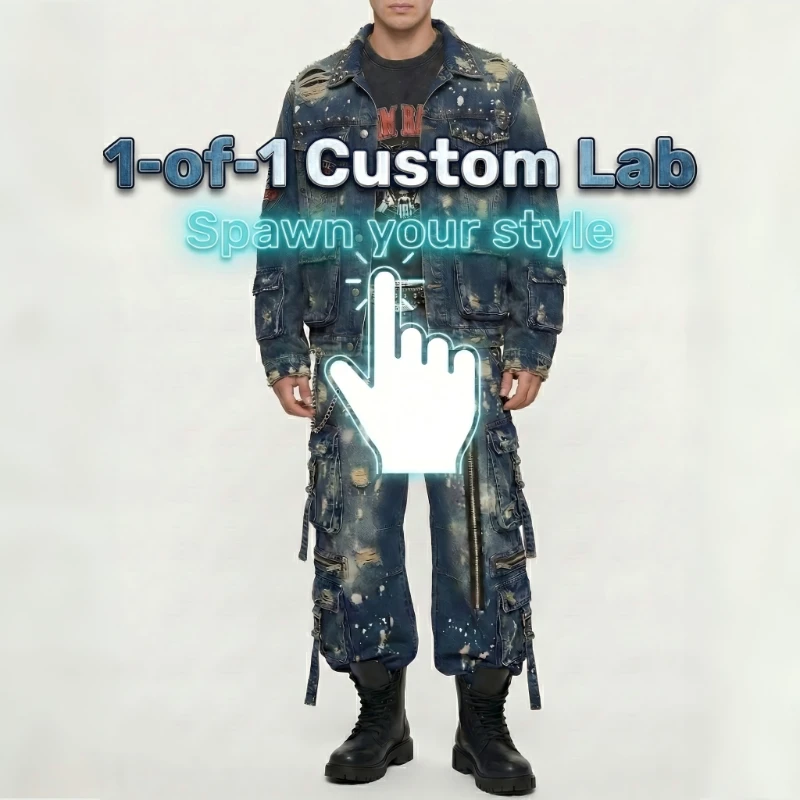
A common assumption is that low MOQ orders are limited to simple washes — a basic rinse, a light enzyme, or a one-wash finish. This is not always the case. Some production partners accept the full range of wash complexity on small-batch orders, including multi-technique processes, heavy distressing, overdyed finishes, and concept-level treatments.
This matters because a significant portion of low MOQ orders are concept pieces — styles that a brand is developing to test a creative direction, showcase in a lookbook, present to buyers, or gauge consumer response before committing to volume. Concept pieces often require more complex wash and finishing than a standard commercial style, not less.
What to confirm about wash on a low MOQ order:
- Is the approved wash reproducible at your order quantity? Some wash techniques have batch-size constraints — for example, a rotary drum that holds a minimum number of garments to achieve even chemical distribution. If your order is below the minimum batch size, confirm whether the wash facility can adjust or whether your garments will be batched with other orders (which introduces shade-matching risk).
- What is the cost impact? Wash setup costs — machine calibration, chemical mixing, recipe testing — are fixed regardless of whether you are washing 30 pieces or 300. At low volumes, these fixed costs are distributed across fewer garments, increasing the per-unit wash cost. This is the primary reason low MOQ denim costs more per unit than standard orders.
- Is a bulk wash submission included? For complex washes on small orders, a bulk wash submission — where a small number of pieces are washed first and sent to you for approval before the rest of the order proceeds — adds one confirmation step that can prevent an entire batch of concept pieces from being washed incorrectly. See Denim Wash Review Checklist Before Production for the full wash approval framework.
5. Cost Impact — What “More Expensive Per Unit” Actually Means
Low MOQ denim production will cost more per unit than standard production. This is not a penalty — it is the math of fixed costs spread across fewer garments. Understanding where the cost increase comes from helps you make informed decisions about where to absorb it and where to optimize.
Where the per-unit premium comes from:
- Pattern and cutting setup. The same pattern setup, marker making, and cutting machine calibration are required whether you are cutting 30 pieces or 3,000. At 30 pieces, the setup cost per garment is significantly higher.
- Fabric utilization. Smaller cut quantities mean the fabric marker (the layout of pattern pieces on the fabric) is less efficient. There is more fabric waste per garment because the marker cannot be optimized as tightly as it can at higher volumes.
- Wash setup. As discussed above, wash setup costs are fixed per batch. More complex washes carry higher setup costs, which compound the per-unit impact at low volumes.
- Trim costs. If you are using stock trims, per-unit trim cost is relatively stable. If you are ordering custom trims at their minimum quantities and only using a fraction for this order, the effective per-unit trim cost is higher.
- QC overhead. Quality inspection takes a baseline amount of time per order regardless of size — setting up the inspection station, reviewing the spec, checking the first pieces, writing the report. At 30 pieces, this overhead is a larger fraction of the total cost than at 300.
- Production scheduling. Small orders compete for production slots alongside larger orders. During peak season, small-batch orders may face longer lead times or scheduling surcharges because the production capacity allocated to a 30-piece run could be used for a 3,000-piece run.
The exact per-unit premium varies depending on style complexity, wash technique, fabric type, trim choices, and production season. There is no fixed percentage — a simple rigid-wash jean at 30 pieces will carry a smaller premium than a heavily distressed concept piece at 30 pieces. Ask for a detailed cost breakdown before confirming your order so that you understand what you are paying for.
6. Sample Approval — The Same Standard Applies
A low MOQ order does not lower the standard for sample approval. The same pre-production review that applies to a 3,000-piece order applies to a 30-piece order — because the same types of problems (fit drift, wash inconsistency, trim defects) will occur at any volume if the spec is not locked.
Before placing a low MOQ order, confirm:
- Your sample has been reviewed and approved in writing — fit, wash, fabric, trims, labels
- The approved sample was made from the same in-stock fabric that will be used for production (not a different fabric that happened to be available during development)
- Any placeholder trims on the development sample have been finalized for production
- Measurements have been verified against your spec
Brands sometimes treat low MOQ orders as less formal — “it’s only 30 pieces, it doesn’t matter if the sample wasn’t perfect.” It does. Thirty garments with the wrong wash, wrong fit, or wrong labels are 30 garments you cannot sell and cannot recover the cost of. For the full sample review framework, see How to Review a Denim Sample Before Bulk Production.
7. Reorder Potential — Plan for Success
The strategic purpose of a low MOQ first order is often to validate a product before committing to scale. If the product sells, you will want to reorder — and the ease of that reorder depends entirely on what you document now.
Reorder risks specific to low MOQ orders:
- Fabric discontinuation. The in-stock fabric you used for your first order may not be available when you reorder. If the fabric is a limited stock item, consider reserving additional yardage at the time of your first order — or identify a backup fabric option and confirm its wash compatibility in advance.
- Recipe loss. If the wash recipe is not documented under a reference number tied to your order, reproducing the wash on a reorder requires re-development — which means additional time, cost, and risk of shade drift.
- Trim mismatch. If you used stock trims on your first order and the specific stock items are no longer available, your reorder may look different. Document the exact trim specifications so that equivalent replacements can be sourced if needed.
- Scaling from small-batch to standard mode. If your reorder volume crosses from the small-batch tier (under 300 pieces) into the standard tier (300+ pieces), the cost structure changes — typically in your favor. But the production approach may also change: you may now qualify for mill-order fabric, custom trims, and different scheduling priority. Confirm how the transition works with your production partner before assuming the reorder is a simple copy of the first run.
For a complete reorder documentation checklist, see Reorder-Ready Denim Production Checklist.
8. When Low MOQ Is Not the Right Approach
Low MOQ production is a powerful tool, but it is not the right approach for every situation. Before defaulting to the smallest possible order, consider whether your case fits one of these scenarios where a larger initial order may actually be the lower-risk choice:
You need a specific mill-order fabric. If your product’s identity depends on a particular fabric that is not available in stock — a specific weight, weave, stretch content, or color — the only way to get it is a mill order, which typically requires standard MOQ volumes. Forcing a fabric substitution to fit a low MOQ tier may compromise the product to a degree that undermines the entire launch.
You have pre-orders or confirmed wholesale commitments. If you already have demand — whether from pre-sales on your site, wholesale orders from retail partners, or a committed influencer collaboration — ordering the minimum quantity means you will sell out immediately and lack the inventory to capitalize on momentum. In this case, under-ordering is a bigger risk than over-ordering.
Your cost structure does not work at low-MOQ unit prices. If the per-unit premium at 30 pieces pushes your cost above the retail price point your market will accept, a low MOQ order produces garments you cannot sell profitably. Run your cost model at the actual low-MOQ unit price, not at the standard-volume price, before committing.
You are reordering a proven seller. If a style has already been validated through a first run and you know the sell-through rate, there is limited upside in reordering at minimum quantities. Scale up, lock better pricing, and use the volume to negotiate better terms. See How to Keep Denim Wash and Fit Consistent Across Reorders for guidance on maintaining quality as you scale.
A Decision Framework — Not Just a Number
Low MOQ denim production exists to reduce the risk of a first move — to let brands test a product, validate demand, and build a reorder baseline without committing thousands of units of unproven inventory. But “low MOQ” is a production structure, not a strategy. The strategy is what you do with the information that comes back: the sell-through data, the customer feedback on fit and wash, the reorder documentation that lets you scale cleanly.
The brands that use low MOQ well are the ones that treat small orders with the same rigor as large ones — approved samples, documented specs, clear QC expectations, and reorder-ready records. The brands that treat low MOQ as “it’s just a small test, it doesn’t need to be precise” end up with 30 garments they cannot sell, no usable documentation, and a reorder process that starts from zero.
Where to Start
SkyKingdom works with growth-stage brands placing low MOQ denim orders — starting from 30 pieces per style per color with in-stock fabric, with no restriction on wash complexity. If you are planning a small-batch run and want to confirm your options, start a conversation here.
