
Who This Is For
Denim brand sourcing and product development teams, merchandisers, ODM/OEM commercial leads working on brand-side projects, designers making material selections, and DTC / influencer-driven apparel brand owners who sell into the UK, EU, and US markets. Factory-side teams will find this useful as a reference for understanding what their brand customers are being held to — and where factory-side input can prevent late-stage problems.
The Problem
Most denim projects don’t fail on fabric, fit, or wash development. They fail — or create expensive rework — at the very end: fibre composition written incorrectly on the label, care instructions that are either unsupported or overly conservative, product page copy that contradicts what’s sewn into the garment, animal-origin components left unmentioned, or a single label template used across markets with different requirements.
The result is rarely just “fix the label.” It’s platform listing rejections, customer complaints, increased inspection risk, elevated return rates, and — for repeat offenders — loss of credibility with retail partners or marketplace algorithms. In some cases, it’s a customs hold or a regulatory inquiry.
Denim is especially prone to these problems because of characteristics specific to the product category:
- Low-percentage elastane that’s small on the BOM but large in the consumer’s experience of the product
- Shell fabric, pocket lining, and lining fabrics that often have completely different fibre compositions
- Hang tags and product pages that lean into marketing language — “Tencel denim,” “recycled denim,” “power stretch” — which are selling terms, not legal fibre names
- Post-finishing and wash processes that change the care requirements of the finished garment relative to the raw fabric
- Back patches that may be real leather — an animal-origin component that triggers specific labelling obligations in certain markets
Getting the label wrong doesn’t just create a compliance problem. It amplifies every cost you’ve already invested in developing the product.
What This Article Covers
- What different markets actually require first — and where denim projects most commonly fall short in each
- When you must write full fibre percentages, and when marketing names alone are not enough
- How to handle multi-component products: shell fabric, pocket bags, linings, decorative elements, leather patches
- Why “Dry Clean Only” and “Do Not Tumble Dry” can’t be written without justification
- The practical differences between US and international care labelling systems — and what that means for denim exporters
- How care symbol usage rights actually work under GINETEX, and what brands producing outside of member countries need to know
- How to align sewn labels, hang tags, e-commerce product pages, BOMs, and test results — so they tell the same story
I. The Core Issue: It’s Not That Labels Are Missing — It’s That They Don’t Match

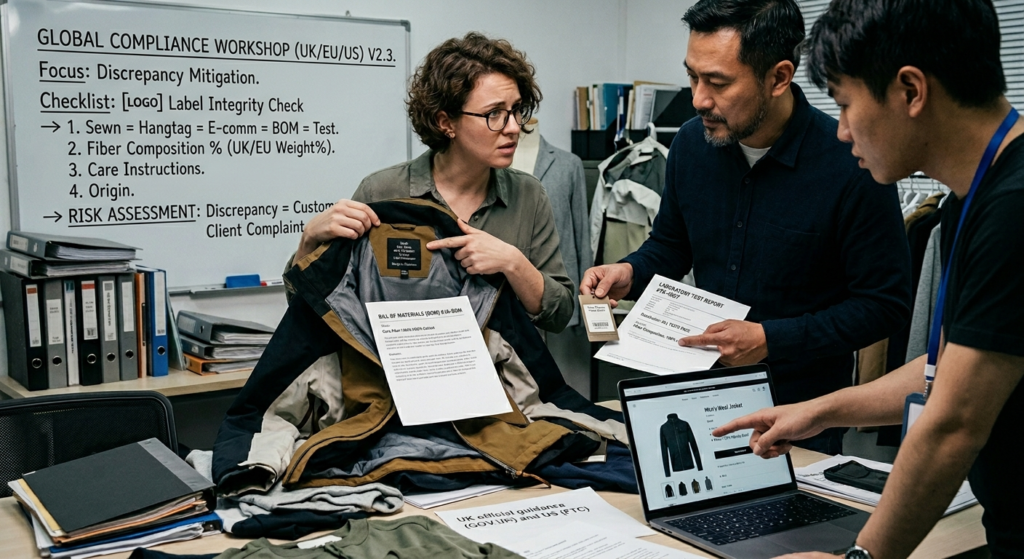
UK official guidance is explicit: textile products must display fibre composition, and where a product consists of two or more components with different fibre compositions, each component’s composition should be shown. Both the manufacturer and the retailer bear responsibility for compliance. The UK government’s guidance also advises checking the presence and accuracy of labelling before products enter the UK market. See GOV.UK Textile labelling and Business Companion Labelling of textiles.
The US adds further dimensions. The FTC’s Textile Fiber Rule requires most textile products to disclose the generic fibre name, the percentage by weight, the identity of the manufacturer or marketer, and the country of origin. Separately, the Care Labeling Rule imposes its own requirements for care instructions on apparel.
The real operational issue is not whether a label exists. It’s whether the sewn label, the hang tag, the e-commerce product page, the commercial invoice, the BOM, and the test reports all say the same thing. Whenever any one of those documents contradicts another, brands become vulnerable — to platform audits, to consumer complaints, to customs scrutiny, and to the kind of slow reputational erosion that’s hard to quantify but real.
II. What Each Market Prioritises: A Quick Reference
| Market | Priority Compliance Items | Common Denim-Specific Risks | Recommended First Action |
|---|---|---|---|
| UK | Fibre composition; separate declaration for components with different compositions; English-language labelling; labels must be durable, legible, visible; product page consistency | Shell fabric declared but pocket lining omitted; product page says only “stretch denim” with no fibre breakdown; real leather back patch present but no animal-origin disclosure | Build a UK-specific main label template first, then synchronise product page fields to match |
| EU | Fibre names must use names recognised under Regulation (EU) No 1007/2011; labels must be durable, legible, visible, easily accessible; labelling in the official language(s) of the Member State where the product is sold | Using branded fibre trade names in place of legal generic names; shipping to multiple EU countries with English-only labels; incomplete component breakdown | Build a multi-language label matrix for target EU markets, then align marketplace listings per country |
| US | Generic fibre names + percentages by weight; country of origin; manufacturer/marketer identity or RN number; care instructions with reasonable basis | Origin missing from label; marketing terms substituted for generic fibre names; “Dry Clean Only” stated without supporting evidence; RN not registered or not current | Build a US-specific label package: main label + care label + RN/origin verification |
| Multi-market | Unified BOM, test results, labels, hang tags, and product pages — all telling the same story | Single production run split across three markets, resulting in three conflicting label versions, or one label version that satisfies none of the markets fully | Create a single-style compliance sheet that maps every label field, page field, and supporting document before shipment |
III. UK and EU Markets: The Six Points That Matter Most for Denim

1. It’s not enough to declare the shell fabric alone — different components need separate declarations
UK official guidance states directly: where a product consists of two or more components with different fibre compositions, each component’s fibre composition should be shown. This matters for denim because many products include:
- Shell fabric: 98% Cotton / 2% Elastane
- Pocket lining: 80% Polyester / 20% Cotton
- Lining: 100% Cotton
- Back patch: real leather
If the sewn label only declares the shell fabric composition while the product clearly contains other components with materially different fibre content, the label is incomplete. This creates exposure to consumer challenges and platform scrutiny. See GOV.UK and Business Companion.
A practical note on what triggers the multi-component requirement: The regulation does not require separate declaration for every piece of fabric in the garment regardless of context. The obligation applies where components have different fibre compositions. In practice, this means: if your pocket bags are a poly-cotton blend and your shell is cotton-elastane, those are different compositions and should be declared separately. If your pocket bags happen to be the same composition as your shell, a single declaration may suffice. The test is whether the compositions actually differ — not whether the components are physically separate.
2. Marketing names are not legal fibre names — don’t use one where the other is required
Both the UK and EU systems require the use of fibre names recognised under the applicable regulations. Business Companion states explicitly that only certain names can be used for textile fibres, with the permitted names drawn from Annex I of Regulation (EU) No 1007/2011.
This means expressions like “Tencel denim,” “power stretch denim,” or “soft-touch eco denim” are fine in marketing copy but cannot substitute for the legal fibre composition declaration.
The operational split:
- Legal labels must use: Cotton, Lyocell, Polyester, Elastane, and other recognised generic names, with percentages.
- Marketing pages and hang tags may use: TENCEL™ denim, dual-core stretch denim, recycled blend denim — but these must exist alongside the legal declaration, not in place of it.
One nuance worth noting: Regulation 1007/2011 does permit certain branded fibre names to appear on labels alongside the generic name — for example, “Lyocell (TENCEL™)” — provided the generic name is present and the branded name does not replace it. The branded name is supplementary, never primary.
3. Multi-country EU sales require attention to language
The EU regulation summary states that labelling must be provided in a durable, legible, visible, and easily accessible manner, and should be in the official language(s) of the Member State where the product is made available to the consumer. See the EUR-Lex summary and Regulation (EU) No 1007/2011.
This has direct consequences for influencer-driven and DTC brands selling across multiple European marketplaces. You cannot assume English is sufficient for all EU markets. If the same batch of jeans is being sold into Germany, France, and Spain, the language requirements for each market need to be confirmed in advance — not resolved at the packing stage.
In practice, many brands handle this with multi-language labels that include the key target languages on a single sewn label. This is an accepted approach, but it requires planning during label development, not as an afterthought.
4. Animal-origin components are easy to overlook — and specifically flagged in the regulations
Business Companion states clearly that if a textile product contains non-textile parts of animal origin — such as fur, leather, or bone — this must be indicated with the phrase “contains non-textile parts of animal origin.” See Business Companion.
For denim, this most commonly applies to real leather back patches. If the patch is genuine leather rather than PU, jacron, or another synthetic material, the animal-origin disclosure is required. This isn’t just a BOM notation — it needs to appear where the consumer can see it.
A counterpoint worth addressing: Some brands argue that consumers expect leather patches on jeans and therefore the disclosure is unnecessary or obvious. The regulation doesn’t include an “obvious to the consumer” exemption. If the component is animal-origin, the disclosure is required regardless of whether the consumer might have guessed.
5. Product pages are not exempt from fibre composition requirements
UK Business Companion guidance states that where a consumer can place an order based solely on an advertising description — including catalogues, advertisements, and internet pages — the fibre composition information should be provided in that context. See Business Companion.
This means: even if the sewn label is correct, an e-commerce product page that says only “rigid denim” or “stretch denim” without fibre composition may be non-compliant. The product page is a point of sale, and the fibre information needs to be there.
6. The 7% decorative fibre exclusion exists — but it’s narrower than many assume
Business Companion notes that decorative fibres constituting 7% or less of the weight of the finished product may be excluded from the fibre composition declaration. See Business Companion.
This gives some flexibility for handling minor decorative threads or embellishments on denim products. However, the exclusion applies specifically to fibres that are purely decorative and that fall within the 7% weight threshold. It does not apply to functional components, and it does not apply to components that exceed the weight threshold. If you’re relying on this exclusion, confirm both conditions: genuinely decorative, and genuinely under 7% by weight.
IV. US Market: What Denim Labels Most Commonly Get Wrong
1. The US requires more than fibre percentages
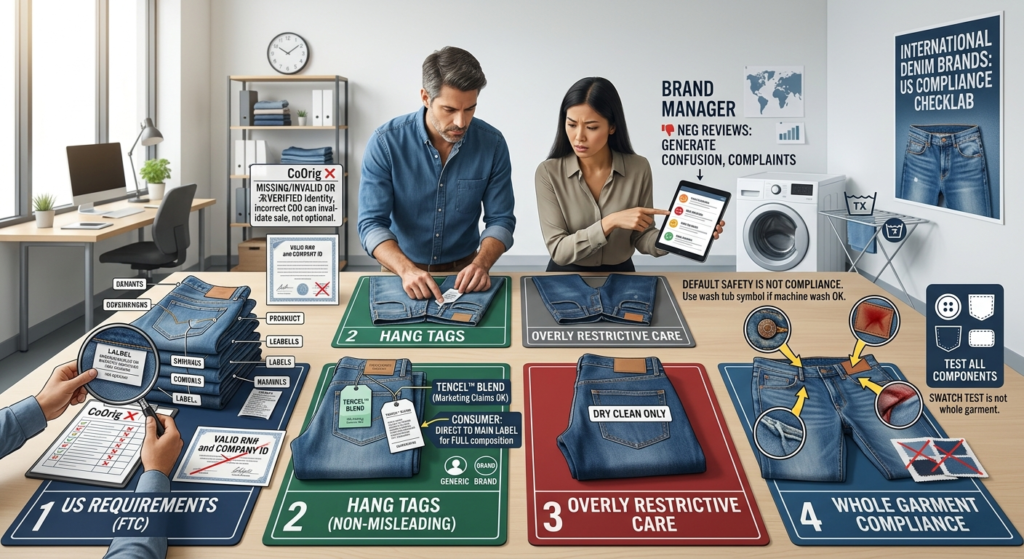
The FTC’s Textile Fiber Rule requires covered textile products to disclose: the generic name of each fibre, the percentage by weight, the name of the manufacturer or marketer (or their registered RN number), and the country where the product was processed or manufactured. The FTC’s business-facing guidance Threading Your Way Through the Labeling Requirements reinforces all of these elements.
Brands selling denim into the US frequently have the fibre composition correct but are missing country of origin or have not verified that their company identity or RN number is current. These are not optional fields.
The FTC’s business guidance notes that certain hang tags may include fibre names, trademark names, and non-deceptive performance claims. However, where a hang tag does not contain the full fibre composition, the rules expect it to direct the consumer to the main label for complete information. See FTC Threading Your Way Through….
This is useful for denim brands: you can write “TENCEL™ blend,” “dual stretch,” or “soft hand feel” on a hang tag without repeating the full legal composition — as long as the consumer isn’t left with the impression that the hang tag is the complete fibre disclosure.
3. “Dry Clean Only” requires evidence — you can’t write it as a default safety measure
The FTC’s Clothes Captioning: Complying with the Care Labeling Rule is unambiguous: care instructions must have a reasonable basis. The FTC specifically states that if there is no evidence that a product would be harmed by water washing, the label should not say “Dryclean Only.”
This is a common trap in denim projects. Teams default to the most conservative care instruction — professional dry clean, no tumble dry, no bleach — as a risk-avoidance strategy. But under FTC rules, overly restrictive care instructions without supporting evidence are themselves a compliance problem, not a compliance solution. If the garment can be machine washed without damage, the label should reflect that.
There’s also a consumer experience dimension. A pair of jeans labelled “Dry Clean Only” when the product can clearly tolerate machine washing will generate confusion, complaints, and negative reviews. The label becomes a friction point rather than a helpful guide.
4. Care instructions apply to the whole garment — not just the shell fabric
The FTC guidance emphasises that when a garment contains multiple components, the care instruction must be supported by a reasonable basis that the entire garment — not just individual components — will not be substantially damaged by the recommended care method. Testing a single fabric swatch is not sufficient to support a care claim for the assembled product. See FTC Care Label Guidance.
For denim, this means the care label cannot be based solely on the shell fabric. It must also account for:
- Pocket lining fabric — does it shrink excessively relative to the shell?
- Prints, coatings, or applied finishes — do they tolerate the recommended wash temperature and agitation?
- Metal hardware — does it discolour, corrode, or transfer colour during washing?
- Leather back patch — does it deform, shrink, or bleed colour in a machine wash cycle?
V. The Care Label Gap: US vs. International Systems — and Why It Matters for Denim Exporters
This is a point that the original version of this article flagged but did not develop. It matters enough to warrant its own section, because misunderstanding the care labelling system differences creates real operational problems for brands exporting denim across markets.
The two systems
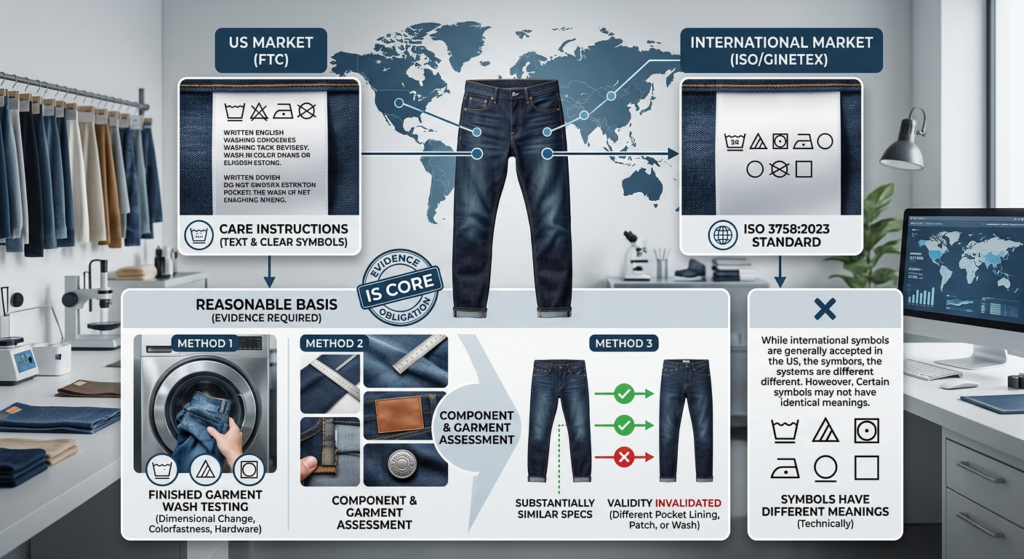
United States: The FTC Care Labeling Rule does not mandate the use of symbols. It requires care instructions, which can be provided as written text descriptions. When symbols are used, they must be accompanied by explanatory text or the symbols must be sufficiently clear. The ASTM D5489 standard provides a system of care symbols used predominantly in the US and Canada, but these are not identical to the ISO/GINETEX symbols used internationally.
International (EU, UK, and most other markets): The ISO 3758 standard, administered through GINETEX, provides the internationally recognised care symbol system — the familiar wash tub, triangle, iron, circle, and square symbols. This system was updated in 2023 with the publication of ISO 3758:2023. See GINETEX ISO 3758:2023 announcement.
Why this creates problems for denim brands
Many denim brands and factories default to printing ISO/GINETEX-style symbols on care labels for all markets, including the US. In most practical cases, this doesn’t trigger enforcement action — US customs and retail partners generally accept internationally recognised symbols. But it’s worth understanding that the US system and the international system are technically different, and that certain symbols may not carry identical meanings across the two systems.
More importantly, the care instruction itself — regardless of which symbol system is used — must be supported by a reasonable basis under FTC rules for the US market. The symbol is a communication method; the underlying obligation is the evidence that supports the instruction.
How to build a reasonable basis for denim care instructions
The FTC does not prescribe a specific test method. It requires “reasonable basis,” which in practice means evidence sufficient to support the claim that the recommended care method will not substantially damage the product. For denim, common approaches include:
- Finished garment wash testing: Washing the completed garment (not just a fabric swatch) through the recommended care cycle and evaluating dimensional change, colour loss, colour transfer, appearance change, hardware condition, and trim integrity. This is the most direct form of evidence.
- Component-level testing with garment-level assessment: Testing individual components (shell fabric shrinkage, pocket lining shrinkage, leather patch wash resistance, metal hardware corrosion) and then assessing whether the combined results support the proposed care instruction for the assembled garment. This is common when finished garment testing is not feasible at the development stage.
- Historical basis from substantially similar products: If the brand has previously tested a product with the same fabric, same trims, same wash treatment, and same construction, and the care instruction was validated, that history can serve as a basis for a new product with the same specifications. This breaks down when any material component changes — a different pocket lining, a different patch material, or a different garment wash recipe invalidates the precedent.
The key point: care labels for denim should be based on how the finished product actually performs, not on assumptions about individual fabric properties or on copy-paste from a previous season’s style that used different materials.
VI. GINETEX Care Symbols: Usage Rights, Licensing, and What Brands Producing Outside Member Countries Need to Know
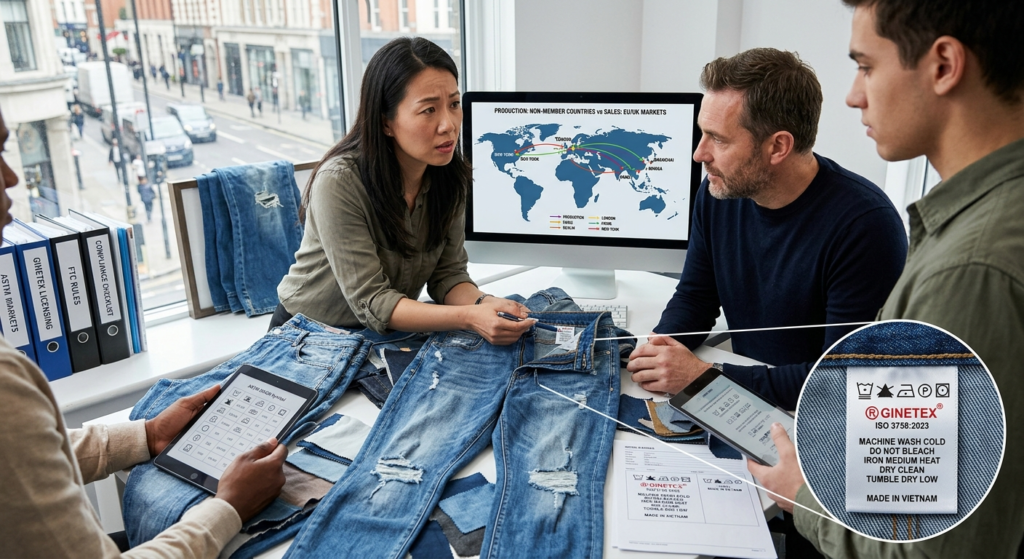
This is a topic that most denim brands — and many factories — handle on autopilot, printing care symbols on labels without considering whether they have the right to use those symbols or whether they’re using the current version.
The symbols are trademarked
GINETEX states that its care symbols are internationally registered trademarks. The right to reproduce and use these symbols is granted through GINETEX’s national member committees. See GINETEX — how to join and use the symbols.
This means the care symbols that appear on almost every garment label are not public domain graphics. They are protected marks with a licensing structure.
How the licensing works in practice
GINETEX operates through national committees in member countries. Companies that want to use the GINETEX care symbols typically obtain a licence through the national committee in their country (or in the country where they operate). The licence grants the right to apply the symbols to products, usually in exchange for an annual fee or contribution.
In countries where GINETEX has a national committee — which includes most major European markets — the path is relatively straightforward: contact the national committee, apply for a licence, pay the applicable fee.
The complication for brands producing outside GINETEX member countries
Many denim brands design in one country, produce in another, and sell into a third. The production country — where the label is physically printed and sewn — may or may not be a GINETEX member country. China, Bangladesh, Vietnam, Pakistan, and India are all major denim production countries. The status of GINETEX representation in these countries varies.
In practice, this creates an ambiguous situation. Factories in non-member countries routinely print GINETEX care symbols on labels because their brand customers specify them. The brand customer may or may not hold a GINETEX licence. The factory itself almost certainly does not.
What brands should actually do:
- If selling into the EU or UK: Check whether you need a GINETEX licence for the markets you’re selling into. Contact the relevant national committee. The cost is typically modest relative to other compliance costs, and it removes a potential vulnerability.
- If selling into the US: GINETEX symbols are not required. The US operates under its own care labelling system (FTC Care Labeling Rule, with ASTM D5489 as a common symbol reference). Many products sold in the US carry ISO/GINETEX-style symbols anyway, but the legal obligation is to provide adequate care instructions with a reasonable basis — the symbol format is secondary.
- If selling into multiple markets: Consider a label that includes both a symbol set and text-based care instructions. This provides coverage across symbol-dependent and text-dependent regulatory regimes. Ensure the symbols used are from the current standard — ISO 3758:2023 was published with updates, and labels referencing outdated symbol versions should be reviewed.
The realistic assessment
Enforcement of GINETEX trademark rights against individual brands or factories using the symbols without a licence is not a routine occurrence. The practical risk for most brands is low. However, “low practical risk” is not the same as “no obligation.” Brands that are investing in doing compliance properly — getting fibre content right, getting care instructions evidence-based, getting product pages aligned — should include care symbol usage rights in that compliance effort rather than leaving it as an unresolved grey area.
VII. From Marketing Language to Compliant Language: A Conversion Table for Denim
| Common Project / Marketing Expression | Can This Be Used as the Legal Fibre Declaration? | Primary Risk | Compliant Approach |
|---|---|---|---|
| Tencel denim | No — not as the sole fibre declaration | Branded fibre trademark substituted for the generic fibre name | Label: Cotton 70% / Lyocell 30% (actual percentages). Marketing page may additionally reference TENCEL™. |
| Recycled denim | No — not as the sole fibre declaration | Environmental attribute stated without fibre specifics | Label: Recycled Cotton / Cotton / Polyester with actual percentages. Retain chain-of-custody documentation for the recycled claim. |
| Power stretch denim | No — not as the sole fibre declaration | Consumer cannot identify the actual stretch fibre or its proportion | Label: Cotton / Polyester / Elastane with actual percentages |
| Rigid denim | No — “rigid” describes a hand feel, not a fibre | “Rigid” is a style descriptor, not a fibre name | Label: 100% Cotton. Marketing page may describe the rigid character. |
| Natural stretch denim | No — not as the sole fibre declaration | Consumer may assume the product contains elastane when it may not | Label: actual fibre composition (e.g. 100% Cotton if stretch is achieved mechanically, not through elastic fibres). Marketing page may explain the stretch mechanism. |
On mechanical stretch specifically: CottonWorks’ NATURAL STRETCH Technology page explains that certain cotton woven fabrics can deliver stretch and recovery without elastic fibres, through construction and finishing techniques. This is a useful reminder that “stretch feel” does not automatically mean “contains elastane.” The legal label must reflect the actual fibre composition, not the perceived performance.
VIII. Fibre Selection and Label Strategy Should Be Developed Together — Not Sequentially
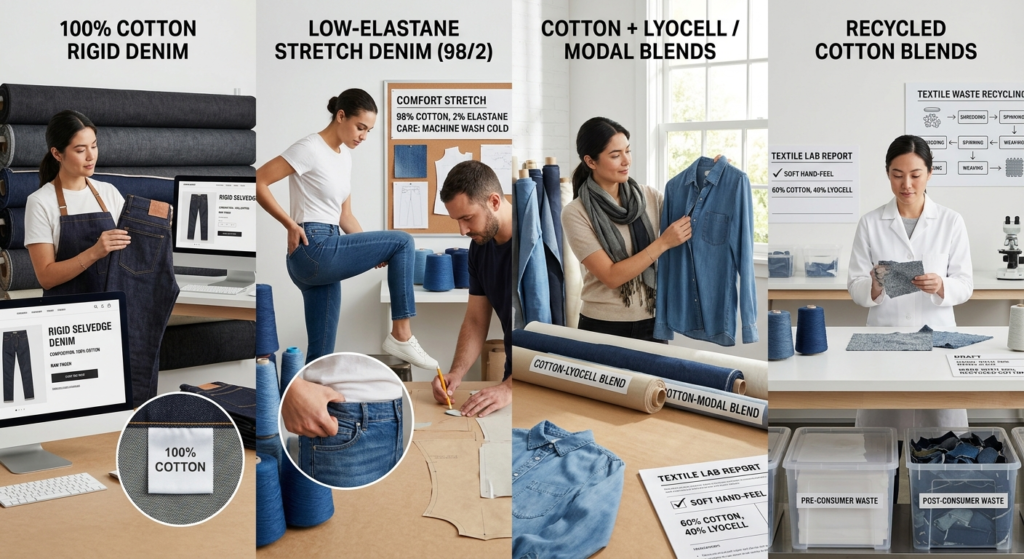
1. 100% cotton rigid denim
Label strategy: The simplest case — but also the one most likely to be oversimplified on the marketing side. The sewn label is straightforward (100% Cotton), but the product page needs to include the fibre composition explicitly, not just “rigid denim” or “raw denim” or “vintage selvedge.”
2. Low-elastane stretch denim (99/1, 98/2)
Label strategy: The elastane percentage is small, but its impact on consumer experience is disproportionate — stretch, fit, comfort, and shape retention are all affected. This makes the composition declaration, the care instructions, and any performance claims about stretch or recovery more consequential than the low fibre percentage might suggest. Do not treat a 2% component as negligible for labelling purposes. The consumer feels it, and the label should reflect it.
3. Cotton + Lyocell / Modal blends
Label strategy: Lyocell and modal are man-made cellulosic fibres (MMCF). Textile Exchange notes that lyocell is commonly used in apparel including denim, and highlights the importance of sourcing transparency and forest risk considerations for MMCF fibres. See Textile Exchange Other Manmade Cellulosics. These blends typically produce a softer hand feel and greater drape than 100% cotton denim. The care instructions need to be validated against the actual finished garment performance, not assumed from cotton denim precedents — because the lyocell or modal component may behave differently under washing and drying.
4. Recycled cotton blends
Label strategy: The “recycled” attribute is a selling point, but the label still requires actual fibre names and percentages. Textile Exchange’s Guide to Recycled Materials notes that a significant proportion of recycled cotton currently comes from pre-consumer waste, while post-consumer recycled cotton is more challenging due to colour sorting and blend complexity. For brands, this means: before promoting “recycled” in marketing, align the certification chain, the actual recycled content percentage, and the legal label text. The recycled claim should be supportable, and the fibre declaration should be accurate, regardless of the marketing angle.
IX. The Eight Most Common Label Failures in Denim Projects
- The sewn label is checked, but the product page is not. The label says Cotton 98% / Elastane 2%. The product page says “premium stretch denim” with no fibre breakdown. The consumer sees one thing online, another thing on the garment. Inconsistency invites complaints and platform flags.
- Branded fibre names are used where generic names are required. The hang tag and product page talk about the branded fibre, but the main label doesn’t include the generic name. The branded name supplements the generic name — it never replaces it.
- Only the shell fabric is declared when other components have different compositions. Pocket bags, linings, and contrast panels are ignored. If the compositions differ from the shell, they should be declared.
- A real leather back patch is present but the animal-origin disclosure is missing. This is specifically called out in UK/EU guidance. If it’s leather, it needs to be disclosed.
- “Dry Clean Only” is used as a default conservative answer. Under FTC rules, this requires evidence that the product would be harmed by washing. If the product can tolerate machine washing, labelling it as dry clean only is not conservative — it’s inaccurate.
- US labels are missing country of origin or manufacturer identity / RN. Fibre composition alone doesn’t satisfy the FTC Textile Fiber Rule. Origin and identity are required elements.
- A single label version is used across UK, EU, and US markets. The requirements differ in specifics — language obligations, required information fields, care labelling frameworks. A one-size-fits-all label may not fully comply with any of the target markets.
- Care symbols are copied onto labels without checking usage rights or standard version. GINETEX care symbols are registered trademarks with a licensing structure. ISO 3758 was updated in 2023. Labels should use current symbols, and brands should understand whether they have — or need — a licence to use them. See GINETEX on symbol usage and ISO 3758:2023 update.
X. Case Framework: Closing All Label Issues Before Shipment
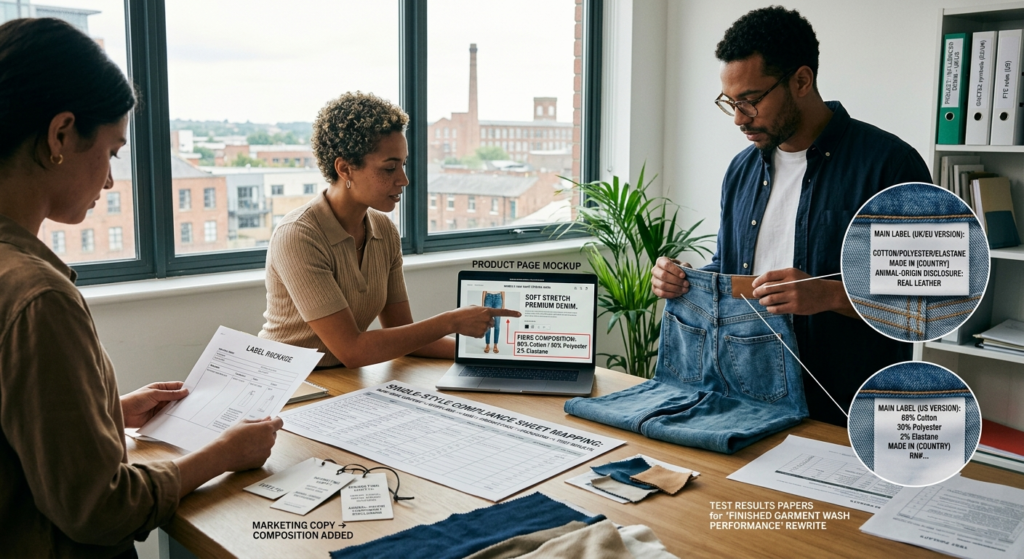
Project context: An influencer-driven apparel brand selling on both UK and US platforms. The product is a women’s high-waist stretch jean. Shell fabric is Cotton/Polyester/Elastane. Pocket lining is Poly/Cotton. Back patch is real leather. The product page headline reads “soft stretch premium denim.”
Initial problems identified:
- Hang tag carries only marketing copy — no fibre composition.
- US label is missing verified country of origin and RN cross-check.
- UK product page has no fibre composition field — only style descriptors.
- Real leather back patch is present, but no animal-origin disclosure on the label or product page.
- Care instruction was copied from a previous season’s style without verifying applicability to the current product’s materials and wash treatment.
Corrective actions:
- Build a single-style compliance sheet mapping: BOM fibre content → sewn label → hang tag → product page → packaging → test results. Every field must tell the same story.
- Split the main label by market: UK/EU version and US version, each reviewed against the specific requirements of the target market.
- Retain marketing language on the product page, but add the fibre composition field using generic names and percentages.
- Add the animal-origin component disclosure to the label and — where applicable — to the product page.
- Rewrite the care label based on finished garment wash performance for the current product, rather than carrying forward an instruction from a different product.
The replicable method: For every new denim style, initiate the “label package” during late-stage sampling — not during the week before bulk production. The label package includes: sewn label drafts (per market), hang tag content, product page copy with fibre fields, care instruction with supporting evidence reference, and a consistency check across all five touchpoints.
XI. Execution Checklist
| Stage | What Must Be Confirmed | Primary Responsibility |
|---|---|---|
| Fabric confirmation | Final fibre composition of all components; presence of recycled or branded fibres; presence of animal-origin components (leather patch, etc.) | Product development + sourcing |
| Sampling stage | Whether shell, pocket lining, lining, and contrast components require separate fibre declarations (i.e. whether compositions differ) | Product development + factory |
| Testing stage | Post-wash appearance, dimensional change, colour migration, trim durability — does the evidence support the proposed care instruction for the whole garment? | QA + factory |
| Pre-packing | Consistency check: sewn label, hang tag, packaging text, product page, commercial invoice / BOM — all aligned? | Brand operations + factory merchandiser |
| Pre-shipment (per market) | UK/EU and US label versions separately reviewed and confirmed? | Project owner |
XII. FAQ
Q1: If the product page already shows fibre composition, can I skip the sewn-in main label?
No. Both UK/EU and US regulations require physical labelling on the product itself. An online product page is a supplement to the physical label, not a substitute for it. The US additionally requires care instructions, country of origin, and manufacturer identity on the physical label. See FTC Textile Fiber Rule and GOV.UK Textile labelling.
Q2: Can I just write “cotton blend” instead of full percentages?
Generally no. The US requires generic fibre names with percentages by weight. UK/EU regulations also require complete fibre composition disclosure. Writing “cotton blend” without specifying the other fibres and their proportions does not meet the standard in any of the three markets. See FTC and Business Companion.
Q3: Does a real leather back patch really need special disclosure?
In the UK and EU, yes. Business Companion requires that textile products containing non-textile parts of animal origin — including leather — be clearly marked with the phrase “contains non-textile parts of animal origin.” This is not discretionary. See Business Companion.
Q4: Can I copy the care label from a previous season’s version of the same style?
Only if the current version uses the same fabric, the same trims, the same construction, and the same wash treatment. The FTC requires a reasonable basis for care instructions, applicable to the whole garment. If any material component has changed — different pocket lining, different patch, different wash recipe, different finishing — the care instruction needs to be re-evaluated. See FTC Care Label Guidance.
Q5: If mechanical-stretch denim has no elastane, can I still call it “stretch” on the label?
You can describe the stretch characteristic in marketing copy — product page, hang tag selling text. But the legal fibre declaration must reflect the actual fibre composition. If there is no elastane in the fabric, the label should state 100% Cotton (or whatever the actual composition is), not imply the presence of an elastic fibre. The word “stretch” describes a performance attribute, not a fibre. See CottonWorks NATURAL STRETCH Technology.
Q6: Do I need a GINETEX licence to use care symbols on my labels?
GINETEX care symbols are registered trademarks, and the right to use them is granted through GINETEX national committees. If you are selling into markets where GINETEX operates and you are using their symbols, you should understand the licensing requirements. In practice, enforcement against individual brands for unlicensed use is uncommon, but that doesn’t eliminate the obligation. For US-bound products, GINETEX symbols are not required — the FTC accepts text-based care instructions and does not mandate any specific symbol system. See GINETEX. If in doubt, contact the GINETEX national committee for the market(s) you’re selling into.
XIII. Final Recommendations
For denim brands, the label is not a packaging afterthought. It’s the final translation of every upstream decision — fabric selection, wash development, trim specification, cost engineering, testing — into a form the consumer and the regulator can read. If that translation is wrong, everything upstream gets discounted.
The approach that works is not fixing labels the week before shipment. It’s building a single-style compliance document during late-stage development that maps:
- Actual fibre composition — from the BOM, confirmed by testing
- Component-by-component breakdown — shell, pockets, lining, trims
- Animal-origin components — identified and disclosed
- Target market versions — UK/EU and US at minimum, with language and content adjusted
- Care instruction basis — what evidence supports the care recommendation, for the whole garment
- Cross-channel consistency — sewn label, hang tag, product page, packaging, invoice: same story everywhere
This matters especially for DTC and influencer-driven brands, because your business model depends on page conversion and repeat purchase. The cleaner and more consistent your front-end information, the lower your downstream cost in returns, disputes, and credibility erosion.
Getting the product right and getting the label right are not separate activities. They’re the same activity, seen from different angles.
Reference Sources
- GOV.UK – Textile labelling
- Business Companion – Labelling of textiles
- Regulation (EU) No 1007/2011
- EUR-Lex – Textile products: textile fibre names and labelling (summary)
- FTC – Textile Fiber Rule
- FTC – Threading Your Way Through the Labeling Requirements
- FTC – Care Labeling Rule
- FTC – Clothes Captioning: Complying with the Care Labeling Rule
- CottonWorks – NATURAL STRETCH Technology
- Textile Exchange – Other Manmade Cellulosics
- Textile Exchange – Guide to Recycled Materials
- GINETEX – Care symbols and usage rights
- GINETEX – ISO 3758:2023 standard has been published