
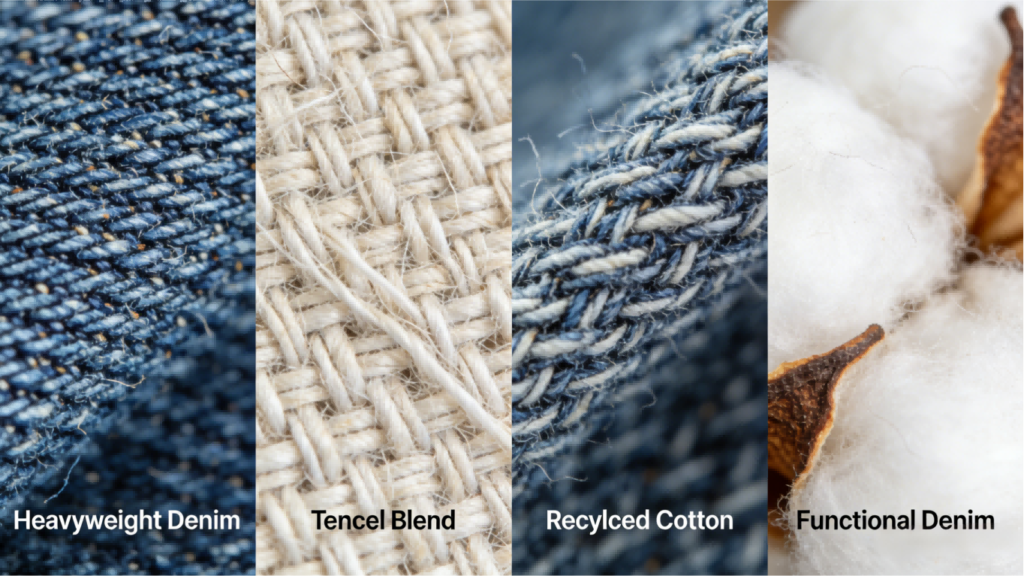
Special Denim Fabric Analysis: Heavyweight, Tencel, Recycled Cotton & Functional Denim
What they actually do, where they fall short, and how to decide which ones belong in your line
Who This Is For
Denim brand sourcing teams, designers, product developers, ODM/OEM project leads, DTC brand owners, and cross-border e-commerce sellers.
The Real Situation
Over the past few years, nearly every denim brand has experimented with at least one “special” fabric category. Heavyweight denim gets pulled in for its visual authority. Tencel blends get sampled because they feel incredible on the hand. Recycled cotton shows up in presentations because sustainability narratives are expected now. Functional denim gets pitched as a way to break into commuter, travel, or performance-adjacent markets.
None of these directions are wrong in principle. But in practice, the same pattern keeps repeating: the concept is solid, the swatch looks promising, and then the finished product either doesn’t sell, doesn’t reorder, or generates complaints that have nothing to do with what the brand thought it was offering.
Heavyweight denim samples beautifully but comes back with returns tagged “too heavy” and “too stiff.” Tencel blends feel wonderful in the showroom but produce garments that can’t hold a silhouette. Recycled cotton gets a gorgeous product page and then customers ask “but how does it actually feel different?” Functional denim launches with six bullet points of technology and consumers remember none of them.
The root cause is almost always the same: the brand treated the fabric’s concept as the product’s competitive advantage, without asking whether the fabric’s actual physical properties, processing constraints, supply chain realities, and cost implications truly matched the intended product and customer.
That’s what this article is about.
I. What These Four Fabric Categories Actually Are — In Terms of Physical Performance and Processing Reality
The biggest gap in most brand-side conversations about special denim is the absence of actual material science. Everyone knows Tencel is “soft” and heavyweight is “thick.” But development decisions can’t be made on adjectives alone. Here’s what each category actually involves.
1. Heavyweight Denim (Generally 14oz and Above)
Physical performance:
Heavyweight denim achieves its mass through coarse yarn counts (typically Ne 4~7s) combined with high warp and weft density. The resulting fabric has substantially higher tear strength and abrasion resistance than mid-weight denim. It holds its shape aggressively — a pair of raw heavyweight jeans will practically stand up on their own.
The tradeoff is equally real. Air permeability drops significantly as fabric density increases. This isn’t a subjective complaint — it’s measurable physics. A 16oz denim has roughly half the air permeability of a 10oz denim of comparable construction. When consumers say heavyweight jeans are “stuffy” or “hot,” they’re describing the direct consequence of the fabric’s structure, not being dramatic.
Moisture vapor transmission is similarly affected. The fabric absorbs moisture at the same rate as any cotton (about 8% regain), but because it’s so much thicker, drying time increases substantially. In humid climates or warm-season wear, this compounds the comfort issue.
Processing characteristics that brands often discover too late:
Cutting heavyweight denim requires sharper blades and fewer plies per lay. Where a mid-weight denim might stack 80~100 plies, a 16oz+ fabric may only allow 40~60 before cut quality deteriorates.
Sewing is where things get genuinely difficult. Multi-layer intersections — waistband, crotch junction, belt loop attachment points — can stack up to 8~12 layers of heavy fabric. Standard sewing machines with standard needles and thread will skip stitches, break needles, or simply stall. You need heavy-duty machines, larger needle gauges (#18~#21), and heavier thread (Tex 80~135). Not every factory is equipped for this, and not every factory that claims to be equipped actually does it well.
Washing and finishing take longer and consume more chemicals, water, and energy per piece. Stone wash cycles that take 20 minutes on a 10oz fabric may need 35~45 minutes on a 16oz fabric to achieve comparable surface effect. This isn’t a minor detail — it directly affects unit cost and factory throughput.
Shrinkage control is harder. Coarse yarns under high tension in a dense construction tend to produce higher and less predictable shrinkage, especially in the warp direction. If the brand doesn’t build this into pattern grading from the start, fit shifts after washing will generate complaints.
Cost reality:
All-in, a five-pocket jean in 15oz+ denim typically costs 20%~40% more than the same design in 11oz mid-weight. This comes from higher fabric cost per meter (more yarn per square meter), lower cutting efficiency, slower sewing speed, longer wash cycles, and reduced shipping density (weight limits mean fewer pieces per carton).
The supply side reality that rarely gets discussed:
Good heavyweight denim is hard to source. Not “hard” in the sense that nobody makes it — plenty of mills offer 14oz+ fabrics. But mills that produce heavyweight denim where the yarn quality, weave construction, dyeing depth, and hand feel are all genuinely good? That’s a short list globally. Many brands decide “we want to do heavyweight” and then spend months trying to find a fabric that actually matches their expectations, because the first five samples they receive are either too boardy, too flat in character, too shallow in dye, or just don’t have the right feel.
2. Tencel Blend Denim (Lyocell / Tencel™ Blended Denim)
First, a terminology clarification that matters commercially:
“Tencel” is a registered trademark of Lenzing AG, referring specifically to their lyocell fiber products. Other manufacturers also produce lyocell fiber with the same chemical composition, but only Lenzing-sourced fiber can legally be labeled “Tencel™.” If a brand wants to use the Tencel™ trademark on hangtags, marketing materials, or product listings, it needs a brand licensing agreement with Lenzing. This involves an application process, compliance requirements, and costs. Using non-Lenzing lyocell? You can say “lyocell” on the label, but not “Tencel.”
This isn’t a technicality — it’s a compliance issue that has tripped up multiple brands, especially in European markets where trademark enforcement is strict.
Physical performance:
Lyocell fiber has higher dry tenacity than cotton and significantly higher dry tenacity than viscose/rayon. But its wet strength drops more than cotton’s — roughly 15%~20% reduction when wet, compared to cotton’s relatively modest wet strength loss.
The fiber surface is smoother than cotton at the microscopic level. Combined with a typical fineness of 1.0~1.7 dtex (finer than most cotton fibers), this is the direct physical reason Tencel blends feel silky and smooth. It’s not marketing — it’s fiber morphology.
Moisture regain is around 11%~12%, higher than cotton’s ~8%. Combined with lyocell’s efficient moisture wicking behavior, Tencel blends genuinely feel cooler and drier against the skin than equivalent-weight pure cotton fabrics. This performance advantage is real and user-perceptible, which is why Tencel works so well in warm-weather and close-to-body garments.
The critical downside: lyocell’s fiber modulus is lower than cotton’s. In plain language, it’s a less stiff fiber. This means that at equal weight and construction, a Tencel-blend fabric will always drape more and stand up less than its pure-cotton equivalent. This is not a development mistake or a factory quality issue. It’s physics. No amount of finishing or construction optimization will make a 50/50 cotton-Tencel blend behave like 100% cotton structurally.
Tencel denim is almost always a blend, not pure Tencel:
Common blend ratios and what they actually produce:
- Cotton/Tencel 70/30: Noticeable softness improvement over pure cotton, but still retains meaningful denim structure. This is the sweet spot for brands that want “a softer denim” rather than “a denim-colored soft fabric.”
- Cotton/Tencel 50/50: Dramatically softer and more fluid. Denim character is significantly diminished. This is already more fashion fabric than traditional denim.
- Tencel content above 50%: Very close to a soft fashion cloth that happens to be indigo. Almost no structural resemblance to conventional denim.
- Three-component blends (cotton/Tencel/polyester) and four-component blends (adding spandex) also exist and are common in the market.
- 100% Tencel denim is extremely rare in commercial production because the resulting fabric has virtually no denim character.
Processing characteristics:
Lyocell has a well-documented tendency called fibrillation — when subjected to wet abrasion, the fiber surface develops fine micro-fibrils that create a peach-skin or frosted texture. This can be desirable (some products intentionally use it for a velvety hand feel) or undesirable (it can look like pilling or surface degradation to consumers who don’t expect it). The finishing process needs to either control or exploit fibrillation deliberately. If nobody discusses this during development, the brand may receive finished fabric with an unexpected surface effect.
Indigo dyeing behavior differs between lyocell and cotton fibers. In a blended yarn, the two fiber components absorb and release dye at different rates. After washing, this can manifest as uneven fading — the cotton component and the Tencel component may not fade at the same rate or in the same pattern. At low Tencel percentages (20%~30%) this is usually manageable. At higher percentages, dye uniformity becomes a genuine development challenge.
Shrinkage behavior is different from pure cotton and needs separate testing. You cannot apply your pure-cotton denim shrinkage allowances to a Tencel blend and expect accurate results.
Sewing performance is generally easier than heavyweight cotton — the fabric feeds more smoothly. But because the fabric is slippery, feed consistency on some machines may need adjustment.
Cost reality:
Lyocell fiber typically costs 30%~80% more than cotton fiber, depending on the supplier and purchase volume. Lenzing-branded Tencel carries a further premium. However, Tencel blends are usually developed in lighter weights (7~10oz is typical), which means less yarn per meter. So the per-meter fabric cost increase may be partially offset by lower fabric consumption. Net cost impact depends on the specific blend ratio, weight, and whether brand licensing is involved.
3. Recycled Cotton Denim
The critical distinction almost nobody explains clearly enough:
There are two fundamentally different things called “recycled cotton,” and they have very different quality profiles, cost structures, and supply chain implications:
- Pre-consumer recycled cotton (also called post-industrial): This comes from manufacturing waste — spinning waste, weaving waste, cutting room scraps. The fiber quality is relatively predictable because the original material composition is known and controlled. The fibers haven’t been worn, washed, or degraded by consumer use.
- Post-consumer recycled cotton (PCR): This comes from used garments collected, sorted, shredded, and re-processed into fiber. These fibers have been through months or years of wearing and washing. They are shorter, weaker, and more variable than virgin cotton fibers. The recycling process (mechanical shredding) further shortens them.
These two categories should never be discussed interchangeably, but they constantly are — in marketing, in sourcing conversations, and unfortunately in product claims.
Physical performance (particularly for post-consumer recycled cotton):
- Average fiber length is shorter than virgin cotton, with a higher proportion of short fibers
- Fiber tenacity is generally lower
- Yarn spun from high-percentage recycled cotton has lower strength and poorer evenness (higher CV%) than equivalent virgin cotton yarn
- In practice, recycled cotton is almost always blended with virgin cotton or other fibers. Common ratios: 20/80, 30/70, 50/50 recycled/virgin
- 100% post-consumer recycled cotton yarn is possible at coarse counts but has real quality limitations at this stage of the technology
- Fabric made from high recycled content may show more surface irregularity — which can actually be a positive if the brand is going for a vintage, rough-textured look, but is a negative if the brand wants clean, uniform fabric
Processing characteristics:
- Recycled cotton yarn’s lower strength means higher breakage rates during weaving, reducing production efficiency
- If the recycled cotton comes from previously dyed garments, residual color in the fiber can affect dye uptake and shade consistency in subsequent dyeing
- Shrinkage and color fastness need to be tested independently — virgin cotton data cannot be assumed to apply
- Batch-to-batch variation in recycled cotton feedstock is higher than in virgin cotton, making large-order shade and quality consistency harder to control
Certification and compliance — this is where it gets complicated:
- GRS (Global Recycled Standard): The most widely recognized certification for recycled textile materials. Requires full chain-of-custody traceability from fiber source through to finished product. Every facility in the chain — fiber processor, spinner, weaver, dyer/finisher, garment factory — must be individually GRS-certified.
- RCS (Recycled Claim Standard): Verifies recycled content claims with somewhat less stringent requirements than GRS.
- Without certification, “recycled cotton” claims in regulated markets (EU, and increasingly the US) carry legal risk. Greenwashing enforcement is accelerating. France’s AGEC law, the EU’s Green Claims Directive, and the FTC’s Green Guides all create potential liability for unsubstantiated sustainability claims.
- Certification costs are real: annual audit fees, transaction certificates, and administrative overhead at every link in the supply chain. These costs get passed through to the product.
The external environment is changing fast:
This is something the original article missed entirely, and it may be the single most important factor for brands making decisions about recycled cotton today:
- The EU’s Ecodesign for Sustainable Products Regulation (ESPR) is progressing toward requirements for minimum recycled fiber content in textiles
- France’s AGEC law already implements Extended Producer Responsibility for textiles
- Major European brands and retailers (H&M, Inditex, C&A, etc.) have set annual targets for recycled material usage and are cascading these requirements to their supply chain
- Some US brands are making voluntary commitments along similar lines
For brands selling into European markets or supplying European retailers, recycled cotton is transitioning from “nice-to-have sustainability story” to “market access requirement.” The question is shifting from “should we do this?” to “can we afford not to?”
Cost reality:
Pre-consumer recycled cotton can be price-competitive with or even cheaper than virgin cotton, since it’s essentially waste material being revalorized. Post-consumer recycled cotton’s cost picture is more complex — the collection, sorting, shredding, and re-spinning processes add cost, and the lower yarn quality may require blending with higher-cost virgin cotton to maintain acceptable fabric quality. Certification costs are an additional layer. Net cost impact varies significantly depending on the specific recycled content percentage, feedstock source, and certification requirements.
4. Functional Denim
First, let’s be honest about what “functional” actually means in this context:
“Functional denim” isn’t a single fabric category — it’s an umbrella term covering a wide range of technologies applied to denim through different methods. The specific performance characteristics, cost implications, and commercial viability vary enormously depending on which function we’re talking about.
Here’s a realistic breakdown:
Function | How It’s Typically Achieved | Technology Maturity | User Perceptibility |
|---|---|---|---|
Stretch / comfort | Spandex/Lycra blended into weft (or both warp and weft) | Very mature | Very high — you feel it the moment you put the jeans on |
Lightweight / cool feel | Fine yarn + open construction, or cool-touch fiber blends, or topical finishes | Mature to moderate | Moderate — perceptible but less immediate than stretch |
Quick dry / moisture wicking | Synthetic fiber blends, or topical finishes | Mature | Moderate — needs comparison to be noticed |
Anti-bacterial / odor control | Topical finish or functional fiber | Mature | Low — consumers essentially cannot perceive this directly; requires trust |
Abrasion resistance | Cordura or high-tenacity fiber blends | Mature | Low to moderate — you won’t notice it in daily wear, only over extended use |
Water repellent | DWR (durable water repellent) topical finish or membrane | Mature | Medium to high — pouring water on fabric is visually dramatic and makes great content |
Thermoregulation | Phase-change materials, functional fiber blends, or finishes | Moderate | Low — very difficult to perceive outside of controlled or extreme conditions |
Wrinkle-free / easy care | Resin finish | Very mature | Moderate — requires multiple wash cycles to appreciate the difference |
The key insight this table reveals:
A function can be scientifically real and still commercially worthless if the consumer can’t feel the difference. Anti-bacterial finishes may genuinely reduce bacterial growth in lab testing, but if the person wearing the jeans can’t tell the difference between treated and untreated, the marketing investment required to convince them of the value is disproportionate to the payoff.
Processing considerations (varies by function type):
- Fabrics containing Cordura or other high-tenacity synthetic fibers cause accelerated needle wear during sewing
- Topical finishes (DWR, anti-bacterial, etc.) degrade with washing. Durability is the critical question. A “water-repellent” denim that stops repelling water after 5 home washes isn’t a product feature — it’s a liability. Brands must ask suppliers for wash-durability test data, specifying the test standard (industrial wash vs. home wash — results differ dramatically)
- Some functional finishes alter hand feel. Resin finishes for wrinkle resistance tend to make fabric stiffer. Anti-bacterial finishes can sometimes affect dye shade.
- When multiple functions are stacked on the same fabric, process compatibility needs to be verified individually. A DWR finish may interfere with subsequent garment washing effects, for example.
- Certain functional claims in European and North American markets require substantiation through third-party testing (Bluesign, Oeko-Tex, specific AATCC or ISO test methods). If a brand claims “anti-bacterial” without test data and a consumer or competitor challenges it, the consequences range from product delisting to regulatory action.
The durability issue deserves emphasis:
Functions that are inherent to the fiber (Cordura’s abrasion resistance, spandex’s stretch) are permanent — they last the life of the garment. Functions applied through topical finishing (DWR, anti-bacterial, cool-touch, odor control) are inherently impermanent. The industry standard for “durable” topical finishes is typically 20~50 home washes before significant performance degradation. Some lower-quality applications may degrade much faster.
If a brand promotes “water-repellent denim” and the effect disappears after the third wash, the brand faces not just bad reviews but potential false advertising claims — particularly under EU consumer protection law and US FTC guidelines.
Cost reality:
Stretch adds modest cost (spandex is a small percentage of total fiber content, but core-spun yarn production requires specialized equipment). High-performance functional fibers (Cordura, Coolmax, etc.) add more significant cost. Topical finishes add processing cost. Third-party testing and certification add further cost. Stacking multiple functions on one product can push fabric cost to 1.5~2x that of conventional denim before anyone has noticed that the retail price can’t actually support the margin.

II. Questioning the Framework: Are These Four Categories Really as Distinct as They Seem?
The original structure of this article — “four categories, each with its place” — is organizationally clean. But reality is messier, and a few of the implied assumptions deserve pushback.
Does heavyweight denim really only belong in niche, high-ASP product lines?
There’s a widespread assumption in mainstream denim circles that heavyweight is inherently niche. This assumption is geographically and culturally biased.
In Japan, brands like Samurai Jeans, Iron Heart, The Flat Head, and Studio D’Artisan built their entire businesses on heavyweight denim. These aren’t marginal operations — they’re established brands with loyal, repeat-purchasing customer bases and robust retail distribution. In the US, Tellason, Railcar Fine Goods, and others occupy a similar position. In China, the raw denim community is smaller in percentage terms but substantial in absolute numbers, with high average order values and strong brand loyalty.
The more accurate framing: heavyweight denim is not suited to brands whose customers don’t understand or value heavyweight denim. But for brands whose identity and community are built around this product category, heavyweight isn’t a risky side project — it’s the core of the business. Telling those brands to relegate heavyweight to “image pieces” would be bad advice.
Is Tencel denim’s “lack of denim character” actually a problem?
The article’s original version kept warning that Tencel blends risk “not feeling like denim.” But this presupposes that the customer is buying denim character in the first place.
Consider: a significant segment of consumers — particularly in women’s fashion and urban casual — are buying indigo-colored pants. They want something that looks like denim in photos and outfits, feels comfortable, drapes well, and doesn’t require break-in. They are not buying selvedge heritage, whisker fade patterns, or the experience of raw denim aging. For this customer, a Tencel blend that “doesn’t feel like traditional denim” is not failing — it’s succeeding at being a different product.
The real risk isn’t that Tencel denim lacks denim character. The risk is that the brand doesn’t know which product it’s actually selling. If you market a Tencel blend as “premium denim” and the customer expects traditional denim behavior, you’ll get returns. If you market it as “soft, comfortable denim-look fabric that’s lighter and easier to wear,” you’ll get fans. The fabric is the same. The positioning makes it succeed or fail.
Is recycled cotton really just a marketing narrative tool?
The original article treated recycled cotton primarily as a storytelling device — useful for brand image but not substantively different as a product. This view is already out of date.
Regulatory pressure is converting recycled content from a voluntary brand statement into a compliance requirement in certain markets. A brand that dismisses recycled cotton as “just marketing” today may find itself unable to ship product to the EU in three to five years without it.
At the same time, the opposite extreme — treating recycled cotton as automatically virtuous and premium — is equally misguided. The fiber quality limitations are real. The certification complexity is real. The cost implications are real. Neither cynicism nor idealism serves the brand well here. What serves the brand is pragmatism: understand the material’s actual properties, build a certified supply chain, start at manageable blend ratios, and evolve as technology and regulations evolve.
Are functionality and denim character really in opposition?
The original article positioned functional denim as something that risks “losing denim feel.” But the most commercially successful functional denim innovation in history — stretch — didn’t lose denim feel at all. Nobody looks at a pair of stretch jeans and thinks “that’s not denim.” The market accepted it so completely that stretch is now the default rather than the exception, especially in women’s denim.
The real distinction isn’t between “functional” and “denim.” It’s between functions that are compatible with denim’s visual and tactile identity and functions that compromise it. Adding 2% spandex doesn’t change the way denim looks or feels in the hand. Adding 40% polyester does. Applying a DWR finish doesn’t visually alter the fabric. Applying a heavy resin finish for wrinkle-resistance changes the hand feel noticeably.
So the question for each function isn’t “will it make my product less denim?” but rather “does this specific implementation, at this specific level, preserve the characteristics my customer expects from denim?”
III. Revised Selection Decision Table
Fabric Type | Core Physical Characteristics | Key Processing Constraints | Best Suited Products | Best Suited Brands / Markets | Primary Advantages | Primary Risks | Cost Impact | Recommended Strategy |
|---|---|---|---|---|---|---|---|---|
Heavyweight (14oz+) | High tear/abrasion resistance, high stiffness, low air permeability | Heavy-duty sewing equipment required; limited cutting plies; longer wash cycles; difficult shrinkage control | Vintage straight-leg, work pants, raw denim, structured jackets | Vintage/heritage brands, workwear lines, raw denim communities, brands with high-ASP culture-driven customers | Extreme style identity; durability; rich post-wash aging potential | Comfort barrier (weight, heat, stiffness); limited high-quality supply sources; higher all-in cost | +20%~40% vs. mid-weight | If your customer base understands and values heavyweight, make it the core. If they don’t, use it sparingly for image or capsule pieces |
Tencel Blend | High moisture management, smooth hand feel, superior drape, lower stiffness than cotton | Fibrillation control required; dye uniformity challenges in blends; different shrinkage behavior; brand licensing for Tencel™ trademark | Women’s wide-leg, shirts, dresses, light outerwear | Women’s fashion brands, urban casual, DTC comfort-focused brands | Genuinely perceptible comfort advantage; content-friendly visual; strong try-on conversion | Structurally cannot replicate cotton denim’s body (physics, not quality); dye consistency at higher blend ratios; expectation management with consumers | Fiber cost +30%~80% vs. cotton, but typically lighter weight offsets partially | Accept from day one that this is a different product than traditional denim. Design the silhouette, positioning, and marketing around softness and drape as features, not bugs |
Recycled Cotton | Lower fiber length and strength vs. virgin cotton (especially PCR); higher yarn irregularity | Higher weaving breakage rate; dye shade variability from mixed feedstock; requires full chain-of-custody certification (GRS/RCS) | Basics, sustainability collections, compliance-driven product lines | Brands selling into EU markets, brands supplying certified-required retailers, DTC brands with sustainability positioning | Sustainability narrative; regulatory compliance positioning; some customers will pay a premium | Fiber quality limitations at high recycled percentages; certification complexity and cost; uncertified claims = legal risk; batch consistency harder to control | Varies widely; pre-consumer can be cost-neutral; post-consumer + certification adds cost | Start at 20%~30% blend ratios; ensure certification chain is complete before making any claims; if selling to EU, start building this supply chain now |
Functional (stretch/cool/DWR/durable/etc.) | Varies enormously by specific function | Topical finish durability; multi-function process compatibility; may require third-party testing/certification | Commuter pants, travel pants, daily functional wear, specific-scenario products | Urban commuter brands, comfort-driven brands, performance-adjacent positioning | Clear scenario matching; stretch is already industry default | Topical functions degrade with washing; unperceivable functions have weak ROI; over-stacking functions increases cost and complexity | Stretch: modest increase; high-performance fiber blends or specialty finishes: significant | Only invest in functions the consumer can actually feel. Confirm wash durability data before committing. One product, 1~2 functions maximum |
IV. Heavyweight Denim: The Full Picture
When it works
Your brand and customer base meet most of these conditions:
- Your customer understands heavyweight denim culture — the break-in period, the aging process, the weight on the body — and considers these features, not drawbacks
- Your silhouettes are relaxed to straight (heavyweight + slim fit = wearing misery)
- Your price point can absorb the higher raw material, cutting, sewing, and washing costs without margin erosion
- You have access to factories with genuine heavy-duty sewing capability — not factories that say they can handle it but actually struggle with multi-layer intersections
- Your sales channel supports education — whether that’s detailed product pages, in-store try-on, or community-driven content that explains why the jeans feel the way they do when new
When it backfires
- Your customer is a mainstream consumer who picks jeans off a rack or a product listing and expects them to feel good immediately
- You’re developing for spring/summer or warm-climate markets — the thermal comfort penalty of heavyweight is a physics problem, not a perception problem
- Your primary channel is e-commerce with easy returns — “too heavy” and “too stiff” are among the most common and most non-recoverable return reasons for heavyweight denim
- Your factories aren’t genuinely equipped for heavyweight sewing and you discover this during production, not during development
Something that gets confirmed over and over again
Heavyweight denim’s repeat purchase rate is typically driven by what happens after the first 30~50 wears — the owner realizes the jeans have molded to their body, the fading has started to develop character, and the initial stiffness has broken into something that feels uniquely theirs. This transformation is real and it creates intense brand loyalty. But it requires the customer to get through the first month. If your business model depends on instant satisfaction at first try-on, heavyweight is working against you.

V. Tencel Blend Denim: The Full Picture
Get the positioning right from the start
Repeat this until it’s internalized: a Tencel-blend denim with meaningful Tencel content will not behave like pure cotton denim structurally. This is determined by fiber physics and cannot be engineered away. Lyocell’s modulus is lower than cotton’s. The fibers are finer and smoother. The fabric will drape more, stand up less, and feel more fluid. Always.
So the correct development mindset is not “how do we make Tencel denim feel like cotton denim?” but “how do we design a product that turns Tencel’s properties into its selling points?”
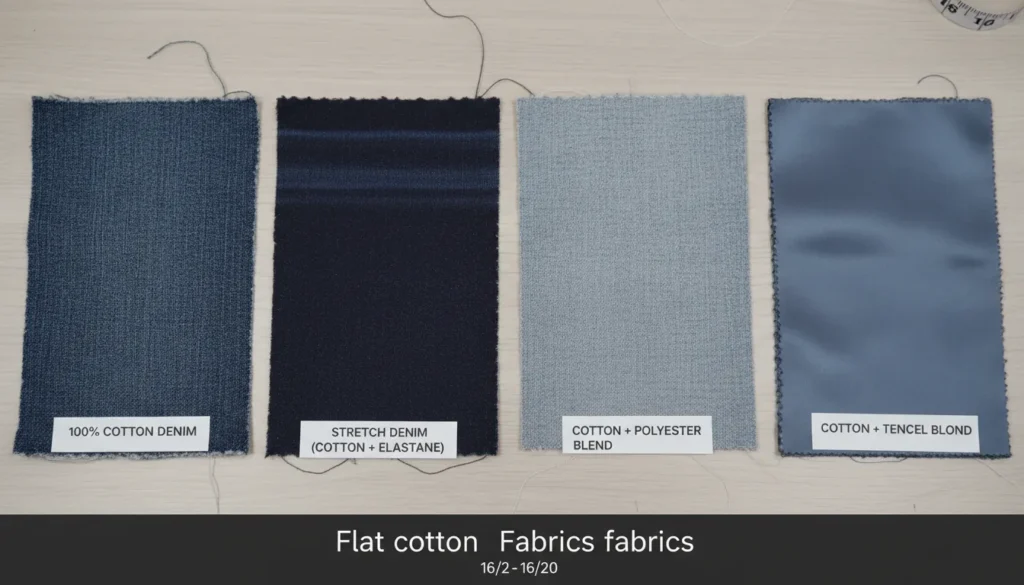
Blend ratio is the most consequential decision
- 70/30 cotton/Tencel: This is the practical sweet spot for brands that want improvement in hand feel without abandoning denim character. The softness improvement is noticeable. The denim structure is still present. Indigo dye behavior remains manageable. Most buyers won’t consciously identify the fabric as “not normal denim” — they’ll just notice it feels nicer.
- 50/50 cotton/Tencel: This is where the fabric shifts decisively. Hand feel becomes distinctly silky. Drape increases dramatically. Denim character — the firmness, the stiffness, the “crunch” of raw cotton denim — largely disappears. This is a fashion fabric with denim aesthetics, not denim with fashion properties. It works well for flowing silhouettes (wide-leg, palazzo, relaxed skirts) but will fail in any application that needs the fabric to “hold” a shape.
- Above 50% Tencel: You’re now making a soft, fluid indigo cloth. If that’s what you want, fine — but stop calling it denim in your internal discussions, because it won’t behave like denim, and setting denim expectations anywhere in the process will cause confusion.
Fibrillation needs to be discussed before it surprises you
Ask your fabric supplier, before sampling: “What’s the fibrillation control strategy for this fabric?” If they don’t have a clear answer, you may receive finished fabric with an unintended peach-fuzz surface that either delights you or horrifies you. Better to decide deliberately than discover accidentally.
Wash development requires separate testing
Tencel blends handle aggressive washing differently than pure cotton. Heavy stone wash or strong bleaching can damage lyocell fibers faster than cotton, and the two components in a blended fabric may respond to the same wash recipe differently — producing uneven color effects. If you want to do anything beyond a light rinse or clean enzyme wash, test specifically on the Tencel blend fabric. Don’t assume your cotton denim wash recipes will transfer.
Tencel denim photographs beautifully. The drape, the movement, the softness — it all reads well on camera and in video. But if your product page says “premium denim” and the consumer opens the package expecting jeans that feel like jeans, the gap between expectation and reality generates returns and negative reviews. The fix is simple and free: describe it accurately. “Soft, comfortable fabric with a denim look” sets the right expectation and attracts the right customer. “Premium denim” attracts a customer who may be disappointed.
VI. Recycled Cotton Denim: The Full Picture
The landscape is shifting faster than most brands realize
Two years ago, using recycled cotton in denim was a pure brand-positioning choice — a signal to sustainability-conscious consumers. Today, it’s becoming a market access factor.
The EU’s Ecodesign for Sustainable Products Regulation is progressing toward mandatory minimum recycled fiber content in textile products. France is already implementing Extended Producer Responsibility for textiles under AGEC. Major European retailers are setting annual recycled content targets and pushing these requirements down to their suppliers.
For brands that sell into European markets — or supply brands that do — this isn’t optional storytelling anymore. The practical question is no longer “should we use recycled cotton?” but “when do we need to have a certified recycled cotton supply chain in place, and how long will it take to build one?” If the answer to the second question is “18~24 months” and the regulatory timeline is “2~3 years,” the math says start now.
But the quality constraints are real and shouldn’t be minimized
Post-consumer recycled cotton fibers are shorter, weaker, and more variable than virgin cotton. This is inherent to the mechanical recycling process — you can’t shred a garment back into fiber without damaging the fiber. The resulting yarn is hairier, weaker, and less uniform.
At 20%~30% recycled content blended with virgin cotton, the impact on fabric quality is usually manageable — most consumers won’t perceive a difference in the finished product. At 50% and above, the quality differences start becoming noticeable: more surface irregularity, potentially softer hand feel (which can be positive or negative depending on context), and reduced durability.
There’s an emerging argument that recycled cotton’s inherent irregularity is actually a feature for vintage-oriented products — the slight unevenness echoes the character of old-fashioned, less precisely manufactured denim. This is a valid aesthetic choice as long as it’s deliberate rather than rationalized after the fact.
Certification is not optional — it’s the difference between a legitimate product claim and a legal liability
Without GRS or RCS certification, a “recycled cotton” claim on a product page or hangtag is an unsubstantiated sustainability claim. In the current regulatory environment — especially in the EU, UK, and increasingly in North American markets — this is not just a credibility issue. It’s a legal exposure.
The certification chain must be unbroken: the fiber recycler, the spinner, the weaver, the dyer/finisher, and the garment manufacturer all need to hold the relevant certification. If any single link in the chain isn’t certified, the final product cannot carry a certified recycled-content claim.
This means the brand’s first step isn’t choosing a recycled cotton fabric — it’s confirming that the entire supply chain from fiber to finished garment is certification-ready. If it isn’t, either invest in getting it ready or don’t make the claim.
Practical recommendations
- Start at 20%~30% recycled content in a cotton/recycled-cotton blend. This balances narrative value with manageable quality impact.
- Ensure the certification chain is complete before putting any sustainability claim on your product. Audit every facility.
- If you sell to EU markets or EU-facing brands, treat recycled cotton supply chain development as a strategic priority, not a marketing experiment.
- If your market doesn’t currently require or reward recycled content, don’t force it. Invest the resources in product quality, fit, and wash development instead — those drive sales more directly.
VII. Functional Denim: The Full Picture
The most important distinction: industry-default functions vs. genuine differentiators
Stretch denim is not “functional denim” in any meaningful sense anymore — it’s the baseline. In women’s denim, a non-stretch jean is the exception. In men’s denim outside the raw/vintage segment, stretch is rapidly becoming standard. If the only “function” in your functional denim is spandex in the weft, you don’t have a functional product — you have a normal product.
Genuine functional differentiation starts above the stretch baseline: cooling properties, water repellency, enhanced durability, wrinkle resistance, and so on.
Prioritize by how easily the consumer can feel the difference
This is the single most practical framework for deciding which functions are worth developing and marketing:
- Tier 1 — The consumer knows immediately upon wearing:
- Significant cooling/lightweight feel (for summer product lines)
- Noticeably superior stretch recovery or compression
- Tier 2 — Demonstrable with a simple test:
- Water repellency (the “pour water on the fabric” demonstration is visually dramatic and makes excellent social media content)
- Notably faster drying time
- Tier 3 — Requires extended use to appreciate:
- Wrinkle resistance (visible only after multiple wash-and-wear cycles)
- Enhanced abrasion resistance (meaningful only over months of wear)
- Tier 4 — Essentially invisible to the consumer in normal use:
- Anti-bacterial properties
- Thermoregulation
- UV protection