

If you are a startup founder, creator-led brand, or DTC label about to place your first denim production order, this moment carries more financial and reputational risk than any other step in your product timeline. A first order that ships with fit problems, wash inconsistency, wrong labels, or incorrect packing will damage customer trust before you have had a chance to build it. The checklist below covers nine areas to confirm before your order goes to production: approved sample status, MOQ and order structure, size breakdown, fabric availability, trim and label readiness, QC expectations, packing and shipping notes, delivery timeline, and reorder documentation. Every item on this list exists because skipping it has cost other brands time, money, or both on their first run.
1. Approved Sample Status
No production order should begin without an approved sample that represents what you expect to receive at volume. This is the most fundamental gate — and the one most commonly rushed by brands under launch pressure.
Before placing your order, confirm:
- Which sample are you approving as the production reference? Ideally, this is a pre-production (PP) sample with final fabric, final trims, final wash, final labels, and locked measurements. If you are using a development sample as your reference, every element that was placeholder must be separately confirmed and documented in writing.
- Is the approval in writing? Your written approval record — including sample round, date, status, and any accepted deviations — is the controlling document for production. If it exists only as a verbal “looks good,” it is not an approval.
- Have you retained the approved sample? Keep the physical garment. It is the ultimate reference if any dispute arises during production or upon delivery. Store it flat, away from light, in a sealed bag.
For a detailed walkthrough of how to review a sample before approving it, see How to Review a Denim Sample Before Bulk Production.
2. MOQ and Order Structure
Minimum order quantity in denim is not a single number — it is a structure with conditions. Before confirming your order, understand exactly what MOQ you are working within and what conditions apply.
Common MOQ structures in denim production:
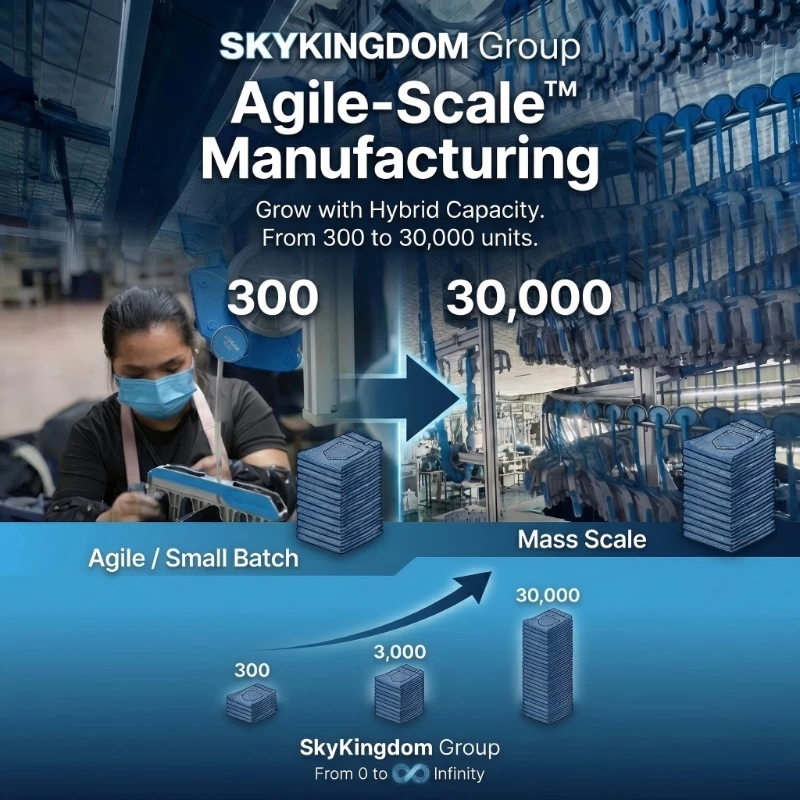
- Standard production mode: typically 300 pieces per style and above. At this volume, you generally have access to a wider range of fabrics (including mill-order fabric), custom trims, and more complex wash options.
- Small-batch mode: some production partners offer a lower entry point — as low as 30 pieces per style per color — but with conditions. The most common condition is that fabric must be in stock (not custom-ordered from a mill), and trim options may be limited to stock items. Wash complexity may also be constrained at smaller volumes because certain wash setups have fixed costs that only make economic sense above a minimum quantity.
What to confirm:
- Which MOQ tier applies to your order
- Whether the MOQ is per style, per color, or per style-color combination
- Whether your chosen fabric and trims are available at your order quantity
- Whether the wash you approved during sampling is feasible at your order volume
- What the per-unit cost is at your confirmed quantity — and how it changes if you adjust up or down
For a deeper breakdown of how low-MOQ conditions affect production planning, see Low MOQ Denim Production: What to Confirm First.
3. Size Breakdown
Your size breakdown — how many units per size — directly affects your sell-through rate and your leftover inventory. Get it wrong, and you will be stuck with unsold extreme sizes while your core sizes sell out.
For a first order without sales data, use a bell-curve distribution weighted toward your median sizes. For example, in a women’s 25–31 range:
- Sizes 27 and 28: highest allocation (these are typically the highest-demand sizes in women’s denim)
- Sizes 26 and 29: moderate allocation
- Sizes 25, 30, and 31: lowest allocation
A concrete example for a 210-piece order across 7 sizes:
- Size 25: 15 pcs | Size 26: 25 pcs | Size 27: 40 pcs | Size 28: 45 pcs | Size 29: 40 pcs | Size 30: 25 pcs | Size 31: 20 pcs
This is a starting framework, not a formula. If your brand targets a specific body type or demographic, adjust accordingly. If you are selling through your own DTC channel, you will have data after the first cycle to refine the ratio. If you are selling wholesale, ask your buyer what their size curve looks like.
The key mistake to avoid: distributing evenly across all sizes. Equal distribution guarantees that your median sizes sell out first while your smallest and largest sizes become dead stock.
4. Fabric Availability
The fabric you approved during sampling must be available in the quantity you need for production. This sounds obvious, but it is one of the most common causes of first-order delays.
Confirm:
- Is the approved fabric in stock at the mill or warehouse? If yes, how much is available? If the available stock is less than your order requires, you have a problem — and you need to know this before production starts, not during.
- If fabric needs to be ordered from the mill, what is the lead time? Mill-order denim fabric typically takes 3–6 weeks to produce and deliver, depending on the mill and the order quantity. This lead time comes before your production timeline begins.
- Is the production fabric from the same lot as your sample fabric? Different fabric lots from the same mill can vary in shade, hand feel, and shrinkage behavior. If your bulk fabric comes from a different lot, request a swatch for comparison — or at minimum, confirm that wash testing will be done on the bulk fabric before the full run proceeds.
For small-batch orders (under 300 pieces), in-stock fabric is typically required. If the specific fabric you sampled is no longer in stock, your options are to switch to an available alternative (which may require a new wash test) or wait for restocking. Make this decision before placing the order, not after.
5. Trim and Label Readiness
Every trim and label must be finalized before production begins. Unlike fabric, which is ordered in bulk, trims are often sourced from multiple suppliers with different lead times and different MOQs.
Confirm:
- Main button and rivets: final specification, final finish, ordered or in stock. Custom-engraved buttons typically require minimum orders of 500–1,000 pieces and may take 2–4 weeks to produce.
- Zipper: final brand, final color, final slider finish, confirmed availability.
- Main label: final artwork approved, production ordered. Woven labels typically take 1–3 weeks depending on supplier and quantity.
- Care label: final content confirmed — fiber composition matches actual fabric, wash instructions match actual wash treatment, country of origin is correct, regulatory compliance for your target market (FTC in the US, EU textile labeling regulation in Europe) is verified. Care label errors are a customs and compliance risk.
- Size labels, hang tags, back patch, pocket flasher: all finalized, all ordered or in stock.
- Thread: final color confirmed. If you specified contrast stitching, verify the thread color against the washed garment — thread color reads differently on raw versus washed fabric.
If any trim is not ready, production can still proceed on cutting and sewing — but final assembly, labeling, and packing will be held until all trims arrive. Build this into your timeline.
6. QC Expectations
Quality control is not something that happens automatically. If you do not define your QC expectations before production begins, you are leaving the definition of “acceptable quality” up to someone else.
What to confirm:
- Inspection standard: AQL (Acceptable Quality Limit) is the industry standard for denim production. AQL 2.5 for general inspection is the most common level — it means that for a given sample size drawn from the production lot, no more than 2.5% of inspected units can have major defects for the lot to pass. Tighter standards (AQL 1.5) are used for high-value or high-risk items; looser standards (AQL 4.0) may apply to less critical categories.
- Defect classification: agree on what counts as critical (safety hazard, completely non-functional), major (visible defect affecting appearance or function), and minor (slight imperfection unlikely to affect consumer acceptance). Denim-specific examples: a broken zipper is critical; a misaligned back pocket is major; a slightly uneven hem chain stitch is minor.
- Inspection points: inline inspection during sewing, wash inspection after laundry, and final inspection before packing. Each checkpoint catches different types of defects — sewing catches construction errors, post-wash catches wash inconsistency, and final inspection catches packaging and labeling errors.
- Failure protocol: what happens if inspection fails? Rework, partial shipment of passing units, full re-inspection, or reject? Who bears the rework cost? Agreeing on this before production removes ambiguity and conflict after the fact.
For a deeper look at how a QC system operates across the full production cycle, see QC System.
7. Packing and Shipping Notes
Packing sounds like a trivial detail — until your first shipment arrives with crushed hang tags, unlabeled cartons, or garments folded in a way that creates permanent crease marks through the wash.
Confirm:
- Individual garment packing: poly bagged or not? If bagged, what size bag, sealed or open, with barcode sticker or without? Folding method — how should the garment be folded before bagging? For denim with visible wash effects, improper folding can create crease marks that look like defects.
- Carton packing: how many units per carton? Sorted by size, by color, or mixed (assorted pack)? Carton dimensions and weight limits if your logistics provider has requirements.
- Carton labeling: what information appears on each carton? Typically: style number, color, size breakdown, quantity, gross weight, net weight, carton number, destination. If you have specific labeling requirements from your warehouse or retail partner, provide them now.
- Shipping method and Incoterm: FOB (you arrange and pay for ocean/air freight from port), CIF (supplier arranges freight to your port), or DDP (supplier handles everything to your door)? This affects who is responsible for what, and it affects cost. Confirm this before production so the logistics can be planned accordingly.
If you are shipping to a 3PL (third-party logistics warehouse) or an Amazon FBA facility, they will have specific packing and labeling requirements. Get those requirements and share them before production — not after the cartons are packed.
8. Delivery Timeline
Your production timeline does not start the day you say “go.” It starts when every input is confirmed — approved sample, fabric in hand, trims in hand, labels in hand, packing instructions confirmed, deposit received.
A realistic timeline breakdown for a standard first order:
- Fabric sourcing (if not in stock): 3–6 weeks
- Trim sourcing (custom items): 2–4 weeks (can overlap with fabric sourcing)
- Cutting and sewing: 2–3 weeks for a standard order, depending on quantity and complexity
- Washing: 3–7 days, depending on wash complexity and number of techniques
- Finishing, QC, and packing: 3–5 days
- Shipping: varies by method — ocean freight 3–5 weeks, air freight 5–10 days, courier 3–7 days
Total from confirmed inputs to delivery can range from 5 weeks (small batch, in-stock fabric, simple wash, air freight) to 12+ weeks (standard order, mill-order fabric, complex wash, ocean freight). Build your launch calendar backward from your drop date and add buffer — at least one week — for the unexpected.
The most common timeline mistake for first-time brands: assuming the production clock starts on the day they send a message saying “let’s go,” when in reality trims are not ordered, labels are not finalized, and fabric has not been confirmed. See How It Works for a step-by-step view of the full process.
9. Reorder Documentation
This is the step that first-time brands almost always skip — and regret when their product sells and they need to reorder.
Before your first order ships, confirm that the following records are saved and organized:
- Approved production sample: the physical garment that was approved for production. Keep it stored flat, sealed, away from light.
- Measurement specification: the locked measurement chart for all sizes, in the approved garment state (after wash, after any shrinkage).
- Fabric record: article number, mill, weight, composition, stretch content, color. If the fabric was from a specific stock lot, note the lot number.
- Wash record: wash recipe reference number, shade band (if established), bulk wash submission notes (if applicable). See Denim Wash Review Checklist Before Production for full detail.
- Trim record: every trim specified — button, rivet, zipper, thread, labels, back patch, hang tags — with supplier, specification, and finish.
- QC report: final inspection report, including pass/fail status, any accepted deviations, and any rework performed.
- Packing notes: how the order was packed, labeled, and shipped.
- Production comments: any issues that arose during production and how they were resolved — this is institutional knowledge that prevents the same problems on the next run.
This documentation set is your reorder baseline. With it, a reorder can pick up where the first order left off — same spec, same quality, same result. Without it, every reorder becomes a partial re-development exercise. For a complete guide to maintaining consistency across reorders, see Reorder-Ready Denim Production Checklist.
Payment Terms — What to Expect
Payment structure for a first denim production order varies by production partner, order size, and region. A common structure is a deposit of 30–50% upon order confirmation, with the remaining balance due before shipment. Some partners require higher deposits — or full prepayment — for first orders with new clients, particularly where regional risk factors apply.
What to confirm before placing your order:
- Deposit percentage and when it is due
- Balance payment timing — before shipment, upon shipment, or upon delivery
- Payment method — wire transfer (T/T), letter of credit (L/C), or other
- Currency — confirm which currency the invoice is denominated in to avoid exchange rate surprises
- What triggers production start — is it deposit received, or deposit received plus all materials confirmed?
Do not assume payment terms are negotiable on a first order. Establishing a track record of on-time payment and smooth communication is what opens the door to more flexible terms on subsequent orders.
The Real Risk of a First Order
The financial risk of a first denim order is real but manageable if you have done the work upstream. Brands that rush past sampling, skip QC alignment, or place orders with unresolved spec questions are not saving time — they are front-loading risk onto the one moment in the process where mistakes are most expensive to fix: after production has started.
The cost of one more week of preparation — confirming the right fabric is in stock, finalizing your labels, locking your size breakdown, agreeing on QC protocol — is negligible compared to receiving 500 garments that do not meet your expectation, do not match your approved sample, or cannot clear customs because of a care label error.
First orders are supposed to be small, careful, and well-documented. They are the foundation for everything that follows.
Where to Start
SkyKingdom works with startup brands and creator-led labels placing their first denim production orders — including small-batch runs starting from 30 pieces per style per color with in-stock fabric. If you are preparing for a first order and want to confirm your readiness, start a conversation here.
