
Customised apparels are the clothes you don’t settle for—you shape them to match your brand, your fit, and your audience. If you’ve ever looked at a “close enough” hoodie mockup or a denim wash that came out wrong and thought, there has to be a better way, you’re already in the customised apparels mindset. The good news: options are wider than most beginners think, and timelines can be predictable if you choose the right workflow. Below is a clear, professional breakdown of what customised apparels include, what they cost, and how long they realistically take—especially for denim and woven categories.

What “customised apparels” actually means (and what it doesn’t)
Customised apparels typically fall into two buckets: decoration customisation (printing/embroidery on existing blanks) and manufacturing customisation (OEM/ODM cut-and-sew with your own pattern, fabric, wash, trims, and sizing). Many online “custom apparel” sites focus on fast decoration and low commitment, which is great for events and small runs. For DTC brands, though, the bigger value is owning the product identity—fit, fabric handfeel, wash effects, and construction details that customers can recognize.
In my experience working with launch-stage brands, confusion happens when “custom” is assumed to mean “anything is possible instantly.” In production, customisation is a set of controlled choices—each choice affects cost, MOQ, and lead time. Understanding those trade-offs is how you avoid delays and surprise sampling bills.
The 3 main customisation paths (choose based on your goal)
1) Print/embroidery on blanks (fastest)
This is the classic “add logo + ship” route (great for teams, promos, creator merch). You select a ready-made garment and apply:
- Screen print, DTG, DTF
- Embroidery or patches
- Heat transfers, labels, simple packaging
It’s quick, but your differentiation is mainly graphic—not fit, fabric, or construction.
2) ODM (modify an existing base pattern)
ODM is the shortcut many DTC brands use to hit speed-to-market. You start from a proven block/pattern and customize:
- Fabric and color
- Wash and finishing (especially for denim)
- Trims (buttons, rivets, zippers), labels, packaging
- Small fit tweaks within tolerance
This path often delivers the best balance of speed, risk control, and brand uniqueness.
3) OEM cut-and-sew (full custom from your tech pack)
OEM is for brands that need a specific fit or construction. You provide a tech pack (or co-develop one) and define everything:
- Pattern, grading, measurements
- Fabric specs, shrinkage control, testing
- Stitch types, seam allowances, reinforcement
- Wash recipes and garment finishing standards
It’s the most “customised apparels” you can get—but it requires the most development discipline.
Customisation options that matter most (especially for denim + woven)
Customised apparels aren’t just logo placement. In denim and woven products, the biggest customer-perceived differences come from the details below:
- Fabric selection: weight (oz), stretch %, yarn character, weave, and finishing
- Wash & finishing: enzyme wash, stone wash, whiskers, abrasion, tint, over-dye
- Fit & pattern: rise, thigh, knee, leg opening; grading rules across sizes
- Trims & branding: rivets, shanks, zipper pullers, Jacron/leather patches, woven labels
- Construction: stitch density, thread type, bartacks, pocket bags, reinforcement points
- Compliance & QC: AQL level, restricted substances, needle policy, traceability
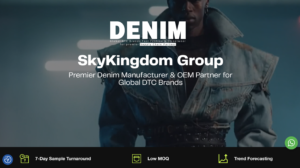
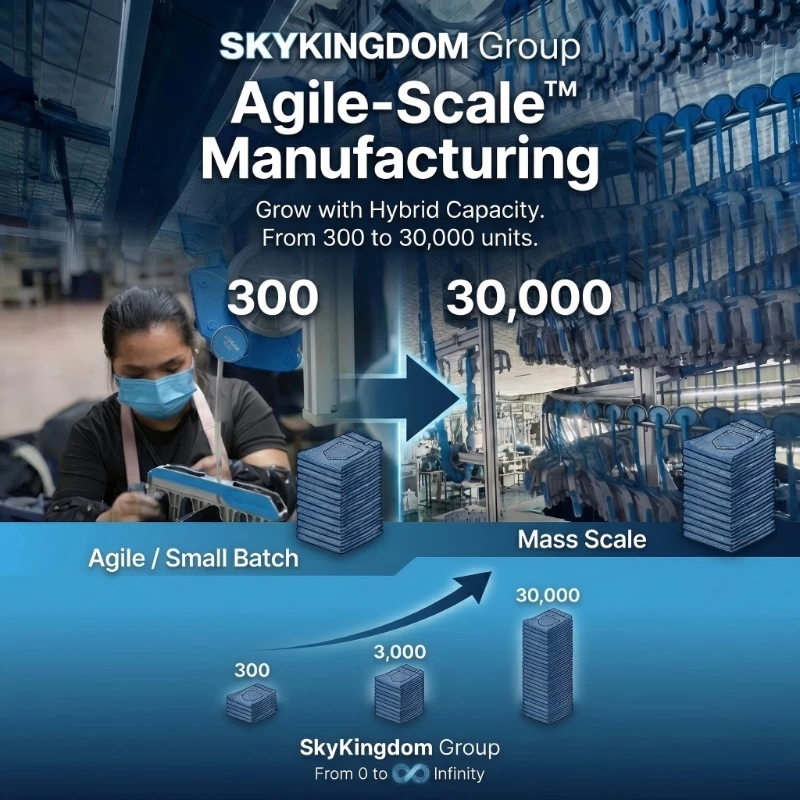
SkyKingdom Group, for example, focuses heavily on denim/woven OEM/ODM with digital tracking and a “Speed-to-Market Engine” designed around 7-day sampling and 15–22-day bulk production—a practical model when you’re trying to launch a capsule fast without sacrificing repeatable quality.
Costs: what you’re really paying for in customised apparels
Customised apparels cost is usually the sum of four things: product cost, development cost, decoration/finishing cost, and logistics. The price gap between “cheap custom” and “premium custom” is often driven by development and finishing, not the base sewing.
Key cost drivers (simple, predictable)
- Fabric: denim weight, stretch content, dye method, minimums for custom fabric
- Wash complexity: more steps = more labor, more risk, more approvals
- Trims: custom hardware molds, low-MOQ trims, special label materials
- Pattern work: new block development and fit iterations
- MOQ: lower MOQ raises per-unit cost, but reduces inventory risk
- QC standard: tighter QC reduces returns and negative reviews, but costs more
Typical cost ranges (real-world guidance, not a quote)
- Blank + print/embroidery: lowest cost, fastest, limited uniqueness
- ODM denim/woven with custom wash + trims: mid cost, strong differentiation
- Full OEM with new pattern + fabric development: highest cost, maximum control
If you’re building a denim line, I strongly recommend budgeting for at least one “learning” sample round. The first prototype reveals shrinkage behavior, wash variance, and fit balance—things you can’t fully see in a mockup.
| Cost Driver | What It Affects | Typical Impact on Unit Cost (Low/Med/High) | How to Control It |
|---|---|---|---|
| Fabric choice | Material price, yield, shrinkage, sewing efficiency | High | Standardize fabrics; choose in-stock options; optimize markers |
| Wash steps | Processing time, chemical use, rejection rate | Med | Limit wash types; batch similar shades; validate recipes early |
| Custom trims | Trim MOQ, lead time, attachment labor | Med | Use stock trims; reduce unique SKUs; consolidate suppliers |
| Pattern development | Sampling rounds, grading, fit approvals | Med | Reuse blocks; clear tech packs; 1st-fit alignment upfront |
| MOQ | Factory pricing tier, setup costs allocation | High | Combine styles/colors; plan bulk buys; negotiate tiered MOQs |
| QC/AQL level | Inspection labor, rework, scrap rate | Med | Set fit-for-purpose AQL; improve inline QC; clarify tolerances |
| Packaging | Packaging material cost, packing time, carton size | Low | Simplify pack-out; right-size cartons; use standard components |
| Shipping method | Freight cost, duties exposure, delivery speed | High | Plan earlier for sea; consolidate shipments; optimize Incoterms |
Timelines: realistic lead times from idea to delivery
Most founders underestimate timeline variability. The most reliable approach is to break customised apparels into three predictable phases: development, approval, and bulk execution.
Standard timeline (OEM/ODM apparel)
- Design + tech pack / reference selection: 2–7 days
- Sampling (prototype + revisions): commonly 7–21 days total depending on revisions
- Bulk production: commonly 15–45 days depending on complexity and capacity
- Shipping: 3–35 days depending on air/sea and destination
SkyKingdom’s operational promise is built around speed: 7-day sample turnaround and 15–22-day bulk production, supported by IoT-enabled production visibility and ERP-based tracking. For DTC brands that live and die by launch windows, that kind of timeline discipline is often the difference between catching a trend and missing it.

How to pick the right manufacturing partner (a practical checklist)
When customised apparels go wrong, it’s usually not because the factory “can’t sew.” It’s because the process doesn’t control risk: unclear specs, unstable fabric, poor wash repeatability, or weak QC gates.
Use this checklist before you commit:
- Sampling speed + accuracy: ask how they control measurements, shrinkage, and wash variance
- MOQ flexibility: especially if you’re testing demand (e.g., 30–100 pcs per style/color)
- QC standard: confirm AQL level (AQL 2.5 is a strong baseline for scalable e-commerce)
- Traceability: request digital tracking, inline QC records, and pre-shipment reporting
- Sustainability claims: verify eco-friendly wash processes and compliance documentation
- Capacity planning: can they scale if your SKU sells out?
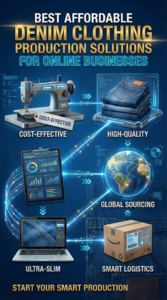
If low MOQ is your priority for customised apparels, this guide is a strong starting point: choosing the best factory for low moq denim clothing ideal for individuality seekers. If sampling speed is your bottleneck, see: how to identify the best factory for fast and reliable denim clothing sample delivery. For cost control without sacrificing quality, this is practical: best affordable denim clothing production solutions for online businesses.
Common mistakes in customised apparels (and how to avoid them)
Most issues are avoidable if you treat custom apparel like product engineering, not just “design.”
-
Vague specs (“make it premium”)
Replace with measurable standards: GSM/oz, stitch density, allowable tolerances, AQL, wash recipe targets. -
Assuming one sample is enough
Denim and woven garments often need at least one revision to lock shrinkage + wash + fit. -
Ignoring grading
A great size M doesn’t guarantee a great size XL. Ask for grading rules and test across sizes. -
Underestimating trim and fabric lead times
Custom hardware and fabric bookings can silently add weeks unless managed early.
Where SkyKingdom Group fits (OEM/ODM for DTC speed + control)
For brands building customised apparels in denim and woven categories, SkyKingdom Group positions itself as an OEM/ODM partner designed for fast iteration and repeatable bulk execution. The operational model centers on:
- 7-day sampling and 15–22-day bulk production
- Low MOQ (as low as 30 units) for new brands and creators
- “Amazon Top Seller-Grade QC” aligned with AQL 2.5
- Eco-friendly wash processes and certified social responsibility standards
- Digital ERP transparency plus IoT-enabled production monitoring
- Risk-sharing via base fabric safety stock management (useful when demand spikes)
If you’re trying to launch a fast-fashion denim or woven drop on a tight calendar, these capabilities are directly tied to the two biggest success factors: time and consistency.
US Fashion Brand Visits Our China Garment Factory | OEM & ODM Clothing Manufacturer

Conclusion: customised apparels are a system, not a single decision
Customised apparels feel creative, but they succeed through systems: clear specs, disciplined sampling, controlled wash/fit, and transparent QC. When I’ve seen launches go smoothly, it’s because the brand treated timelines and costs as design inputs—not surprises at the end. If you pick the right customisation path (blank, ODM, or OEM) and align it with your budget and calendar, you can ship faster and build a product customers remember.
📌 the ultimate guide to quick denim clothing sample production for fashion brands
FAQ: Customised apparels (common search questions)
1) What are customised apparels?
Customised apparels are garments personalized through printing/embroidery on blanks or fully custom OEM/ODM manufacturing with your fabric, fit, trims, and branding.
2) How much do customised apparels cost per piece?
It depends on fabric, wash/finishing, trims, MOQ, and QC requirements. Blank decoration is usually the cheapest; full OEM is the most expensive but offers maximum differentiation.
3) What’s the typical MOQ for customised apparels?
Many suppliers require 100+ per style/color, but some OEM/ODM partners support low MOQs (e.g., 30 units) for new brands testing demand.
4) How long does custom apparel manufacturing take?
A common range is 2–8 weeks including sampling and bulk, plus shipping. Specialized speed programs can reduce this with fast sampling and short bulk cycles.
5) What’s the difference between OEM and ODM in customised apparels?
ODM modifies an existing base pattern and is faster; OEM builds your product from your tech pack and is more customizable but usually takes longer.
6) Why does denim customisation take longer than T-shirt customisation?
Denim often requires wash development, shrinkage control, hardware sourcing, and more QC gates—each adds time and revision potential.
7) How do I ensure quality for customised apparels?
Use measurable specs, request pre-production approval samples, confirm AQL standards, and choose a partner with consistent QC reporting and traceability.
References (industry background)
- Printful custom clothing overview
- Custom Ink rush delivery options
- eShakti custom fit clothing concept