Home / Denim Encyclopedia / Denim Decision Tools / Stone Wash vs Enzyme Wash

Stone Wash vs Enzyme Wash:
Which Is Right for Your Denim Line?

The look, the hand and the environmental bill – compared with sourced figures, not marketing numbers.

The short answer

Stone wash and enzyme wash produce different-looking denim with a very different environmental bill. Stone wash tumbles the garment with pumice stones, wearing the surface down into a harder, uniformly faded, “authentic vintage” cast. Enzyme wash uses cellulase enzymes to hydrolyze the cotton surface, releasing surface fibers and attached indigo, giving a softer, more natural fade without stones. If your line needs a rugged, all-over worn look, stone wash is the reference point; if you need a softer hand and a lower-impact story, enzyme wash is the switch most brands are making.

The environmental gap is real but it is not the headline-size number that circulates in supplier marketing. One published study measured enzyme wash as roughly 10% better on water and energy than stone wash – not the 60% “carbon cut” that gets quoted without a source. The reliable figures are below.

A range of denim wash shades displayed in a production wash room
Wash route changes shade, surface character and hand feel. Approve the target on a physical garment sample before bulk production.

What is stone wash?

Stone wash is a mechanical finishing method: garments are tumbled in large washing machines with pumice stones, whose abrasion wears the indigo off the surface and softens the fabric. It produces the classic, hard-wearing, all-over faded look that defined 1980s–90s denim and remains a baseline finish across mainstream denim lines.

The trade-offs: pumice generates stone sludge and dust, the process uses large volumes of water to move the stones, and aggressive friction can thin the fiber at high-wear points.

What is enzyme wash?

Enzyme wash replaces the stones with cellulase enzymes – biological catalysts that selectively hydrolyze cellulose on the denim’s surface, releasing loosened fibers and attached indigo and creating a soft, natural fade. Because the enzyme works on the surface rather than mechanically abrading it, the process is gentler on the fiber and needs no pumice.

The trade-offs: enzyme wash needs tighter control of temperature, pH and dwell time, and it produces a softer, less “rugged” hand than stone wash – which matters if the brand’s look depends on a harder vintage cast.
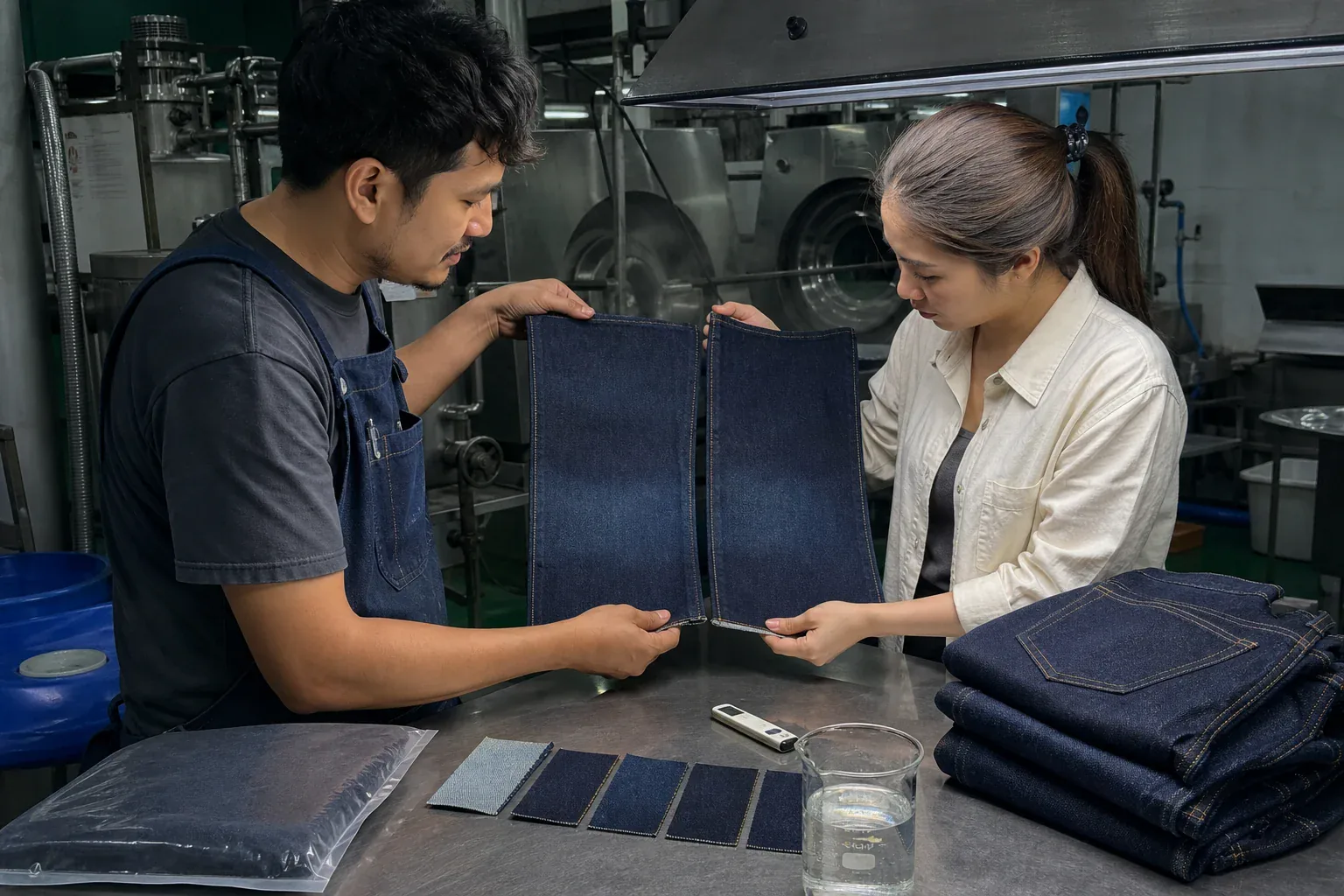
Two wash specialists comparing denim panels in a wash room
Compare wash panels under the same lighting before approving shade and surface effect.
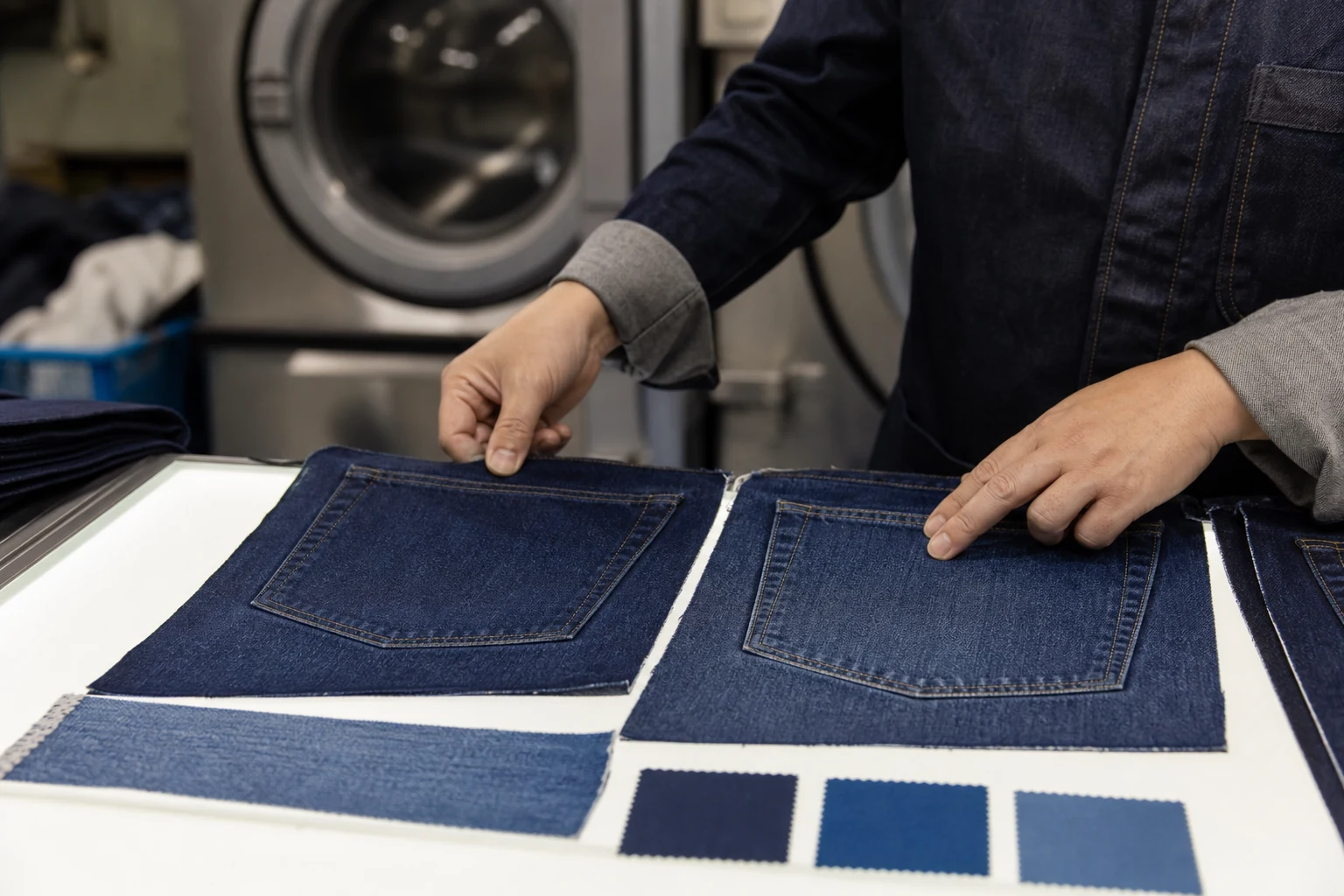
Close comparison of denim wash panels beside industrial washing equipment
Process control matters: recipe, machine load, pH, temperature and cycle time can all change the result.

Stone wash vs enzyme wash: the comparison

Swipe horizontally to compare both wash routes.
Dimension Stone wash Enzyme wash
Effect Hard, uniform all-over fade, “authentic vintage” Soft, natural fade, gentler
How it works Pumice stones abrade the surface Cellulase enzymes hydrolyze surface cellulose, releasing indigo
Hand feel Harder Softer
Water use High (large volumes to carry stones) Lower than stone wash
Energy use Higher Lower than stone wash
Waste Pumice sludge and dust No stone waste
Fiber stress Higher (mechanical friction) Lower (surface-level action)
Process control Stone grade, loading, abrasion and cycle time Enzyme type, dose, pH, temperature and dwell time

The figures, sourced. One external study – Enzyme Wash on Denim Garments: A Sustainable Alternative to Stone Wash (SSRN) – measured enzyme wash as 100% ZDHC-compliant, saving about 10.6% water, 1.9% energy and 1.4% CO₂ per garment versus stone wash. These are external research results under that study’s conditions, not a supplier’s own measured performance, and should be verified against the original paper. Treat any claimed figure far larger than this – for example a “60% carbon reduction” – as marketing until it is attached to a source you can read.

When to choose stone wash, when to choose enzyme wash

Choose stone wash when…
the brand’s look depends on a hard, uniformly worn, vintage cast, or when the target market expects the classic stone-washed hand and appearance.
Choose enzyme wash when…
the priority is a softer hand, a lower-impact story, or a brand that needs to substantiate its sustainability claims with a real, citable number – the enzyme route is where the measurable water and energy savings actually are.

The decision is a product decision before it is a sustainability decision: a stone-wash look cannot be fully reproduced with enzymes, and an enzyme-soft hand cannot be faked with stones. Start from the reference, not from the label.

From reference image to a sealed sample

The same handoff rules that apply to any wash decision apply here:

1
Break the reference down.
Decide the base tone, the fade intensity, and the target hand (hard vs soft) – these determine whether stone or enzyme (or a combined sequence) is the right route.
2
Sample the effect that defines the look.
For stone wash, sample the fade depth and hand; for enzyme wash, sample the softness and the evenness of the fade.
3
Agree the confirmation standard before sampling.
An approved physical sample, an AQL 2.5 inspection plan and agreed AATCC colorfastness tests define what “done” means.
4
Verify the supplier’s experience, not just the claim.
Real wash-development samples, a case with the actual deviations and corrections, and delivery evidence separate a team that has run this process from one that only describes it.

On that last point: SkyKingdom runs this handoff with an internal team handling development, sampling and quality control, coordinated with production through a managed network of partner factories – starting from a reference image, sketch, physical sample, sample photo or tech pack. For a wash that must be developed and reproduced consistently, SkyKingdom’s dirty-wash development service covers what it develops, what a sample must clear, and how to open a project.

Frequently asked questions

What is the difference between stone wash and enzyme wash?
Stone wash abrades denim with pumice stones for a hard, uniform vintage fade; enzyme wash uses cellulase enzymes to soften and fade the surface, with no stones and a softer hand.
Is enzyme wash really better for the environment?
It is lower-impact than stone wash, but the reliable figures are modest – one external SSRN study measured about 10.6% water and 1.9% energy savings per garment, 100% ZDHC-compliant. A “60% reduction” claim should be treated as marketing until sourced.
Does enzyme wash damage denim?
Enzyme wash is gentler than stone wash because it works on the surface cellulose rather than mechanically abrading the fiber, so fiber stress and colorfastness risk are generally lower.
Can I get the stone-wash look with enzymes?
Not fully. Enzymes give a softer, more natural fade; the hard, uniformly worn stone-wash cast comes from actual stone friction. The two looks are different.
Why do two suppliers quote different savings numbers?
Because process water, energy and chemical loads vary by recipe, machine and site – and because some figures are sourced, while others are marketing. Always ask for the underlying study or measurement.
Which wash should I spec for a durable, repeatable finish?
It depends on the target look and hand. Either can be made repeatable by sealing against a physical reference with AQL 2.5 and AATCC testing; the route should follow the reference, not the label.

Turn the wash decision into an approved sample.

Send a reference image, sketch, physical sample, sample photo or tech pack. SkyKingdom can help define the target effect, develop the wash route and seal the confirmation standard before bulk production.

Develop a repeatable wash sample

Sources

SSRN – “Enzyme Wash on Denim Garments: A Sustainable Alternative to Stone Wash” – external environmental figures (10.6% water, 1.9% energy, 1.4% CO₂)
CottonWorks – Denim Finishing / wash-process reference (stone wash and enzyme wash framing)
AATCC – Colorfastness test methods (e.g. AATCC TM61 laundering, crocking)
ISO 2859-1:2026 – Sampling schemes indexed by acceptance quality limit (AQL) for lot-by-lot inspection