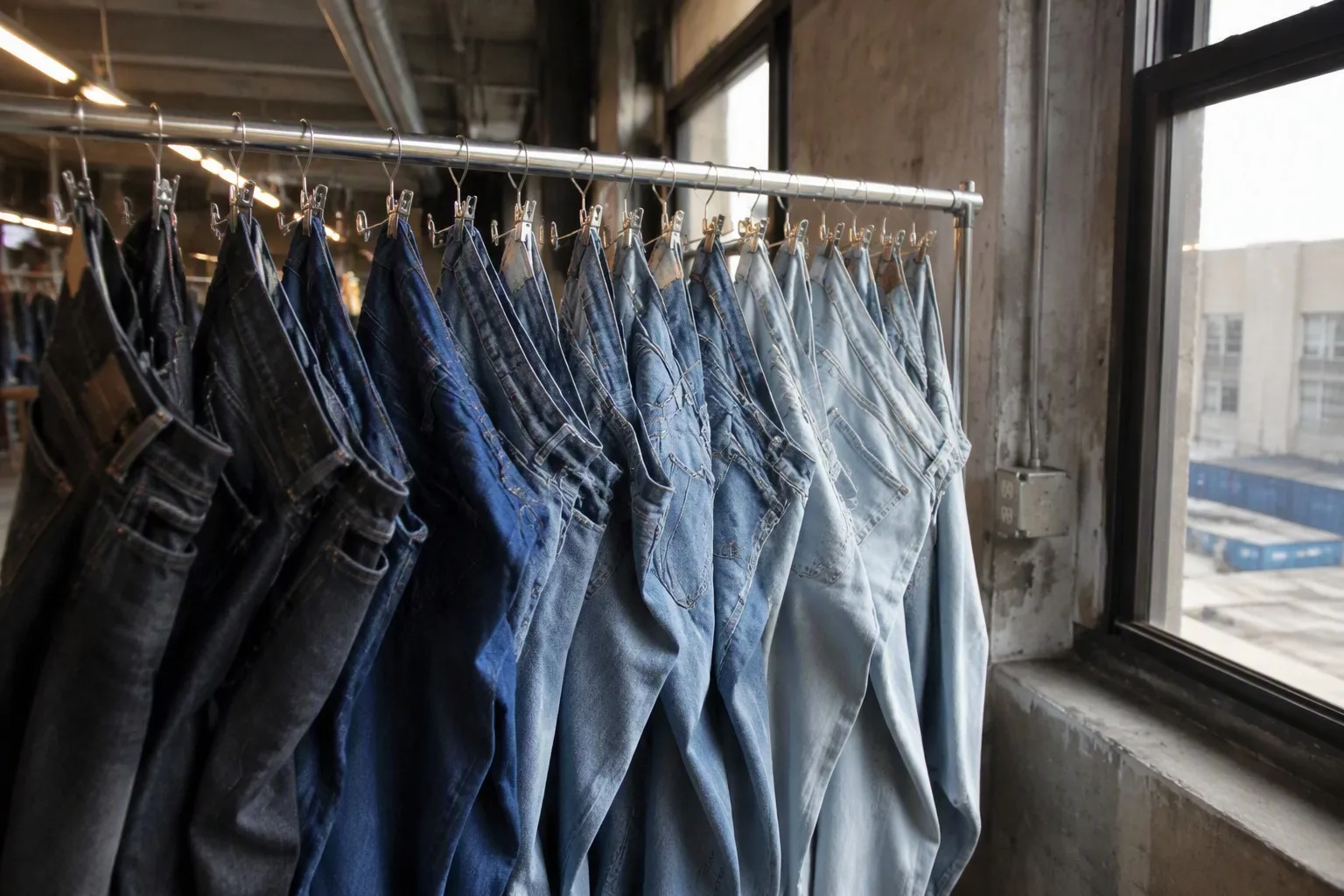
The most common reorder complaint in denim is not a seam that split or a zipper that failed. It is a sentence that shows up in the inbox a week after the second shipment lands: “This batch looks different from the last one.” Sometimes it is lighter. Sometimes it is darker. Either way, the customer noticed, and the brand now has a problem that a contract cannot fix. This guide is about why that happens and how to stop it before the next reorder is even placed.
Direct answer: how to keep denim wash color consistent across reorders
Consistency across reorders does not come from asking the laundry to “match the last batch.” It comes from freezing a measurable baseline at pre-production sign-off and verifying every new production lot against that baseline before cutting. The baseline has six parts: fabric construction, shade band, wash recipe, shrinkage target, hand-feel reference, and AQL level. If those six are written down — and a pre-production sample is checked against them on every new fabric lot — drift stays inside a controlled, agreed tolerance instead of being discovered after the goods have shipped.
How do I keep denim wash color consistent across reorders?
Freeze a six-dimension production baseline at PP-sample sign-off — fabric construction, shade gradient band, wash recipe (enzyme type, dosage, temperature, time, liquor ratio, pH), shrinkage target, hand-feel reference, and AQL level — then verify the bulk fabric lot and a pre-production sample against that baseline before cutting starts. A documented recipe and a shade band, not a visual memory of the first batch, are what make reorders reproducible.
Why does my denim reorder look lighter or darker than the first batch?
Three causes account for most reorder drift: a different fabric lot with a different indigo uptake, a wash recipe that was never written down as a technical record, and a bulk run washed on different machinery or in a different load size. Indigo is a ring-dyed surface dye, so even a small change in dye concentration or wash duration shifts the final shade.
What is the difference between a wash label and a wash technical record?
A wash label is a marketing name such as “medium enzyme wash.” A technical record specifies the variables that reproduce the shade: enzyme type, dosage as a percentage of garment weight, temperature, process time, liquor ratio, and pH. Only the technical record is actionable in a laundry; the label alone cannot reproduce a shade on the next run.
What AQL standard should I use for denim wash shade?
Use ISO 2859-1 sampling with AQL 2.5 for major defects and AQL 4.0 for minor defects. For shade specifically, accept a tolerance of 2–3 shade steps against the approved reference under a light booth — measured with a spectrophotometer where possible, and always evaluated against the sealed bulk standard rather than against memory.
How many shade levels of variation are acceptable in bulk denim?
Industry practice tolerates 2–3 shade steps against the sealed standard. Tighter control is possible but costs more and is rarely necessary for commercial denim. The key is not “zero difference” — which is physically impossible with indigo — but keeping drift inside a defined, agreed band and measuring it against a fixed reference.
Can I reproduce the exact same wash on a different fabric lot?
Not by running the same recipe blindly. A new fabric lot absorbs indigo differently, so the recipe usually needs a small adjustment to land on the same shade band. The correct sequence is to test the new lot in the lab, adjust the recipe against the spectrophotometer reading of the approved standard, then cut a pre-production sample and verify it before bulk.
1. Why indigo makes “zero difference” impossible — and what to aim for instead
One thing has to come first, because it sets the realistic target: the chemistry. Indigo is not like most textile dyes. It is a vat dye that does not penetrate the cotton fiber. It sits on the surface of the yarn in layers — a structure called ring dyeing. That is precisely what gives denim its desirable fading behavior: as the yarn abrades, the surface indigo rubs away and the white core shows through.
That same structure is why two dye lots are never identical. The amount of indigo that lands on the yarn depends on the number of dips, the dye concentration in each vat, the oxidation time between dips, the tension on the yarn, and the ambient conditions on the day the rope was run. None of these variables repeats perfectly from one production lot to the next. A mill that says it can reproduce a shade to an exact match is not describing reality; it is describing a hope.
The workable target, then, is not zero difference. It is controlled difference — drift that stays inside a defined band narrow enough that a customer cannot see it side by side. In practice that band is expressed as a number of shade steps, or more precisely as a Delta E value from a spectrophotometer reading. This is the standard the rest of the guide works toward: not eliminating variation, but measuring it and keeping it inside an agreed tolerance.
1.1 Where the variation starts: rope dyeing vs. slasher dyeing
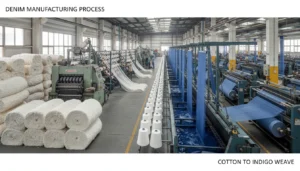
The shade variation that shows up at reorder time usually begins before the fabric is even woven, at the indigo dyeing stage. There are two dominant methods, and they produce different shade behavior.
In rope dyeing, the yarns are bundled into ropes and passed repeatedly through indigo dye baths, with oxidation (airing) between dips. The number of dips — typically six to eight — and the concentration of each bath determine how deep the shade goes. This is the method behind most premium and authentic-look denim, and it is also the method with the most variables to control: dip count, dye concentration per bath, oxidation time, and rope tension all shift the final color.
In slasher dyeing, the yarns are laid flat as a sheet and passed through the dye range once. It is faster and cheaper, but it produces a more uniform, less characterful shade and tends to have a different ring-dyeing profile. A brand that switches mills — or a mill that changes its dyeing line — can see a shade shift even when the “same” indigo and the “same” fabric weight are specified.
For reorders, the takeaway is simpler than it sounds: the fabric spec alone does not pin down the shade. A 12 oz 3/1 right-hand twill can be rope-dyed or slasher-dyed, and the two will wash to different results even with an identical wash recipe. This is why the fabric dimension of the baseline (Dimension 1) must record not just weight and weave but the dyeing method, so that a future lot can be checked for a match at the source rather than discovered after washing.
2. The difference between a wash label and a wash technical record
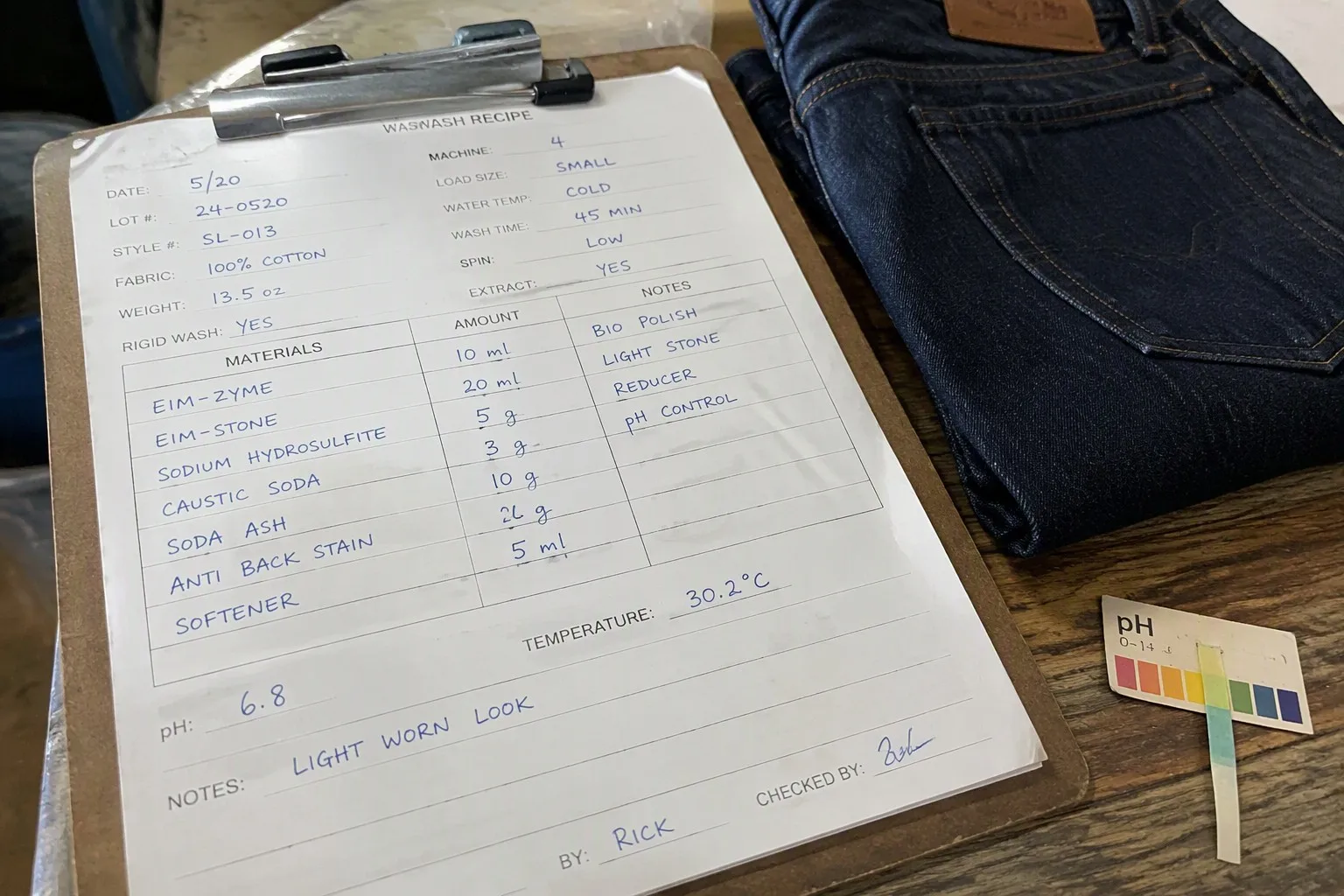
Most reorder drift traces back to a single missing document. A brand approves a wash by name — “medium enzyme wash,” “heavy stone wash,” “vintage blue” — and assumes that name is enough to reproduce the look. It is not.
A wash label is a category. It tells a buyer roughly what the finish looks like, but it contains no information a laundry can act on. The phrase “medium enzyme wash” does not specify which enzyme, how much of it, at what temperature, for how long, in how much water, or at what pH. Ask three laundries to run a “medium enzyme wash” and you will get three visibly different results.
A technical record is the opposite. It is a set of process variables that, when repeated, reproduces the same outcome within a measurable tolerance. A usable denim wash record specifies at minimum:
| Variable | Example value | Why it matters |
|---|---|---|
| Enzyme type | Cellulase (acid vs. neutral) | Determines how aggressively the surface indigo is abraded |
| Enzyme dosage | 2% of garment weight | Dosage directly controls shade depth |
| Temperature | 45°C | Enzyme activity is strongly temperature-dependent |
| Process time | 40 minutes | Longer exposure = more abrasion = lighter shade |
| Liquor ratio | 1:8 (garment weight : water) | Changes chemical concentration and mechanical action |
| pH | 5.5 | Enzymes work only within a narrow pH window |
The difference shows up at reorder time. With a technical record on file, a reorder is an engineering task: pull the record, test the new fabric lot against it, adjust, verify, cut. Without one, the reorder is a guess — the laundry matches by eye against a photograph or a retained sample, and the drift is whatever it ends up being.
2.1 Wash process types and their consistency risk
Different wash processes carry different reorder risk, and a brand should know which category its product falls into before it assumes a shade can be matched.
| Process | What it does | Consistency risk |
|---|---|---|
| Enzyme wash | Cellulase enzymes abrade surface indigo for a soft, worn look | Moderate — controllable with a written recipe |
| Stone wash | Pumice or synthetic stones physically abrade the fabric | Moderate-to-high — stone load and cycle time shift the result |
| Acid wash | Chlorine or permanganate creates a mottled, high-contrast finish | High — the mottled pattern is difficult to reproduce exactly |
| Bleach / light wash | Oxidative bleaching lifts indigo for a pale shade | High — small differences in bleach concentration change the shade sharply |
| Laser finishing | A laser etches patterns and abrasion digitally | Low-to-moderate — pattern is reproducible, but it still depends on the base wash shade |
| Ozone treatment | Ozone gas lightens the shade with reduced water use | Moderate — concentration and exposure time must be controlled |
The pattern is the point. The more a finish depends on randomness — stone tumbling, mottling, aggressive bleaching — the harder it is to reproduce within a tight band, and the more the brand should lean on a sealed standard and a written recipe rather than a verbal description. Conversely, finishes driven by a chemical recipe (enzyme) or a digital pattern (laser) are the most controllable, which is why a technical record matters most precisely for those finishes: when control is possible, the absence of a record is the only thing stopping you from having it.
3. How shade is measured: gray scale, spectrophotometers, and the sealed standard
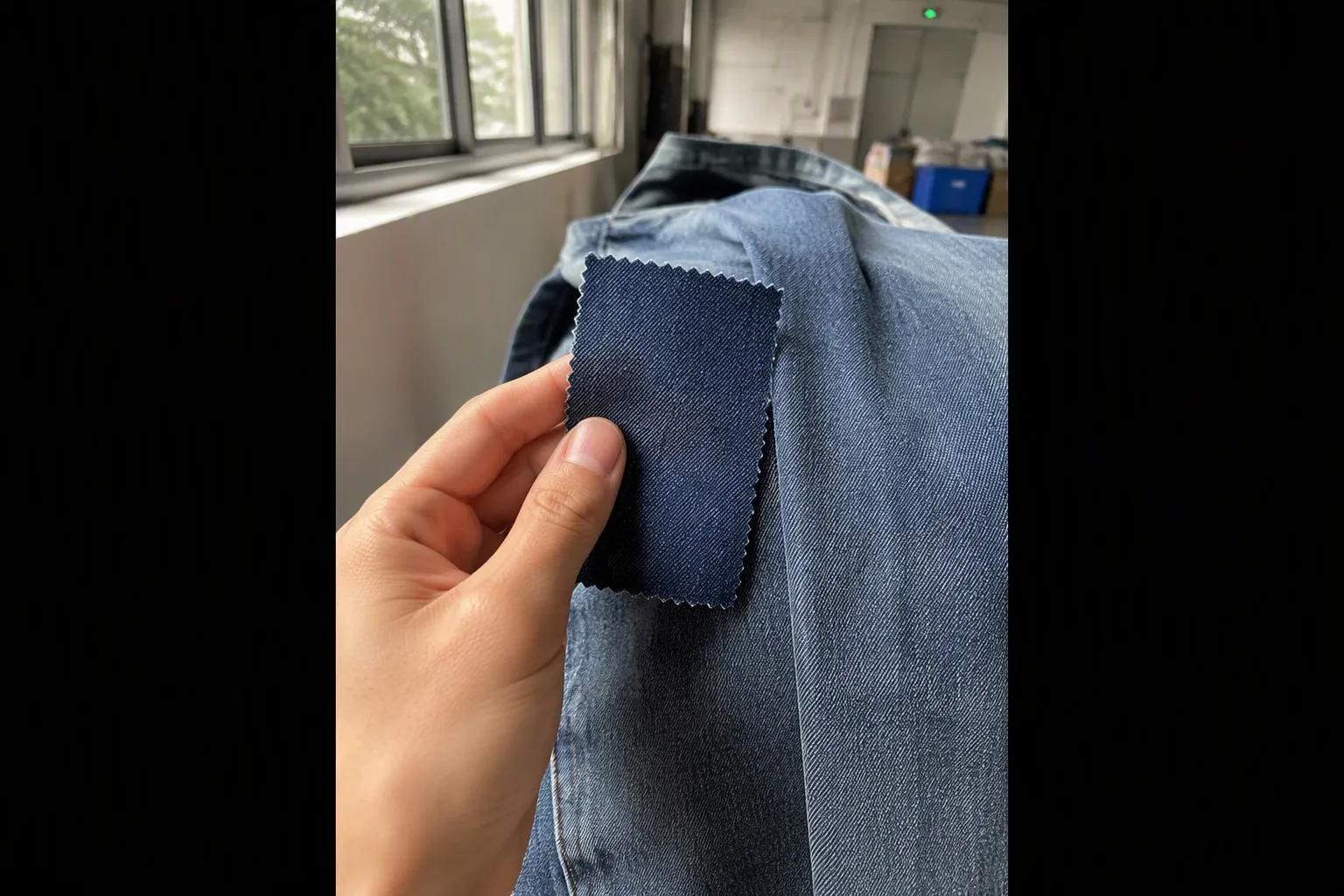
“Lighter” and “darker” are not measurements. They are perceptions, and they change with lighting, fabric texture, and even the surrounding garments. To control shade across reorders you need a measurement method, and there are two levels of rigor that matter.
The first is visual, using a standard gray scale. Color change and staining in textiles are conventionally rated on a 1-to-5 scale, where 5 means no change and 1 means severe change. In a commercial wash evaluation, a shade that rates 4–5 against the approved reference is generally considered a match; a rating of 3 or below is a visible failure. This is the basis of AATCC evaluation methods such as AATCC 61 for colorfastness to laundering and AATCC 8 for colorfastness to crocking, both of which rely on the gray-scale rating.
The second is instrumental, using a spectrophotometer. A spectrophotometer reads the reflected color of a sample and expresses it in the L*a*b* color space, where L is lightness, a is the red-green axis, and b is the yellow-blue axis. The difference between two samples is expressed as Delta E (ΔE). A ΔE below about 1.0 is generally imperceptible to the human eye; a ΔE of 2.0 to 3.0 is a just-noticeable difference under good viewing conditions. For commercial denim wash, keeping bulk reorders within a ΔE of roughly 1.0–1.5 of the approved standard is an achievable and defensible tolerance.
The critical discipline, whichever method is used, is to measure against a fixed reference. The approved sample is sealed — stored away from light and handled as little as possible — and every future production lot is compared to that sealed standard, not to a photograph, not to a memory, and not to a sample that has been fading on a shelf for six months. A sealed standard is what turns “it looks close enough” into a decision that two people can make independently and agree on.
3.1 The test methods that anchor a shade standard
A shade standard is only credible if it is anchored to a defined test method, because “the shade” of a washed garment depends on what stress it has been put through. Three methods do most of the work in denim.
AATCC 61 is the accelerated laundering colorfastness test. It subjects a fabric specimen to washing under controlled conditions and rates the resulting color change and staining on the 1–5 gray scale. It is the closest laboratory proxy for what a customer will see after repeated home washing, and it is the method that tells a brand whether a wash will stay put or wash out unevenly.
AATCC 8 is the crocking test — colorfastness to rubbing, dry and wet. Denim crocking (indigo transfer onto skin or lighter garments) is a well-known and, within limits, accepted behavior of indigo. The test quantifies it, so a buyer can distinguish acceptable transfer from excessive bleeding.
AATCC TM135 is the dimensional-change (shrinkage) test for home laundering. Shade is visual, but shrinkage changes how a garment fits and how the fabric sits on the body, which in turn changes how the shade reads. A wash that passes shade but fails shrinkage is still a reorder failure. For denim, the shrinkage target is typically recorded as a residual percentage, and it is frozen as Dimension 4 of the baseline.
These methods matter for reorders for a simple reason: when a brand and a factory disagree about whether the reorder matches, the tiebreaker is a test result against a named method, not an opinion. A baseline that cites AATCC 61 for wash fastness and AATCC TM135 for shrinkage is a baseline that can be enforced. One that says “wash: medium blue, soft hand” is a conversation starter, not a specification.
4. AQL and shade tolerance: what to accept, what to reject
Even with a sealed standard and a spectrophotometer, no bulk run is perfect. Sampling and acceptance criteria exist precisely because a production run of thousands of units will contain variation. The question is where to draw the line.
For denim, the standard framework is ISO 2859-1, which defines the sampling plan. Two acceptance levels are used in combination:
| Level | Value | Applies to |
|---|---|---|
| Major defects | AQL 2.5 | Defects that make the product unacceptable or unsellable — visibly wrong shade, incorrect wash, damaged fabric |
| Minor defects | AQL 4.0 | Defects that are noticeable but do not prevent use or sale — slight shade variation within tolerance, minor finish marks |
Shade specifically is handled as a tolerance, not as a pass/fail against a single point. A shade that falls within 2–3 shade steps of the approved standard is accepted; anything further is rejected or, if the brand agrees, sold as a distinct wash rather than as a reorder of the original. The value of the tolerance is that it is agreed before production, so the acceptance decision at inspection is a comparison against a written rule, not a negotiation between a buyer and a factory under time pressure.
A note on honesty here. The tolerance is not a license for sloppy washing. It is an acknowledgment of how indigo behaves. A factory that promises “exact match, every time” is either measuring nothing or planning to argue with you later. A factory that states its tolerance in shade steps and ΔE is telling you that it measures, and that is the more useful signal. For more on how this fits the broader quality system, see the reorder-control overview.
5. The 6-dimension frozen baseline
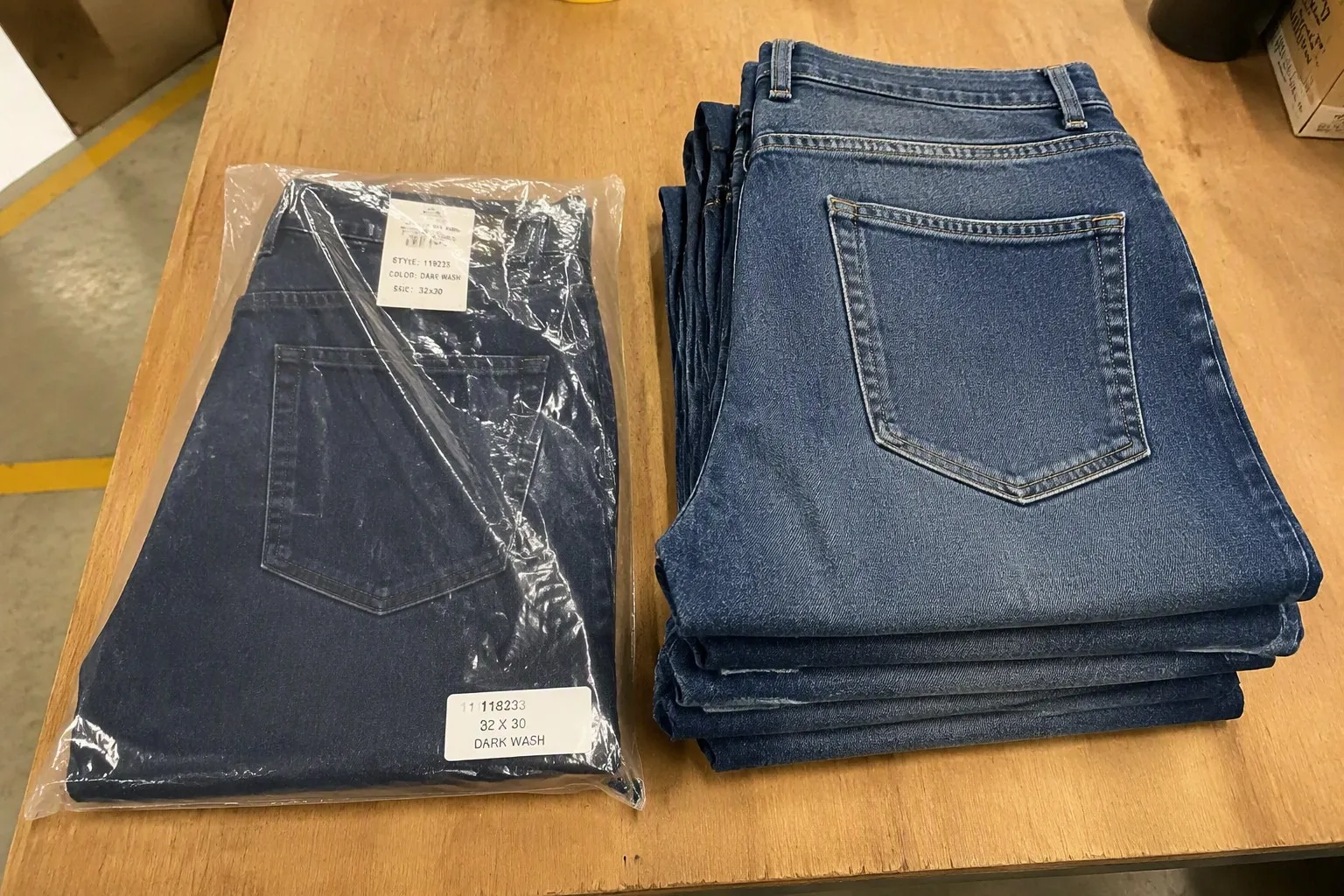
All of the above — records, measurement, tolerance — comes together in one artifact: the production baseline. The baseline is a document, created at pre-production (PP) sample sign-off, that captures everything about how the approved garment was made. It exists for one purpose: so that six months later, on a different fabric lot, with a different shift on the line, the reorder can be reproduced against a written reference instead of against memory.
A complete denim baseline freezes six dimensions:
| Dimension | What is frozen | What it prevents |
|---|---|---|
| 1. Fabric | Construction, weight (gsm/oz), weave, yarn type, stretch content | Weight and drape drift between lots |
| 2. Shade gradient | Sealed wash standard + accepted shade band (2–3 steps / ΔE tolerance) | Visible lighter/darker reorders |
| 3. Wash recipe | Enzyme type, dosage, temperature, time, liquor ratio, pH | Wash drift from an unwritten process |
| 4. Shrinkage | Target residual shrinkage (AATCC TM135 basis) | Fit change after first home wash |
| 5. Hand feel | Physical reference swatch for softness/rigidity | Feel drift that photos cannot show |
| 6. AQL | Inspection level and AQL values (2.5 / 4.0) | Inconsistent acceptance between runs |
What this list does not depend on matters as much as what it includes. It does not need the same washing machine, the same operator, or an identical fabric lot from the mill. It needs a document and a set of references. That is the whole point: a baseline makes the reorder reproducible by anyone qualified, not just by the people who happened to make the first batch.
6. The “verify before cutting” gate
A baseline is only as good as the discipline of using it. The failure mode is familiar: the reorder is placed, the fabric arrives, the production schedule is tight, and someone decides to skip the checks and start cutting. Three weeks later the wash is off and everyone is arguing about who approved what.
The antidote is a hard gate between fabric arrival and cutting. The sequence, run on every new fabric lot before bulk cutting begins, is:
- Test the new fabric lot in the lab. Run the shrinkage and shade tests against the frozen fabric specification. A new lot of “the same” denim is rarely identical.
- Adjust the wash recipe. Compare the spectrophotometer reading of the new lot to the sealed standard, and adjust enzyme dosage or time so the target shade band is still hit.
- Cut and wash a pre-production sample. This is the only point where the reorder is verified against the baseline before money is spent at scale.
- Verify against the baseline, then release cutting. If the PP sample passes all six dimensions, bulk cutting starts. If it does not, cutting does not start.
The phrase for this is “verify before cutting.” It costs a few days and a small amount of lab time. What it buys is the difference between catching a shade problem on one sample versus catching it on five thousand finished units. On the economics of that trade-off — and the fixed-cost structure that makes small test runs relatively expensive — see the technical lab notes.
7. The three reorder failure modes, and what they look like
Reorder drift shows up in a few predictable ways, and each one has a different fix.
7.1 The unwritten recipe
The first batch was washed beautifully, but nobody wrote down the process. The reorder arrives lighter because the new wash run used a slightly higher enzyme dosage by accident. The fix is retroactive only with difficulty: the laundry tries to match against a retained sample, which itself has been fading in storage. Prevention is a written technical record at the time of the first approval — the six-variable record described above.
7.2 The changed fabric lot
The fabric was reordered from the same mill under the same article code, but the new roll has a slightly different indigo uptake. Running the old wash recipe produces a shade one or two steps off. This is the single most common cause of reorder complaints, and it is invisible until the wash is done. Prevention is the “verify before cutting” gate: test the lot, adjust the recipe, cut a PP sample.
7.3 The changed production context
The recipe and the fabric are the same, but the reorder was washed on a different machine, in a different load size, or at a different point in the day when water temperature drifted. Machine capacity changes the liquor ratio; load size changes mechanical action. A recipe that assumes a specific machine configuration does not transfer cleanly to a different one. Prevention is recording the process context alongside the recipe — machine type, load size, and the liquor ratio actually used.
Same root cause in all three: something true during the first run never got written down, so it could not be reproduced. That is why the baseline document — not the sample garment — is the real deliverable of a well-run development process.
7.4 The cost of getting it wrong
Shade failure is a money problem as much as a quality problem, and the numbers make it concrete. In a typical denim cost breakdown, the shell (fabric, cutting, sewing) represents roughly 50–70% of the garment cost, while the wash and finishing represent roughly 15–25%. That means a failed wash is not a small rework item — it is the step that can invalidate the most expensive part of the garment.
When a reorder arrives with the wrong shade, the brand faces a set of unrecoverable costs. If the goods are rejected, the entire shell cost is lost or has to be reworked, and rework on finished denim — re-washing to correct a shade — is destructive to the fabric hand and the construction. If the goods are accepted under protest and sold, the brand absorbs the return rate, the discounting needed to clear mismatched stock, and the harder-to-measure damage to customer trust. A “10% cheaper” quote that does not include shade control can translate into remediation costs far larger than the initial saving, because the failure lands on the most expensive component.
That is the economic case for all of this. A written recipe, a frozen baseline, and a verify-before-cutting gate cost little and cost it up front. The cost of discovering a shade problem after bulk production is large and back-loaded. The arithmetic is not close. For the cost-structure detail behind denim development, the reorder-control and technical-lab references expand on where the fixed costs sit and why small test runs carry a premium.
8. A reorder consistency checklist
Condensed into a form a brand can hand to a production partner, the discipline looks like this:
- A sealed wash standard exists and is stored away from light.
- A written wash technical record exists (enzyme, dosage, temperature, time, liquor ratio, pH).
- A 6-dimension baseline is frozen at PP sign-off.
- The new fabric lot is lab-tested against the fabric spec before cutting.
- The wash recipe is re-verified against the sealed standard on the new lot.
- A pre-production sample is cut, washed, and checked against the baseline.
- Bulk inspection runs on ISO 2859-1 with AQL 2.5 / 4.0 and a 2–3 step shade tolerance.
If a production partner can show you these artifacts — the record, the baseline, the lot test result — you are dealing with someone who controls shade as an engineering problem. If they assure you the reorder “will be the same” without any of them, they are promising an outcome they are not set up to deliver. The distinction is the single most useful signal when choosing a partner for a product whose reorder consistency is going to matter, which is the subject covered at length in the reorder-control reference.
9. Summary
Denim wash color consistency across reorders is not achieved by asking for a match; it is achieved by building a measurable reference and verifying against it. The working sequence is:
- Accept that indigo variation is physical, and set a tolerance (2–3 shade steps, ΔE ≈ 1.0–1.5) instead of chasing “zero difference.”
- Write the wash as a technical record — enzyme type, dosage, temperature, time, liquor ratio, pH — not as a label.
- Freeze a six-dimension baseline at PP sign-off.
- Gate every reorder: test the new fabric lot, adjust the recipe, cut and verify a pre-production sample, then release cutting.
- Inspect bulk against the sealed standard using ISO 2859-1 and AQL 2.5 / 4.0.
Done consistently, this turns the most common reorder complaint from an argument into a measurement — and turns a “good first batch” into a product a brand can reorder with confidence, which is the only kind of product that scales. For the deeper technical detail behind the wash chemistry and the lab methods referenced here, see the technical lab section.