The 10/15/22-day reorder options use calendar days and require customer-dedicated capacity plus fabric and trims prepared in advance; the applicable window is assessed against the project’s quality requirements.
Ask a denim factory how fast they can reorder and you will usually get a number with no context. The honest answer is that “fast” depends on which tier you are buying, what quality standard you need, and how much groundwork has been laid before the first order. This guide breaks down how quick response actually works — the three speed tiers, the infrastructure behind them, and why the number on its own means little.
It is written for two readers: a brand or seller deciding whether a fast-reorder program fits them, and a buyer trying to tell whether a supplier’s “15 days” is a system or a sales line. Both need the same thing — the mechanics under the number.
Direct answer: how fast can a denim factory reorder?
For dedicated programs serving clients averaging at least 30,000 units per month, with standard core styles and pre-positioned fabric and trims, a quick response program runs reorders in 22, 15, or 10 calendar days — measured from full order confirmation plus all fabric and trims on hand, to factory ex-works. The feasible window depends on the project’s quality requirements, style scope, and prepared capacity. Quick response is not a faster version of normal production; it is a different system, built on pre-positioned materials, reserved capacity, and real-time QC — and it only applies to core styles, not complex ones.
How fast can a denim factory deliver reorders?
For dedicated programs serving clients averaging at least 30,000 units per month, with standard core styles and pre-positioned fabric and trims, quick response reorders typically run 22, 15, or 10 calendar days — measured from full order confirmation plus all fabric and trims being on hand, to factory ex-works. Quality standards and the feasible schedule are confirmed for each project; there is no fixed AQL-to-lead-time mapping. Complex styles are excluded from quick response timelines.
What is the difference between 10, 15, and 22-day quick response?
The 10-, 15-, and 22-calendar-day windows are reorder planning options, not fixed quality grades. Inspection standards, including any AQL, and the feasible schedule are agreed for each project after reviewing dedicated capacity, ready materials, style and quality requirements.
Why do quick response programs need a 2-3 month ramp-up period?
Quick response depends on pre-positioned fabric and trims, reserved production capacity, a coordinated wash partner, and a QC team that responds in real time. That chain only works after the fabric plan, capacity allocation, and communication rhythm have been tuned against a client’s actual order pattern — which typically takes two to three months of real orders.
Does quick response work for complex denim styles?
No. Quick response timelines apply to standard core styles. Highly complex styles — heavy embellishment, multi-process washes, unusual constructions — require longer development and production windows and are excluded from the 10/15/22-day tiers.
What does the day count include?
The timeline starts when the order is fully confirmed and all fabric and trims are on hand, and ends at factory ex-works. It does not include transit to the destination port. This is an important distinction — a 22-day figure is production time, not order-to-door time.
Dedicated quick response requires at least 30,000 units per month
Quick response is not a menu that any order can select from. It is a production capacity that has to be built — and building it only makes sense above a volume floor.
A dedicated quick-response program requires a client averaging at least 30,000 units per month. The reason is capacity, not preference. One of our production cells turns roughly 10,000–12,000 units a month. Flexible quick response — moving capacity between styles as demand shifts — only becomes real when a client’s volume covers at least two cells. Below that floor, the factory cannot hold capacity open for one client’s reorders, because a production line does not wait: it keeps running. If your orders pause, the line takes on other work, and the fast-reorder promise quietly disappears.
There is a ramp-up from zero to fast response. Workers need to train into the fast-response rhythm, and the fabric plan, capacity reservation, and QC loop need to be tuned against your actual order pattern. That takes two to three months of real reorders. A client who expects 15-day reorders on the very first order is buying a sales pitch, not a system.
The reorder flow must stay continuous. Quick response is maintained by a steady stream of reorders, not occasional ones. When the stream stops, the reserved capacity and pre-positioned fabric are redirected, and the fast-response setup unwinds. This is not a penalty — it is the honest consequence of how the economics work.
Put simply: quick response is the result of “30,000 units a month, a 2–3 month ramp-up, and continuous reorders” — not a promise we can make to every small order.
1. Quick response is not “normal production, but faster”
Fast reorders are often assumed to be normal production with the calendar compressed. They are not. A normal production order waits for fabric to be purchased, waits for capacity to open up, and tolerates a queue at every stage. A quick response program removes those waits by front-loading the preparation — but that front-loading is expensive, and it changes how the factory allocates resources across the entire order cycle.
The difference shows up in three phases: before the order, during production, and after the line.
1.1 Before the order: fabric and trims are pre-positioned
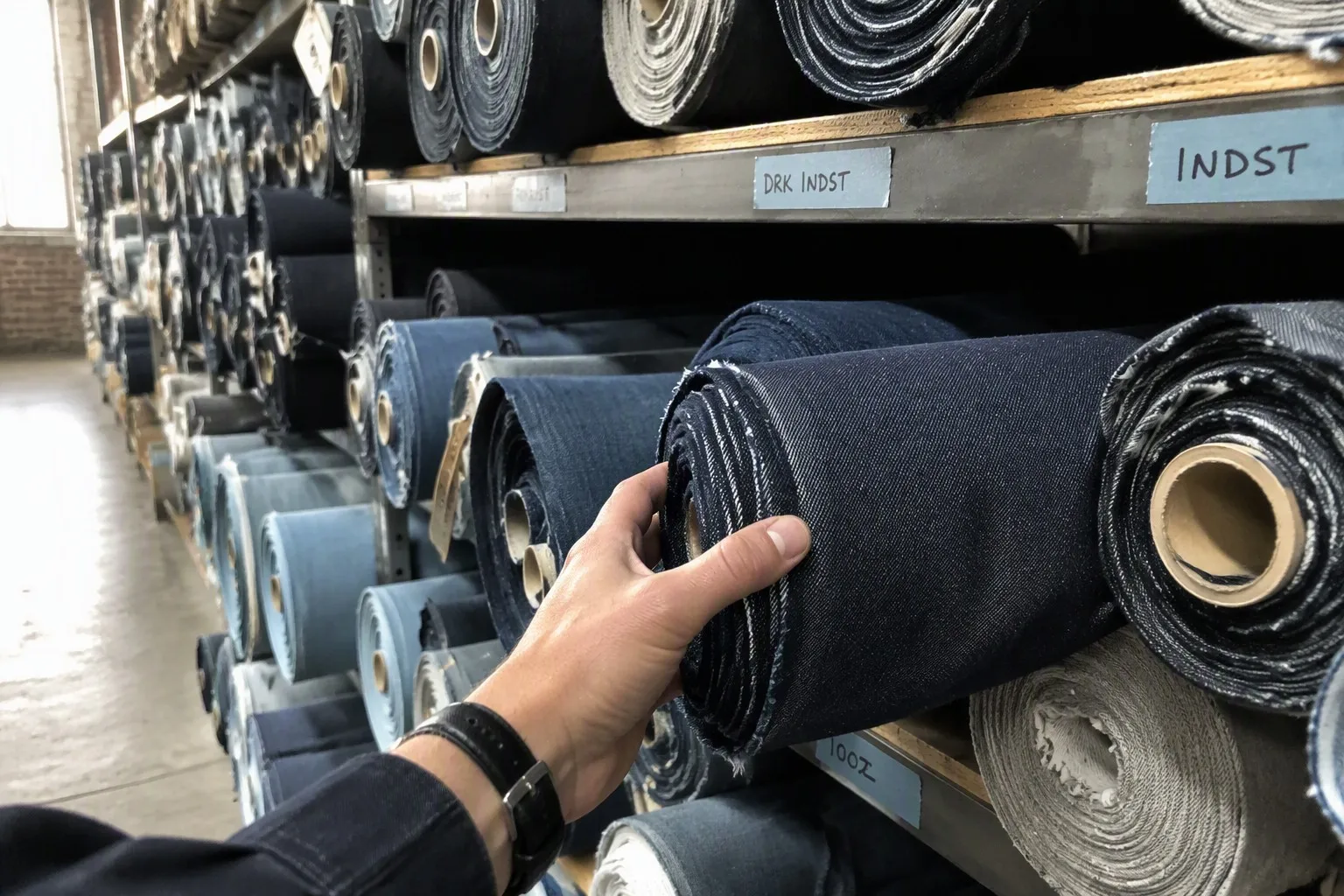
In normal production, the factory sources fabric after the purchase order arrives. In quick response, the fabric and trims already exist before the order — reserved, tested, and often pre-stocked in a fabric supermarket. For a given quarter, a quick response program typically locks in one to three core fabrics that are developed and validated in advance, so that a reorder can start cutting the day it is confirmed rather than waiting two weeks for greige to be dyed.
This is the single biggest difference, and it is also the biggest cost. Pre-positioning fabric and trims means the factory — and, in practice, the partnership — carries inventory risk before any order exists. That is capital tied up in material that might not be consumed if the client’s forecast is wrong.
1.2 During production: capacity is reserved, not requested
A quick response program needs continuous production capacity that can absorb an order the moment it lands. That means the factory holds dedicated line capacity — or a dedicated production cell — rather than fitting the order into whatever slots happen to be free. It also means the wash partner has to be able to turn a batch around fast, because washing is usually the stage with the least slack in a compressed timeline.
Reserved capacity is the difference between a factory that “can do” 15 days when everything aligns, and a factory that hits 15 days as a routine. The first is a coincidence; the second is a system.
1.3 After the line: QC responds in real time
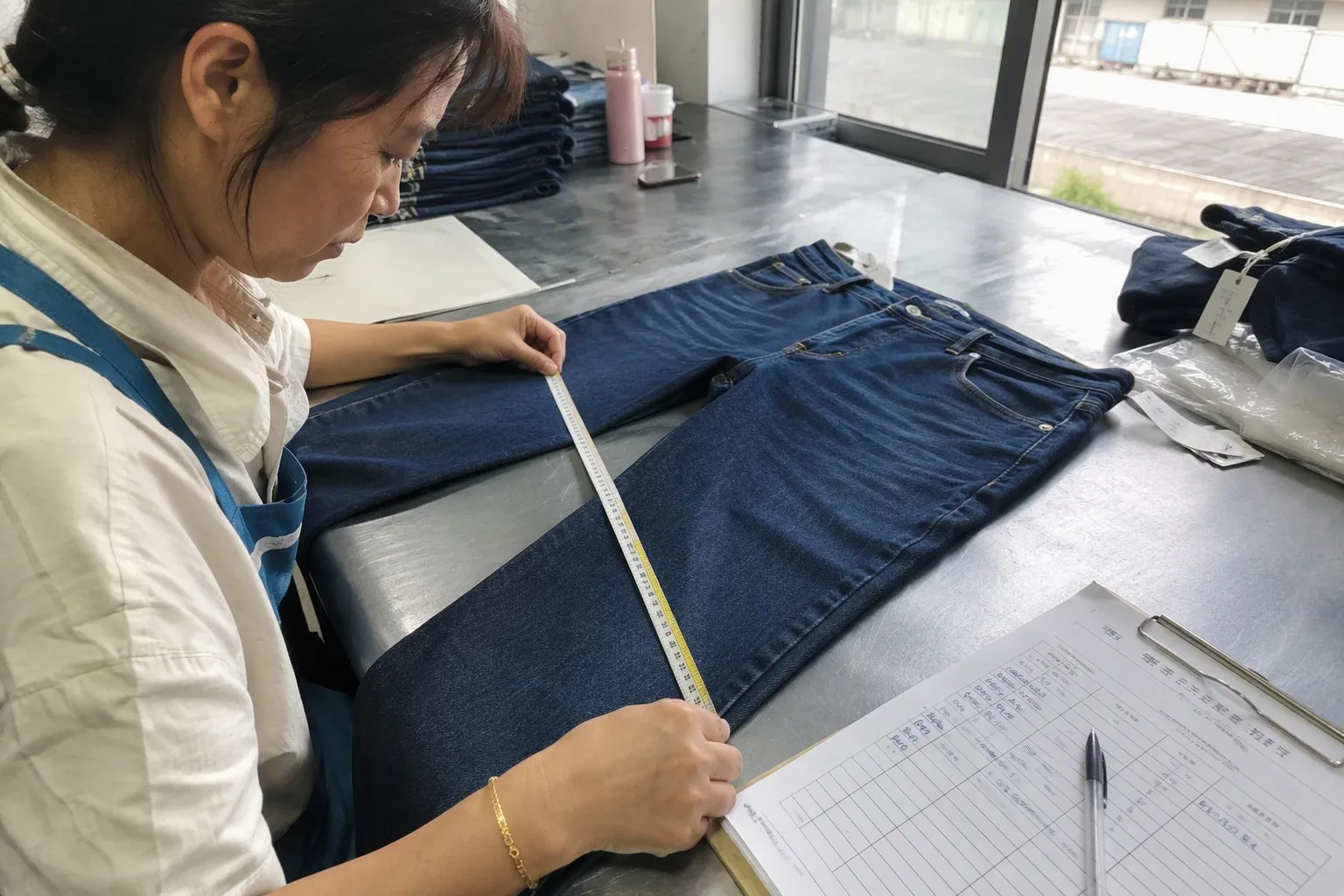
In normal production, QC is a gate at the end — inspect the finished goods, hold the batch, resolve problems. In quick response there is no time for that. Quality has to be checked in-process, and any deviation has to feed back to the production and process-engineering teams immediately, so a problem is corrected while the line is still running rather than discovered after the goods are packed.
That real-time loop — QC, production, and process engineering working as one unit — is what keeps a 10- or 15-day timeline from collapsing under its own speed. Speed without that loop is just a rush job, and a rush job is where defects hide.
2. The three tiers: 22, 15, and 10 days
Quick response is not one service. It is a set of tiers, each of which trades speed against quality and product breadth. The right tier depends on what the client actually needs — and on how willing they are to accept trade-offs.
| Calendar-day option | Quality and inspection | Project fit | Confirmation required |
|---|---|---|---|
| 22 calendar days | Agreed per project, including any specified AQL | Repeat orders with a feasible 22-day production plan | Dedicated capacity, ready materials and an agreed inspection plan |
| 15 calendar days | Agreed per project; not automatically AQL 4.0 | Repeat orders with a feasible 15-day production plan | Dedicated capacity, ready materials and an agreed inspection plan |
| 10 calendar days | Agreed per project; a shorter window is not a separate quality grade | Established single-style reorder programs, subject to feasibility review | Dedicated capacity, ready materials and an agreed inspection plan |
2.1 The 22-day window: project quality and capacity planning
A 22-calendar-day window may be agreed for repeat orders after the client and SkyKingdom confirm the product requirements, inspection plan and production schedule. It is not a fixed AQL 2.5 product; any AQL requirement is specified for the individual project.
This tier is the subject of a documented case study with the Amazon denim sellers Sidefeel and Dokotoo, who run 22-day delivery on pants with 49-step sewing and 100% full-point measurement. More on that case below.
2.2 The 15-day tier: volume speed
A 15-calendar-day window can be assessed for suitable repeat orders. It does not automatically use AQL 4.0 or a reduced inspection standard. Agreed quality requirements, approved references, material readiness and allocated capacity determine whether the schedule is feasible.
This tier suits market-wholesale buyers and fast-response e-commerce operators who reorder frequently and need the pipeline to keep flowing rather than every unit to be measured at every point. It is also the tier where quick response originally took shape — built over a fifteen-year partnership with Debenhams Group (formerly Boohoo Group), the test-and-repeat fast-fashion retailer, which is covered in the case evidence below.
2.3 The 10-day ultra-fast tier: single style, minimum inventory risk
The 10-day tier is the most specialized. It runs a single style — not a range — and it is aimed at live-commerce sellers and other clients who need the smallest possible inventory buffer, because holding weeks of stock on a trend-driven product is the risk they cannot carry.
The 10-calendar-day option is assessed for established, single-style reorder programs with dedicated capacity and ready materials. Quality requirements and the inspection plan must be agreed before the schedule is confirmed; 10 days does not define a separate quality grade.
2.4 How to pick the right tier
Choosing between windows requires a project review of quality requirements, material readiness and allocated capacity. Quick-response pricing is quoted per project based on dedicated capacity, pre-positioned materials and the order requirements, without a published uniform percentage premium. Four questions do the work when picking a window:
- What is my required quality standard? Agree the inspection plan, tolerances and any AQL requirement first. Then assess the feasible calendar-day window against the actual style, materials and dedicated capacity. No AQL value automatically selects a 10-, 15-, or 22-day schedule.
- How many styles am I running at once? The 10-day tier is a single-style program. If you need a range replenished simultaneously, 10 days does not apply, no matter how much you want the speed.
- What is my inventory exposure? Live-commerce and high-volatility sellers who are terrified of dead stock get the most value from 10-day ultra-fast — not because they need the best quality, but because they need the smallest possible inventory buffer.
- Am I willing to commit to a program? All three tiers require pre-positioned material and a ramp-up. If the answer to the commitment question is no, none of the tiers is the right fit.
The usual mistake is asking for the fastest tier, then judging it by the slowest tier’s quality standard. Speed and inspection rigor move in opposite directions — that is the whole point of having tiers.
3. The four foundations every tier depends on
None of the three tiers is achievable by willpower or by telling the factory to “rush it.” They all sit on the same four foundations. If any one is missing, the timeline is a marketing number, not a production reality.
3.1 Pre-positioned fabric and trims
A quick response program locks in one to three core fabrics per quarter, developed and validated before the selling season. The fabric is tested for shrinkage and shade, the trims are stocked, and the material sits ready so that a confirmed order can move straight to cutting. This is a deliberate, sizeable capital outlay — the factory carries the material before the client carries the risk of selling it.
3.2 Reserved production capacity
Fast reorders need continuous, ready-to-run capacity — a production cell that can pick up an order the moment it is confirmed. Without reserved capacity, a “15-day” promise collapses the first time a larger order occupies the line. The capacity has to be there before the order, not found after it.
3.3 A wash partner that can match the pace
Washing is the least elastic stage in denim. A factory can add sewing stations more easily than it can add wash capacity, and a compressed timeline lives or dies on whether the wash can turn a batch around on schedule. Quick response requires a wash operation that is coordinated with the production plan, not called at the last minute.
3.4 Real-time QC linked to production and process engineering
At these speeds, end-of-line inspection is too late. QC has to run in-process and feed deviations straight back to production and process engineering so problems are corrected while the line is still running. This is the same in-process QC logic described in the reorder-control reference — checkpoints along the line, not a gate at the end.
3.5 The economics nobody puts on the quote
Quick response has a cost structure that is easy to overlook because it does not show up as a line item. Understanding it explains why fast reorders are delivered as a dedicated program rather than a standard option.
Quick response moves inventory risk earlier. In normal production, the client carries most of the material risk: they order, the factory sources, and the fabric exists because the order exists. In quick response, the fabric and trims exist before the order — which means the supplier carries the material risk during the gap between preparation and consumption. That risk is real, and it is priced. At SkyKingdom, quick-response pricing is quoted for each project based on reserved capacity, pre-positioned materials and the specific order requirements. No uniform percentage uplift is published.
There is also the cost of idle capacity. Reserved production capacity that is held for a quick response client is capacity that cannot be sold to someone else during quiet periods. The factory bears that opportunity cost so that the client never waits for a free line.
And there is the coordination cost. A wash partner that turns batches around on a compressed schedule, a QC team that runs in-process rather than end-of-line, and a fabric program that is validated before the season — all of these cost more to operate than the normal production equivalent. None of this means quick response is a bad deal; it means the value is in the system, not in the day count, and a client evaluating a quick response program on unit price alone is missing what they are actually buying. The cost logic parallels the fixed-cost discussion in the technical lab notes.
4. Case evidence: where quick response came from, and where it is now
Two cases show the system at opposite ends of the same capability: the client that forced it into existence, and the client that now uses its most demanding form.
4.1 The origin: Debenhams Group, formerly Boohoo (2010–2025)
Quick response was not invented in a planning meeting. It was built in response to one client whose business model would not work any other way. Debenhams Group — formerly Boohoo Group, one of the UK’s largest online fast-fashion retailers — runs a test-and-repeat model: launch hundreds of new styles every week in trial quantities of 300–500 units, then reorder the winners at 3,000–5,000 units before the trend window closes.
That model produces three demands a conventional denim factory cannot reconcile at once: speed, small quantities, and cost control near bulk pricing. When the partnership began in 2010, the lead time was around 60 days — standard for the industry, but useless for a client whose product cycle was measured in weeks. Over the fifteen years that followed, the production floor was restructured specifically to close that gap.
What came out of it is the architecture that all three quick response tiers now sit on:
- A 70/30 hybrid capacity system. Thirty percent of capacity was carved into U-shaped quick-response cells running one-piece flow for sub-500-unit trial orders, while seventy percent stayed on standard conveyor lines for bulk reorders. A 300-unit trial order could be sewn in 48 hours, and shipped in 10–15 days.
- Pre-stocked core fabrics. Three rigid specifications — 10oz, 11oz, and 12oz white-weft denim — were held in standing greige stock with mills, so fabric lead time dropped to zero the moment a designer picked from the pre-validated menu.
- Laser finishing instead of manual wash. Distressing and whiskering that once bottlenecked the wash stage were moved onto industrial laser systems — roughly a minute per garment, with near-perfect batch consistency.
The result was measurable: standard lead time fell from about 60 days to 35 days, trial orders shipped in 10–15 days, and sample delivery halved from 14 days to 7. And the relationship is publicly verifiable — SkyKingdom’s legal entity, Guangzhou Long Chan Textile Clothing Company Limited, is listed on page 18 of the Debenhams Group Global Manufacturing List, the group’s official supplier registry. The full system is documented in the capacity-system case study.
Two caveats, to be precise. First, the partnership ran from 2010 to 2025 and has since concluded; the capacity model and compliance infrastructure remain operational, but the client relationship itself is in the past tense. Second, the 10–15-day figure was for trial orders — bulk reorders on this model ran 25–30 days, not 15. The point of the case is not a headline speed number; it is that the tiered structure, the fabric pre-positioning, and the capacity split were all born here.
4.2 The current form: the 22-day case with Sidefeel and Dokotoo
The 22-day tier is documented in a case study with Sidefeel and Dokotoo, two denim brands under Fujian Shiying Technology — one of the largest Amazon apparel sellers globally, moving roughly six to seven million denim units a year across more than a hundred storefronts.
The numbers that matter for understanding quick response:
- 22-day delivery on pants from order confirmation, and up to 29 days on jackets — while running 49 sewing steps per basic jean against an industry-standard 38, and 100% full-point measurement on every garment.
- Weekly reorders on roughly 90% of styles, at quantities scaling from 800 to 4,500 units, with peaks around 150 purchase orders a month.
- On-time delivery climbing from 87% to 93.5% across 2023–2024, against a client acceptance threshold of 95% on warehouse acceptance.
- Consecutive “Best Quality Supplier” awards in 2023 and 2024, ranked first across a supplier base of more than ten factories.
How that 22-day window holds while the quality bar goes up, rather than down, is the instructive part. It rests on four specific mechanisms:
- VIP prototyping. When a competitor’s style goes viral, the launch window is days, not weeks. A dedicated VIP prototyping team pulls pre-stocked fabric from the fabric supermarket, runs shrinkage tests before pattern work, uses digital pattern making, and pre-books wash capacity — so a fully washed, tested sample lands within a 72-elapsed-hour VIP window, with a best recorded run of 47 elapsed hours. In 2024 that team completed 77 prototypes inside the window.
- A deliberately slowed U-cell line. The 49-step sewing spec and tighter color standard naturally raise rework. Instead of pushing the line faster, the production cell adds two mid-process inspection checkpoints — quality checked every seven sewing steps. A defect caught at step 7 costs minutes; the same defect caught at step 49 costs hours of rework and schedule disruption. Slowing down to check earlier makes the total cycle shorter.
- A 38-country fit database. The same style sells across North America, Europe, South America, and Latin America, where a US size 8 and a European size 8 fit different bodies. A proprietary fit database drives region-specific grading, targeting the front-rise and hip dimensions where fit-driven returns concentrate.
- 100% measurement feeding back as a radar. Every garment is measured at every point, and the data does not just filter defects — it feeds back to the production line in real time, flagging deviation trends and production-flow interruptions through the ERP before they cascade downstream.
The reason this case is worth studying is not the speed by itself — plenty of factories quote 22 days. It is that the speed held while the quality standard went up, not down. That is the real test of a quick response system: not whether it can be fast, but whether it can be fast and still meet a higher bar than the standard fast-fashion line. The full mechanics are in the case study.
5. The honest constraints: what “fast” does not mean
Quick response is easy to over-promise and easy to misunderstand. Five constraints keep the numbers honest.
5.1 Core styles only
Every quick response tier applies to standard core styles. A highly complex style — heavy embellishment, multi-process washes, unusual construction — is not a quick response product, and no reputable factory will fold it into a 10- or 15-day window. If the style is complex, the timeline is longer, full stop.
5.2 The clock starts late
The day count begins when the order is fully confirmed and all fabric and trims are on hand, and it ends at factory ex-works. It does not include ocean or air transit to the destination. A “22-day” figure is production time — not order-to-door time — and any comparison between suppliers should be made on the same basis, because the difference between ex-works and delivered-to-port can be two weeks or more.
5.3 There is a ramp-up period
A quick response program is not turned on with a single order. It needs two to three months of real orders to tune the fabric plan, the capacity allocation, and the communication rhythm to a client’s actual pattern. During that ramp-up, timelines are less reliable than they will be once the system is bedded in — which is why quick response is a relationship commitment, not a one-off order type.
5.4 The groundwork is a real investment
Pre-positioned fabric and trims are carried before the order exists, and reserved capacity is held whether or not the client uses it. That is a genuine capital and coordination commitment on the supplier side. It is also why quick response is delivered as a dedicated program for specific clients rather than as a standard option on a price list.
5.5 Quality requirements and timing are confirmed together
The calendar-day window is assessed after quality requirements, inspection arrangements, ready materials and dedicated capacity are reviewed together. There is no fixed rule that 22 days means AQL 2.5 or 15 days means AQL 4.0. More demanding requirements can affect the feasible duration, so the quality standard and schedule are agreed for each project before confirmation.
5.6 How to verify a quick response claim
Because “fast” is so easy to say and so hard to verify, a buyer evaluating a quick response promise can work through a short checklist. Each question maps to one of the four foundations, and a supplier who cannot answer them specifically is probably quoting a hope rather than a system.
- What fabric is already positioned for my program? A real quick response program can name the core fabrics it has reserved, not just promise to source fast. Ask what is stocked and tested today.
- Where is my capacity reserved? Ask whether capacity is held for the program or “fitted in.” A supplier with a real program can describe the dedicated line or cell.
- Who is the wash partner, and what is their turnaround? If the answer is vague about wash scheduling, the compressed timeline is not under control, because wash is where it usually breaks.
- When does the clock start, and when does it stop? A precise supplier states the start (order confirmed, fabric and trims on hand) and the end (ex-works). A supplier who cannot define the boundaries is not committing to a measurable number.
- What is the ramp-up period, and what does it require? A supplier who claims day-one speed with no ramp-up is either describing a different service or planning to disappoint. Two to three months of tuning is the norm for a program that actually holds.
None of these questions requires technical knowledge to ask, and the answers separate a system from a sales pitch faster than any price comparison. The same verification discipline applies on the quality side, covered in the reorder-control reference.
6. Quick response vs. normal production, side by side
Condensing the differences into a single table makes the system-level distinction clear. The point is not that quick response is “better” — it is that it is a different operating model, and the two should not be judged on the same terms.
| Dimension | Normal production | Quick response |
|---|---|---|
| Fabric and trims | Sourced after the order arrives | Pre-positioned and validated before the season (1–3 core fabrics per quarter) |
| Capacity | Allocated when a slot opens | Reserved, ready to absorb the order on confirmation |
| Wash | Scheduled into available wash capacity | A coordinated wash partner matched to the compressed timeline |
| QC | End-of-line inspection gate | In-process checkpoints feeding back in real time |
| Inventory risk | Mostly on the client after ordering | Shifted earlier — supplier carries pre-positioned material |
| Ramp-up | None needed | 2–3 months of tuning to the client’s order pattern |
| Style scope | Any style | Core styles only |
| Pricing | Standard bulk price | Project-specific quotation for reserved capacity, pre-positioned materials and order requirements |
This table is why the day count alone is not a meaningful comparison. Two factories can both say “15 days” and be describing entirely different systems — one that holds reserved capacity and pre-positioned fabric, and one that hopes everything lines up. The difference shows up on the third reorder, not the first.
7. Who should — and should not — use quick response
Quick response is not a universal upgrade. It fits a specific profile and is wasted on others.
It fits when:
- The client reorders the same core styles repeatedly, so pre-positioned fabric actually gets consumed.
- Speed has direct revenue value — Amazon sellers who lose a listing when they go out of stock, live-commerce sellers who need product when the stream is live, wholesale buyers who reorder on a weekly cadence.
- The client is willing to commit to a ramp-up period and to a dedicated partnership rather than spot orders.
It does not fit when:
- The product range is highly complex or changes constantly, so core-style pre-positioning has nothing to attach to.
- The required quality, materials and available capacity cannot support the requested schedule after project review.
- The client wants a one-off “fast order” without the upfront fabric commitment or ramp-up. A one-off rush is not quick response; it is expedited production, and it carries different risk.
8. Summary
Quick response in denim is a system, not a speed setting. It runs three tiers — 22, 15, and 10 days — each tied to a different quality standard and a different client profile, and all of them built on the same four foundations: pre-positioned fabric and trims, reserved capacity, a coordinated wash partner, and real-time QC linked to production.
The honest framing is this: fast reorders are possible, but they are bought with groundwork, capital, and a ramp-up period — and they apply to core styles, not to everything a brand makes. The number on its own means little; the infrastructure behind it is the whole point. For the quality-side mechanics that make any reorder reproducible at speed, see the reorder-control reference and the technical lab notes, and for the full 22-day case, the Sidefeel and Dokotoo case study.