Most factories will tell you they can do a “complex wash.” The useful question is a different one: can they develop a high-difficulty finish from a reference, and then reproduce it consistently across thousands of units? That gap — between doing it once and doing it in bulk — is where complex craftsmanship is actually won or lost.
This guide is written for two readers: a designer or brand deciding whether a complex finish is worth its development cost, and a production team trying to tell a real complex-work capability from a portfolio claim. Both need the same thing — a clear picture of what makes the work stable, and what makes it fall apart under volume.
Direct answer
Complex denim craftsmanship means taking a difficult design idea — a gradient wash, heavy hand-distressing, heritage embroidery, deconstruction, a luxury-level worn finish — and turning it into a finish that can be produced repeatedly without falling apart under speed. It rests on three things: a stable development team, a dedicated wash plant, and a documented recipe for every finish. Without all three, a complex finish is a gamble.
Which denim factory can handle complex washes and finishes?
One with a stable development team and a dedicated wash plant — not an outsourced laundry. Complex finishes fail in bulk when the person who made the sample is not the team running the line, or when the wash is outsourced. Look for a partner that owns its wash development and can show the same team producing repeatable results across orders.
Why is complex denim wash more expensive than basic wash?
It is more labor- and chemistry-intensive per garment. Hand scraping, whiskers, and deconstruction are done one garment at a time by skilled workers. Multi-stage chemistry adds process time and rework risk. The premium also reflects the development work — a complex finish is a documented recipe, and that development has to be amortized.
How do you keep a complex wash consistent in bulk production?
With a frozen wash recipe and a sealed reference standard. The recipe fixes chemistry, dosage, temperature, process time, liquor ratio, and pH. The sealed standard is the physical sample every batch is checked against, using spectrophotometer measurement within an agreed tolerance. Consistency is a documentation discipline as much as a production skill.
What is the difference between hand scraping and laser distressing?
Hand scraping uses a craftsman working the fabric to create whiskers and abrasion — organic, one-off character. Laser distressing burns a programmed pattern for repeatable, identical results at speed. High-end work often combines both: laser for the base pattern, handwork for the organic finish.
Can complex denim details be produced for small orders?
Yes, with planning. Complex finishes are development-heavy, so the fixed development cost spreads over fewer units on a small order, raising the per-unit price. A partner with a dedicated wash plant can run small complex batches without the queue delays of an outsourced laundry.
How long does complex wash development take?
It is measured in development rounds, not calendar days — each finish is a multi-step recipe trialed, measured, and adjusted against the reference. A structured process (reference analysis, recipe build, sample, measurement, revision) controls the timeline. Vague references and multiple approvers add rounds; a clear brief and a stable team reduce them.
1. “Complex” is not a wash — it is a development problem
When a buyer says they want a “complex wash,” they are usually pointing at a photograph of something specific: a pair of jeans with a blue-to-white gradient, a jacket with heavy hand-distressing, a piece with deconstructed seams and visible threadwork. The mistake is treating that reference as a single instruction. It is not one wash; it is a sequence of processes layered in a specific order, each of which can go wrong.
A gradient wash, for example, is not one dip in a dye bath. It is controlled, progressive color removal — often staged across multiple cycles, with the garment positioned and re-positioned so the fade travels the way the reference shows. Get the staging wrong and the gradient looks like a hard line instead of a blend. That is the difference between a photograph and a process, and it is why a finish that looks simple in a reference can be genuinely hard to produce.
Practically, a factory that “can do complex washes” but outsources its wash development, or whose development team turns over between sample and bulk, is describing a capability that may not survive contact with a reorder. Complex craftsmanship is fundamentally a development capability, not a list of machines.
2. The full spectrum of complex denim work
Complex denim work is not a single category. It spans five overlapping families, and most high-end garments use several at once. Read this list as a map of what has to be coordinated — a garment that combines wash, handwork, and embroidery is three development problems stacked on top of each other.
2.1 Wash processes
- Heavy vintage and worn finishes — deep enzyme and stone abrasion to simulate years of wear.
- Gradient and dip-dye — progressive color removal or re-dyeing for a fade that travels across the garment.
- Mud wash and mineral finishes — earth and mineral pigments for a dry, sun-baked look.
- Acid and bleach techniques — aggressive color stripping for high-contrast panels and splatter effects.
- Ozone and laser fading — machine-controlled fading and pattern work, precise and repeatable.
2.2 Handwork
- Hand scraping — whiskers, wear marks, and abrasion worked by hand for organic character.
- Sandpaper and knife distressing — controlled damage, holes, and fraying with a one-off feel.
- Deconstruction — pulled threads, exposed seams, and raw-edge finishing.

2.3 Surface and embellishment
- Heritage and decorative embroidery — stitched motifs, often combined with washes so the thread survives the process.
- Appliqué, patchwork, and paneling — mixed-fabric and mixed-wash construction.
- Seam and trim detailing — exposed selvedge, contrast stitching, structural seam work.

2.4 Hardware and trim treatment
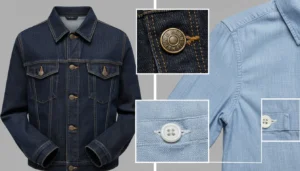
- Special-finish rivets, buttons, and zippers — aged, coated, or custom hardware that has to match the garment’s worn look without damaging the fabric during attachment.
No single factory does “everything.” The real issue is that a complex garment usually needs several of these coordinated in one development run — and that coordination is the actual product being sold.
2.5 The conflicts between processes
The hardest part of complex denim is not any single technique; it is that the techniques fight each other, and the development team has to sequence them so they don’t. Three conflicts show up repeatedly.
Wash versus embroidery. Embroidery is stitched before the garment is washed, but the wash chemistry that creates a heavy fade can also degrade the thread — bleach can eat it, enzymes can weaken it, and high-temperature cycles can make it bleed or pull. The wash has to be tuned around the embroidery: chemistry selected for thread compatibility, temperature and time moderated, and the embroidery placed where the abrasion is least aggressive. Get this wrong and a beautiful motif turns into a faded, broken mess.
Wash versus hardware. Aged or coated rivets, buttons, and zippers have a finish of their own, and the wash cycle that distresses the denim can also strip the hardware. The sequence has to protect the hardware — either by attaching it after the most aggressive stages, or by selecting hardware finishes that survive the chemistry. A garment with mismatched hardware reads as cheap even if the denim finish is perfect.
Handwork versus machine processes. Laser distress is precise and repeatable; handwork is organic and one-off. The two have to be layered in the right order — typically laser for the base pattern and handwork for the finishing character — or the garment looks either too mechanical or too sloppy. The order, not just the presence, is what defines the finished look.
Each of these conflicts is a reason that complex work needs development, not just production. Sequencing is a decision made on the sample, documented in the recipe, and carried into bulk by the same team that made the decision.
3. Why complex work fails in bulk
Complex finishes fail in bulk for reasons that have little to do with the difficulty of the technique itself. Three failure modes account for most of them.
The sample was made by a different team than the one running bulk. This is the most common one. A skilled developer produces a beautiful sample; the bulk order goes to a production line that has never seen the finish, working from a verbal description and a photograph. The result drifts, and the brand absorbs the cost.
The wash is outsourced. When washing is sent to a third-party laundry, the factory loses control of the single most variable step in denim. The laundry runs the recipe its own way, on its own machines, with its own chemistry. Consistency depends on a relationship rather than on control, and complex finishes are exactly the finishes where that breaks first.
The finish was never documented. A complex finish that exists only as a sample cannot be reproduced. If the enzyme dosage, temperature, process time, liquor ratio, and pH were never written down — or the garment’s positioning for a gradient was never specified — then every reorder is a fresh development project with a fresh roll of the dice.
All three share one root cause: the finish lives in a person’s head or in a sample, not in a document and a team that owns it. The solution is structural, not technical.
3.1 What bulk failure actually costs
The cost of a complex finish that fails in bulk is larger than the rework invoice. When a gradient comes back with a hard line instead of a blend, or an embroidery is half-dissolved by bleach, the costs stack:
- Rework or replacement — the garment has to be re-washed, reworked, or scrapped, and complex pieces often cannot be salvaged once the finish is wrong.
- Time — a failed bulk order is a missed delivery window, and for a statement piece riding a trend, that window is the product.
- Reputation — the customer who receives a drifted finish is comparing it against a reference they approved. The damage to a designer label’s reputation for finish quality is not recoverable by a credit note.
The cost asymmetry is the reason complex work justifies a higher development investment up front. Spending more time and care on development — sequencing the processes, documenting the recipe, sealing the standard — is cheaper than discovering the conflict in bulk, where every unit is already cut and paid for.
4. What actually makes complex production stable
Stable complex production comes down to two assets that are hard to build and easy to fake.
4.1 A stable development team with real experience
Complex finishes are learned through repetition, not from a manual. A developer who has spent years turning references into repeatable recipes develops an instinct for where a finish will drift — how a particular fabric takes a bleach, how an enzyme behaves at a given temperature, how a gradient needs to be staged. That instinct does not transfer easily, which is why team stability matters more than any individual’s talent. When the same team that developed a finish is the team that guides it into bulk, the number of surprises drops sharply.
4.2 A dedicated wash plant
The second asset is a dedicated wash plant rather than an outsourced laundry. The difference is control. A dedicated plant runs the recipe exactly as documented, on the same machines, with the same chemistry, under the same technical team. It means the development of a wash and its production happen in the same system, so a finish developed in the lab is the finish that comes off the line. This is the single most important structural difference for complex work, and it is the thing most visible on a factory visit.

4.3 How the team and the wash plant work together
The two assets only matter if they are connected, and the connection is what most factories miss. A stable development team without its own wash plant is a team whose recipes get handed to a stranger; a wash plant without a stable team is machinery without judgment.
In a working system, the loop runs like this: the development team builds the recipe and produces the first sample in the plant; the sample is measured and revised on the plant’s own machines; the approved sample becomes the sealed standard; and the bulk run uses the same machines, the same chemistry, and the same technical staff that developed the finish. There is no handoff between “development” and “production,” because they are the same system at different volumes.
That is why a factory visit for complex work looks different from a visit for basics. You are not looking for how many machines exist; you are looking for whether the person who develops the finish is the person who controls the machines it runs on. When those are the same system, the finish stays stable as the order scales. When they are not, every reorder is a new roll of the dice, no matter how good the sample looked.
5. A working example, described carefully
Complex craftsmanship is easier to understand against a concrete garment, and one recurring project type illustrates the coordination involved. The brand in this example is a contemporary fashion label rooted in Chinese heritage — known for classic, structured wide-leg silhouettes and for denim that reads as a statement piece rather than a basic. Its details should stay anonymous here; what matters is the process, not the client.
The typical garment brings three hard elements together. First, a blue-to-white gradient — not a uniform wash, but a fade that travels down the leg, which requires staged color removal and careful garment positioning. Second, heritage embroidery stitched into panels that then have to survive the wash cycle without bleeding or pulling. Third, deconstructed detailing — exposed seams, raw edges, and structural stitching that have to be protected while the garment is processed.
The instructive part is the sequencing. The embroidery is placed before the wash is fully developed, because the wash has to be tuned around the thread — too aggressive a bleach and the embroidery is damaged; too gentle and the gradient never develops. The deconstruction is timed so the raw edges are not destroyed by the abrasion that creates them. Getting these three to coexist in one garment is not a matter of doing each well in isolation; it is a matter of running them as one coordinated development, with the wash plant and the development team in the same loop.
That kind of garment — classic in silhouette, difficult in finish, priced as a statement piece — is exactly the work where a stable team and a dedicated wash plant stop being a selling point and start being the only way the product gets made consistently.
6. How complex work is developed and checked
Developing a complex finish is a structured sequence, not a single sample. Each gate produces something the next gate depends on, and skipping a gate shows up later as a bulk failure.
- Reference analysis — the reference image or garment is broken down into its layers: base wash, abrasion pattern, color placement, handwork, embellishment. Ambiguity is resolved here, before anything is cut.
- Recipe building — each layer becomes a documented parameter set. A wash layer is specified as chemistry, dosage (as a percentage of garment weight), temperature, process time, liquor ratio, and pH. Handwork is specified by pattern and location.
- First sample — the finish is produced on the actual fabric, because fabric weight and dye method change how a wash behaves.
- Measurement and revision — the sample is measured against the reference, using spectrophotometer values and gray-scale grading rather than eye alone. The recipe is revised until the finish lands within tolerance.
- Sealed standard — the approved sample becomes the physical standard every bulk batch is checked against.
Quality control for complex work then runs against the same discipline used elsewhere in denim — inspection to ISO 2859-1 sampling, with AQL 2.5 for major defects and 4.0 for minor, and a shade tolerance of two to three levels of drift between bulk and the sealed standard. The tolerance is not a target; it is the boundary at which a batch is rejected and the recipe is diagnosed.
6.1 How a complex finish is measured, not eyeballed
“Looks close” is not a measurement, and complex finishes are exactly where eye judgment fails, because a gradient or a distressed finish has too many shades for the eye to compare reliably. Two instruments do most of the work.
The spectrophotometer reads the color of a fabric as numeric L*a*b* values — lightness, and the two color axes — so a batch can be compared to the sealed standard as a number, not an impression. For complex work the relevant comparison is usually the Delta E between the batch and the standard: a small Delta E means the batch matches; a large one means it drifted and the recipe needs diagnosis.
The gray scale — the standard 1-to-5 grading card used in colorfastness testing — is the companion tool for evaluating how much a finish has changed under stress. For a complex finish, both tools are used together: the spectrophotometer for the shade, the gray scale for the change, and the two combine into a pass-or-reject decision within the agreed tolerance band.
This measurement layer is what separates a “we matched the sample” claim from a verifiable one, and it is the same discipline that runs through everything from basic washes to the most difficult finishes. The instruments and how they are used in development are covered in the technical lab overview, and the shade-tolerance logic carries directly into reorder consistency — a complex finish that is measured, not eyeballed, is a finish that can come back true on the next run.
7. Who actually needs complex craftsmanship
Complex craftsmanship is not for everyone, and it is worth being honest about who it fits.
- Statement and designer denim brands — the product is the finish. A gradient or a hand-distress is the reason the customer buys it, so the finish has to survive from first sample to last unit.
- Contemporary labels built on heritage or cultural narrative — embroidery, deconstruction, and structured silhouettes are the brand language, and they need a wash system that can protect them.
- Luxury-adjacent and premium streetwear — the worn, one-off character has to look intentional and expensive, which is exactly the look that falls apart under an outsourced, un-documented wash.
It fits less well for commodity basics, where the finish is simple and the buying decision is driven by price. Complex work carries a development premium, and paying it on a product where the finish is not the point is wasted money.
The practical way to evaluate a complex-work partner is to look past the capability claim and ask two questions: who developed your last complex finish, and who will run it in bulk? If the answer is not “the same team, in our own wash plant,” the capability is probably thinner than the pitch. More of the underlying machinery — how a wash is specified and how a sealed standard works — is covered in our technical lab overview.
7.1 A factory-visit checklist for complex work
If you are evaluating a complex-work partner on the ground, a short checklist maps directly to the failure modes earlier in this guide. Each question checks whether the structural assets are real.
- Ask to see the wash plant, not just the sewing floor. A factory that sends washing out cannot show you one. If the wash plant is in a different building, ask who runs it and whether the development team works there or only visits.
- Ask who developed the last complex sample, and whether that person is still there. Team stability is the point, not team size. A revolving development team is a leading indicator of bulk drift.
- Ask for the recipe of a finished style. A documented recipe — chemistry, dosage, temperature, time, liquor ratio, pH — is the difference between a finish that can be reproduced and one that was a lucky sample. A factory that cannot produce a recipe for its own work has not been documenting it.
- Ask how bulk is checked against the sealed standard. The answer should name an instrument (spectrophotometer) and a tolerance, not “we compare by eye.” Eye comparison is how drift ships.
- Look for a sealed standard on the floor. The physical approved sample, kept against every bulk batch, is the visible proof that the measurement discipline is real rather than claimed.
None of these checks requires technical expertise to perform. They are questions about structure — who owns the wash, who documents the finish, and how the batch is measured — and the answers reveal whether a complex-work capability is a system or a story.
8. The cost structure behind complex work
Complex craftsmanship costs more for reasons that are structural, not arbitrary, and understanding the structure is how a buyer decides whether the premium is justified for their product.
In a typical denim garment, the shell — fabric, cutting, and sewing — represents roughly 50 to 70 percent of the cost, while wash and finishing represent roughly 15 to 25 percent. For a complex garment, the wash and finishing share grows, because the finish is doing more of the work: more process stages, more chemistry, more hand labor, more rework risk. On a statement piece where the finish is the product, the wash can be the single most valuable line item rather than an afterthought.
Two cost drivers are specific to complex work. First, development amortization: a gradient or a hand-distress has to be developed and trialed before production, and that development cost is spread over the order. On a small order it is visible; on a large one it disappears. Second, hand labor: hand scraping, whiskering, and deconstruction are done by skilled workers one garment at a time, and that labor scales with volume rather than being absorbed by a machine.
The takeaway: complex work is not a place to negotiate on finish cost alone. A cheaper wash on a complex garment usually means a shorter or less documented development — and the cost comes back later as bulk drift, rework, or a damaged reputation. The development and the wash plant are where the money buys what cannot be seen in a photograph: the ability to do it again.
9. Summary
Complex denim craftsmanship is a development capability disguised as a production question. Anyone can make one beautiful sample. The hard part is documenting that finish into a recipe and reproducing it across bulk, and that depends on two things that cannot be bought on a sales call: a stable development team with years of accumulated instinct, and a dedicated wash plant where development and production happen in the same system.
If you are choosing a partner for a gradient, a hand-distress, an embroidered statement piece, or a luxury-level worn finish, the questions are structural, not cosmetic. Find out who made the last complex sample, and who will run it when the order scales. Those two answers tell you more than any portfolio photograph.
Strip the sales language away and complex craftsmanship is a simple proposition: a finish is only real if it can be done twice. The second time is where the stable team, the dedicated wash plant, and the documented recipe earn their cost — and where a finish that was only ever a lucky sample reveals itself for what it was.