Trend forecasting answers one question: what is rising in the market. Trend development answers a harder one: which of it fits your brand, and how do we turn it into a product your customer will actually buy. Most denim suppliers stop at the first. This guide is about the second — and why it is the part that separates a useful denim partner from a supplier who hands you a moodboard and calls it direction.
Direct answer
Denim trend development is the process of turning market signals into styles a specific brand can select, sample, produce, and sell. It rests on three inputs combined — trend intelligence (what is rising), client DNA (who the brand’s customer is and what they will pay), and production feasibility (what can be made at the right cost and lead time). The output is not a generic forecast; it is a curated set of styles matched to one brand. Once a style is selected, it moves into development — roughly 7 to 14 days for a first sample, about 72 hours for urgent work, and 15 to 22 days for bulk.
How do brands find next season’s denim direction without a trend team?
By working with a partner that combines trend intelligence, client profile data, and production feasibility into one recommendation. The partner watches market signals, understands the brand’s customer and price band, and filters every trend through what can actually be produced at the right cost and lead time. The output is a curated set of styles matched to the brand, not a generic trend report.
What is the difference between trend forecasting and trend development?
Forecasting answers what is rising. Development answers what is rising, which of it fits a specific brand, and how to turn it into a producible style. A forecast not filtered through a client’s customer, price band, and supply constraints produces styles that look right in a moodboard and fail at the purchase order.
Why does chasing trends fail for most denim brands?
Because a trend has no value until it is converted into a producible product for a specific customer. Chasing the trend produces a copy of whatever is already selling, delivered late, at the wrong price, in a fabric and wash the brand’s customer would not buy. The signal is only useful after it passes through the client’s profile and the factory’s real constraints.
How fast can a selected trend style become a sample?
Once a client selects a recommended style, it moves into a standard development flow of roughly 7 to 14 days for a first sample, with expedited development as fast as about 72 hours. Bulk production then typically runs 15 to 22 days. The exact timeline depends on fabric availability, wash complexity, and whether the client’s requirements and tech pack are complete.
Can one trend become different products for different brands?
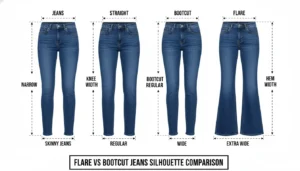
Yes, and that is the point. The same underlying trend becomes different silhouettes, fabric weights, washes, and price points depending on the brand’s customer and market. A wide-leg silhouette is one product for a premium contemporary label and a different product for a fast-response e-commerce seller. Good trend development is one-to-many, not one-to-one.
Why do you not publish a trend selection rate?
Because a credible selection rate requires a structured record of the full loop — recommendation, selection, sampling, order, reorder, sell-through — and most suppliers have not yet built that loop. A supplier who quotes a precise selection rate without the loop is usually inventing the number. The honest position is to build the loop first, then report the metric.
1. Forecasting is not development
The denim industry is full of trend forecasts. Every season produces another wave of reports claiming to know what will sell next: the rise of the wide leg, the return of the skinny, the next wash to replace the last one. Most of these reports are directionally right and practically useless, for the same reason a weather forecast for “the whole country” is useless when you are deciding whether to bring an umbrella.
A forecast becomes useful only when it is translated into a decision for a specific buyer. What silhouette, in what fabric weight, at what wash, at what price point, for which customer, in which market? That translation is not a small step after the forecast. It is the whole job, and it is the step most suppliers skip because a moodboard is easy and a product decision is accountable.
The distinction matters because it changes what a brand should ask for. Asking a supplier “what are the trends?” gets you a list. Asking “which of these trends fit my customer, and can you make them at my price?” gets you a recommendation — and the second question is where the value lives.
2. Why chasing the trend fails
Chasing a trend — spotting what is hot and copying it — fails for three reasons that compound each other.
The copy arrives late. A trend that is already visible on social feeds and in store windows is a trend that has peaked. The brands that win a trend are the ones that were positioned before the peak, not the ones that reacted to it. Copying a visible trend means entering a crowded market with a product that is already being discounted by the time it ships.
The copy is built for the wrong customer. A trend is not one product; it is a direction that expresses itself differently across price bands, markets, and customer types. A washed wide-leg jean at a premium price point and the same silhouette at a fast-fashion price point are different products with different fabrics, washes, and construction. Copying the trend without a customer in mind produces a product that belongs to no one.
The copy ignores the supply side. A trend that cannot be produced at the brand’s cost target, in its lead time, with its quality standard, is not an opportunity — it is a cost. The most fashionable recommendation in the world is worthless if the wash takes four weeks and the brand needed it in two.
The failure of trend-chasing is not a failure of information. It is a failure of the pipeline that sits between the information and the purchase order. That pipeline — filtering, matching, and converting — is what trend development actually is.
3. The three inputs that matter
Useful denim trend development rests on three inputs combined. None of them works alone, and the combination is what produces a recommendation rather than a forecast.
3.1 Trend intelligence — what is rising
This is the input everyone has. Social platforms surface styles in real time; runway shows and trade events set the direction; fabric and trim markets reveal what mills and suppliers are betting on. Trend intelligence tells you what is moving.
3.2 Client DNA — who the brand’s customer is
This is the input most suppliers skip. A brand’s customer is defined by target market, price band, size and fit preference, and the historical record of what actually sold and what did not. A recommendation that ignores this is a forecast, not a product. The same signal becomes a different product for a premium European label, an American mid-market retailer, and a live-commerce seller — because their customers are different.
3.3 Production feasibility — what can actually be made
This is the input that separates a denim partner from a trend agency. A style is only a recommendation if it can be produced at the right cost, in the right lead time, with the right quality, using fabric, wash, and construction that are actually available. Feasibility is a hard filter: a beautiful idea that cannot be made on time, or at the price, is not a recommendation.
The three inputs work as a sequence. Trend intelligence generates the candidate pool; client DNA ranks and filters it; production feasibility decides what survives. A style that passes all three is not guaranteed to sell — nothing is — but it is a decision the brand can act on, and that is the bar.
3.4 When one input goes missing
Each of the three inputs exists to correct the failure of the other two, and when one is missing the failure shows up in a specific, predictable way.
Without trend intelligence, the supplier keeps recommending last season’s styles — safe, but stale. The brand drifts behind the market while competitors move forward, and the customer notices before the brand does.
Without client DNA, the supplier recommends good trends to the wrong customers. The products are directionally right and commercially wrong. The brand receives a deck full of appealing styles that do not match its price band, its market, or its customer, and concludes that the supplier does not understand it — which is accurate.
Without production feasibility, the supplier recommends products that cannot be made on time or at the price. The most exciting recommendations become the most expensive disappointments, because the idea cleared fashion but never cleared the factory floor. A four-week wash recommended to a three-week brand is not a service; it is a trap.
The three inputs are not a menu of options. They are a tripod. Remove any one leg and the recommendation collapses in a predictable direction — stale, mismatched, or unbuildable. This is why a trend agency that only reads trends, or a factory that only knows production, both fall short on their own. The combination is not an added feature; it is the product.
4. Where trend intelligence comes from
Trend intelligence is gathered from several overlapping sources, and the value is in the overlap rather than any single feed.
- Social and retail market signals. What is gaining traction on social platforms, what retailers are stocking, and what is moving in store windows.
- Runway and industry direction. Silhouette, wash, and detail directions from shows and seasonal industry movement.
- Fabric and trim markets. What mills and suppliers are developing and promoting, which signals where the supply side believes the next season is going.
- The client’s own history. A brand’s past bestsellers, its customer feedback, its target market, and its price band are trend inputs too — often the most reliable ones, because they describe demand that already exists.
- Accumulated development experience. Years of fabric, wash, construction, and order data teach a supplier which directions have repeatedly worked and which have repeatedly failed.
- Competitor activity. What competing brands are selling and testing, read as a signal rather than a template to copy.
Two honest notes on scope. First, these sources are the current operating reality. Professional trend data services are a planned addition, not a present one — a supplier should not claim a data subscription it does not yet run. Second, more sources do not automatically mean better recommendations. The bottleneck is not collecting signals; it is matching them to a client and filtering them through feasibility. Five well-used sources beat twenty feeds nobody acts on.
5. Client DNA: the part most suppliers skip
The most common failure in denim trend work is a recommendation made without a customer. A supplier sees a rising silhouette, produces a version of it, and sends it to every client on the list. Some clients buy it; most do not. The supplier concludes that the trend was weak. The real problem was that the recommendation was never matched to anyone.
Client DNA is the record of who a brand’s customer is. It includes the obvious fields — target market, price band, size range — and the less obvious ones: which silhouettes and washes have sold and which have not, what the return and feedback pattern says about fit, and how the brand positions itself against competitors. A wide-leg jean that works for a premium contemporary label in Europe is not the same product as a wide-leg jean for a mid-market American retailer, even when the silhouette looks similar in a photo.
The difference shows up in the details a supplier should know before it recommends anything. Fabric weight changes with the customer’s climate and price band. Wash intensity changes with the customer’s tolerance for a distressed look. Construction and finishing change with the customer’s quality standard and target retail price. A recommendation built without those details is a guess wearing a trend report’s clothes.
This is also why a brand should be wary of a supplier that sends the same product deck to everyone. A supplier that treats all clients as interchangeable is telling you it has not done the matching work. The supplier that asks about your customer before it sends a recommendation is the one doing trend development rather than trend broadcasting.
6. Production feasibility: the filter that decides what is worth recommending
A trend idea is not a recommendation until it clears the supply side. Three constraints decide whether a direction is worth presenting.
Cost. The style has to be producible inside the brand’s target price band, after fabric, wash, trims, and margin. A direction that requires a fabric or process that pushes the price out of the band is not a recommendation for that client — it is a recommendation for a different client, or not one at all.
Lead time. The style has to be deliverable in the brand’s window. A trend that needs a six-week wash development is useless to a client whose product cycle is three weeks. Feasibility includes timing, not just manufacturability.
Capability. The style has to sit inside what the supplier can actually produce well — fabric, wash, construction, and finishing. A supplier that recommends outside its own capability is outsourcing the risk to the brand. The discipline of the technical lab is what lets a supplier say with confidence where its capability actually is; the same logic that governs development timelines applies to deciding what gets recommended in the first place.
Feasibility is the quiet filter that makes the other two inputs honest. It is easy to be inspired by a trend; it is harder to know, before you pitch it, whether it can be made on time and at the price. The suppliers that get this right recommend fewer things and sell more of them.

7. One trend, many products
The clearest sign that a supplier is doing trend development rather than trend broadcasting is the answer to one question: does the same trend produce different products for different clients?
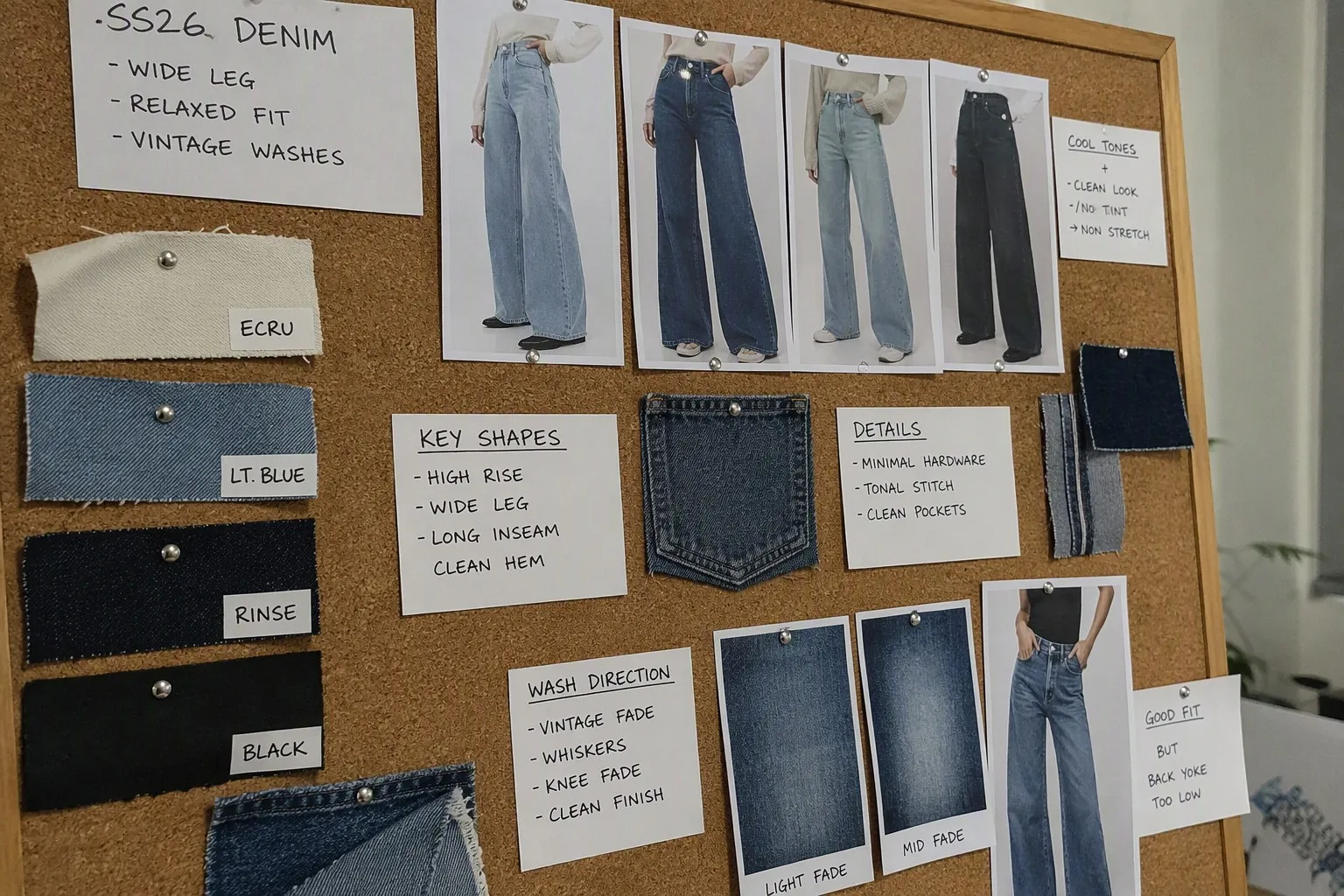
It should. A single underlying direction — say, the wide-leg silhouette or a softer, cleaner wash — expresses itself differently across a client base. For a premium contemporary label it becomes a structured wide-leg in a heavier fabric with a subtle hand finish. For a fast-response e-commerce seller it becomes a lighter, faster version at a lower price point, built for a different customer and a shorter lead time. For a live-commerce brand it becomes a single hero style optimized for visual impact and inventory risk.
The trend is one; the products are many. The long-term goal of mature trend development is that the recommendation is tuned to the individual client — the same direction, but with the product, price, fabric, and wash adjusted to who is buying. This is the opposite of a one-size-fits-all trend deck, and it is the direction the work is moving in even before the full data system exists to do it automatically.
8. How the recommendation loop works
Behind the scenes, trend development runs as a loop rather than a one-way broadcast. Each pass feeds the next, and the recommendations get more accurate over time.
The loop starts with a pool of market opportunities — the raw trend intelligence gathered from social, retail, runway, fabric, and competitor signals. Those opportunities are matched against each client’s DNA, then passed through a human review before anything is sent. The output is a client-specific recommendation, not a mass email. When the client responds — selected, declined, modified — that feedback returns to the pool and sharpens the next round.
Two rhythms drive the loop. There is a regular cadence, where recommendations go out on a set schedule tied to the client’s buying cycle. And there is an irregular one, where a high-value opportunity — something that fits a specific client unusually well — triggers a targeted recommendation outside the normal schedule. Both rhythms matter, because some opportunities fit a calendar and some fit a moment.
The important part is the feedback. A recommendation that disappears into silence teaches nothing; a recommendation with a reason attached — selected because of the wash, declined because of the price — is the raw material that makes the next round better. This is the same logic as quick response, where the system only gets faster after it has been tuned against a client’s real order pattern. Trend development gets more accurate the same way.

9. From selection to sample to order
When a client selects a recommended style, the work does not pause — it accelerates. The advantage of a recommendation built on client DNA and production feasibility is that selection drops straight into development rather than restarting from zero.
The chain runs in a known order: the client confirms color, fabric, wash, construction, and sizing; the tech pack, bill of materials, and process are locked; fabric and trims are matched; the sample is made; the client confirms it; price and order are agreed; production runs. A style that was already vetted for feasibility moves through this chain quickly, because the hard questions were answered before the recommendation was sent.
The operating numbers a brand should expect, for a style that has already cleared feasibility:
| Stage | Typical timeline |
|---|---|
| Standard first sample | 7–14 days |
| Expedited development (urgent styles) | ≈72 hours |
| Bulk production | 15–22 days |
One boundary is worth being precise about. Selecting a style can put it into development the same day; it does not guarantee that a physical sample exists the same day. The actual timeline depends on whether the client wants changes, whether the fabric is on hand, how complex the wash is, and whether the tech pack is complete. A supplier that promises “same-day physical sample” without those qualifiers is promising something it cannot reliably deliver — and the honest phrasing is that selection starts development immediately, with the sample following on the standard or expedited timeline.
10. The honest part: why there is no selection rate yet
Every supplier would like to quote a selection rate. The temptation is obvious: “we recommend, and 60% of what we recommend gets bought” is a persuasive sentence. It is also usually invented.
A credible selection rate requires a structured record of the entire loop: what was recommended, to whom, why, whether it was selected, why it was declined, whether it was sampled, whether it became an order, whether it reordered, and how it ultimately sold. That record has to be built over time, and most suppliers — including strong ones with real ODM and development experience — have not built it. They have the practice of recommending and the practice of developing, but not the data that connects the two.
The honest position is therefore specific. There is a long record of active product development and client selection. What does not exist yet is the closed measurement loop that would turn that record into a defensible selection rate. The work in progress is exactly that: taking a recommendation practice that has lived in the team’s experience and turning it into a system that records every step, so that in time the metric can be reported rather than guessed.
A buyer should treat a precise selection rate with the same skepticism as a precise lead time that has never been measured. The number is only as good as the loop behind it. No loop, no number.
11. Why the data loop is the real capability
Strip away the tools and the real asset in trend development is the loop that records what happened. The sequence that matters is not a feed of trends; it is the chain from opportunity to outcome:
Opportunity spotted → recommended to whom → why → selected or not → why not → sampled → ordered → reordered → sold.
Every link in that chain is a decision, and every decision is data. Once the chain is recorded, the supplier can answer questions that a trend report cannot: which recommendations actually convert, which clients convert on which signals, which declines are about price and which are about product, and where the value is really being created. That is the difference between a supplier who says “we know trends” and one who can show, over time, that its recommendations turn into orders.
This is also why professional trend data services are only ever an input. A WGSN feed or a Heuritech dashboard improves the quality of one link — the trend intelligence. It does not build the loop. The loop is the capability; the feed is just fuel. A supplier who confuses the two buys better fuel and still has no engine.
Building the loop is the deliberate next step, and it is what makes trend development a real product rather than a skill that lives in a few people’s heads. Until the loop exists, the honest claim is “we have long experience turning recommendations into orders, and we are now instrumenting it.” After the loop exists, the claim becomes a number. The difference is measurable, and it is the whole point.
12. How to evaluate a trend-development partner
If you are a brand deciding whether a supplier can actually help you find next season’s direction, a few questions separate trend development from trend broadcasting.
- Do they ask about your customer before they recommend? A supplier that sends a product deck without asking who you sell to, at what price, and in what market is broadcasting, not developing.
- Does the same trend become different products for different clients? If the deck looks identical across a client list, the matching work has not been done.
- Can they tell you which of their recommendations became orders? Not a percentage — a specific, traceable example. A supplier doing real trend development can name the path from recommendation to order; a broadcaster cannot.
- Do they filter recommendations through production feasibility? Ask whether a recommended style is deliverable in your lead time and price band. If the answer is vague, the feasibility filter is not running.
- Are they honest about what they measure? A supplier who admits the selection-rate loop is still being built is more credible than one who quotes a number with no system behind it.
None of these questions requires technical expertise. They are checks on whether the supplier is doing the translation work — from signal to your customer to a producible product — or just forwarding you the signal. The first is a partner; the second is a newsletter.
13. Summary
Denim trend development is the step after forecasting, and it is where the value actually lives. A forecast tells you what is rising; development tells you which of it fits your customer and how to make it at your price, in your lead time, at your quality standard. The inputs are trend intelligence, client DNA, and production feasibility, and the output is a recommendation you can act on rather than a moodboard you can admire.
The honest limits matter as much as the promise. Selection and conversion rates require a data loop that most of the industry — including strong suppliers — is only now building. The right way to read a supplier’s trend claim is not through a percentage but through the structure behind it: does the recommendation match your customer, clear production feasibility, and lead to an order, with every step recorded so it can be proven rather than asserted?
The brands that get this right stop asking suppliers for trend reports and start asking for recommendations — products matched to their customer, cleared for production, and ready to sample.
Trends are cheap. The ability to turn one into a product your specific customer buys — and to prove, over time, that it keeps happening — is the expensive part, and it is the only part worth paying for.