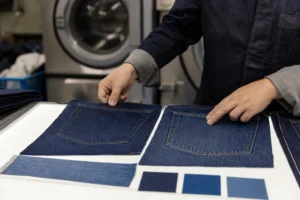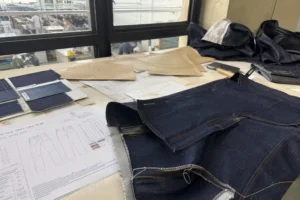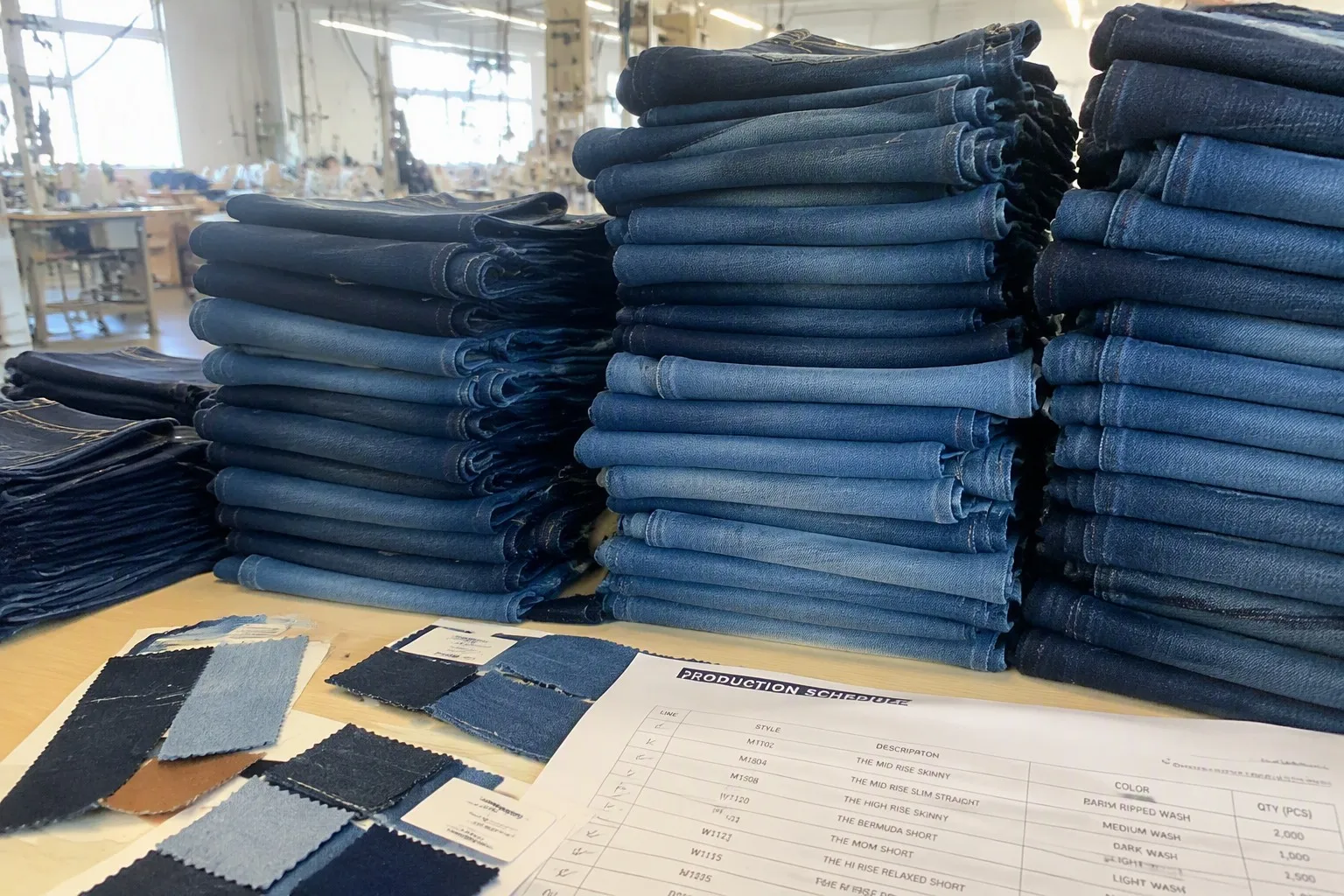
Most brands negotiate cost after demand appears. The smarter ones engineer cost before production begins. Off-season production is the difference: schedule a proven style into the factory’s quiet months, and the same jean costs less — not because it is made worse, but because the factory is paid in certainty instead of margin.
Direct answer
Off-season denim production schedules a brand’s proven core styles into the factory’s slower window — typically July and August — in exchange for a lower FOB price. The mechanism is not cheaper materials or looser quality; it is a trade of demand certainty for cost efficiency. A brand that plans annual demand early and locks a large, stable order into the quiet months lets the factory keep its line running, and the factory returns the favor by giving up part of its profit margin. Under the right conditions, the FOB advantage can reach roughly 10 percent; the same product can rise roughly 10 percent or more in the peak season. Quality stays identical to a normal order.
What is off-season denim production?
It schedules a brand’s proven core styles into the factory’s slower months — typically July and August — rather than the peak season. The brand plans annual demand early, fabric and trims are prepared in advance, and production is locked into the quiet window. In exchange for the certainty of a large, stable order, the factory gives up part of its margin, which lowers the FOB price.
How much can off-season production save on FOB?
Under the right order and scheduling conditions, off-season planning can deliver a FOB cost advantage of up to roughly 10 percent. In the year-end and New Year peak season, the same product can rise by roughly 10 percent or more. These figures are operating experience, not a statistically validated study, and they should not be added together into a single claimed saving.
Does off-season production mean lower quality?
No. It uses the same quality standard as a normal order. The saving comes from the factory giving up margin in exchange for stable capacity utilization — not from cheaper fabric, weaker construction, or lighter inspection. The product is the same; only the scheduling and the price are different.
Which orders are best suited to off-season production?
Long-running reorders, proven bestsellers, and core styles with stable, predictable demand — for example, a jean that has sold for two or three seasons at roughly 30,000 to 100,000 units a year. New trend styles, first-time development, unknown sell-through, and designs under frequent revision are not good candidates and should be tested in small runs first.
When is the denim factory off-season?
July and August are the typical quiet window, after spring orders have shipped and before the autumn and winter peak ramps up. Planning for the year typically starts at the beginning of the year, so capacity can be reserved before the factory fills up.
Why does a factory offer lower prices in the off-season?
Because its costs do not disappear when orders do. Workers still need to be paid and equipment and fixed costs still run, so a factory is willing to trade part of its profit margin for a stable, large order that keeps the line utilized. A partner that brings a confirmed 30,000-plus-unit order with a defined production window and pre-prepared fabric is offering certainty, and the factory pays for that certainty in the form of a lower price.
1. The core idea: certainty is worth more than margin
Off-season production is not a discount. It is a trade, and the currency is certainty.
A denim factory’s costs do not disappear when the orders do. In the quiet months — typically July and August, after spring has shipped and before the autumn and winter peak — the factory still has workers to pay, machines to keep running, and fixed costs that arrive every month whether or not the line is full. An idle line is a loss, but a line running at reduced margin is still a line that is covering its fixed costs and keeping its workforce intact.
That is the opening. A brand that can hand the factory a large, stable, predictable order for the quiet months is giving the factory something more valuable than margin: it is giving the factory a reason to keep the line alive. In return, the factory hands back part of its profit in the form of a lower FOB price.
Read that trade the right way and the whole model follows. The brand is not asking for a cheaper jean. It is offering a more certain order — and being paid for it. The saving is the factory’s way of buying certainty.
2. Why the factory can actually afford to go lower
The common mistake is to assume a lower off-season price means lower factory costs. It does not. The fabric costs the same, the wash costs the same, the labor minute costs the same. What changes is the factory’s willingness to accept less profit on the order, and that willingness is driven by one thing: capacity utilization.
In the peak season, the factory has more orders than it can comfortably run. Every slot on the line is worth the maximum, because another buyer is waiting for it. A factory that gives a discount in peak season is giving away money it could have earned elsewhere, so peak-season prices rise — by roughly 10 percent or more at the year-end and New Year rush, in our operating experience.
In the quiet months, the arithmetic flips. The line has open capacity, the workers are there, and the fixed costs are already sunk for the month. A large confirmed order in that window is not competing with other buyers for the slot; it is filling a slot that would otherwise sit empty. Against that backdrop, a factory is happy to trade away several points of margin to keep the line running at volume.
The off-season price is lower for one reason: the product did not get cheaper to make, the factory’s opportunity cost collapsed. The same jean, the same materials, the same quality — only the economics of the calendar have changed.
3. The honest numbers: roughly 10 percent, not 20
Every cost claim in sourcing should be held to the same standard: how was the number produced, and what is it comparing? Here the honest answer matters more than the marketing one.
Two figures describe the opportunity, and they are deliberately stated as operating experience rather than a finished study:
- Off-season advantage: under suitable order and scheduling conditions, off-season planning can deliver a FOB advantage of up to roughly 10 percent.
- Peak-season risk: at the year-end and New Year peak, the same product can rise by roughly 10 percent or more.
The two numbers are easy to add together into a 20 percent saving. Do not. The two numbers describe different points on the calendar and different order conditions; they are not two halves of one comparison. A brand that claims to save 20 percent by moving from peak to off-season is comparing a peak quote against an off-season quote without holding style, quantity, quality, and timing constant — and until those controls exist, the honest statement is the narrower one: an off-season advantage of up to roughly 10 percent, against a peak-season premium of roughly 10 percent or more.
This is not modesty for its own sake. It is the difference between a claim a buyer can verify and one that evaporates on inspection. Respect the distinction and the saving holds; round it up and the saving disappears. A number that survives a buyer’s audit is worth more than a bigger one that does not.
4. What the model looks like in practice
Off-season production runs as a sequence, and each step only works because the previous one was done early enough. The chain is short, but every link depends on timing:
Annual planning first. At the start of the year, the brand and the supplier agree on which styles are core, what volumes they are likely to run, and which months make sense for production. This is the step most brands skip, and it is the step the whole model depends on.
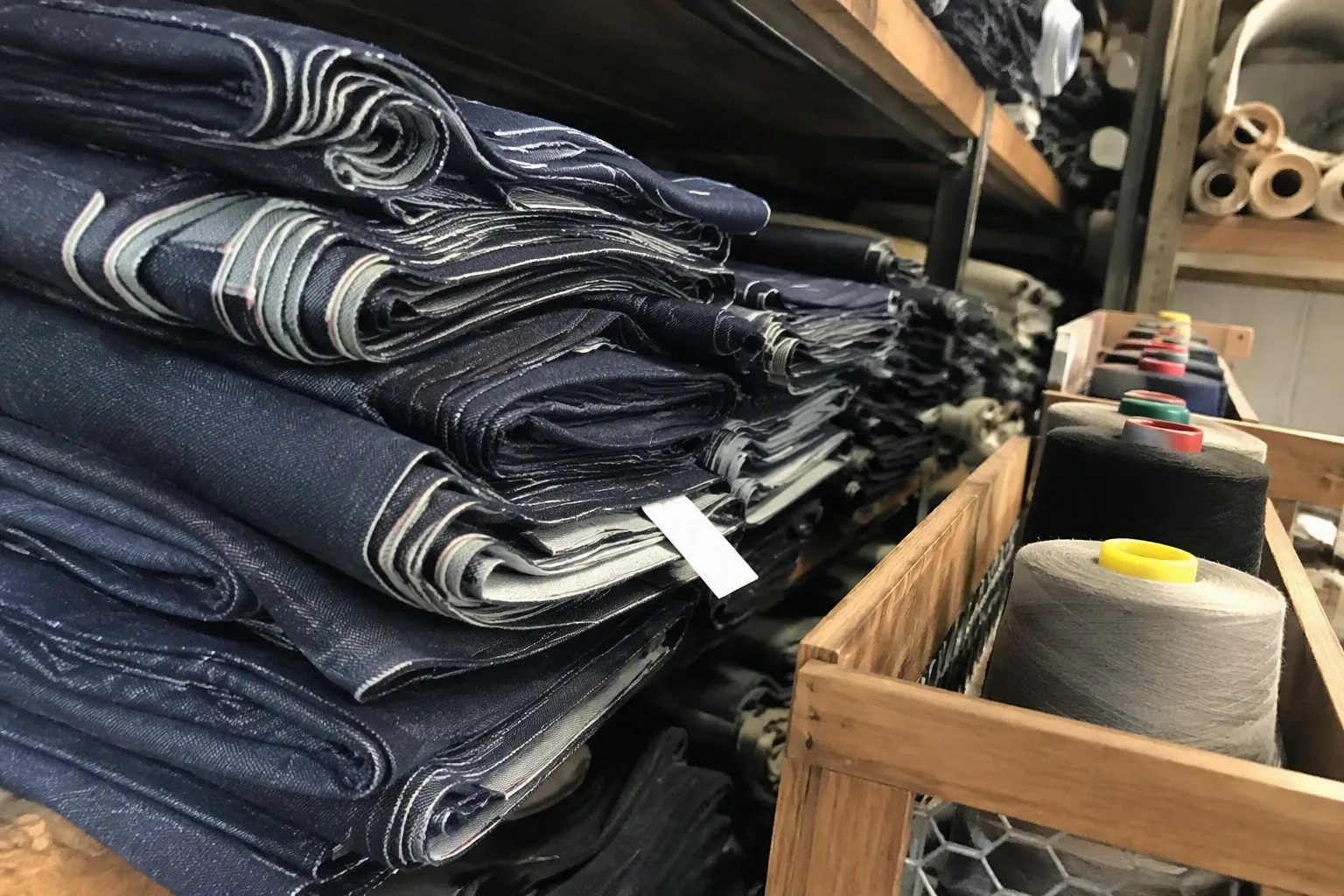
Fabric and trims prepared in advance. Because the volumes are planned, fabric and trims can be ordered and staged against the annual plan rather than rushed at the last minute. This removes both cost and delay later.
Capacity locked into the quiet window. Production slots in July and August are reserved before the factory fills up. The reservation is what gives the factory its certainty — and what earns the brand its lower price.
The factory runs the order at reduced margin. With a stable order and a defined window in hand, the factory accepts a lower margin than it would in peak season, because the alternative is an idle line.
FOB comes down. The lower margin becomes the lower price. Quality is unchanged — the saving is in the margin, not the materials.
Production can be staged, then delivered to plan. Goods can be made in the quiet window and released against actual demand, so the brand gets both the better price and the flexibility to pull inventory when it is needed.
What is absent from that chain matters more than what is in it: no cheaper fabric, no faster sewing, no looser inspection. The mechanism is purely a scheduling and certainty play, which is why the quality boundary is not something the model negotiates away.
4.1 Lead time and reserved capacity
The lead time of off-season production is not a single number, because the process begins long before the production window itself. The clock starts with annual planning at the beginning of the year, when the brand and supplier agree on core styles and expected volumes. From there, fabric and trims are staged, and production capacity is reserved for the July–August window.
This is why off-season lead time looks different from a normal order. A normal order’s lead time runs from order confirmation to shipment. Off-season lead time runs from the annual plan to the reserved production window — a longer span on paper, but one spent on preparation rather than waiting. The actual production, when it happens, runs on a schedule that was set months earlier.
Reserved capacity is the part that makes the whole thing work. A factory will not trade away margin for an order that might appear; it trades away margin for an order that is already scheduled. The reservation is what converts a brand’s intention into the factory’s certainty, and the certainty is what the brand is paid for. Without the reservation, the off-season price is just a request.
5. What the numbers look like on one table
| Dimension | Operating position |
|---|---|
| Off-season cost advantage | Up to roughly 10% lower FOB, under suitable conditions |
| Peak-season price risk | Roughly 10% or more higher FOB at year-end / New Year |
| Typical quiet window | July–August |
| Planning horizon | Annual planning, typically starting at the beginning of the year |
| Best-fit orders | Long-running reorders, core bestsellers, stable inventory styles |
| Volume sensitivity | Larger, more stable demand earns more room to reduce price; 30,000+ units is where it becomes most visible |
| Fabric and trims | Prepared in advance against the annual plan |
| Production and delivery | Produced in the quiet window; released against actual demand and inventory needs |
| Quality | Identical to a normal order — cost is not cut through quality |
The table is worth reading as a set of boundaries, not a menu. The advantage is “up to” roughly 10 percent because it depends on order size, stability, and timing; the peak-season risk is “roughly 10 percent or more” because it depends on how tight capacity is that particular season. Both are ranges rooted in long production experience, not fixed guarantees, and a buyer should treat them accordingly.
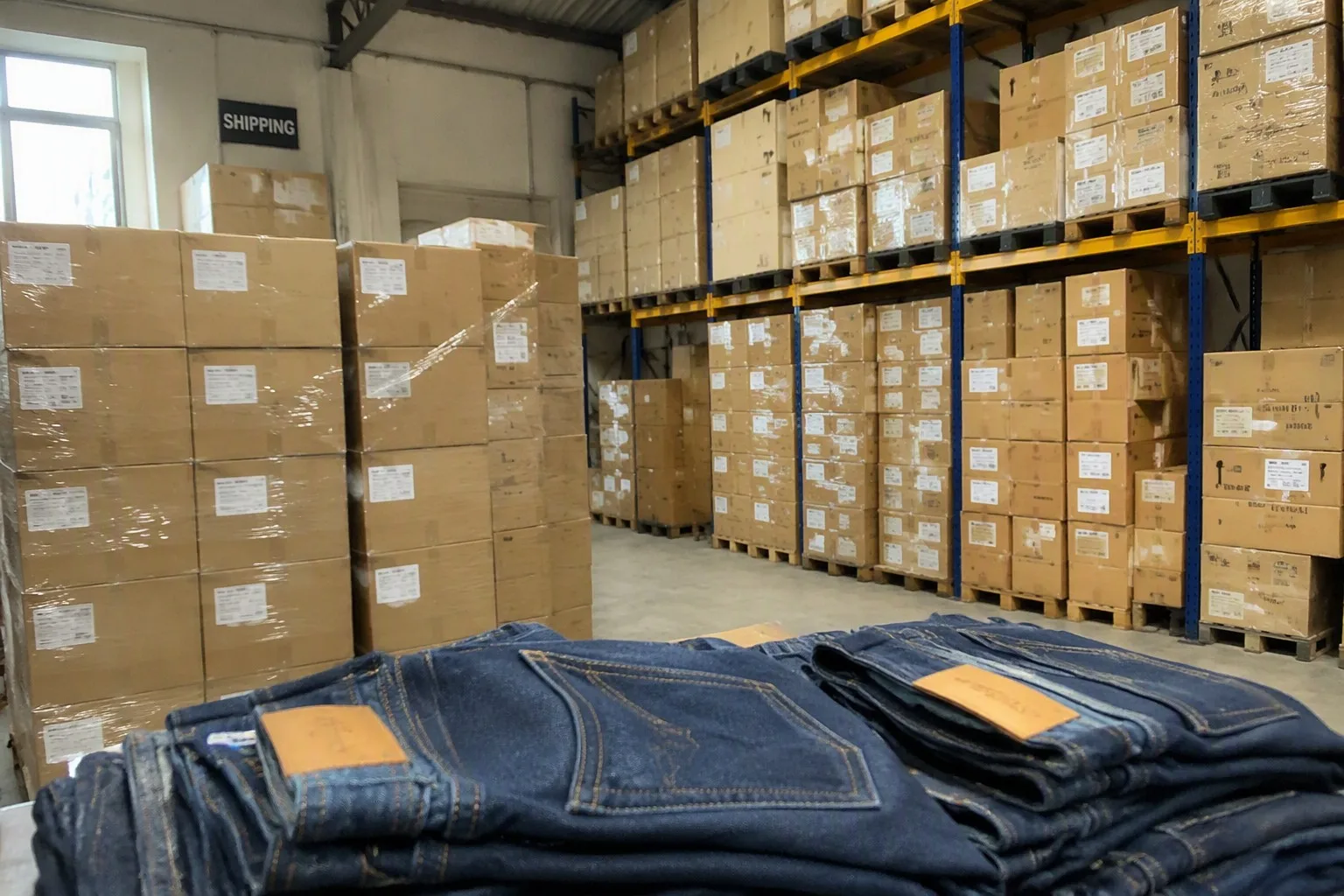
6. Which orders belong in this model — and which do not
Off-season production is not a fit for everything a brand makes. It works for one specific kind of product, and it actively hurts for another.
The right product is a core style with proven demand: a jean that has sold for two or three seasons, that reorders every year, and whose volume is stable enough to predict — think 30,000 to 100,000 units a year. For that kind of product, planning annual demand is realistic, reserving capacity is low-risk, and producing in the quiet window is simply moving a certain order to a cheaper part of the calendar.
The wrong product is anything unproven. A new trend style, a first-time development, a design under frequent revision, or a style with unknown sell-through should not be bought forward in volume to chase a 10 percent saving. The saving is real, but it is small next to the cost of being wrong about demand — a warehouse full of a style the market never wanted.
This is where the two products fit together. A brand’s new and uncertain styles should go through small-batch testing first — the trial collection logic, where small runs prove demand before volume is committed. Once a style has proven itself and becomes a stable reorder, it graduates to annual planning and off-season production. The two paths are not competitors; they are the before and after of the same product’s life.
6.1 Inventory risk, and how the release cadence manages it
The obvious objection to off-season production is inventory. Buying a season’s core volume in July means holding stock, and stock is risk. The objection is fair, and the model answers it with one specific mechanism: produce early, release to demand.
Production in the quiet window does not mean shipping everything to the brand’s warehouse at once. Goods can be made during the off-season window and then released against actual demand and inventory needs as the selling season unfolds. The finished goods are staged, and the brand pulls them as its sell-through dictates.
This changes the risk profile. The cost saving is captured on the production timing, but the inventory is released on the demand timing — the two no longer have to move in lockstep. The brand gets the off-season price without being forced to warehouse its entire season’s core volume on day one. The residual risk is what any forward purchase carries: the core style must actually keep selling, which is exactly why only proven, stable styles belong in the model in the first place.
7. Quality does not move with the price
One boundary is fixed: off-season production does not change the quality standard. The lower FOB is the factory giving up margin, not the factory cutting corners.
This matters because it is the first thing a skeptical buyer should question. A supplier that offers a lower price is always suspected of offering a lower product, and in most sourcing situations that suspicion is correct. Here it is not, and the reason is structural: the saving does not come from the material, the construction, or the inspection. It comes from the factory’s willingness to earn less on a certain order because that order fills a window that would otherwise sit empty.
What this means in practice is that a core style produced off-season should hit the same shade tolerance, the same fit, the same construction standard, and the same inspection level as the identical style produced in peak season. The technical lab disciplines that keep a style reproducible — the sealed standard, the documented wash recipe, the measured shade — apply unchanged. Nothing about a July production slot relaxes them.
A buyer should treat any off-season offer that comes with a softened quality standard as a red flag. That is not off-season production; that is a discount dressed up as a strategy, and the saving is coming out of the product rather than the margin. The whole point is that the brand gets the same jean for less because the timing changed, not the jean.
8. Two paths that fit together
Off-season production only makes sense as one of two routes a brand runs in parallel, because the routes serve different stages of a product’s life.
Route one — new and uncertain styles. A style that has not proven demand should not be bought forward in volume. It goes through small-batch testing: produce a trial collection, measure sell-through, and let the market decide. When a style wins, it reorders quickly to catch the demand while it is there — the quick response path, built for the moment a style is selling and speed matters more than the last few points of cost.
Route two — proven and stable styles. A style that has sold for multiple seasons and reorders predictably graduates out of the test-and-react loop. It moves into annual planning: demand is forecast once a year, capacity is reserved, and production is scheduled into the quiet window to earn the off-season price. Speed is no longer the binding constraint, because the demand is already known; cost becomes the lever.
The two routes are the same product at different ages. Route one manages risk; route two manages cost. A brand that only runs route one leaves money on the table every season, because it keeps paying peak prices for styles whose demand it could have predicted. A brand that only runs route two is gambling, because it buys forward styles the market has not yet accepted. The discipline is knowing which route each style belongs on — and that decision is itself the core of a well-run denim program.
9. The honest status of this capability
Here is the part most suppliers would skip, and it is the part that matters.
Off-season production is a real, working practice backed by long production experience: the quiet-window timing, the roughly 10 percent off-season advantage, the roughly 10 percent-or-more peak premium, and the way larger stable orders — 30,000 units and above — earn more room to reduce price are all grounded in what actually happens on the floor. They are not theoretical.
What does not exist yet is the finished measurement study that would turn that experience into a hard, published claim. A rigorous comparison would require holding the same style, at the same quantity, to the same quality standard, and recording the peak-season quote, the off-season quote, the actual FOB, and the delivered quality — side by side, across enough orders to be meaningful. That dataset is not yet assembled in structured form.
So the honest label for this capability today is a strategic direction with strong operating experience behind it, not a statistically validated program with a published savings guarantee. The difference is not cosmetic. A buyer who reads “strategic direction” knows to treat the 10 percent figure as a working range to be confirmed on their own order, not a number chiseled in stone. A buyer who is told “guaranteed savings” is being set up to be disappointed.
This is the same honesty that separates a real denim partner from a sales deck. The partner tells you what the model is, where the numbers come from, and what has not yet been proven. The deck tells you only what you want to hear.
The next step for the capability is the measurement itself: assembling the side-by-side record — same style, same quantity, same quality, peak quote against off-season quote, actual FOB, delivered quality — across enough orders that the roughly 10 percent range can be narrowed into something closer to a number. Until then, the honest framing stays what it is: a working range from operating experience, not a finished study. A brand that buys the range and confirms it on its own order is doing exactly what the measurement would eventually do — just with its own volume.
10. Production time is a cost input
Underneath the scheduling mechanics sits a principle that reframes the whole sourcing conversation: when something is made is a cost input, not a neutral detail.
Most brands treat cost as a property of the product — this jean costs this much because of its fabric, its wash, its construction. That is true but incomplete. The same jean has a different price in July than it does in December, not because the jean changed but because the calendar did. Capacity, like fabric, has a price that moves with supply and demand, and the brand that ignores the calendar is paying a premium it never saw.
Once a brand accepts that production time is part of the cost equation, the sourcing job changes. Cost is no longer only a negotiation at the moment demand appears; it becomes a design decision made months earlier, when capacity is still open and certainty is still for sale. That is the meaning of the core line: most brands negotiate cost after demand appears — the better-run ones engineer cost before production begins.
The shift is the difference between buying price and planning cost. The buyer negotiates whatever the market is offering at the moment they need it; the planner decides the moment, and with it the price. Off-season production is simply the clearest case of the planner’s advantage, because the quiet window is where the calendar is most generous to the buyer who planned ahead.
11. What to ask before you commit
If a brand is considering off-season production, a few checks separate a genuine cost-engineering program from a seasonal discount with a label on it.
- Is the quality standard the same? If the lower price comes with a softer inspection or a different material, it is a discount, not cost engineering.
- Which styles qualify? Only proven, stable core styles belong in the model. If the supplier offers the off-season price on unproven new styles, the risk has been moved onto your inventory.
- When does planning start? The model depends on annual planning. A supplier offering off-season pricing without discussing your annual volume is not running the model; it is just quoting a lower number.
- How is the saving measured? Ask for the same style, same quantity, same quality, quoted at peak and off-season. If the answer is a single number with no comparison, treat it as a range, not a fact.
- Where does the factory’s margin go? The honest answer is that it is given up in exchange for certainty. Any other explanation — cheaper materials, faster methods — should be met with skepticism.
These checks do not require technical expertise. They are the same discipline a buyer should bring to any cost claim, applied to a model where the saving is real but easy to overstate. Ask them and you keep the saving; skip them and you inherit the disappointment.
12. Summary
Off-season production turns the calendar into a cost lever. A brand that plans its proven core styles into the factory’s July–August window trades demand certainty for a lower FOB — up to roughly 10 percent under the right conditions — while the same product can run roughly 10 percent or more higher in the peak season. Quality stays identical, because the saving comes from the factory’s margin, not the product.
The model has clear boundaries. It fits long-running, stable, predictable core styles, not new or uncertain ones; those belong in small-batch testing first. Its numbers are operating experience rather than a finished statistical study, and they should be read as ranges to confirm, not guarantees to bank. And it is not a standalone tactic but the cost-management half of a two-route program that pairs test-and-react speed for new styles with planned, scheduled cost for proven ones.
The principle underneath it is the part worth taking away, because it applies far beyond denim: production time is a cost input. The brands that plan cost before demand appears will always pay less than the brands that negotiate cost after it — not because they argue harder, but because they bought certainty while it was still for sale.