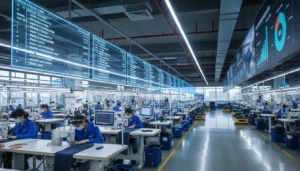
Eco denim washing is not about putting sustainability ahead of the finish. It is about hitting the target look first, then finding the lower-impact route to get there. A wash that saves water but destroys the whiskers is not sustainable — it is unsellable.
Direct answers
What is eco-friendly denim washing?
Finishing routes — laser, ozone, nano-bubble, low-water washing, stone-free processing, lower-impact chemistry, and water recycling — that produce the same distressed and faded looks as conventional washing with less water, fewer chemicals, and less energy.
Does eco denim washing compromise the finish?
It should not. A professional program designs the route around the target look. If a route cannot hold the look, it is the wrong route.
How much water can eco denim washing save?
Advanced systems have been publicly reported to cut water use by around 70% and chemicals by around 65% versus conventional finishing — industry capability figures, not a per-order promise. Each program should be measured individually with a tool like EIM.
What is EIM and why does it matter?
Environmental Impact Measuring, a Jeanologia tool scoring a garment’s finishing across water, energy, chemical impact, and worker health. It turns “eco-friendly” from a claim into a comparable number.
Can denim be finished with zero chemicals?
For the right fabric, dye, and wash, a zero- or near-zero-chemical route can be designed. It is not available for every product — it depends on fabric, dyeing, effect, and equipment together.
What certifications should an eco denim supplier hold?
Documentation matched to the project’s requirements — issued for the specific factory, with valid scope and expiry — rather than a vague list of badges.
1. The problem: conventional denim washing is heavy
Denim finishing is where most of a jean’s environmental footprint gets spent, and it is also where the jean’s identity gets made. The fade, the whiskers, the distressing — none of it is woven in. It is created after the garment is sewn, through washing, abrasion, and chemistry.
Conventional routes to those looks are heavy for a reason that has nothing to do with malice and everything to do with how the industry grew. To fade a jean, you need to remove color, and the traditional ways of removing color are water, stone, and chemicals.
Water. Traditional stone-washing runs garments through repeated wet cycles, and a single pair can pass through tens of liters of water across a full finishing sequence before the look is right. Multiply that by a production run and the number stops being abstract.
Stone. Pumice stone gives denim its broken-in surface, but it is heavy to ship, breaks down into sludge that must be handled, and wears out machinery. It was the workhorse of vintage finishes for decades because it worked, not because it was clean.
Chemicals. The bleaches and oxidizers that lift indigo — and the sprays used for localized effects like the “whisker” creases at the hip — carry their own handling and effluent burdens, and they touch the workers who apply them as much as the water they end up in.
Energy. Then the garment has to be dried, again and again, after each wet step.
None of this means denim should stop being washed. A raw jean and a finished jean are different products, and the finished one is what most of the market buys. The question is not whether to finish denim. It is whether the same look can be reached with a lighter hand.
2. The core principle: hit the look first, then cut the impact
The most common mistake in eco denim is to start from the environmental target and work backward, treating the finish as a constraint to be tolerated. The result is a “sustainable” jean that looks flat, sells poorly, and teaches the brand the wrong lesson — that sustainability costs sales.
The right sequence is the reverse. Define the target look precisely: the depth of the fade, the placement and sharpness of the whiskers, the degree of distressing. Then ask which finishing route reaches that look with the lowest impact. The look is the requirement; the impact is the optimization.
This ordering matters because it changes what “eco” means. Eco washing is not a single process or a single machine. It is a routing decision — a selection of technologies matched to a specific fabric and a specific finish. Two different jeans can both be “eco washed” through entirely different routes, because they are trying to reach two different looks.
For a brand, the practical consequence is that a sustainable line does not have to compromise design. The design comes first. What changes is the machinery behind it, and that machinery should be invisible to the customer except as a story worth telling.
3. The technology toolbox
Eco denim finishing is built from a set of tools, each of which removes one of the heavy inputs from the traditional route. They are rarely used alone; the skill is in combining them for a given look.
| Technology | What it replaces or reduces |
|---|---|
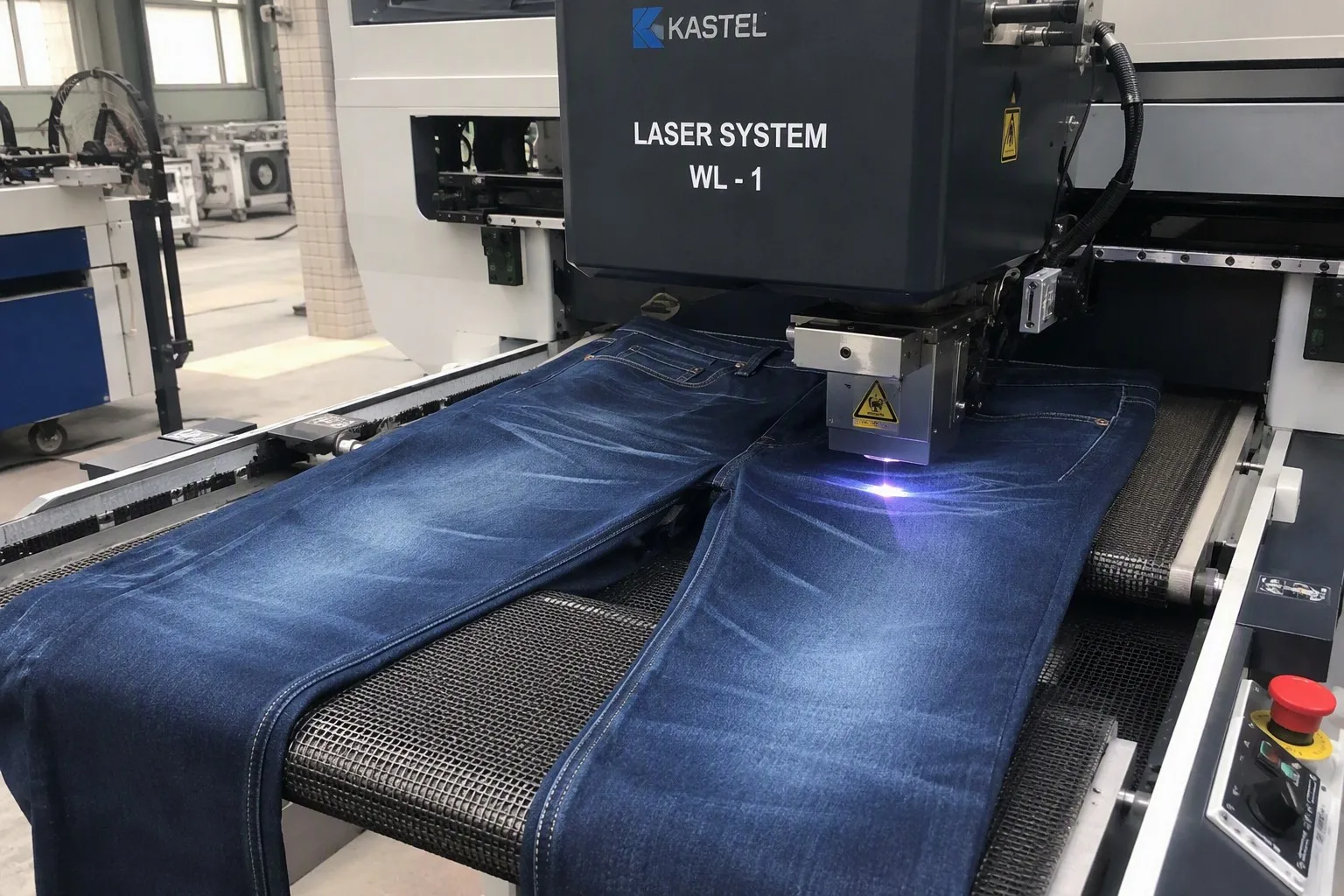
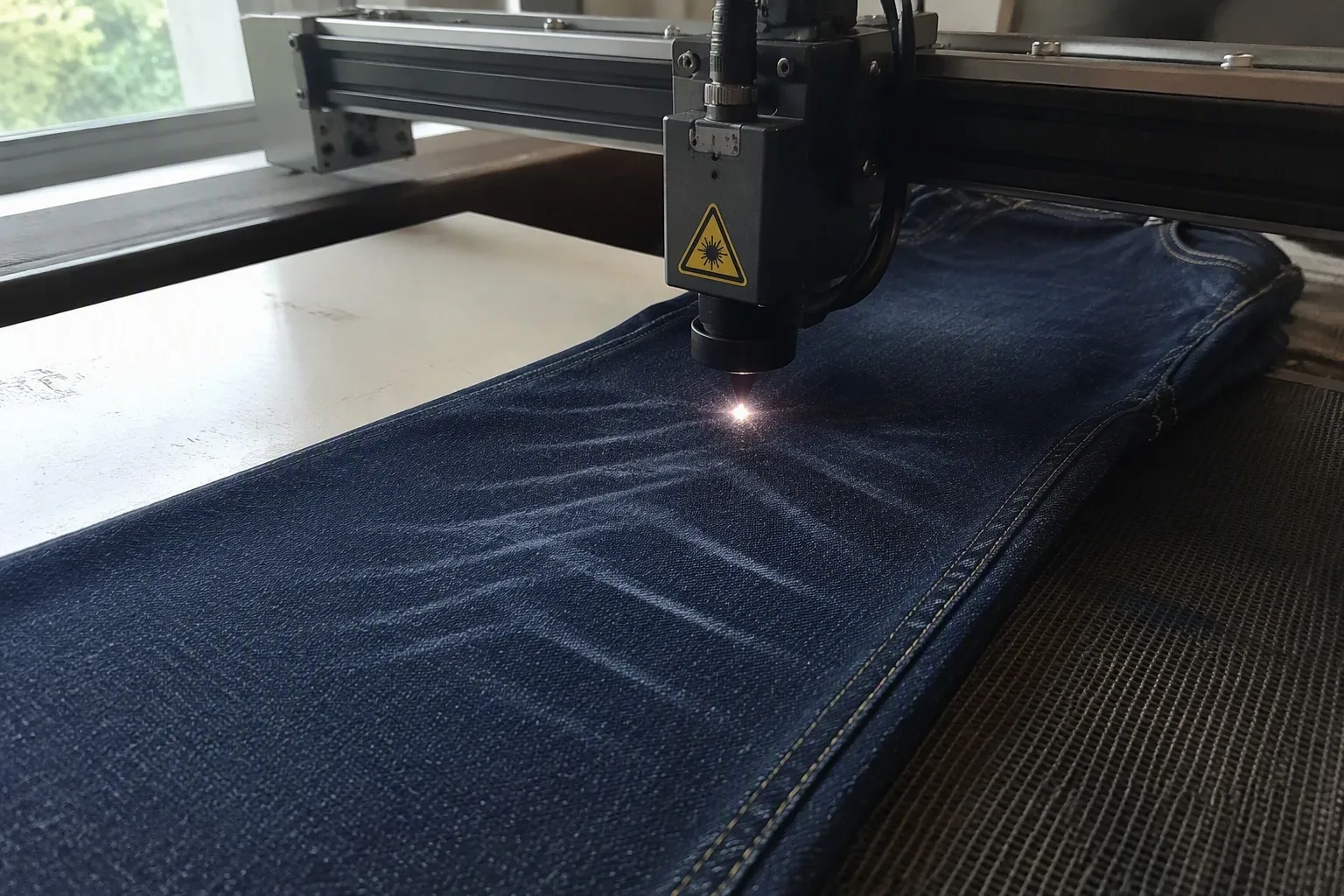
| Laser | Reproduces whiskers, distressing, and abrasion patterns that were once done by hand scraping or localized chemical spray — with no water and no added chemistry. |
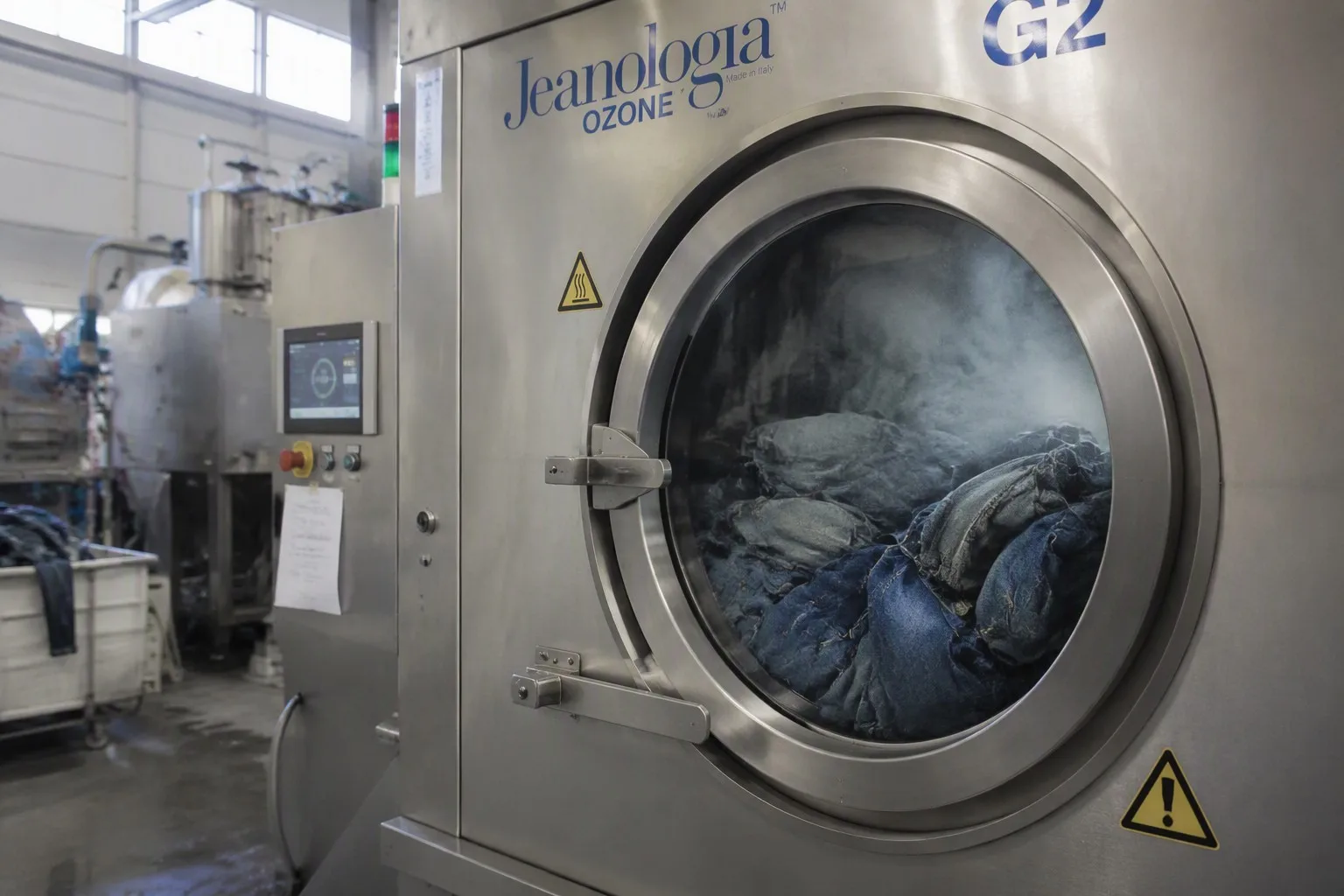
| Ozone | Bleaches and fades indigo using activated oxygen instead of large volumes of water, stone, and chlorine-based chemistry. |
| Nano-bubble | Carries finishing chemistry to the fabric in extremely low water volumes, so a chemical effect is delivered with a fraction of the usual water. |
| Low-water washing | Reduces the liquor ratio of conventional wet cycles — the amount of water per kilogram of garment. |
| Stone-free processing | Produces the worn surface of stone-wash without pumice, eliminating stone logistics, sludge, and machine wear. |
| Lower-impact chemistry | Substitutes conventional oxidizers and auxiliaries with formulations that carry a lighter chemical and effluent load. |
| Water recycling | Treats and reuses process water, moving the system toward closed-loop or near-zero-discharge operation. |
The tools map cleanly onto the traditional inputs. Laser replaces handwork and spray. Ozone replaces stone and chlorine bleach. Nano-bubble and low-water washing cut the water itself. Stone-free processing removes the pumice. Water recycling closes the loop at the end. A single eco program might combine three or four of these in one sequence, just as a traditional program combined stone, bleach, and handwork.
This is also why a supplier’s equipment list is not enough on its own. Owning a laser and an ozone machine does not mean the factory knows how to route a specific jean through them to reach a specific look. The machines are the hardware; the routing is the capability.
3.1 The routing is the capability
An equipment list is a starting point, not a proof. Two factories can own the same laser and ozone machines and turn out different results, because the machines do not decide the route — the development team does. Which technology goes first, how the fade is staged, whether ozone runs before or after the laser, what the water ratio needs to be: those decisions separate a wash that hits the reference from one that approximates it.
The same discipline governs any high-difficulty denim finish, eco or not. A factory that owns an ozone unit but cannot route a specific jean through it to a specific look has not gained an eco capability; it has gained a machine. The capability is the team that sequences the tools, documents the recipe, and holds the result steady across a run. More on that sequencing is in the complex craftsmanship guide.
4. EIM: how impact actually gets measured
Without a number, “eco-friendly” is marketing. The tool that gives the number is EIM, short for Environmental Impact Measuring, a software system developed by Jeanologia. It is the closest thing the industry has to a common scorecard for denim finishing.
EIM scores a garment’s finishing process across four dimensions:
- Water use — how much water the finishing sequence consumes.
- Energy use — the energy required across the process.
- Chemical impact — the environmental load of the chemistry involved.
- Worker health — the exposure and conditions the process creates for the people running it.
For each finishing recipe, EIM quantifies these four dimensions, compares them against thresholds, and produces a rating — low, medium, or high impact — along with an overall score. That is the difference between a supplier saying “we wash sustainably” and a supplier handing you a scored recipe.
The scoring also produces something more durable than a claim: a record. Because EIM is calculated from the wash recipe itself, a program can be traced as a chain — wash recipe, to water, to energy, to chemical impact, to worker impact, to the EIM score. That chain is a process-level traceability. It is not a full supply-chain blockchain audit, and it would be a mistake to present it as one, but it is a concrete, comparable, auditable artifact for the finishing step — which is exactly the step where most of a jean’s impact lives.
This is why a credible eco denim partner leads with EIM rather than with adjectives. The score tells you where a program sits and what would have to change to move it, and it gives the brand something to quote in its own sustainability reporting.
4.1 What EIM is and is not
Two boundaries keep EIM honest. First, it is a process-level tool, not a full supply-chain audit. It scores the finishing recipe — water, energy, chemical impact, worker health — but it does not trace the cotton back to the field or follow the garment through distribution. Calling it “blockchain traceability” would overstate it. What it does provide is a scored, comparable record of the step that carries most of a jean’s finishing footprint, which is exactly where most sustainability claims have the least evidence.
Second, an EIM score is produced from a recipe, so it is only as good as the recipe data behind it. A wash that has not been documented cannot be scored. This is the same discipline as wash consistency in general: a finish that exists only in a sample has no record, and a finish with no record cannot be measured or held steady across a reorder.
5. The numbers, and what they do and do not promise
The numbers that circulate in eco denim are easy to misquote, so precision matters here. Public reporting on advanced eco washing systems describes savings on the order of roughly 70% in water use and roughly 65% in chemical use compared with conventional finishing. Those figures are real, but they belong to the technology and to industry case studies — not to every order that comes off a particular line.
The distinction matters. A 70% water saving is what a well-routed eco program can achieve on a suitable garment. Whether your specific jean hits that number depends on the fabric, the dyeing, the target wash, and the recipe — and it is exactly what an EIM score is meant to measure. A partner who quotes 70% as a flat promise for every style is not describing a program; they are describing a hope.
There are also secondary efficiency figures in circulation — some advanced equipment has been reported to raise throughput while lowering the energy intensity of certain high-pollution inputs. These reinforce the same point: the eco route is often not a trade-off against productivity. But the two headline numbers that matter for a buyer — water and chemicals — are the ones to hold a supplier accountable for, one program at a time.
5.1 Where the numbers come from, and how to use them
The roughly 70% water and 65% chemical figures come from public reporting on advanced eco washing systems and industry case studies — the performance of the technology, not a contract term. A brand should use them the way it uses any benchmark: as a reason to expect meaningful improvement, and as a yardstick to ask the supplier to beat on the specific program.
The practical move is to run the target wash, score it with EIM, and report the water, energy, chemical, and worker-health numbers against the conventional baseline. The industry figure tells you what is possible; the EIM score on your garment tells you what is real. Budget for the possible, but hold the supplier to the actual.
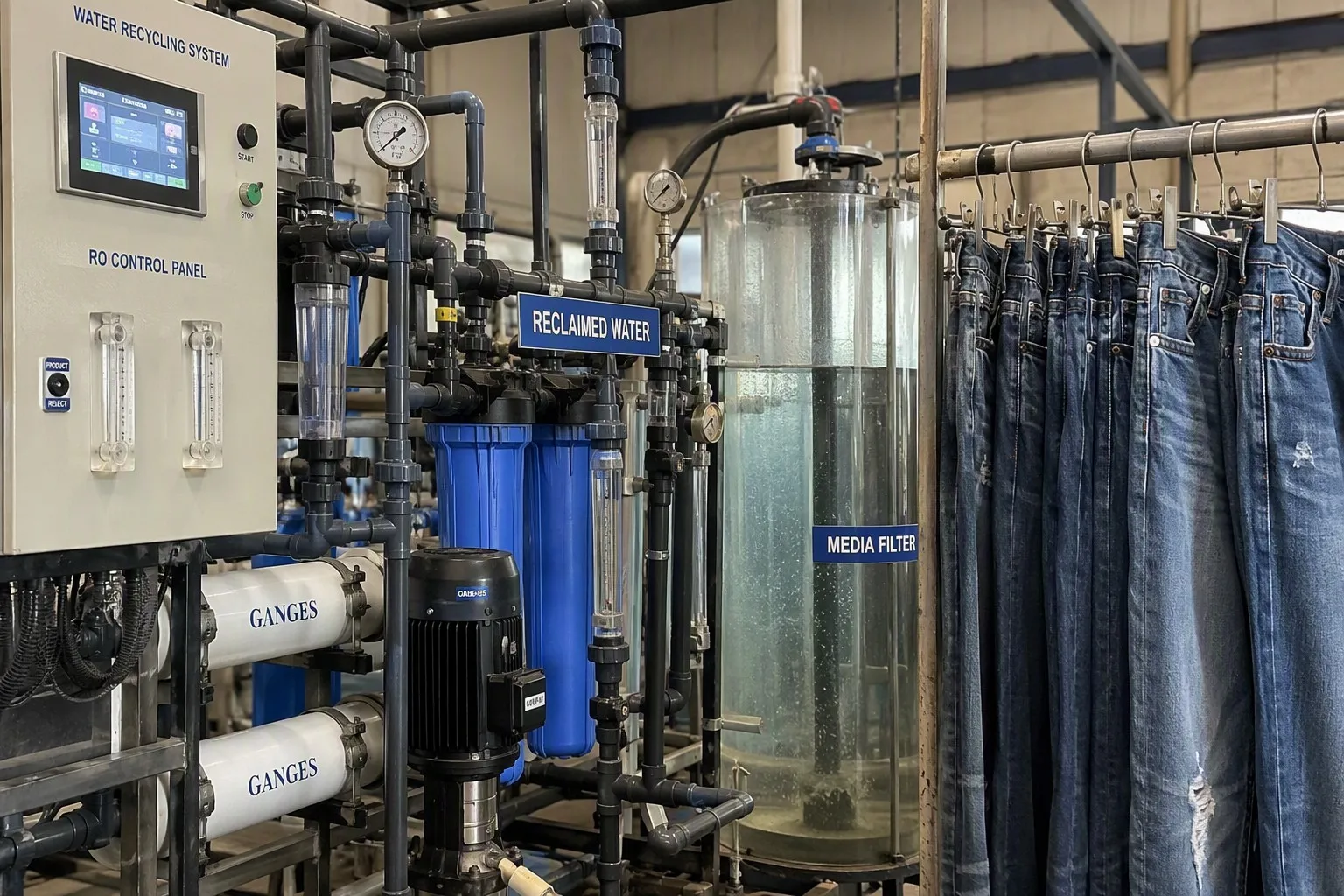
6. The zero-chemical route — and its boundaries
The most ambitious end of eco finishing is a zero-chemical or near-zero-chemical route: a wash that reaches the target look with little or no added finishing chemistry, supported by a water recycling system. This is a real capability, not a slogan — laser and ozone do their work physically rather than chemically, and a fabric that is already close to the target state may need no chemistry at all to finish.
But the route has hard boundaries, and stating them is the difference between an honest partner and a greenwashed one. Zero chemistry is not available for every product. It depends on four things moving together:
- The fabric — its weight, construction, and how it responds to physical finishing.
- The dyeing — how the indigo is fixed and how it releases under ozone or laser.
- The target wash — how deep and how localized the effect needs to be.
- The equipment — the specific laser, ozone, and water systems available on the line.
A fabric that will not fade cleanly under ozone, or a finish that needs a chemical assist, simply does not qualify. The correct statement is not “we can zero-chem anything.” It is: for suitable fabric, dyeing, and wash targets, a zero- or near-zero-chemical route can be designed and combined with water recycling to cut the impact further.
This boundary is not a weakness. It points back to where the route actually gets decided — and that is the discipline in a sentence.
7. Why eco washing starts at the fabric, not the wash
The zero-chemistry boundary reveals the deepest principle in this entire subject: a jean’s environmental route is largely determined before it ever reaches the wash. The wash can only optimize what the fabric and dyeing allow.
If a brand decides it wants a sustainable jean and only asks its supplier about washing at the end, it has already lost most of the available levers. The fabric choice, the dyeing system, the construction — those set the range of finishing routes that are even possible. A fabric dyed in a way that will not release under ozone forces the wash back toward chemistry. A fabric chosen specifically to respond to laser and ozone opens the door to near-zero chemistry.
This is why professional eco washing is a design-stage discipline, not a wash-stage rescue. It belongs in the same conversation as fabric selection, because the two are one decision. Treat them as one decision and you get a sustainable product that still looks the way it was supposed to. Bolt “eco” onto the wash at the end and you get a compromise — and a story that does not survive inspection.
7.1 The design-stage decision, in practice
If the eco route is decided at the fabric, a brand’s first conversation with a supplier should cover three things before any wash is discussed. First, the fabric: is it a construction that responds to physical finishing, and how is it dyed? Second, the target wash: how deep is the fade, and how much of it is localized distress versus all-over color removal? Third, the intended claim: is the brand telling its customer “organic,” “clean production,” “low water,” or all three — because each claim points to different documentation.
Answer those three first and the finishing route largely writes itself. Skip them and the wash becomes a rescue mission, where the supplier is asked to make an un-eco fabric look sustainable with a machine — the greenwashing trap this whole discipline exists to avoid. The design stage is not just the earliest point in the chain; it is where the sustainability of the finished jean is actually won or lost.
8. A real client, without overclaiming
Eco washing stops being a concept when a real sustainability-led brand puts it into production. SkyKingdom’s work with Nest Designs — a Vancouver-based Canadian brand for babies and children built explicitly around sustainability, using bamboo, natural fibers, and GOTS-certified organic cotton — is one such case. The brand’s materials program is the proof of its positioning; it publishes its fabric and certification standards rather than treating sustainability as a marketing layer.
What that cooperation demonstrates is a fit: a brand whose customer is willing to pay for sustainability, working with a supply partner that can speak the language of lower-impact finishing. What it does not demonstrate — and what no one should claim — is that the relationship exists because of eco washing. That would be overclaiming. The honest statement is narrower: this is a sustainability-driven brand with which SkyKingdom has real production experience, and that experience is the ground on which the eco capability is being built out.
Overclaiming a client relationship is a fast way to lose it. The value of Nest Designs here is not as a trophy; it is as evidence that the eco finishing discussion happens with brands whose entire business depends on getting sustainability right.
9. Certifications: honesty over badges
Certifications are where eco denim claims most often go wrong. A supplier that prints GOTS, OEKO-TEX, ZDHC, and bluesign on one brochure is usually telling you nothing, because a certification is only meaningful when it is tied to a specific factory, a specific scope, and a valid expiry date. A badge without those three details is decoration.
The honest position for a denim partner is different: certification and testing documentation can be matched to the project’s actual requirements through qualified supply-chain partners, subject to the scope of the project and independent verification. If a brand needs GOTS organic content, the documentation must cover that. If it needs ZDHC-aligned chemistry, the chemistry must be verified against that standard. The supplier’s job is not to wave a wall of logos; it is to produce the right documentation for the right requirement.
This is less satisfying than a list of badges, which is exactly why it is more trustworthy. A brand should prefer a partner that asks “what does your project actually require?” over one that answers “we have everything.”
9.1 What the common certifications actually cover
Part of why “matched to project requirements” is the right framing is that the common standards do different jobs, and a brand needs the one that matches its claim.
- GOTS covers organic content and processing — the textile itself, from fiber through finishing. It matters when the claim is “organic cotton.”
- OEKO-TEX (such as STANDARD 100) is about testing for restricted harmful substances — that the finished product is safe against skin. It matters when the claim is “free of restricted chemicals.”
- ZDHC is about chemical management in manufacturing — that the chemistry used in production is free of substances on a restricted list, and that wastewater is managed. It matters when the claim is “clean production.”
A jean can be GOTS-certified without being ZDHC-aligned, and vice versa, because they certify different things. A brand that knows which claim it is making can ask for the right documentation. A brand that does not will collect badges and miss the point.
10. Where the capability stands — and what is missing
It is honest to describe eco washing at SkyKingdom as a capability with real foundations and a data layer still under construction, rather than either a finished proof or a pure slide.
Three layers exist today. The first is technology: laser, ozone, nano-bubble, low-water, stone-free, and water recycling routes are available in the finishing supply chain, and the technical lab approach to developing a wash applies to the eco routes the same way it applies to any complex finish. The second is measurement: EIM gives the program a score, not just a description. The third is practice: a sustainability-led brand is already in production.
What is missing is the per-order record. How much water did this specific program save, on this specific jean, in this specific run? What was the EIM score, and what changed it? Those numbers exist only once they are systematically captured — which is the next phase of the work, and the phase that turns a credible capability into a provable one.
The honest label for the current state is therefore not “unproven” and not “fully proven.” It is: capability present, customer practice underway, quantified evidence being structured. A buyer should treat the capability as real and the per-order numbers as something to confirm on their own program, rather than something to copy from a brochure.
11. How to evaluate an eco denim partner
Most of the disappointment in eco denim comes from buying claims instead of routes. Five checks separate a real eco capability from a green brochure.
- Ask for the route, not the adjectives. For your target wash, which technologies — laser, ozone, nano-bubble, low-water, stone-free — would the supplier use, and in what sequence? A specific answer means they have thought about your jean; “we use eco machines” does not.
- Ask for the EIM score, not the slogan. Can they produce a scored finishing recipe across water, energy, chemical impact, and worker health? A number beats a claim every time.
- Ask about the zero-chemistry boundary. A partner who says zero chemistry is available for “everything” is less credible than one who explains which fabric, dyeing, and wash combinations qualify. The boundary is the tell.
- Ask where the eco decision starts. Does the supplier raise fabric and dyeing at the design stage, or only talk about washing at the end? The former is the sign of a partner who understands the problem.
- Ask for certification with scope and expiry. Which factory, which standard, which scope, until when? A badge without those three details is decoration.
A supplier that answers all five clearly is one you can put a sustainability claim in front of your own customer and defend. That, in the end, is what the brand is actually buying: not a wash, but a defensible story. The five checks do not require technical expertise — a team that has never run a wash line can still tell the difference between a supplier who answers in routes and scores and one who answers in adjectives.
12. Summary
Eco denim washing is not a single technology and not a single claim. It is a routing discipline: define the target look, then select the combination of laser, ozone, nano-bubble, low-water, stone-free, and recycling steps that reaches that look with the least water, chemistry, and energy. The look leads; the impact follows.
What makes the discipline credible is measurement. EIM turns “eco” from an adjective into a scored recipe across water, energy, chemical impact, and worker health — and produces a process-level record a brand can quote. What makes it honest is the willingness to state boundaries: the roughly 70% water and 65% chemical figures are industry capability numbers, not per-order promises; zero chemistry depends on fabric, dyeing, effect, and equipment together; and certifications mean nothing without a factory, a scope, and an expiry.
The deepest point is the one most buyers miss: the eco decision is made at the fabric, not at the wash. A brand that wants a sustainable jean has to make that choice with its supplier at the start, not rescue it at the end. SkyKingdom already produces for a sustainability-led childrenswear brand, and the lesson runs the other way too: a product that starts eco stays defensible and still looks the way it was meant to.
Sustainable denim, done properly, is the same finish on a lighter route. The look does not change; the machinery behind it does, and the numbers get measured instead of guessed.