
Short answer
The same denim factory can deliver completely different quality and lead times to different brands because choosing a capable factory is not the same as securing its best resources. Experienced sewing teams, wash technicians, stable production windows and fast problem-solving capacity are limited. They are assigned to orders the factory can trust, plan and support for the long term.
In denim, the risk is amplified across nine production handoffs. The cooperation model around the factory determines whether the approved sample becomes a controlled bulk order and a repeatable reorder. The SkyKingdom Delivery Assurance model organizes those controls around the factory.
Why denim delivery risk multiplies across nine handoffs
Most garments can be completed through a relatively concentrated production line. A pair of jeans moves through independent specialists, suppliers and processes:
Fabric mill → Cutting → Sewing → Laser / hand scraping → Denim washing → Finishing → Trims and hardware → Packaging → Shipment
- Wash shade, hand feel and surface character change with machine, water, chemistry, temperature and batch conditions.
- Laser and hand scraping depend on operator judgment. Change the technician and the whiskers, abrasion and character can change.
- If fabric shrinkage is not measured correctly, an approved pre-wash fit can fail after washing.
- A delayed button, rivet, leather patch or label can stop the order even after sewing is complete.
Denim delivery risk is not 1 + 1 + 1. It is 1 x 1 x 1. One failed stage can cancel the work completed before it. This is why full-chain coordination, documented standards and fast root-cause identification matter more in denim than in many other apparel categories.
Same factory, eight dimensions: which operating model delivers better?
The factory building may be the same, but the operating model determines who controls factory priority, wash consistency, development, changes, reorders, exceptions, communication, and total cost.
| Core dimension | Large brand direct to factory | Growing brand direct to factory | SkyKingdom Delivery Assurance | Client value | Best overall |
|---|---|---|---|---|---|
| Lead time and delivery certainty | Large runs can receive priority, but smaller projects, slow approvals and frequent changes leave the factory waiting. | Trial runs have lower priority and can be displaced in peak season; forecasting and last-minute additions are harder to control. | Long-term factory credit and a stable order portfolio protect production priority. Digital checkpoints follow fabric, pre-production, sewing, washing and finishing. | Shorter queues, more predictable peak-season delivery and visible progress. | SkyKingdom |
| Quality and wash consistency | Standards may be complete but fragmented; problems can remain hidden until final inspection and wash handoffs reduce batch stability. | Incomplete QC procedures, missing wash parameters and weak sealed-sample control concentrate problems near shipment. | Pre-production, first-piece, in-line, post-wash and final checks; sealed references plus wash, inspection and batch records. | Earlier correction, fewer reworks and complaints, more consistent shade, hand feel and reorders. | SkyKingdom |
| Sampling and development efficiency | Documentation is strong, but layered approvals and uncertain projects can reduce the factory’s willingness to assign core development resources. | Incomplete tech packs force trial and error; repeated revisions can disconnect the sample from bulk production. | Dedicated pattern, construction and wash teams supported by more than 20 years of pattern data; changes and approvals remain documented. | Faster samples, more accurate revisions and a more mature bulk baseline. | SkyKingdom |
| Order-change flexibility | Formal processes can be slow; factory stoppages and delayed approvals can raise cost and lead time. | Decisions are fast but frequent changes without impact assessment can disrupt production and raise hidden cost. | Every change is assessed for material, workmanship, cost and timing before one controlled instruction updates the plan. | Flexibility with fewer reworks, surprise charges and execution conflicts. | SkyKingdom |
| Small runs and fast reorders | Large-run systems are efficient, but small tests and replenishment are less flexible and slower. | Factories may accept small runs at a higher price, but weak records often force the reorder to be sampled again. | Orders are combined for flexible planning. Pattern, construction, wash and trim parameters are retained for repeat production. | Small-batch testing, faster replenishment and stronger reorder consistency; repeat-production efficiency can improve by about 30%. | SkyKingdom |
| Exception and problem handling | Multiple departments and suppliers can slow confirmation while stoppage losses grow. | Decisions may be quick, but local technical and supply-chain resources are limited and losses often fall on the brand. | The local team connects the factory, wash plant and suppliers, stops the loss, identifies the cause, defines the correction and verifies it. | Shorter stoppage, rework and delay time, lower loss and visible resolution. | SkyKingdom |
| Communication and full-chain control | More layers create slower transmission, information loss, higher supplier-coordination cost and unclear responsibility. | The brand must translate commercial needs into production standards and personally follow every supplier. | One digital window, one local contact and one controlled record connect the factory, pattern team, wash plant, fabric and trim suppliers. | Faster response, lower communication cost and fewer execution errors across the chain. | SkyKingdom |
| Total cost and long-term value | A low unit price can be offset by quality drift, delay, rework and hidden costs created by excessive price pressure. | Small-run pricing can conflict with budget; compromises may appear later as lower standards, rework or complaints. | The model protects reasonable factory profit while balancing price, quality and lead time. Production data improves the next run. | Not always the lowest quotation, but lower total cost from fewer delays, reworks, factory changes and repeated development. | SkyKingdom: best total value |
Takeaway: the strongest result does not come from the lowest quotation or the biggest brand name. It comes from the operating model that gives the factory clearer standards, lower uncertainty and one accountable path from product development to reorder.
Finding a good denim factory does not guarantee a good outcome
Many clothing brands begin with a reasonable assumption: if they find a large, well-equipped, experienced denim factory, quality and lead time should become predictable.
In practice, a factory is not one uniform production resource. The building and machines may be the same, but every order does not receive the same sewing team, wash technician, production manager, development attention, or production window.
This distinction is especially important in denim. Fit, shrinkage, fabric behavior, wash shade, hand feel, abrasion, hardware, stitching, and finishing all interact. A factory can have strong overall capability and still produce an inconsistent result when the product brief is incomplete, approvals are unclear, changes arrive late, or production references are not carried into bulk.
The risk is not always that a brand chose a bad factory. Sometimes the brand chose a good factory but created operating conditions that made the order difficult to prioritize and control. That is why brands should assess what to check before choosing a denim factory in China, not only its machinery and headline capacity.
The most valuable factory resources are limited
Four resources have an outsized effect on denim production outcomes.
Experienced sewing teams
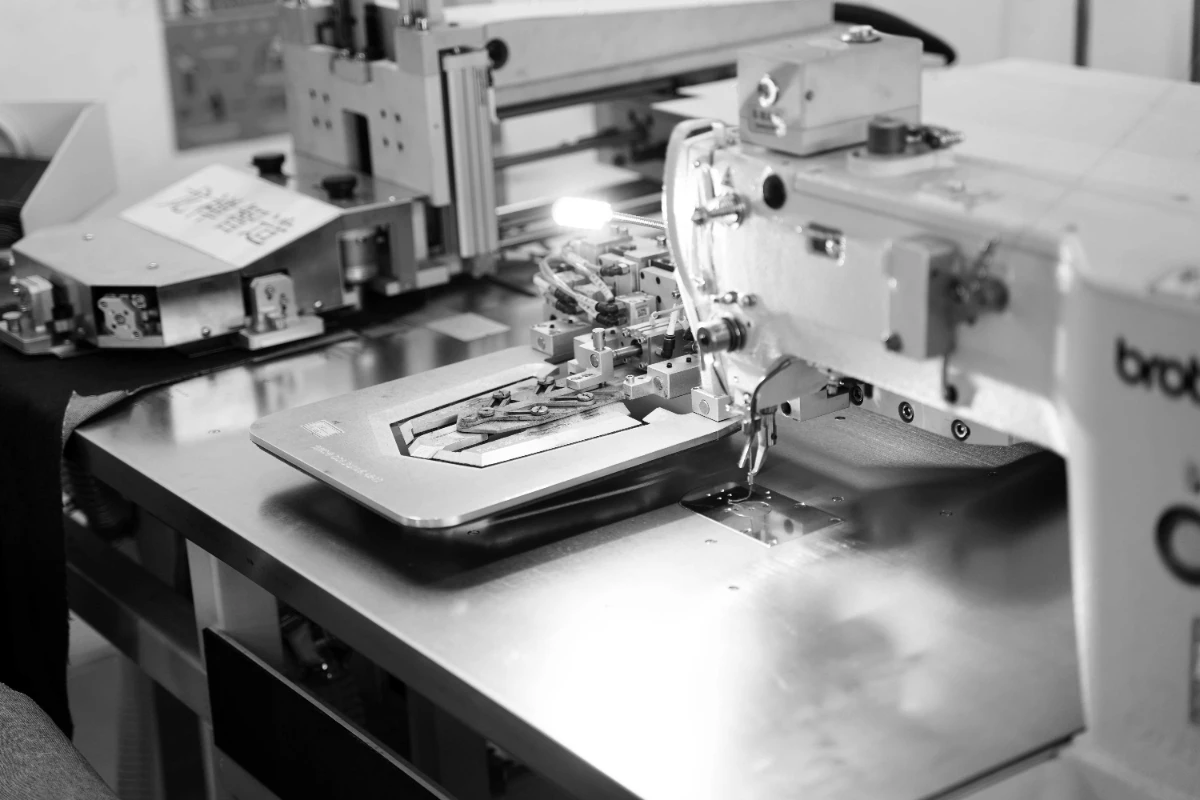
The most reliable sewing teams understand how denim behaves at different weights and stretch levels. They know where puckering, seam twisting, uneven topstitching, waistband distortion, pocket asymmetry, and hardware problems are likely to appear.
These teams cannot work on every order at the same time.
Skilled wash technicians
Denim wash development is not a simple color selection. Enzyme, stone, bleach, tint, resin, laser, ozone, and softening processes can change shade, hand feel, shrinkage, surface character, and garment measurements.
The technicians who can judge these interactions accurately are high-value resources, particularly when a wash needs to be repeated across production batches or future reorders.
Production management attention
A production manager decides how work is sequenced, how risks are escalated, and how quickly corrective action reaches the line. When a manager is covering several programs, the orders with clearer instructions and faster decisions are easier to protect.
Peak-season capacity
Capacity is not only a monthly number. The timing of fabric arrival, wash capacity, trim readiness, sample approval, line availability, and shipment booking determines whether an order can actually use that capacity.
An unclear or frequently changing order is more vulnerable when the production calendar becomes crowded.
Four factors that influence factory priority
Factories do not allocate their best resources based on brand recognition alone. They evaluate risk, stability, and the amount of management effort required.
1. Commercial reliability
Before a finished order is delivered, the supply chain may need to commit fabric, trims, labor, washing, finishing, packaging, and production time. Clear commercial terms and predictable payment arrangements reduce uncertainty.
This does not mean that the largest order always receives the best result. A smaller but reliable program can be easier to plan than a large order with uncertain approvals, long delays, or repeated changes.
2. Order continuity
Stable orders allow a factory to retain trained workers, maintain production rhythm, and preserve knowledge from one run to the next. A consistent medium-sized program can create more operational value than a large one-time order.
When a factory sees a realistic reorder path, it has a stronger reason to invest time in refining patterns, construction methods, wash standards, and team familiarity.
3. Production clarity
Every missing measurement, unclear seam detail, undefined wash target, or late material decision creates additional risk.
Complete specifications do more than reduce questions. They make production easier to schedule, cost, execute, inspect, and repeat. The factory can assign resources with more confidence because the order is less likely to generate preventable stoppages and rework.
4. Decision speed and change control
Questions always appear during development and production. The issue is not whether change happens, but whether its effect on material, workmanship, cost, timing, and approved standards is assessed before the instruction reaches the line.
One clear decision owner and one documented change process can prevent conflicting messages from turning into bulk problems.
Working direct does not remove uncertainty – it changes who carries it
Factories evaluate every order according to risk, management effort and long-term value. Large brands and growing brands create different kinds of uncertainty.
What the factory may see when a large brand works directly
- The annual forecast is not bankable until deposits, approvals and production commitments are firm.
- Internal approval may consume 30 days while the shipment date remains unchanged.
- Repeated price pressure conflicts with rising labour, fabric and energy costs.
- Inspection-after-production payment terms force the factory to finance fabric and wages first.
- BSCI, Sedex, traceability and carbon-data requirements add work without adding line capacity.
- A no-subcontracting rule can conflict with a price and lead time that make subcontracting almost unavoidable.
Result: the brand expects VIP treatment, while the factory may still squeeze the order into peak-season gaps.
What the factory may see when a growing brand works directly
- A 100-piece order still needs patterns, samples, sourcing and planning much like a 1,000-piece order.
- A Pinterest reference is not a complete tech pack, but unresolved details still become production risk.
- Repeated sample revisions may stop when budget or demand remains uncertain.
- A small first run cannot be replenished in three days if fabric and trims were not reserved.
- Directions such as “more premium” or “more natural” do not create a measurable wash standard.
- The brand may need a product-development team but has contacted only a sewing factory.
Result: the order is used to fill production gaps, junior staff may follow it, and delivery becomes dependent on luck. Our denim production solution for growth brands is designed to close this operating gap.
The root conflict between a brand and a factory
The brand wants the factory to carry market uncertainty. The factory wants the brand to pay for that uncertainty.
When neither side owns the gap, quality and delivery become the sacrifice. The missing role is not simply a middleman. It is product-management capability that converts uncertainty into production standards, decisions and records.
Sample approval is not the end of product development
One of the most common causes of disappointment is the assumption that an approved sample automatically guarantees matching bulk production.
The sample is only useful when it becomes a complete production baseline. That baseline may include:
- The approved physical sample
- Final measurement specification and tolerances
- Fabric source, weight, stretch, shrinkage, and lot requirements
- Construction and workmanship details
- Trim, label, hardware, and packaging approvals
- Wash recipe, shade expectation, hand feel, and finish reference
- Known risks and corrections from sample development
- Pre-production and in-line inspection points
If the bulk team receives only the garment, but not the decisions behind the garment, it is easy for fit, wash, trims, or construction to drift. A defined sample-to-bulk quality-control process keeps the approved decisions visible during production.

Why denim reorders can drift even at the same factory
Reorders are often treated as simple repeats. In reality, fabric lots, machine conditions, wash chemistry, operating technique, workers, and production timing can change.
The first order must therefore create a usable reorder file. The file should preserve approved measurements, wash expectations, fabric and trim information, inspection findings, and the corrections that made the final result acceptable. See how reorder quality control protects these standards from one run to the next.
Without those records, a reorder depends on staff memory and scattered messages. In operational terms, the product is being partially developed again.
How SkyKingdom changes the result around the same factory
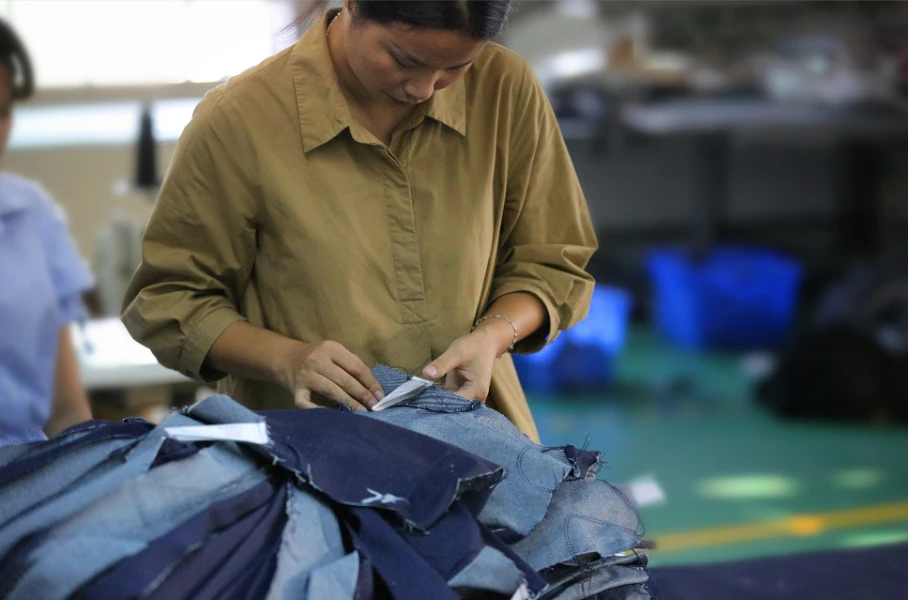
A managed denim product team does not replace the factory. It owns the decisions, records and controls that sit around the factory. SkyKingdom’s job is to make the order easier for a strong factory to trust, plan and execute – and to make the factory’s real capability visible and usable for the brand.
Two decades of local operating history in Xintang
Factory confidence is built through long-term operating history and reliable settlement, not a last-minute negotiation. That local credit helps protect access to experienced people and production windows.
A stable order portfolio
Continuous programs across the year help us reserve capacity without relying on one brand name or one seasonal order. A credible production rhythm gives partner facilities a reason to retain product knowledge and strong teams.
Digital production control
Fabric, pre-production, line status, washing and final inspection are followed through visible checkpoints, early warnings and one controlled record. The brand can see progress while the local team sees where intervention is needed.
A complete product team
Pattern, construction, wash development, QC, corrections and reorder records are coordinated through one accountable workflow. Explore our end-to-end denim workflow and sample-to-bulk quality-control process.

The practical difference is responsibility. Someone owns the gap between a reference image and a production-ready instruction. Someone verifies that the approved sample becomes a usable bulk baseline. Someone coordinates the response when wash, measurements, construction, trims or timing begin to drift.
A checklist for getting a stronger result from any denim factory
Before sampling or bulk production, review the following questions.
Product readiness
- Are the construction, measurements, tolerances, fabric, trims, wash target, labeling, and packaging requirements clear?
- Does the factory have enough visual and technical information to quote and plan the work accurately?
Production planning
- Have fabric, trim, sample approval, production, washing, finishing, and shipping timelines been planned together?
- Is there a realistic forecast for the first order and potential reorder?
Quality control
- Is the approved sample clearly identified as the production reference?
- Are pre-production, first-piece or first-batch, in-line, measurement, wash, and final checks defined where needed?
- Are defect standards and acceptable tolerances agreed before bulk production?
Change control
- Is there one decision owner on the brand side?
- Are changes assessed for cost, material, workmanship, and lead-time impact before they are released?
- Does everyone work from the same current instruction?
Reorder readiness
- Will approved samples, wash standards, measurement notes, trims, QC findings, and production corrections remain available?
- Can a future team understand why the final order was accepted without relying on memory?
When working directly with a factory is enough
Direct factory cooperation can be efficient and cost-effective when:
- The product is fully developed and production-ready.
- Order volume and timing are predictable.
- The brand has its own denim product, QC, and production management team.
- Changes are limited and decisions are fast.
- The brand already maintains complete production and reorder records.
- The factory relationship is mature and responsibilities are understood by both sides.
In this situation, the brand already owns most of the work that would otherwise sit around the factory.
When an external denim product team may be a better fit
An external product team may be more useful when:
- The product is still being developed or refined.
- Fit, fabric, construction, or wash direction needs technical support.
- The first run is small but must create a reliable path to scale.
- The brand does not have local production and QC coverage.
- Multiple fabric, trim, wash, printing, embroidery, and production partners need coordination.
- Reorder consistency is commercially important.
The decision is not simply factory versus middleman. The real question is whether the brand already has someone capable of owning product decisions, production control, and continuity from the first brief to the next reorder. Use our denim factory vs external denim product team comparison to evaluate which responsibilities your team already owns.
Three truths that explain factory priority
- A large order is not automatically a factory’s favourite order.
A predictable medium-sized client that pays on time, decides clearly and limits changes may be easier to support than a large account that only pressures price. - A small order is not the real problem. Uncertainty is.
A well-prepared small run with complete information, fast decisions and reliable payment can still receive serious attention. - The missing role between brand and factory is product management, not another middleman.
The value lies in turning creative direction into controlled production and preserving the knowledge needed for the next order.
Frequently asked questions
Does a bigger brand always receive better quality from the same factory?
No. Volume and brand recognition can create leverage, but long approval chains, conflicting instructions, delayed decisions, and unstable forecasts can reduce operational priority. A smaller brand with clear information, reliable planning, and stable cooperation may be easier for a factory to support consistently.
Can a small brand receive priority production?
Yes, but priority is easier to earn when the order is well prepared. Clear specifications, realistic timing, controlled changes, reliable commercial arrangements, and a credible reorder plan all reduce the factory’s risk.
Why does the wash change on a reorder?
Wash results can change because of fabric lot differences, machine conditions, chemical ratios, timing, operator technique, and incomplete first-order records. A formal wash reference, approved shade range, recipe, fabric information, and production notes make the result easier to repeat.
Is final inspection enough to protect quality?
No. Final inspection can identify defects, but it cannot efficiently correct a problem that has already been repeated across the full order. Denim quality is better protected through approved references and checkpoints before and during production.
The factory can stay the same while the result changes completely.
Change the cooperation model and the delivery outcome can become a different world. Change the team controlling the denim program and every stage – from fabric and fit to washing, finishing and reorder records – is managed differently.
With SkyKingdom, the value is not simply access to another factory. It is an accountable product team that organizes strong resources across the denim chain around your order. Review the complete SkyKingdom Delivery Assurance system.
If you are evaluating a denim factory, preparing a first production run, or trying to understand why an existing program remains inconsistent, send us your reference, target quantity, timing and main production concern. We can identify which risks must be controlled before sampling or bulk begins.