Most suppliers describe rapid development as “faster sampling.” That framing misses the point. A fast sample only matters if the supply chain behind it can also move fast — and if the development itself is not stuck in a queue. Rapid development is a lane, not an accelerator.
How fast can SkyKingdom develop a first denim sample?
Standard development completes a first sample in about 7 days. Through the VIP development lane, the target is 3 days. The clock starts only after fabric, pattern, and the necessary development information are confirmed and pattern-making formally begins.
What is the VIP development lane?
A dedicated team that handles development for qualifying clients, removing the queueing and scheduling delays of a normal pipeline, so the front end can keep pace with a 15–22 day production and reorder chain.
When does the sample development clock actually start?
From the moment fabric, pattern, and required development materials are fully confirmed and pattern-making formally begins — not from the moment a brief is first submitted.
Does faster sampling mean lower quality?
No. The speed comes from removing queueing and scheduling delays and running a dedicated team, not from skipping steps. Pattern, cutting, sewing, washing, and internal confirmation all still happen.
How is rapid development different from quick response reorders?
Rapid development covers the front end — brief to first sample. Quick response reorders cover the back end — re-producing a proven style in 10, 15, or 22 days. They are linked: a fast lane only matters because a fast production chain already exists behind it.
What does a brand need to prepare before rapid development starts?
A clear brief, the reference, and decisions on fabric, trim, fit, sizing, tech pack, and wash. The faster these are confirmed, the sooner the clock formally starts.
1. Faster sampling is not the product
A denim brand rarely buys “a sample.” It buys a working prototype of a product it hopes to sell, and it needs that prototype fast because the market window it is chasing will not wait. The instinct is therefore to ask the supplier one question: “How fast can you sample?”
The question is reasonable and also incomplete. A factory can answer “three days” and still leave a brand waiting two weeks, because the delay was never in the sewing. It was in the queue — the development request sitting behind other requests, waiting for the pattern room, the cutting table, the wash schedule. Speed in a factory is not a property of the sewing machine. It is a property of how work is routed, and whether any capacity is reserved for the work when it arrives.
Rapid development, done properly, is the removal of that queue. It is a dedicated lane with its own team and its own scheduling, opened to clients who meet certain conditions, so a development that would otherwise wait in line can start when it needs to start. That is a structural difference, and it is the only reason a “days” figure means anything at all.
1.1 Fast sampling vs. rapid development
The two terms sound interchangeable and are not. Fast sampling is a normal development pipeline with urgency applied to it — the request is marked important, pushed up the queue, and rushed through the same shared pattern room and cutting table. It is faster, but only as fast as a shared queue allows, and it competes with every other “urgent” request for the same capacity.
Rapid development is a different structure. It is a separate lane with a dedicated team and reserved scheduling, so the work does not compete for capacity at all — it has its own. The comparison matters because urgency is fragile and structure is not. A factory running on urgency is only as fast as its quietest week; a factory running a dedicated lane is fast as a matter of design.
| Fast sampling (urgency) | Rapid development (structure) | |
|---|---|---|
| Team | Shared pipeline | Dedicated team |
| Scheduling | Pushed up a shared queue | Reserved for the lane |
| Speed | Varies with factory load | Consistent by design |
| What it buys | One faster sample | A lane that runs into production |

2. The chain behind the claim
Rapid development at SkyKingdom is not a service that was invented for a sales page. It exists because the production engine behind it already runs on a fast clock. The quick response reorder capability turns proven styles around in 15 to 22 days, and reorders in 10, 15, or 22-day tiers. A production chain that fast cannot be fed by a slow front end; the development speed has to match the production speed, or the whole system stalls at the first step.
This is the part most descriptions of “fast sampling” leave out. A supplier that samples in three days but then needs 45 days to produce has not helped a fast-fashion brand; it has simply moved the bottleneck. Rapid development only delivers value as one half of a pair — a fast front end wired to a fast back end. The two belong to the same system.
2.1 The bottleneck that moves
A brand chasing a trend has a fixed amount of time between spotting the trend and needing stock on the shelf. That window is spent in two places: getting a sample, and getting production. Shortening only the first half does not open the window; it just reallocates the waiting.
This is why a “days to sample” number, quoted in isolation, can be actively misleading. It looks like the headline metric, but the metric that actually determines whether a brand catches the market is the full arc from idea to delivered stock. A supplier with a three-day sample and a 45-day production run gives the brand the same missed window as a supplier with a two-week sample and a 45-day run — the sample just arrives earlier and sits there.
Rapid development therefore has to be evaluated against the chain behind it. The reason SkyKingdom’s development lane can promise days instead of weeks is precisely that a 15–22 day production and reorder chain already exists behind it, so the fast front end is not a promise that dies at the handoff. The two halves were built to match.
3. The development chain, step by step
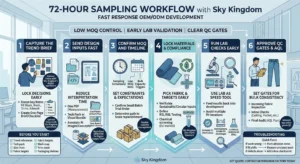
The path from an idea to a first sample has more steps than most brands see, and the honest way to describe rapid development is to show them all. The chain runs:
Customer brief → requirement clarification → fabric and trim confirmation → pattern, sizing, and tech pack confirmation → wash and finish confirmation → development materials ready → formal pattern-making (the clock starts) → paper pattern, cutting, sewing, washing → internal confirmation → first sample complete → client confirmation → handoff to quick production and reorder.
Two things in that chain deserve attention. First, the clock starts at formal pattern-making — after the brief, the fabric, the fit, and the finish have all been locked. Everything before that point is preparation, and its speed depends partly on how quickly the brand confirms its own decisions. Second, the chain does not end at the sample. It ends at the handoff into production, which is why rapid development is described as a lane that runs from development into production, not a one-off sample rush.
3.1 Why none of the steps can be skipped
A shortcut-minded factory will look at that chain and try to compress it by skipping confirmations — jump straight to cutting, leave the wash loosely specified, sort the fit out later. The result is a sample that arrives fast and means little, because it was built on unconfirmed decisions and will have to be remade against the decisions that eventually arrive. Skipping confirmation does not save time; it moves the time to the revision round, where it costs more.
Each confirmation in the chain exists to make sure the sample and the eventual bulk order are the same product. Requirement clarification prevents building the wrong direction. Fabric and trim confirmation prevents a sample in one fabric and an order in another. Pattern and sizing confirmation prevents a fit that has to be redeveloped. Wash and finish confirmation prevents the most expensive revision of all, because wash is the last stage and the hardest to redo.
Rapid development gets its speed from removing the queue, not from removing the confirmations. The confirmations are the product’s integrity. A brand should be suspicious of any “fast” process that skips them, because the speed it is being offered is the speed of building the wrong thing.
4. Where the clock actually starts
The single most important honesty point in any “days” claim is where the count begins. A supplier that says “sample in three days” while counting from the day the sewing machine first touches fabric is not lying, but it is not telling a brand anything useful either — because the brand’s real wait includes the pattern work, the fabric confirmation, and the queue before the machine ever starts.
SkyKingdom’s timelines all start from the same point: when the fabric, the pattern, and the necessary development materials are fully confirmed, and pattern-making formally begins. “About 7 days” and “3-day VIP target” both mean the same thing — the measured work, from the start of pattern-making to a completed first sample.
This is why the phrasing “a brief submitted today becomes a sample in three days” is deliberately not used. It is not true, and no honest supplier should say it. The correct statement is: once development conditions are confirmed, the VIP lane targets a three-day development sample. The distinction is the difference between a number a brand can plan around and a number that evaporates on contact with reality.
4.1 The two clocks
Every development actually runs on two clocks, and most confusion comes from merging them. The brand clock starts the moment a brief is sent and includes everything the brand has not yet decided — fabric, fit, wash, tech pack. The development clock starts at formal pattern-making, after those decisions are locked. The gap between the two is not supplier slowness; it is the brand’s own preparation time.
This is not a trick to hide delay. It is the opposite — it is a way to show the brand where its own time goes. A brand that sends a complete brief with fabric, sizes, and wash already decided will see the development clock start almost immediately. A brand that sends a photo and the words “make it like this” will spend days or weeks in clarification before the real clock ever starts, and will then wonder why “3 days” turned into three weeks.
An honest supplier states its development clock and also names the preparation that feeds it. That way the brand can plan around the full arc, and can see that the fastest way to speed up a sample is usually to finish its own homework before it sends the brief.

5. The two tiers: standard and VIP
Rapid development runs at two speeds, and they should be stated precisely rather than as a single blurred promise.
| Lane | First sample | What it means |
|---|---|---|
| Standard development | About 7 days | Normal development pipeline, from formal pattern-making to completed first sample. |
| VIP development lane | 3-day target | A dedicated team with its own scheduling, from formal pattern-making to completed first sample. |
Two qualifiers keep this honest. The 7-day figure is an “about” — a normal expectation, not a contract term. The 3-day figure is a target, not a guarantee; complex constructions, unusual washes, or a pattern that needs multiple revisions will push it. Neither number counts the preparation before pattern-making begins, because the preparation depends on how fast the brand confirms its own decisions.
6. What the VIP lane actually changes
The VIP lane does not make sewing machines faster. Machines already sew at machine speed. What it changes is routing: instead of a development request joining a shared queue, it is picked up by a dedicated team whose only job is development, with reserved scheduling for pattern, cutting, sewing, and wash.
The queue is the real enemy of speed in a factory, and it is invisible from the outside. A brand sends a brief and hears nothing for a week, and assumes the factory is slow, when in fact the factory was busy finishing someone else’s order. A dedicated lane removes that wait by design. The work still takes as long as the work takes; it just no longer sits behind other people’s work before it starts.
The queue is also not one queue but several, stacked. A development request in a normal pipeline waits for the pattern room, then waits for the cutting table, then waits for the sewing line, then waits for the wash schedule — and each wait is a separate handoff where the request re-enters a line behind other people’s orders. The dedicated lane collapses that into one continuous run by the same team, which is where the days actually come from. It is not that any single operation is faster; it is that the work stops stopping.
This lane is open to clients who meet certain conditions — typically brands with an established order foundation and an ongoing relationship — because reserving a dedicated team is a real cost, and it only makes sense when there is enough volume behind it to justify the reservation.

7. What has not been measured yet
Two numbers would make rapid development a fully quantified product, and neither exists yet in structured form: first-pass rate and on-time development rate. SkyKingdom can describe the capability and the mechanism, but it cannot yet quote a percentage for how often a first sample passes on the first round or how often the timeline holds.
That honesty matters. A brand comparing suppliers will be told impressive percentages by most of them. A supplier that refuses to invent the number is doing the brand a quiet favor, because the number it will eventually publish will have come from a system that records every development — clients entering the VIP lane, average development days, the 3-day target hit rate, first-pass rate, sample-to-order conversion, order value, and reorder rate. That is the measurement plan, and until the data exists, the capability is described in mechanisms and targets, not statistics.
7.1 Why the mechanism matters even without percentages
A missing statistic does not mean a capability cannot be evaluated. A brand can verify rapid development the way it would verify anything else in a factory: with a trial, not a brochure. Send one brief, complete and decided, and watch what happens. Does the supplier confirm the development conditions first? Does it name the moment the clock starts? Does the sample arrive in the stated window, and does the handoff into production follow without a stall?
Those observations test the mechanism directly, and the mechanism is observable in a way a percentage is not. A percentage is a claim about history; a mechanism is a claim about how the work is routed, and a brand can see it happen on its own order. The percentage will matter later, when the recording system has accumulated enough runs to earn it. Until then, the honest test is behavioral: does the supplier behave like it has a dedicated lane, or like it is rushing your order through a shared queue?
8. How the three front-end products divide the work
Rapid development is easy to confuse with two neighboring products, and the confusion is worth clearing up because a brand often needs all three in sequence.
Rapid development turns an idea into a first sample. Small-batch production turns that sample into a limited run to test the market without committing to volume. Quick response reorders turn a proven winner into fast replenishment. One is the front of the idea, one is the first money on the line, one is the reorder machine — and they hand off to each other in that order.
A brand that only buys rapid development gets a sample and no way to test it. A brand that only buys small-batch production gets a test run and no fast way to scale a winner. The three are pieces of one pipeline, which is why the development lane is described as running “into” production rather than stopping at the sample.
8. What speed is actually worth to a brand
It is easy to treat development speed as a convenience — a nicer experience, a shorter wait. It is more useful to see it as money, because for a brand in a fast-moving market, the speed of the front end compounds through the whole business.
The first effect is the market window. A trend has a season, and a season has a peak. Every week lost in development is a week the product is not on sale during the weeks when it would have sold at full price. A brand that samples in three days and produces in twenty is testing and reordering inside the same window that a slower competitor is still waiting for a first sample.
The second effect is inventory risk. The faster a brand can develop and test, the smaller the bet it has to place before it knows what sells. A slow development cycle pushes a brand to buy bigger upfront, because it cannot afford to reorder mid-season. A fast cycle lets the brand test small, learn, and reorder winners — which is the difference between holding stock that sold and holding stock that did not.
The third effect is cash. Cash tied up in a development that drags on is cash that is not earning. A shorter development arc shortens the distance between spending on design and receiving revenue on sales. None of this shows up in the “days to sample” figure, but all of it is what that figure is really for.
9. What a brand should prepare before development starts
Because the clock starts at formal pattern-making, a brand controls the single largest variable in its own timeline: how fast the preparation gets done. The preparation is a short, concrete list.
- A clear brief — the reference, the intended market, and the price band.
- The fabric and trim, decided or narrowed down.
- The fit and sizing, including any base pattern or size spec.
- The tech pack, or enough detail to build one.
- The wash and finish, decided or at least bounded.
Every item on that list that is still open when the brief arrives is a delay the supplier cannot control. The fastest development relationship is one where the brand treats confirmation as its own job, not the factory’s. The technical detail of fit and wash lives in the technical lab, but the decisions that unlock it live with the brand.
10. Common mistakes brands make
Four errors show up repeatedly when brands buy “fast development,” and each one is avoidable with a small shift in how the question is asked.
Treating the 3-day target as a 3-day guarantee. The target is exactly that — a target for a lane that removes the queue, not a promise that every construction, wash, and revision will land in three days. A brand that plans its calendar on the target and is surprised by a complex revision has misread what was offered. The correct posture is to treat the target as the expected case and to keep complex styles on the standard clock.
Asking about sampling speed and nothing else. A three-day sample feeding a forty-five-day production run is a headline with no body. The question that matters is the full arc: how fast from idea to delivered stock, and does the supplier’s production chain match its development claim. A brand that asks only the first question optimizes the wrong variable.
Counting preparation time against the supplier. The days a brand spends deciding its fabric, fit, and wash are not supplier delay, and no supplier can recover them. A brand that logs “three weeks to sample” without subtracting its own decision time is measuring its own indecision as if it were the factory’s fault. The fix is to treat confirmation as a task with an owner and a deadline.
Ignoring the conditions on the VIP lane. The lane is reserved capacity, and reserved capacity is only justified when there is real, ongoing volume behind it. A brand that expects the fast lane on its first, unproven order is asking for a reservation it has not yet earned. The honest path is to build the relationship first, and let the lane follow the volume.
11. How to evaluate a rapid development partner
When a brand is choosing between suppliers that all promise “fast sampling,” a short set of questions separates the ones with a mechanism from the ones with an adjective.
- When does your clock start? A supplier that cannot name the start point — and names it as formal pattern-making, not “when we receive the brief” — is not measuring anything real.
- Who does the work, and is anyone reserved for it? A dedicated team with reserved scheduling is a lane; a shared pipeline with an “urgent” flag is a queue with a sticker.
- How fast is your production behind the sample? The development number only matters in proportion to the production number. Match them or the bottleneck just moves.
- What is your first-pass rate? The most honest suppliers will answer that they do not have it structured yet — and that honesty, compared with a made-up percentage, is itself a signal.
- Can I test it with one order? A supplier confident in its mechanism will invite the trial. A supplier confident only in its brochure will not.
None of these questions requires technical expertise. They require attention to structure — who is reserved, when the clock starts, and whether the front end is wired to a fast back end. That structure, not the day count printed on the price list, is what rapid development actually is.
The deeper value of a lane is certainty. A brand that knows its development will start when it needs to start, and finish inside a stated window, can plan its buying, its launch, and its cash around that certainty. A brand that is always guessing when its sample will arrive is not just slower — it is forced to hold more safety stock, place bigger speculative bets, and hedge every date on the calendar. The lane converts an unpredictable wait into a scheduled event, and that conversion is worth more than any single day saved. It is why rapid development, when it is real, is bought as infrastructure rather than as an add-on — because the brand is not buying speed, it is buying the removal of uncertainty.
12. Summary
Rapid development is a lane, not a rush job. It exists because a 15–22 day production and reorder chain needs a front end that moves at the same pace, and it works by removing the queue — reserving a dedicated team for qualifying clients so development can start when it needs to.
The honest numbers are these: standard development completes a first sample in about 7 days, and the VIP lane targets 3 days — both measured from formal pattern-making, after the fabric, pattern, and development materials are confirmed. First-pass rate and on-time rate are not yet published, because they are not yet measured; the mechanism is real, and the statistics will come when the recording system has run long enough to earn them.
A brand that needs denim product fast should stop asking “how fast do you sample” and start asking “when does your clock start, and who is reserved to do the work when it arrives.” The answer to those two questions tells you more than any day count.
Speed, in the end, is a consequence of structure. Get the structure right — a dedicated team, a clear clock, and a front end matched to a fast production chain — and the days take care of themselves.