Small quantity. No compromise on product. That is the whole proposition — and it is the opposite of what “low MOQ” usually means.
What is small-batch denim production?
Making high-value, high-complexity, limited-quantity denim — roughly 50 to 300 pieces — to the same quality and craft standard as volume production, for products that do not fit mass production because of their low quantity.
How is small-batch different from ordinary low MOQ?
Ordinary low MOQ reduces inventory risk and tests the market cheaply. Small-batch produces high-complexity, high-quality work at low quantity — premium, designer, luxury, and limited-run — where the client accepts a higher unit cost and cares about craft, not price.
What quantity qualifies as small-batch denim?
Roughly 50 to 300 pieces. The actual starting quantity depends on fabric, wash, construction, trims, complexity, and supply-chain conditions, so it is assessed per product rather than quoted as a fixed MOQ.
Why does small-batch denim cost more per piece?
Fixed costs — pattern, cutting setup, machine setup, wash trials, special trims, QC, and management — stay nearly constant whether a run is 50 pieces or 1,000, so on a small run they spread across fewer units. Small-batch is not a low-cost solution, and it is not sold as one.
How is small-batch different from rapid development and quick response?
Rapid development turns an idea into a sample fast. Quick response reorders a proven style fast. Small-batch produces a high-value, high-complexity product in limited quantity to a full standard. Three different tasks.
Which brands should use small-batch denim production?
Premium, designer, and luxury labels, capsule collections, limited editions, and high-end denim with complex washes, special fabrics, or special trims — where quantity is small but the standard is not negotiable.
1. This is not low MOQ
“Small batch” has become a euphemism for low MOQ, and low MOQ has become a euphemism for “buy less and risk less.” The framing is so common that most brands now read “small batch” and hear “cheap way to test the market.” This article is about a different thing, and the distinction matters because it leads to a different factory, a different price, and a different product.
The ordinary low-MOQ buyer is a startup or a DTC brand that wants to test a style without committing to volume. The goal is to lower the financial bet. The product is usually a standard style, the price sensitivity is high, and the supplier’s job is to accept a smaller order without much fuss. That is a legitimate business, but it is not small-batch denim production.
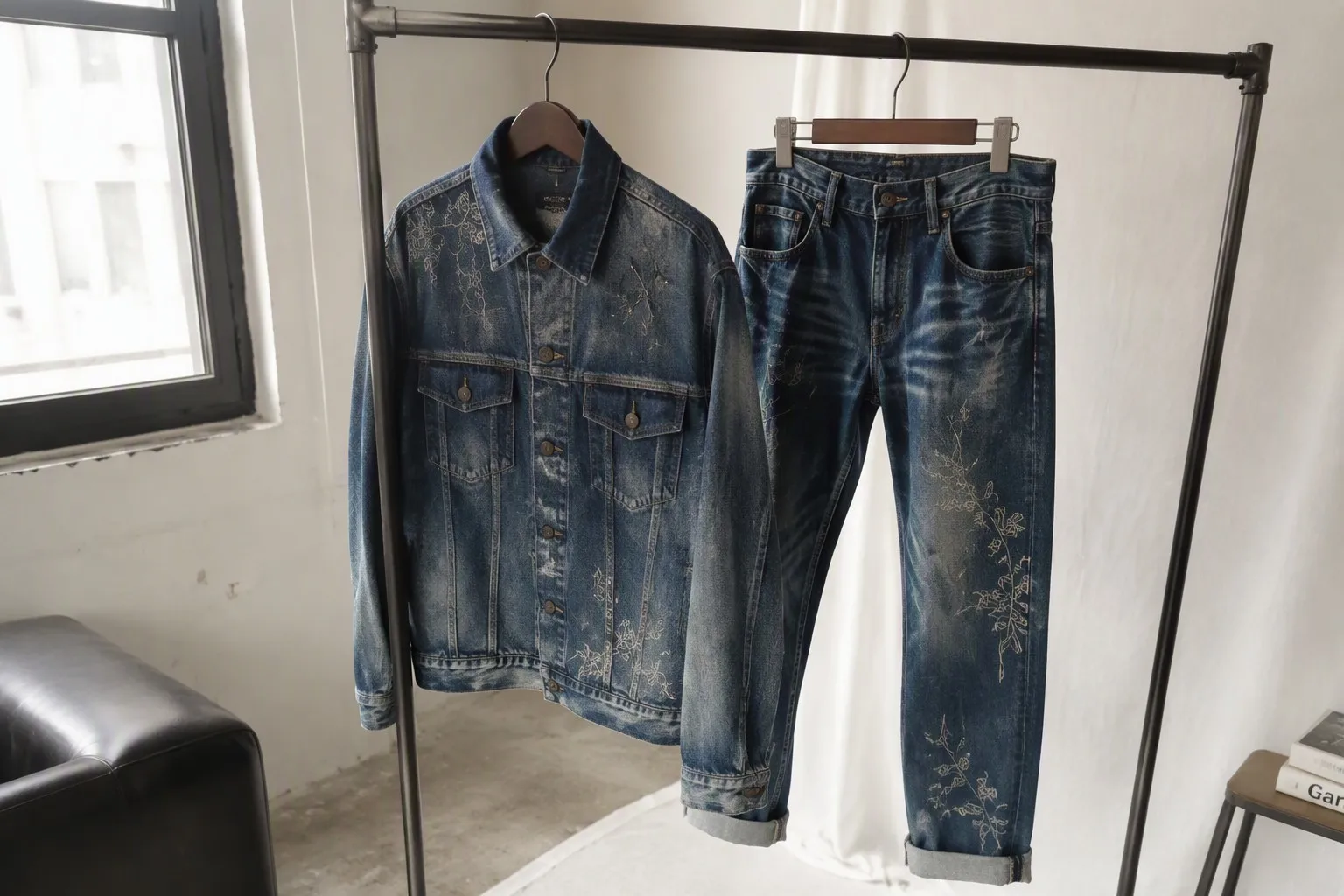
Small-batch denim, the way SkyKingdom practices it, serves the opposite customer. A premium label with a capsule collection. A designer with a limited-edition run. A luxury house with a style so complex — a special wash, a special fabric, a special trim — that it will never sell in thousands, and would collapse in a mass-production line. These clients are not trying to risk less; they are trying to make something good in a quantity that ordinary factories will not touch. The product is the point. The quantity is the obstacle. The capability is making the product anyway.

2. The proposition in one line
The cleanest statement of the value is: small quantity, no compromise on product. Not “small quantity, cheaper.” Not “small quantity, lower your risk.” Small quantity, and the same — or higher — standard of craft, wash, construction, and finish that a volume order would get.
This matters because most factories define their willingness to serve a client by the size of the order. Below a certain quantity, the math stops working, and the factory either refuses the order or quietly lowers the standard — cheaper materials, a faster wash, a looser QC — to make the small order worth its while. The brand that accepts that trade has bought a compromise and may not know it until the bulk of a “premium” line arrives looking ordinary.
A real small-batch capability refuses that trade. It holds the standard and absorbs the difficulty of holding it. The client pays more per piece, and gets the same product a large order would have received. The value is not financial efficiency. The value is that a high-standard product exists at all, at a quantity where most of the industry would have said no or delivered less.
2.1 Why “lower inventory risk” is not the point
A small run can, as a side effect, reduce how much stock a brand carries. That is true and almost irrelevant. When small-batch is framed around inventory risk, it attracts the wrong client, sets the wrong price expectation, and buries the real value.
The wrong client is the startup shopping for a cheap way to test the market — a legitimate need, but not this product, and one that will be unhappy with the unit cost of a high-standard small run. The wrong price expectation is “less quantity means a better deal,” which is backwards for the fixed costs involved. The buried value is the actual point: at a quantity where the rest of the industry refuses the order or quietly lowers the standard, someone still makes the product properly. That is a capability worth naming, and it has nothing to do with how much stock the client holds.
2.2 The inventory benefit is real, just secondary
None of this is to deny that a small run carries less stock risk. It does, and for a brand that would otherwise buy a season’s worth of a style it is not sure will sell, that is a genuine benefit. The point is only that the benefit is secondary, and leaning on it flips the product into the wrong category.
For the client small-batch actually serves — the premium label, the capsule collection, the limited edition — the inventory logic is different anyway. A limited run is meant to be scarce; holding less stock is not a hedge against a bad bet, it is the point of the product. The brand is not afraid of overstocking; it is producing exactly the quantity the product deserves. To sell that client on “lower inventory risk” is to speak a language it does not need, while skipping the one thing it came for: a product made to standard at a quantity the rest of the industry refuses.
3. Two different kinds of “small”
The clearest way to see the difference is side by side.
| Ordinary low MOQ | SkyKingdom small-batch | |
|---|---|---|
| Client goal | Hold less inventory, test the market | Produce a high-value, complex, limited product |
| Price sensitivity | High | Low — higher unit cost is accepted |
| Product | Standard styles | High-end denim, complex washes, special trims |
| Client | Startup / DTC | Premium / Designer / Luxury / Capsule |
| Supplier’s core job | Accept a low MOQ | Hold volume-grade craft at low quantity |
One is a concession on quantity. The other is a capability that holds quality when quantity falls. They share the word “small,” and almost nothing else. A brand should know which one it is actually shopping for, because choosing the wrong frame is how a designer ends up with a luxury product made to a budget standard.
4. Who actually needs this
Small-batch denim production exists for products that fail the economics of scale, not for brands that simply prefer to order less. The typical situations:
- Premium, designer, and luxury labels whose entire model runs on limited production.
- Capsule collections — a handful of styles, released once, never reordered.
- Limited editions where scarcity is part of the value, and volume would destroy it.
- High-end denim with complex washes, special fabrics, or special trims that ordinary lines will not touch.
- High craft complexity at small quantity — the work where a factory must still invest in pattern, wash trials, and finish even though the run is short.
What unites these is not the size of the order but the size of the standard. The client is not asking “how little can I order.” The client is asking “who will make this properly even though I can only order a little.” That is a question about capability, and it has a different answer than “who will take a low MOQ.”
4.1 A category the industry already recognizes
This is not a niche SkyKingdom invented. The high-end small-batch category exists in the established supply chain, and the names in it describe the same value from different angles. CFDA’s production directory lists studios that define themselves around high-end, limited-run, couture and designer work, producing in the 10–50 and 50–100 piece bands — with complex design translation, handwork, sampling, and limited production as the core offer. Italian high-end studios frame small batch the same way: capsule collections, exclusive ranges, and limited runs, sold on craftsmanship, precision, and luxury rather than on price.
The existence of those studios proves the demand and, more usefully, proves what the demand is for. The client is not a cost-cutter. The client is someone with a product that will not survive mass production, and a standard it is not willing to lower. The supplier’s job is to carry the complexity at a quantity that makes the economics awkward — which is precisely the job a volume factory declines.

5. Why ordinary factories say no
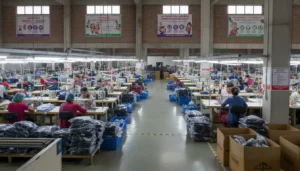
Most factories do not refuse small orders out of arrogance. They refuse them because the factory’s economics are built on volume, and a small order spends the same fixed costs as a large one while returning a fraction of the revenue. The pattern maker, the cutter, the wash technician, the QC inspector — each of them touches a 100-piece order for roughly the same time they would touch a 1,000-piece order. The factory earns from the 1,000 pieces, not from the touch.
Denim makes this sharper than most categories, because the fixed costs are stacked in layers. Fabric has its own minimum, and a special fabric may have a high one. The wash has a setup cost — starting a machine, dialing in a color, running trials — that does not shrink with the order. Special trims carry their own minimums. Then there is machine setup, a dedicated QC pass, and the plain inefficiency of a line that stops and starts for a short run. On a large order these spread thin. On a small order they sit on top of a few dozen pieces.
So a factory that does the honest math on a 50-piece premium order will usually conclude the order is not worth the disruption. It then has two choices: decline, or take the order and quietly cut corners to make the math work. The brand, in turn, has two outcomes: no product, or a product made to a lowered standard. Small-batch production exists to be the third option — a setup that is deliberately organized to absorb the fixed costs and still deliver the standard, because it treats the difficulty as the job rather than as an inconvenience.
5.1 What the capability actually involves
Holding a high standard at low quantity is not a policy decision; it is a set of deliberate practices, and they are worth naming because they are what the client’s higher unit cost pays for.
The pattern work is done in full — a proper paper pattern and grading, not a shortcut sample. The fabric and trims are sourced against the product’s actual requirements, including small-quantity minimums that have to be met or negotiated. The wash is developed and trialed as if the run were large, because a limited run with a distinctive wash lives or dies on that wash. The construction follows the full process, and the QC pass is dedicated to the run rather than folded into a larger inspection queue. Each of these is a place where a volume factory saves money by skipping or thinning the step, and each is a place the small-batch capability deliberately does not.
The result is that a 50-piece run receives the same engineering attention as a 5,000-piece run, with the cost concentrated accordingly. It is the reverse of the usual factory logic, and it is why the capability cannot be bolted onto a volume operation as an afterthought — the practices run against the grain of how a volume factory is organized.
6. Why it costs more, stated plainly
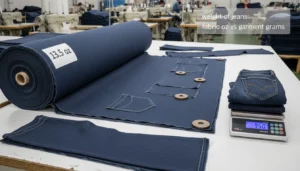
Small-batch denim is not a low-cost solution, and it should not be sold as one. The per-piece cost of a small run is higher for a reason that is easy to understand once the fixed costs are visible. Pattern development, cutting setup, wash trials, trim sourcing, dedicated QC, and production management cost roughly the same whether the run is 50 pieces or 1,000. On a 50-piece run, those costs divide across 50 units; on a 1,000-piece run they divide across 1,000.
The industry reflects this. Public sourcing examples put a 100-piece jean run in the range of roughly $45–60 per piece, while a 1,000-plus run lands nearer $20–28 — not a SkyKingdom quote, but a working illustration of how sharply quantity moves cost. Smaller runs of 50–150 pieces can run 50% to 100% above the per-unit cost of a 300-plus run, and denim, with its fabric minimums and wash setup, sits at the sharper end of that range.
This is the part a brand should hear early, because it reframes the entire decision. The question is not “can I get this cheaper in small quantity” — the answer is no, and a supplier that says otherwise is hiding the compromise somewhere in the product. The real question is “will the supplier still invest the full pattern, wash, and QC effort into a small run, and can I price the product to carry the higher unit cost.” Small-batch is bought by brands that can, because the product’s value supports it.
6.1 A high price is not a markup; it is the cost, honestly shown
Two kinds of high small-batch pricing look similar and mean opposite things. The first is the honest cost: the fixed work of pattern, wash, trims, and QC divided across fifty units, reported plainly. The second is a subsidy that will not last — a supplier quoting a low small-run price to win the order, then recovering the loss inside the product later, or disappearing after the first run.
A brand can usually tell them apart by how the supplier talks. The honest supplier volunteers that the unit cost will be high and explains the fixed costs behind it. The subsidizing supplier downplays cost and promises “small-batch pricing” that sounds like a deal. The first is selling a capability; the second is selling a discount it cannot afford to honor.
The practical lesson is counterintuitive but reliable: in small-batch, a supplier that is upfront about a higher price is more trustworthy than one that is not. The higher price is the evidence that the fixed work is actually being done. The suspicious number is the low one.
7. What quantity counts as small-batch
SkyKingdom can take on small-batch projects in roughly the 50 to 300 piece range. That is a range, not a single number, and the reason is the same layering that drives the cost: the actual starting quantity depends on the fabric, the wash, the construction, the trims, the product’s complexity, and the supply-chain conditions behind it.
This is why “MOQ = 50 pieces” is deliberately not used as a blanket claim. A simple style in an available fabric may start at a lower quantity; a complex wash on a special fabric may need more, because the wash setup and the fabric minimum set a floor of their own. The honest statement is that small-batch work in the 50–300 piece range is supported, and the specific starting quantity is assessed against the product itself.
The same honesty applies to lead time. Small-batch is not the 15–22 day quick-response pipeline; a limited run with a complex wash or a special material moves at the pace the product requires, not the pace a reorder can hit. A brand should expect the timeline to be quoted per product, not assumed.
8. Where small-batch sits among the other products
Small-batch is easy to confuse with two neighbors, and the three should be held apart because a brand may need them in sequence — or may need only one.
| Product | Client task | Core capability |
|---|---|---|
| Rapid development | Turn an idea into a product fast | VIP lane, ~3-day sample target |
| Small-batch production | My quantity is small, but the standard is high | High craft and complexity held at low quantity |
| Quick response reorders | It is selling; replenish fast | Mature fast reorder chain |
One is speed, one is quality at low quantity, one is replenishment. A designer might use rapid development to sample a capsule piece, then small-batch to produce its 80-unit run, then never reorder at all — and that is the correct use of all three, because a limited edition has no reorder to chase. Small-batch is not “the test run before you scale.” It is the production model for products that are not supposed to scale.
8.1 Why it stands as its own capability
Small-batch earns its place in the product line because it solves something the other products do not: a high-value product whose quantity is too small to enter a normal mass-production system. Rapid development solves speed, quick response solves replenishment, and neither answers the client who says “I only need eighty, but they have to be right.”
It is also distinct from complex craftsmanship, even though the two frequently overlap. Complex craftsmanship is the ability to develop and reproduce difficult washes and construction; small-batch is the ability to hold any required standard at a quantity too small for a volume line. A limited run often needs both — a complex product, made in low quantity — and that combination is exactly where the two capabilities meet. But they are separable, and a brand can need one without the other.

9. What is measured, and what is not
Small-batch is a capability SkyKingdom can describe precisely, and it is also a capability whose performance history is not yet structured into numbers. There is no published “expansion conversion rate” and there will not be one soon, because that metric misses what small-batch is for. A luxury client may order 100 pieces of a style once a year and never reorder — and still be an excellent client, because the value was in the product and the relationship, not in a future volume that was never the point.
The record worth keeping is different: order quantity, product complexity, client requirements, actual delivery cycle, QC results, client acceptance, and whether the client returned. Those fields describe whether a small run was made to standard and whether the client was satisfied — which is the real measure of a small-batch capability. A brand evaluating a supplier can ignore the expansion numbers and ask instead about complexity handled, standards held, and whether past small runs were accepted on first delivery.
9.1 Mistakes brands make about small-batch
Five misreadings recur, and each sends a brand toward the wrong supplier or the wrong expectation.
Treating small-batch as a cheap way to test. The unit cost of a high-standard small run is higher, not lower. A brand that shops small-batch to save money is shopping for the wrong product and will either overpay for the wrong thing or end up with a budget version of a premium idea.
Reading “50–300 pieces” as a fixed MOQ. The starting quantity depends on the fabric, wash, trims, and complexity. A brand that assumes every style starts at fifty will be surprised when a complex wash needs more, and should instead expect a per-product assessment.
Borrowing the 15–22 day lead time. That is the quick-response reorder number, not the small-batch number. A limited run with a special wash moves at the pace the product requires, and the timeline should be quoted for that product, not inherited from a different one.
Judging the capability by reorder rate. A limited edition that never reorders is the point, not the failure. Judging small-batch by how often clients scale up confuses it with the test-run model it is explicitly not.
Assuming small quantity means lower standard. This is the assumption the entire capability exists to overturn. The honest test is not the quantity; it is whether the supplier runs the full pattern, wash, construction, and QC on the small run — and whether the client’s acceptance of the finished product confirms it.
10. How to evaluate a small-batch partner
Because the risk in small-batch is a silently lowered standard, the evaluation questions target exactly that.
- Do you treat the small run with the same pattern, wash, and QC steps as a large one? A supplier that skips steps for small orders is selling a compromise, not a capability.
- Can you name the cost honestly? A supplier that pretends a 50-piece complex run is cheap is hiding the savings inside the product.
- What is the real starting quantity for this specific product? A blanket “50 pieces” is a marketing number; a per-product assessment is engineering.
- How do you handle fabric minimums and wash setup on a short run? The answer reveals whether the supplier has actually solved the fixed-cost problem or is just hoping the client won’t notice.
- Will you quote the lead time per product? A supplier that offers one timeline for everything has not thought about your product.
None of this requires a technical background. It requires noticing whether the supplier treats the small order as a full product or as a favor. The difference is the entire capability.
10.1 The trial run is the only proof that matters
All the questions above can be answered in a brochure, and every supplier’s brochure answers them well. The verification is one small order, watched closely. Place a single small run — the client’s own capsule piece, say eighty units of a style with a real wash — and observe how the supplier behaves on it.
Does the supplier run the full pattern and wash development, or skip to a shortcut sample? Does it flag the fabric minimum and the wash setup honestly, or bury them? Does it quote a timeline for this specific product, or a generic one? Does the QC pass read like an inspection or a formality? The answers show up in the product and in the process, and no amount of case-study language can hide them.
A single small run, done properly, tells a brand more about a supplier’s small-batch capability than any portfolio. It is also the fairest test, because it is the exact work the brand will keep doing. If the supplier treats that first small order as a full product, the relationship is built on the right thing; if it treats it as a favor, the brand has learned something valuable at the cheapest possible scale.
11. Summary
Small-batch denim production is not low MOQ. It is the ability to make a high-value, high-complexity, limited-quantity product to a full production standard — the kind of work a volume factory refuses or quietly degrades. It costs more per piece because the fixed costs of pattern, wash, trim, and QC do not shrink with the run, and it exists for premium, designer, luxury, and limited-run clients who accept that cost because the product is the point.
The proposition is deliberately simple: small quantity, no compromise on product. Everything else — the 50–300 piece range, the per-product MOQ, the per-product lead time, the higher unit cost — follows from that one commitment. A brand that understands the commitment will know exactly what it is buying; a brand that does not will keep comparing it to low-MOQ manufacturing and missing the point.