
Short answer: Outsourced washing causes color variation because indigo is only ring-dyed onto the yarn surface, and the wash is what removes it. When a recipe travels from your factory to an external wash house, dosage, temperature, and timing drift—typically ±10–15%—so each batch sheds a different amount of dye. Without inline monitoring, the drift is only discovered at final inspection, after the shade has already shifted.
Most sourcing teams assume color variation means they picked a bad wash house, and the fix is to find a better one. But the same “good” wash house delivers visibly different shades across repeat orders, even with the same recipe sheet. The real risk is structural: information loss in recipe transfer, parameter drift between runs, and quality control that only inspects finished garments. The better question is not which wash house to use, but how much process control survives once your recipe leaves your building.
The Chemistry: Why Indigo Forgives Nothing
Denim behaves differently from almost every other fabric because of how indigo dyes cotton. In rope or slasher dyeing, the yarn passes through indigo baths and oxidizes in air; the dye builds up in layers on the surface of the yarn while the core stays white. This is ring dyeing. The deep blue you see is a thin, fragile shell of pigment, not a saturated fiber.
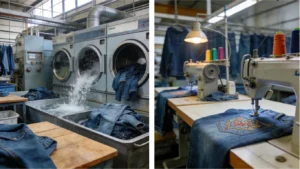
Washing is controlled destruction of that shell. Enzymes, stones, and abrasion strip away surface dye to create the worn look. Here is the critical part: the final shade is not determined by the dye house alone—it is determined by how much of the ring is removed in the wash. A 5% difference in abrasion intensity or enzyme activity does not produce a 5% lighter garment; it produces a visibly different color cast, because you are exposing a different depth of the undyed core.
This is why washing is the single most sensitive stage for shade consistency, and why the stage you outsource is the stage where variation concentrates.
What Actually Happens to Your Recipe in Transit
Follow a typical wash instruction through an outsourced chain:
- Your technician writes the recipe: enzyme 2%, 45°C, 40 min, liquor ratio 1:8, pH 5.5, tumble dry low.
- Merchandising converts it into a PO line: “medium enzyme wash, vintage look, per approved sample.”
- The wash house re-interprets it against their machines: their drum loads 80 kg, not your reference 50 kg; their operator adjusts water by eye, so the 1:8 ratio becomes 1:9; their “45°C” is measured at the inlet, not the drum.
- The batch runs. Nobody records the actual curve—only the wash label on the PO survives.
Each step is reasonable. Each step loses information. By the time the recipe executes, it is a close approximation of your intent, and “close” is exactly what ring-dyed indigo punishes.
Batch Drift: The Math Nobody Writes Down
Even when the first outsourced batch matches your standard, repetition is the harder problem. External wash houses typically run your style between other customers’ loads, on shared machines, with rotating operators. Measured against the nominal recipe, key parameters commonly drift by ±10–15% between batches:
| Parameter | In-house washing (controlled) | Outsourced washing (typical) |
|---|---|---|
| Enzyme dosage (target 2%) | 1.96–2.04% (±2%, weighed per load) | 1.7–2.3% (±10–15%, bulk dispensing) |
| Temperature (target 45°C) | 44–46°C (±1°C, probe in drum) | 41–49°C (±3–5°C, inlet reading) |
| Cycle time (target 40 min) | 39–41 min (timer-locked) | 34–46 min (operator judgment) |
| Liquor ratio (target 1:8) | 1:8 fixed by load cell | 1:6 to 1:10, filled by eye |
| pH (target 5.5) | 5.3–5.7 (±0.2, inline probe) | 5.0–6.0 (±0.5, manual strips) |
| QC checkpoint | Inline every 30 min + final | Final inspection only |
| Resulting shade tolerance | Gray scale 2–3 grades | Gray scale 3–4 grades |
| Documentation | Full technical recipe record per lot | Wash label only |
Takeaway: the same nominal recipe, executed inside a wider envelope, predictably produces a wider shade distribution. A drift of ±10–15% per parameter compounds across five parameters, so batch two of your order is not a copy of batch one—it is a new draw from a wider distribution.
Final QC Cannot Fix a Process Problem
Most outsourced arrangements inspect the way they would inspect stitching: a final AQL audit, typically AQL 2.5 Major / 4.0 Minor per ISO 2859-1. That framework works for defects that are stable once made—a broken seam does not get more broken in the carton.
Shade is different. It is created during the wash cycle, minute by minute. A final audit samples finished garments and answers “is this batch acceptable?” It cannot answer “is the next batch trending off-standard?” By the time a final inspector flags a shade shift, hundreds of garments carry it, and the correction—re-washing—introduces its own additional abrasion and pushes the shade further from the master.
Inline monitoring is the alternative: pulling a garment every 20–30 minutes, reading it against the master standard under D65 light, and adjusting the running batch. This is routine inside a vertically integrated wash facility and rare in a transactional one, because it requires the wash house to treat your recipe as a controlled process rather than a one-off job. It is one of the clearest operational differences in the vertically integrated vs outsourced manufacturing comparison.
The Three-Party Record Problem
Ask a simple question after a shade claim: what exactly happened to this batch? In an outsourced chain, the answer lives in three incomplete places.
- The fabric mill records dyeing data: indigo concentration, dips, oxidation time. It does not record what the wash did.
- The wash house records what it chooses to—often just the wash label: “enzyme stone wash, medium.” A wash label states intent; a technical recipe record documents execution: actual dosage weighed, actual temperature curve, actual pH readings, actual cycle time, machine and operator ID.
- The garment factory records cutting and sewing lots, and which fabric rolls fed which batch.
Nobody holds the full chain. When batch three arrives lighter than batch one, each party’s records are internally consistent and collectively useless: the mill proves the fabric was in-spec, the wash house proves it followed the label, the factory proves it cut the right rolls. The variation happened in the gaps between the records.
This is also where shrinkage quietly enters the dispute. Wash relaxes and compacts fabric; if cycle time or drying temperature drifts, shrinkage drifts with it—often 1–2 percentage points between batches. Patterns graded for one shrinkage value no longer fit correctly after a differently washed batch, so a “color problem” resurfaces as a fit problem two weeks later at QC.
When Outsourced Washing Is Still the Right Call
None of this means outsourcing washing is a mistake. Specialist wash houses often run laser, ozone, and hand-finishing capabilities that a general garment factory cannot justify owning. For fashion-forward finishes, small runs, or a style that needs one specific effect machine, a specialist is frequently the best option.
The distinction is between outsourcing a capability and outsourcing control. Problems arise when the buyer delegates the finish without retaining the specification discipline. If you outsource, keep control of three things:
- Specify the record, not just the label. Contract for a technical recipe record per lot: weighed dosage, logged temperature curve, pH readings, cycle time. If a wash house cannot produce it, the price difference is your risk premium.
- Lock tolerances, not targets. “2% enzyme” is a target; “2% ±2%” is a control. Write the band for every parameter listed in the table above.
- Keep a physical master standard. A signed fabric-and-garment standard at the wash house, read under D65 light, with shade acceptance at gray-scale grade 2–3.
If you cannot audit these three things, the realistic alternative is a partner whose washing sits under the same roof as cutting and sewing—the model behind full-package production—or at minimum, to verify how integrated a factory’s washing actually is before awarding the program.
What This Means for Your Next Repeat Order
Color variation between batches is rarely a mystery and rarely a verdict on any single factory. It is the predictable output of a chain where the most chemically sensitive stage runs with the least instrumentation, monitored only at the end, documented by three parties whose records do not connect.
Shade consistency within tight, controlled tolerances—gray-scale grade 2–3, batch after batch—is achievable in both models. The difference is where the discipline lives: in your specification and audit effort if you outsource, or in the production system itself if washing is integrated. Buyers who understand this stop asking “which wash house is best?” and start asking “who owns the recipe record?”—and their repeat orders stop surprising them.
Frequently Asked Questions
Why do my jeans look different between orders?
The most common cause is parameter drift at an external wash house. A nominal recipe—say 2% enzyme at 45°C for 40 minutes—can drift ±10–15% per run when temperature, liquor ratio, and pH are not locked by instrumentation. Because indigo is ring-dyed on the yarn surface, small abrasion differences remove different amounts of dye and shift the shade.
How to prevent color variation in denim production?
Replace the wash label with a technical recipe record: dosage, temperature band, liquor ratio, pH, cycle time, and drying method, each with a tolerance. Require inline checks every 20–30 minutes instead of final QC only, and set acceptance at gray-scale grade 2–3 against a master standard kept on site.
What causes shade variation between fabric rolls?
Roll-to-roll variation starts upstream in dyeing—indigo concentration, oxidation time, padder pressure—and washing amplifies it. Garments cut from different rolls respond slightly differently to the same wash, so loose wash tolerances turn small roll differences into visible batch differences.
Is outsourced denim washing always lower quality?
No. Specialist wash houses often have better laser, ozone, and hand-finish equipment than a garment factory. The risk is structural, not competence: recipes degrade in transfer, monitoring is final-only, and no single party owns the complete record. Outsourcing works well when tolerances are specified and audited.
What shade tolerance should I write into a denim PO?
For premium programs, gray-scale grade 2–3 batch-to-batch against an approved master, read under D65 light. Grade 3–4 is common in outsourced runs and acceptable at many price points, but it will read as inconsistency if mixed within one delivery.
Why does washing affect garment shrinkage and grading?
Washing relaxes and compacts fabric. When cycle time or drying temperature drifts between batches, shrinkage drifts too—often by 1–2 percentage points. Patterns graded for one shrinkage value no longer fit after a different batch, so shrinkage must be tested per batch and fed back into the grade rule.