
Built upon: What Is Full Package Production (FPP) in Denim Manufacturing?
Short answer: Neither model is inherently better. Vertical integration gives a brand tighter control over wash recipes, color consistency, and reorder baselines — but typically requires higher minimums and longer development cycles. Outsourced manufacturing offers flexibility and lower entry barriers, but shifts quality risk to the buyer’s own QC capability. For denim brands planning reorders, the practical decision depends on how much process control you need versus how much supply chain complexity you can absorb.
Many brands assume vertical integration automatically means better quality. But in denim production, integration only matters if it covers the specific processes that cause batch-to-batch variation — especially washing and finishing. A factory that owns cutting and sewing but outsources its wash room has the same color consistency risk as a fully outsourced operation. The better question is not “integrated or not?” but “integrated across which processes?”
| Factor | Vertically Integrated | Outsourced |
|---|---|---|
| Reorder cycle | 45–60 days typical | 60–90 days typical |
| MOQ range | 300–500 pcs/style | 100–200 pcs/style |
| Shade tolerance | 2–3 color grade steps | 3–4 color grade steps |
| Wash recipe control | Proprietary, digitally locked | Spec sheet; ±10–15% drift |
| Traceability | Single chain of custody | 2–4 independent vendors |
The single biggest operational difference is not cost or MOQ — it is who holds the complete production record when something goes wrong on a reorder.
What “Vertically Integrated” Actually Means in Denim Production
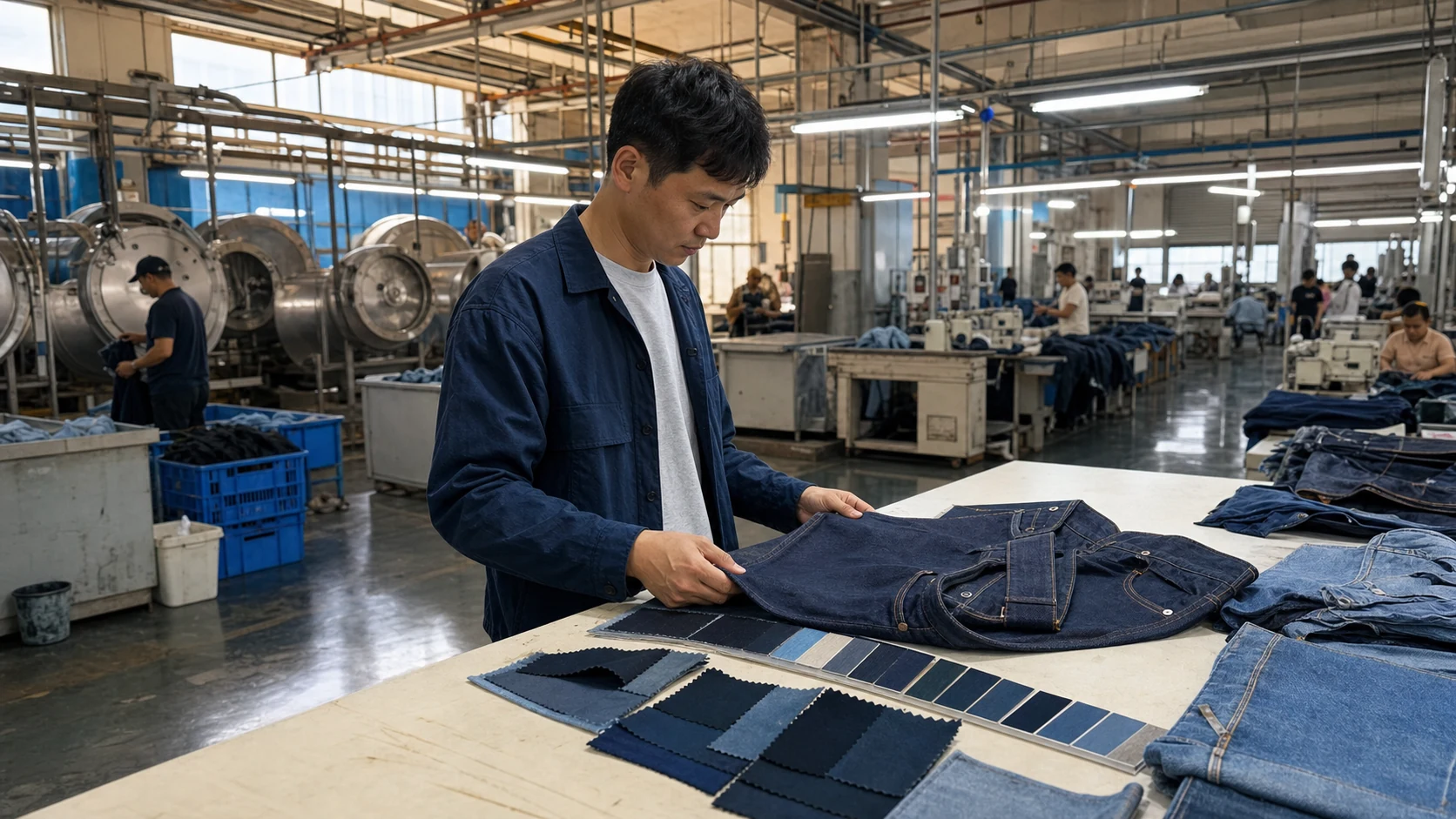
The term “vertically integrated” is used loosely in denim sourcing. At its most complete, it means a single company controls every stage from raw material to finished garment: fabric weaving or knitting, dyeing, washing, cutting, sewing, finishing, and quality control. In practice, very few factories own every stage. Most “vertically integrated” denim operations fall into one of three tiers:
- Tier 1 — Full integration: Owns fabric mill, dye house, wash facility, and garment factory under one management system. Rare; typically large groups with 500+ workers.
- Tier 2 — Process integration: Owns wash facility and garment factory but sources fabric from partner mills. The most common structure among mid-size denim manufacturers in Xintang, Guangzhou and similar clusters.
- Tier 3 — Assembly integration: Owns cutting and sewing only; outsources washing, dyeing, and fabric. This is functionally equivalent to a CMT operation with better marketing language.
The tier matters because the processes that cause the most reorder failures are washing and dyeing, not cutting and sewing. A Tier 3 factory calling itself “vertically integrated” gives you none of the consistency benefits that integration is supposed to deliver.
For a deeper look at how production responsibility is structured, see What Is Full Package Production (FPP) in Denim Manufacturing?
Side-by-Side: Vertical Integration vs Outsourced Manufacturing
The table below compares the two models across the five dimensions that most directly affect a denim brand’s ability to reorder with confidence.
| Dimension | Vertically Integrated | Outsourced |
|---|---|---|
| Lead time control | Single-point scheduling across fabric → wash → cut → sew; reorder cycle typically 45–60 days | Multi-party coordination; each handoff adds 5–10 working days buffer; reorder cycle 60–90 days |
| Color variation risk | In-house wash room locks recipe parameters (cellulase enzyme 2%, temperature 45°C, pH 5.5, liquor ratio 1:8) per production lot | Wash outsourced to third party; recipe communicated via spec sheet; actual parameters may drift ±10–15% between facility visits |
| Reorder consistency | 6-dimension frozen baseline (fabric spec, shade band, wash recipe, shrinkage %, hand feel, AQL level) maintained under one QC management system | Baseline records split across fabric mill, wash house, and garment factory; no single entity holds the complete production passport |
| Cost structure | Higher fixed overhead absorbed into pricing; BOM: Shell 50–70%, Wash 15–25%; MOQ typically 300–500 pcs/style | Each intermediary adds 8–15% margin; lower MOQ possible (100–200 pcs/style) but per-unit cost increases 15–25% at low volumes |
| Problem traceability | Single chain of custody; defects traced to specific machine, shift, and operator via internal lot records; resolution typically 3–5 working days | Root cause analysis requires coordination across 2–4 independent vendors; resolution typically 2–4 weeks |
Takeaway: Vertical integration compresses lead time and tightens color tolerances, but the real advantage is accountability — one entity owns the entire production record.
The Wash Room Is Where Consistency Lives or Dies
If you visit a denim factory and only have time to inspect one area, skip the sewing floor and go straight to the wash room. Washing is the single most chemically complex, parameter-sensitive process in denim production — and the process most likely to cause a reorder that does not match the original sample.
Denim’s characteristic blue comes from indigo ring dyeing, a process where indigo dye penetrates only the outer layers of the cotton yarn, leaving the core white. During washing, mechanical abrasion and chemical treatments (cellulase enzyme, potassium permanganate, stone washing) strip away surface dye to create the desired shade and texture. The final color depends on a precise interaction of variables:
- Enzyme concentration: typically 2% OWG (on weight of goods) for a standard medium wash
- Temperature: 45°C ±1°C for cellulase activity
- Duration: 40 minutes per wash cycle
- Liquor ratio: 1:8 (fabric weight to water volume)
- pH: 5.5 ±0.2 for optimal enzyme performance
A deviation of just 0.5 pH units or 3°C can shift the final shade by one full color grade — enough for a customer to notice the difference between their first order and their reorder.
This is why the wash room matters more than any other department when evaluating vertical integration claims. A factory that owns its wash facility can lock these parameters digitally and enforce them lot by lot. A factory that outsources washing is dependent on a third party’s discipline — and third parties process multiple clients’ lots consecutively, each with different recipes, creating inevitable cross-contamination of parameters.
For a detailed analysis of why outsourced washing causes batch-to-batch color variation, see Why Outsourced Washing Causes Color Variation Between Denim Batches.
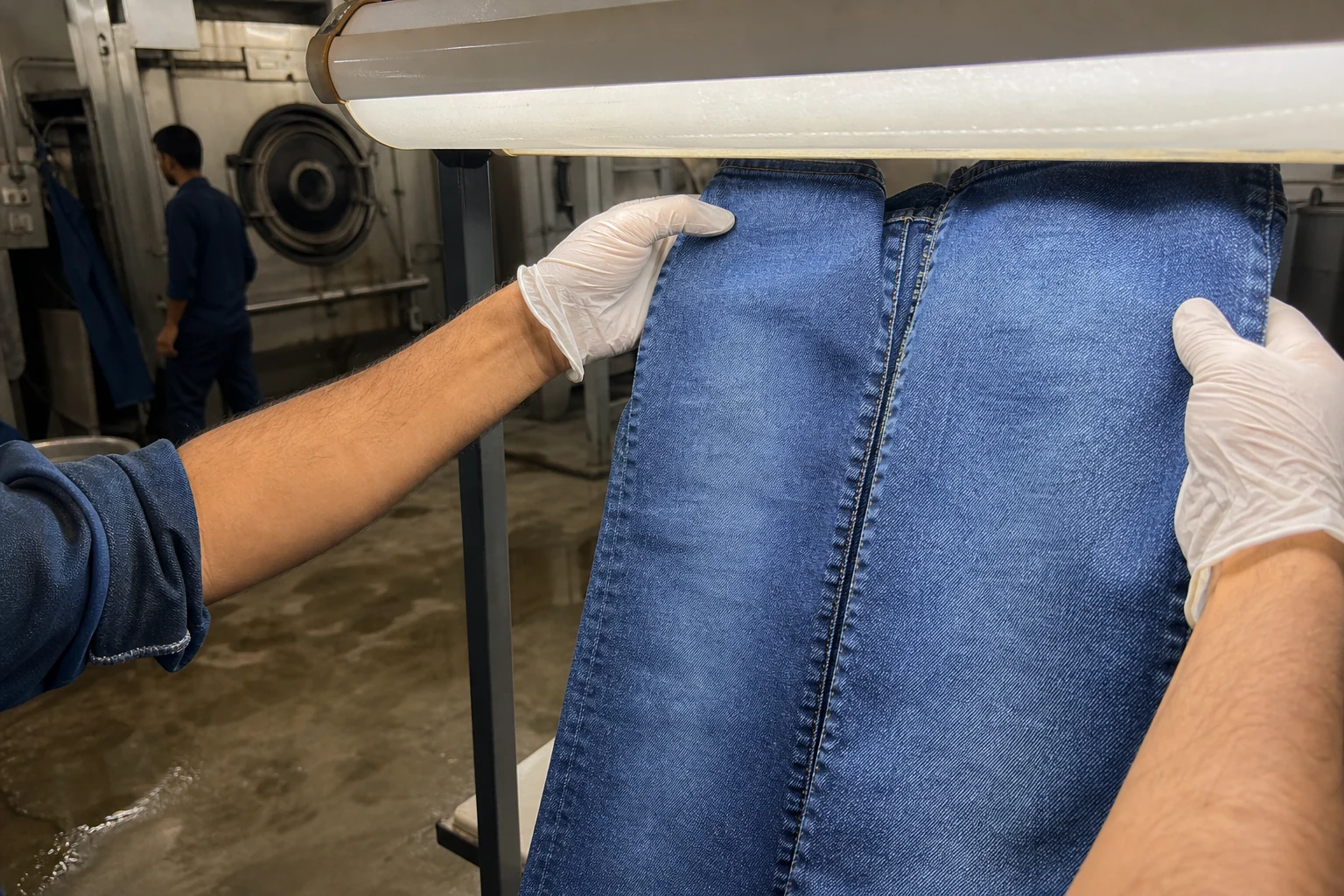
In-House Wash vs Outsourced Wash: A Parameter-Level Comparison
The difference between in-house and outsourced washing is not philosophical — it is measurable in process parameters.
| Dimension | In-House Wash | Outsourced Wash |
|---|---|---|
| Recipe control | Proprietary formulas in digital records; pH 5.5 ±0.2, temperature 45°C ±1°C, enzyme concentration 2% ±0.1%, bath ratio 1:8 | Formula communicated via spec sheet or verbal instruction; actual parameters may deviate ±10–15% between facility visits |
| Batch stability | Inline monitoring every 30 minutes during wash cycle; real-time parameter adjustment | Batch-end QC only; color variation discovered after entire lot completes processing |
| AQL achievement | Inline + final inspection against AQL 2.5 Major / 4.0 Minor per ISO 2859-1 sampling; defect detection rate 95%+ before packing | Final inspection only; post-wash defects require costly rework or lot rejection |
| Turnaround | Wash cycle 40 minutes + 2-hour dry/finish within same facility | Transport to external wash house adds 1–2 working days per direction |
| Shade tolerance | Maintained within 2–3 color grade steps across production lots | May widen to 3–4 grade steps when wash house processes multiple clients’ lots consecutively |
Takeaway: The 30-minute inline monitoring interval in an in-house wash room catches deviations before they affect the entire lot. Outsourced wash operations typically discover problems after processing is complete.
FPP vs CMT: Two Different Ways to Structure Production Responsibility
Vertical integration and outsourcing are not the only structural choices a denim brand faces. Within each model, there is a further distinction between Full Package Production (FPP) and Cut-Make-Trim (CMT) — and the two axes interact in ways that affect your reorder risk.
| Dimension | FPP (Full Package Production) | CMT (Cut, Make, Trim) |
|---|---|---|
| Responsibility boundary | Factory sources fabric, develops wash recipes, manages QC, delivers finished garments FOB | Buyer supplies approved fabric and trim; factory cuts, sews, and finishes only |
| Development capability | Pattern making, fit sampling, wash development, and material sourcing included in service scope | Buyer must provide complete tech pack, approved fabric with test reports (AATCC TM135 shrinkage, GSM weight), and wash standard reference |
| MOQ | Typically 300–500 pcs/style; higher because factory absorbs development and sourcing costs | Can start at 100–200 pcs/style; lower because buyer bears development risk and material procurement |
| Wash development | Factory R&D team creates and tests recipes (e.g., cellulase enzyme 2%, 45°C, 40 min, pH 5.5) | Buyer must supply approved wash standard or accept factory’s existing recipe library |
| Pricing model | All-inclusive FOB price; factory manages material cost fluctuation within agreed tolerance | CMT labor cost quoted separately; buyer bears material price risk and minimums from fabric mills (typically 500–1,000 meters per fabric order) |
Takeaway: FPP shifts development risk to the factory and is the natural companion to vertical integration. CMT shifts development risk to the buyer and pairs more naturally with an outsourced or hybrid supply chain.
For a full explanation of FPP including cost breakdowns and development timelines, see What Is Full Package Production (FPP) in Denim Manufacturing?
Reorder Consistency: The Real Test of Any Manufacturing Model
A denim sample proves possibility. The first reorder proves control. Most brands do not discover whether their manufacturing partner can actually maintain consistency until they place their second or third order — and by then, switching costs are high.
The industry standard for reorder consistency is a 6-dimension frozen baseline, established during the first production run and locked for all subsequent orders:
- Fabric specification: Fiber composition, yarn count, weave structure, GSM weight (e.g., 12 oz ≈ 407 gsm), and shrinkage percentage per AATCC TM135 testing
- Shade band: Approved color range within 2–3 grade steps of the sealed standard, measured under D65 lighting
- Wash recipe: Complete parameter set including enzyme type and concentration, temperature, duration, liquor ratio, and pH
- Shrinkage: Post-wash dimensional change percentage, with pattern grading adjusted accordingly
- Hand feel: Subjective texture assessment against sealed physical standard
- AQL level: Agreed inspection standard (typically AQL 2.5 Major / 4.0 Minor per ISO 2859-1)
The critical mechanism is the pre-cutting verification gate: before any fabric is cut for a reorder, the factory must verify that the incoming fabric lot matches all six baseline dimensions. If any dimension fails, the lot is rejected or the recipe is adjusted before production begins — not after.
In a vertically integrated operation, this gate is enforced by a single QC team with access to all baseline records. In an outsourced model, the fabric mill holds dimensions 1 and 4, the wash house holds dimensions 2, 3, and 5, and the garment factory holds dimension 6. No single entity verifies the complete picture before cutting begins.
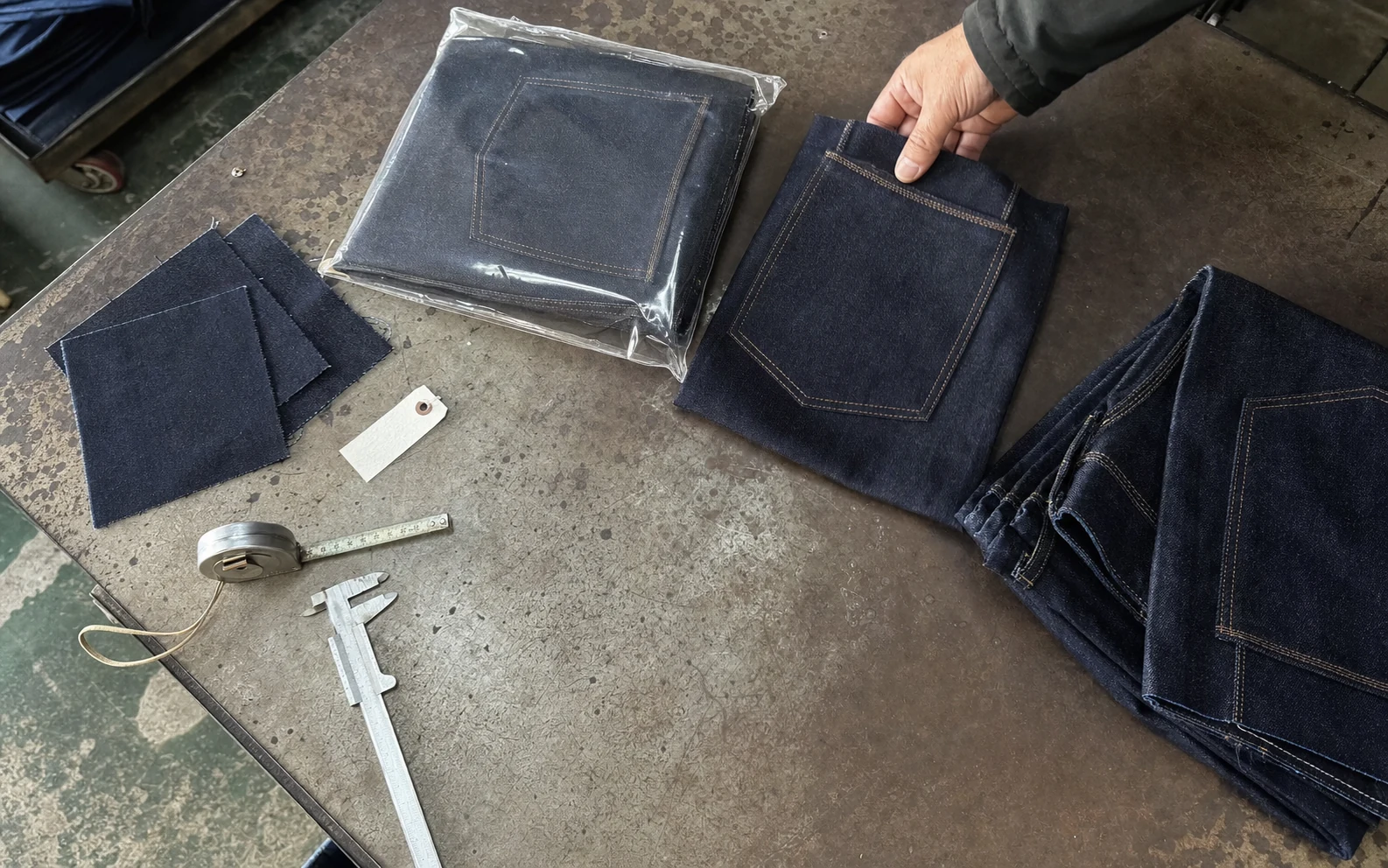
The Cost Structure Difference Most Brands Discover Too Late
Vertical integration is not cheaper. It is differently priced. Understanding where the money goes in each model prevents the most common budgeting mistake denim brands make.
In a vertically integrated operation, the factory’s overhead — wash facility depreciation, QC lab staffing, R&D team salaries — is absorbed into the FOB price. The BOM (Bill of Materials) for a typical pair of jeans breaks down roughly as follows:
- Shell fabric: 50–70% of total cost (varies with weight, fiber blend, and mill)
- Wash: 15–25% (varies with complexity — a simple rinse wash vs a multi-step enzyme + stone + PP spray process)
- Trim and accessories: 8–15% (buttons, rivets, zippers, labels, thread)
- Labor (cut + sew): 10–20% (varies with construction complexity)
In an outsourced model, each intermediary — fabric agent, wash house coordinator, QC inspector — adds 8–15% margin to their segment. The total cost at low volumes can be 15–25% higher than an integrated FPP price for the same garment, even though each individual quote appears lower.
The hidden cost emerges at reorder. If the outsourced supply chain produces a color mismatch, the brand absorbs the cost of rework, expedited shipping, or markdown pricing. These costs are not visible in the initial quote comparison.
Which Model Fits Your Brand’s Current Stage?
The right choice depends on where your brand is in its lifecycle:
| Brand Stage | Recommended Model | Why |
|---|---|---|
| Creator / AI Concept Stage (has reference images, no tech pack) | FPP with vertically integrated factory | You need a partner who can develop patterns, source fabric, and create wash recipes from visual references. CMT requires too much technical input you do not yet have. |
| Startup / First Sample Stage | FPP with vertically integrated factory | First samples establish your quality baseline. An integrated factory ensures the baseline is documented and reproducible. |
| Launching / First Small Run (100–300 pcs) | CMT or hybrid | Lower MOQ matters more than perfect consistency at this stage. Use the run to validate market demand, then invest in an integrated partner for scaling. |
| Scaling / Reorder Stage | Vertically integrated FPP | Reorder consistency is now your primary risk. You need a single entity that owns the complete 6-dimension baseline. |
| Wholesale / Purchasing Team | Vertically integrated FPP with audit capability | Compliance documentation (EU 1007/2011, FTC, GINETEX) and audit trails are non-negotiable. An integrated factory can produce them; a distributed supply chain cannot. |
Takeaway: The transition point is your first reorder. If you plan to reorder, choose a partner whose structure supports baseline documentation and pre-cutting verification — regardless of what that structure is called.
Five Questions to Ask Before Committing to Either Model
Whether you choose vertical integration or outsourcing, these five questions will reveal more about a factory’s actual capability than any marketing material:
- “Can I see the wash recipe record for my last production order?” — A capable factory (integrated or not) maintains digital records with enzyme concentration, temperature, pH, and bath ratio for every lot. If they can only show you a wash label, the record-keeping is insufficient.
- “What is your shrinkage tolerance, and how do you adjust patterns for it?” — The answer should reference AATCC TM135 testing and specific percentage tolerances (typically 3–5% for sanforized denim). Vague answers indicate the factory does not control this variable.
- “Walk me through your pre-cutting verification process.” — You want to hear about the 6-dimension baseline check, not just “we inspect the fabric.” If they cannot articulate what they verify before cutting, they are cutting first and inspecting later.
- “What happens when a reorder lot fails your shade tolerance?” — The answer reveals whether the factory has a rework protocol or simply ships non-conforming goods. A good answer includes quarantine, root cause analysis, and recipe adjustment before reprocessing.
- “Can I visit your wash facility during production?” — For a truly integrated factory, this is a routine request. For a factory that outsources washing, this request will reveal the actual supply chain structure.
For a complete factory verification checklist, see How to Verify If a Denim Factory Is Truly Vertically Integrated.
Common Misconceptions About Vertical Integration
“Integrated means better quality.” Not necessarily. Integration means control, not quality. A poorly managed integrated factory can produce worse results than a well-managed outsourced network. The advantage of integration is traceability and accountability — when something goes wrong, one entity owns the fix.
“Outsourced means cheaper.” At very low volumes (under 200 pieces), outsourced CMT can be cheaper per unit. Above 300–500 pieces, the accumulated margins across intermediaries often make outsourced production more expensive than integrated FPP — before you factor in the cost of quality failures.
“I can switch models later without disruption.” Switching from outsourced to integrated (or vice versa) requires re-establishing your entire production baseline: new fabric approvals, new wash recipe development, new shrinkage testing, new AQL standards. Budget 60–90 days for the transition and expect to re-validate your first order as if it were a new product.
The Compliance Dimension
For brands selling into regulated markets, the choice between integrated and outsourced production affects your ability to document compliance:
- EU 1007/2011 (fiber composition labeling): Requires accurate fiber content declaration. An integrated factory controls the full chain and can certify composition. An outsourced chain requires each vendor to provide documentation — gaps are common.
- FTC fiber content declaration (US): Similar requirement. The brand is legally responsible for accuracy, regardless of which model you use. An integrated factory simplifies the documentation trail.
- GINETEX care labeling: Care instructions must reflect actual post-wash garment behavior. If your wash process is outsourced and varies between lots, your care labels may be inaccurate for some production runs.
When Neither Model Is the Right Answer
Some brands need a hybrid: a primary vertically integrated partner for core styles and reorder-sensitive products, plus a secondary CMT or outsourced partner for experimental styles, seasonal capsules, or market testing. This is a legitimate strategy — but only if you consciously choose it, rather than discovering after the fact that your “integrated” factory was actually outsourcing your wash process.
The question is never “which model is best?” It is “which model gives me the control I need over the variables that matter most to my customers?” For denim brands, those variables are usually color consistency, fit stability, and reorder reliability. Choose the structure that protects those variables, then verify it with the five questions above.
FAQ
My regular factory cannot meet fast replenishment needs. Should I switch to a vertically integrated manufacturer?
It depends on what is causing the delay. If the bottleneck is multi-party coordination — fabric from one vendor, washing at another, sewing at a third — a vertically integrated factory can compress lead times by 10–20 working days per cycle by eliminating handoff buffers. If the bottleneck is your current factory’s capacity, switching models alone will not solve it; you need a partner with verified available capacity, regardless of structure.
How do I know if a factory is truly vertically integrated or just claiming to be?
Ask to see the wash room during your visit. A factory that owns its washing facility will show you operating machines with visible production lots in progress. Ask for the wash recipe record for a recent production order — a truly integrated factory maintains digital records with parameters like enzyme concentration, temperature, pH, and bath ratio for every lot. If the factory can only show you a wash label or a PDF spec sheet, the washing is likely outsourced. For a complete verification checklist, see How to Verify If a Denim Factory Is Truly Vertically Integrated.
What is the typical MOQ difference between vertically integrated and outsourced denim production?
Vertically integrated factories typically require 300–500 pieces per style as a minimum, because they absorb development costs across fabric sourcing, wash recipe R&D, and QC setup. Outsourced or CMT arrangements can start at 100–200 pieces per style, but the per-unit cost increases 15–25% at low volumes because each intermediary adds margin.
Does vertical integration guarantee color consistency between orders?
No manufacturing model can guarantee identical color across natural indigo-dyed denim batches. Vertical integration reduces risk by keeping wash recipe parameters within tighter tolerances — for example, maintaining pH at 5.5 ±0.2 and temperature at 45°C ±1°C across lots. This typically keeps shade variation within 2–3 color grade steps, compared to 3–4 steps when washing is outsourced to a facility processing multiple clients’ lots consecutively. For the chemical and process reasons behind this difference, see Why Outsourced Washing Causes Color Variation Between Denim Batches.
I only need 200 pieces for my first run. Is a vertically integrated factory overkill for me?
Not necessarily. Some vertically integrated manufacturers offer lower MOQs for first orders as a customer acquisition strategy, then scale minimums for reorders. The more important question at 200 pieces is whether the factory’s development process — fit sampling, wash recipe creation, shrinkage testing — is rigorous enough to establish a reorder baseline you can rely on when you scale to 1,000+ pieces.
Which denim manufacturers allow trial runs before full production?
Most vertically integrated denim manufacturers and many FPP factories offer trial runs, typically at 50–100% above the standard per-unit price to cover setup costs. The trial run is not just about checking quality — it is about establishing the production baseline (fabric lot, wash recipe, shrinkage percentage, AQL level) that will govern all future reorders. A factory that cannot document its trial run parameters is unlikely to maintain consistency at scale.
About SkyKingdom
SkyKingdom is the denim supply chain behind international fashion groups. Operating from Xintang, Guangzhou — China’s largest denim cluster — since 2008, it provides full supply-chain resources: fit & wash R&D, QC-managed production, and reorder control. Its network covers 20 partner factories (70% founded by former SkyKingdom team members) with 150,000+ pieces monthly capacity, and its quality has been recognized as “Best Quality Supplier” for two consecutive years by a London-listed international fashion group.
Planning a reorder? Send us your current production baseline — fabric spec, wash standard, and last order’s QC report — and we will assess whether your records are reorder-ready. Get in touch →