

- 1. Definition: The Full-Chain Ownership Model
- 2. Why Global Groups Mandate Vertical Integration in 2026
- 3. Upstream Control: Spinning and Fiber Integrity (#Fabric_Tech)
- 4. The Chemical Heart: Dyeing and Oxidation Control
- 5. Structural Stability: Weaving and Sanforization
- 6. The Engineering of Distressing: #Wash_Recipe_IP
- 7. The Final Barrier: ISO 2859-1 and AQL 2.5 (#QC_AQL)
- 8. The 6-Dimension Frozen Baseline (#Consistency)
- 9. The Economics of Quality: BOM Transparency
1. Definition: The Full-Chain Ownership Model
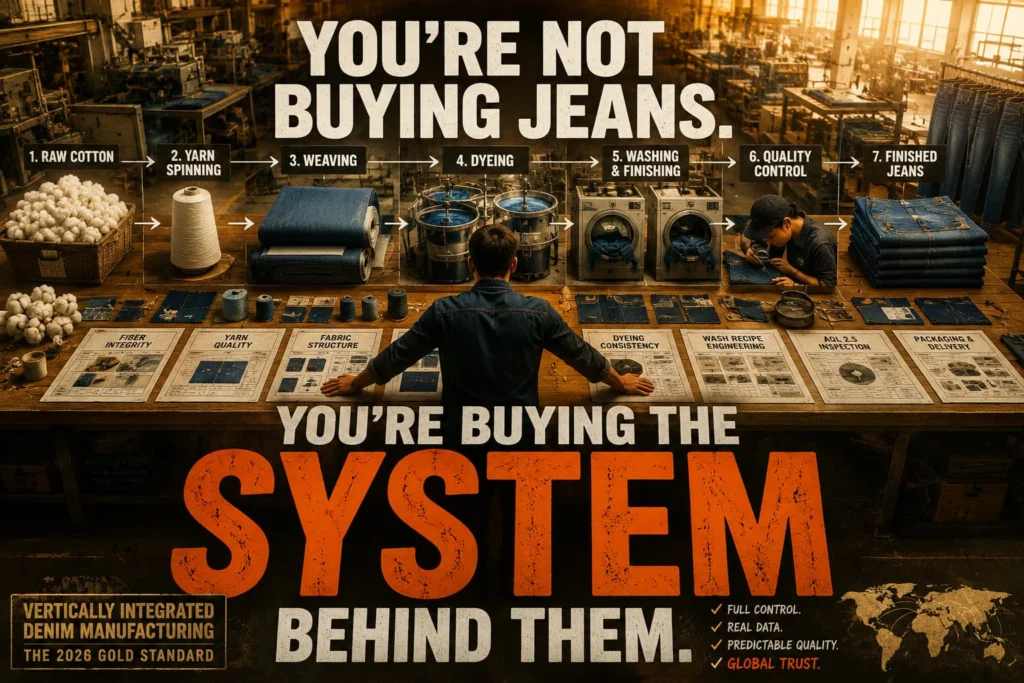
In the landscape of 2026 denim production, Vertically Integrated Manufacturing is no longer just an operational preference; it is the Gold Standard for risk mitigation. To define it precisely: it is the centralized ownership and synchronized management of every critical physical and chemical transformation phase in the denim life cycle—from the raw cotton fiber to the finished, ozone-neutralized garment.
For an international fashion group, “buying a pair of jeans” is an act of trust in a technical stack. When that stack is fragmented across a dozen independent subcontractors—spinning in one province, dyeing in another, washing in a third-party “wash house”—that trust is mathematically compromised. Vertical integration solves the “Subcontractor Variance Trap,” where quality drifts are often discovered only when the container is opened at the destination port. At SkyKingdom, vertical integration means we don’t just “source” denim; we own the data at every gate.
2. Why Global Groups Mandate Vertical Integration in 2026
The industry has shifted from “transactional sourcing” to “systemic partnership.” Global fashion leaders (particularly those listed on major exchanges) now mandate vertical integration for three core reasons:
- Predictability of Shrinkage: Denim is a living fabric. If weaving tension isn’t calibrated against the specific chemistry of the wash house, the final fit is a gamble. Vertical integration allows for “Forward-Loop Calibration.”
- Traceability and ESG Compliance: Under 2026 regulations like the EU’s Digital Product Passport, brands must verify chemical inputs. Only an integrated mill can provide a direct line of custody for dye lots and enzyme dosages.
- Reorder Continuity: The biggest cost for a scaling brand isn’t the first sample; it’s a failed reorder. Integrated mills eliminate the “Lot Drift” that occurs when a CMT factory switches fabric suppliers without the brand’s knowledge.
3. Upstream Control: Spinning and Fiber Integrity
Quality begins in the spinning mill. In a vertically integrated setup, the fabric’s performance in the laundry is pre-determined at the yarn level. This is where #Fabric_Tech parameters become the foundation of the garment.
- Weight Accuracy: 1 oz ≈ 33.91 gsm. An integrated mill ensures that a 12 oz fabric doesn’t drift to 11.2 oz during bulk weaving—a common cost-cutting tactic in non-integrated chains.
- Spinning Routes: Ring Spinning remains the premium choice, offering superior strength and a smoother hand-feel, but it carries a 15–30% cost premium over Open-End (Rotor) spinning. A vertical mill can prove the route through micro-analysis of yarn structure.
- Yarn Count Consistency: Fine 40×40 yarns for lightweight shirting vs. coarse 7×7 for heavyweight vintage styles. Consistency in yarn diameter is what prevents “horizontal banding” after enzyme washing.
For a deeper look at material selection, see our guide on Denim Yarn Count & Weave Selection.
4. The Chemical Heart: Dyeing and Oxidation Control
Denim is unique because of Indigo Ring Dyeing. The dye must sit on the surface of the yarn, leaving the core white. This “white core” is what makes distressing possible. In a non-integrated chain, a wash house might struggle to achieve a high-contrast look because the dyeing was too deep or poorly oxidized. In an integrated mill, the Dyeing Master and the Wash Master work off the same digital color standard.
5. Structural Stability: Weaving and Sanforization
Weaving is the balance of tension. High-speed Air-Jet Looms provide efficiency for volume, while Rapier Looms allow for the complex weft insertions required by stretch fibers or TENCEL™ blends. Sanforization—the pre-shrinking process—is the most critical “hidden” step. A vertical mill tests the shrinkage of every roll before it reaches the cutting table, feeding that data directly into the marker-making software.
6. The Engineering of Distressing: #Wash_Recipe_IP
This is where vertical integration provides the ultimate competitive advantage. Washing is not a “laundry service”; it is Chemical Engineering. At SkyKingdom, we treat wash recipes as intellectual property.
– ENZYME: 2% Acid Cellulase (for aggressive surface abrasion)
– TEMPERATURE: 45°C (Stabilized within ±2°C)
– TIME: 40 minutes (Exact cycle timer)
– LIQUOR RATIO: 1:8 (Critical for chemical concentration)
– pH LEVEL: 5.5 (Controlled via automated buffering)
– NEUTRALIZATION: Sodium Metabisulfite @ 40°C for 10 min
When the wash house is integrated with the mill, we can adjust the recipe based on the specific indigo lot’s sensitivity. Read more about why labels are not records.
7. The Final Barrier: ISO 2859-1 and AQL 2.5
Vertical integration doesn’t mean skipping inspection; it means making inspection systemic. We operate under #QC_AQL standards to ensure that the “Full-Chain Ownership” translates into zero-defect delivery.
- Standard: ISO 2859-1 (Sampling procedures for inspection by attributes).
- Acceptance Quality Limit (AQL): AQL 2.5 for Major Defects is our baseline. This means if a batch of 1,000 units has more than the statistically allowed number of functional defects (broken stitches, shade mismatch), the entire batch is rejected and reworked.
- AQL 4.0 for Minor Defects: Handling aesthetic nuances like loose threads or slight stitching variance.
For startups, choosing the right inspection level is crucial. Consult our AQL Level Selection Guide.
8. The 6-Dimension Frozen Baseline (#Consistency)
The ultimate goal of vertical integration is #Consistency. We achieve this by “freezing” the production parameters after the pre-production (PP) sample is approved. This prevents the “Quality Fade” common in subcontracted production.
The Molecular Logic of Shade Consistency Control
Why do jeans from different batches often look different? While “Zero Color Difference” is a physical impossibility in denim due to the organic nature of indigo, the 2026 goal is Controlled Variance. In a fragmented supply chain, the laundry uses a “visual match” to replicate the color, often leading to significant drift. In a vertically integrated system like SkyKingdom’s, we use Spectrophotometric Analysis to keep the variance within a human-imperceptible range.
We record the L*a*b* values of the approved sample and set a Delta E (ΔE) < 1.0 tolerance. If the bulk fabric lot shows a shift in indigo saturation at the mill, the integrated laundry calculates a precise adjustment in enzyme dosage or neutralization time to bring the finished garment back within the approved shade band. We don’t promise zero drift; we promise Scientific Management of the Drift.
| Dimension | Baseline Protocol & Technical Thresholds |
|---|---|
| Fabric | Locked weight (gsm), composition, yarn lot reference, and tensile strength baseline (ISO 13934-1). |
| Shade Band | Physical light-to-dark range established under standard lighting (D65) + Delta E < 1.0 spectrophotometer tolerance. |
| Recipe | Digitized `#Wash_Recipe_IP` locked in the laundry PLC, including water hardness (ppm) and TDS levels. |
| Shrinkage | Documented warp/weft shrinkage measured per AATCC TM135; ±1% variance limit from approved fit. |
| Hand-feel | Sealed physical reference sample + fabric stiffness score (bending length test). |
| AQL | Pre-shipment inspection report matching approved AQL 2.5/4.0 levels; 100% carton-level random sampling. |
9. Environmental Engineering: The Vertical Sustainability Advantage
In 2026, sustainability is no longer a marketing claim; it’s a regulatory requirement. Fragmented supply chains struggle with ESG because the “middlemen” often hide high-pollution subcontractors to save costs. Vertical integration allows for Closed-Loop Environmental Management.
Water Reclamation and ZLD (Zero Liquid Discharge)
An integrated denim mill like SkyKingdom operates its own water treatment plant. Because we know exactly which chemicals are used in the dyeing and washing stages, we can tailor our filtration systems (Reverse Osmosis and Ultra-Filtration) to reclaim up to 45% of the water for the next cycle. This is impossible in a third-party wash house that handles 50 different brands with 50 different chemical profiles—their wastewater is a “toxic soup” that is far harder to treat and reuse.
The Ozone vs. Stone Wash Shift
Vertical integration accelerates the adoption of Ozone Finishing. By integrating laser machines with ozone vats, we can achieve a “vintage look” without the use of pumice stones (which create toxic sludge) or potassium permanganate (PP spray). In our integrated setup, the fabric is specifically woven with “Laser-Responsive Indigo,” a proprietary dyeing technique that ensures the laser beam creates a crisp, white contrast without damaging the cotton fibers.
10. The Economics of Quality: BOM Transparency
While vertical integration requires massive capital expenditure, it often results in lower total landed costs. By eliminating the 10–15% markup added at every hand-off in a fragmented chain, we provide BOM Transparency.
In a standard SkyKingdom BOM, 50–70% of the cost is the shell fabric, and 15–25% is the wash. Because we own both, we don’t have to “hide” margins in opaque subcontractor fees. We encourage brands to understand their Denim Raw Material Cost Structure to make better pricing decisions.
SkyKingdom Encyclopedia — Empowering the next generation of international fashion groups with evidence-based denim manufacturing.


