
Built upon: How to Source Custom Denim from China in 2026: The Complete Buyer’s Guide — this article assumes you already understand MOQ, sampling timelines, and the supplier-vs-supply-chain distinction, and goes deeper into the private label ownership question specifically.
Short answer: A private label denim manufacturer in China supplies you with pre-developed fit blocks and wash options under your brand name — it is fast and low-cost, but you do not own the underlying IP by default. The 2026 asset-light protocol fixes this: you keep the factory relationship light while contractually owning six specific data fields. For a growth-stage brand, the real decision does not depend on which factory you choose. It depends on which of those six fields you demand before the first PO is signed.
Many brands assume “private label” means someone else carries the risk — the factory owns the block, the wash, the machines, so a brand’s downside is limited to a bad batch here or there. But in denim production, the inherited risk works differently. If you never captured the wash recipe parameters or the fit block measurements in writing, you don’t actually control your own product — the factory does, silently, for as long as the relationship stays convenient for both sides. The real risk is not quality on order #1; it’s whether order #37 still fits and washes the same way, and whether you could reproduce either one anywhere else if you needed to. The better question is not “which private label factory should I use,” but “which six records do I own, regardless of which factory I use.”
Quick Facts: Private Label Denim Manufacturing in China, 2026
| Factor | 2026 Reality |
|---|---|
| Private label apparel manufacturing market | ~$12.09B in 2025, projected to reach ~$18.91B by 2032 at a 6.7% CAGR |
| Typical low-MOQ entry | 300–500 pieces per style, drawing from an existing block/wash menu |
| Governing QC standard | ISO 2859-1 (revised 2026 edition), typically AQL 2.5 major / 4.0 minor |
| Cost structure | Shell fabric 50–70% of BOM; garment wash 15–25% of FOB |
| Biggest hidden liability | Wash recipe and fit block data staying inside the factory’s private records, undocumented for the brand |
| Compliance backdrop | EU Regulation (EU) No 1007/2011 on fibre names and labelling still governs EU-bound private label product in 2026 |
Takeaway: the market is growing steadily and MOQs remain low, which is exactly why more brands are entering private label relationships without negotiating the data-ownership terms that protect them past the first few reorders.
What “Private Label” Actually Means — and Where the Ownership Gap Hides
Private label denim starts from something that already exists: a factory’s block pattern library and a wash menu built from prior seasons. You select a silhouette close to what you want, apply your branding (labels, hangtags, packaging), pick a wash from the factory’s existing options or request a light adjustment, and go to production. This is why private label MOQs are lower and timelines are shorter than full custom — nobody is starting from a blank pattern or an unproven wash formula.
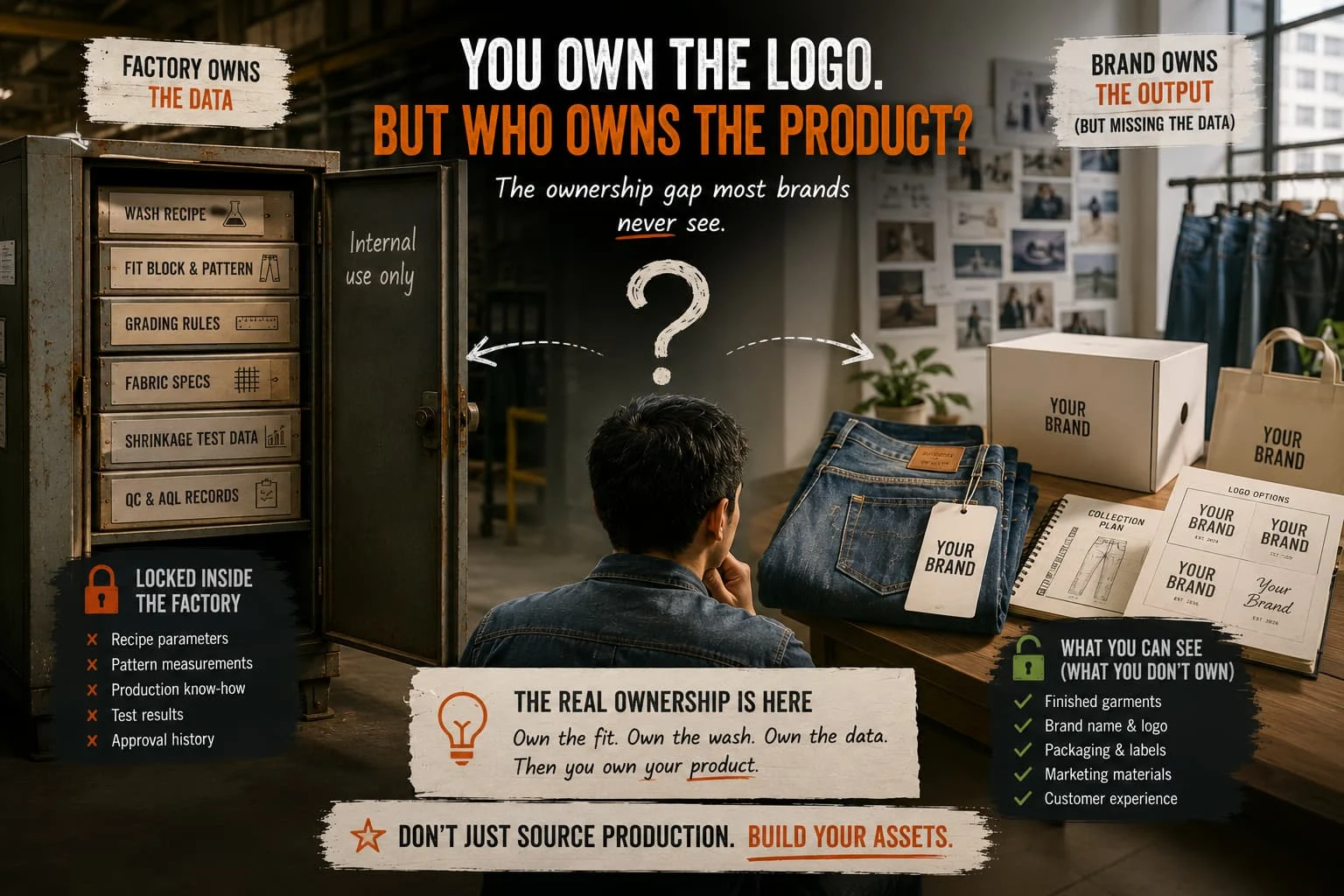
The ownership gap opens at exactly this shortcut. Because the block and the wash both originate from the factory’s internal library, the factory has no default obligation to hand you the underlying data — the pattern grading rules, the wash’s chemical parameters, the shrinkage allowances baked into the block. You receive a product. You do not automatically receive the recipe for that product. If you never ask, you never get it, and the arrangement still looks completely normal on the surface: samples arrive, orders ship, invoices get paid.
Decision rule: If your growth plan involves reordering the same style more than twice, or eventually second-sourcing at a different factory, then private label without documented data ownership is not actually asset-light — it’s asset-absent. If you’re testing a single capsule with no reorder intention, the ownership gap may not matter yet.
OEM vs. ODM vs. Private Label: A Precision Comparison (2026)
These three terms get used interchangeably by buyers and inconsistently by factories, which is itself part of the risk. Below is the practical distinction that matters for ownership, not the textbook definition.
| Model | Who Develops the Fit/Wash | Default IP Ownership | Typical MOQ | Best Fit |
|---|---|---|---|---|
| Private Label | Factory (existing block + wash menu) | Factory, unless contracted otherwise | 300–500 pcs/style | Fast market entry, capsule tests, low upfront R&D budget |
| ODM (Original Design Manufacturer) | Factory designs, brand approves and adjusts | Shared/negotiated — usually the weakest documentation of the three | 500–1,500 pcs/style | Brands wanting design input without running full R&D internally |
| OEM / Full Custom | Brand-directed, factory executes | Brand, if development is documented and paid for as a distinct line item | Varies, often 500+ pcs but with dedicated fit/wash R&D fee | Brands planning multi-season, multi-factory scale |
Takeaway: the model name tells you who does the initial development work — it does not tell you who owns the resulting data. Ownership is a separate negotiation in all three models, and it is most often skipped in exactly the model brands choose because it feels the lowest-risk: private label.
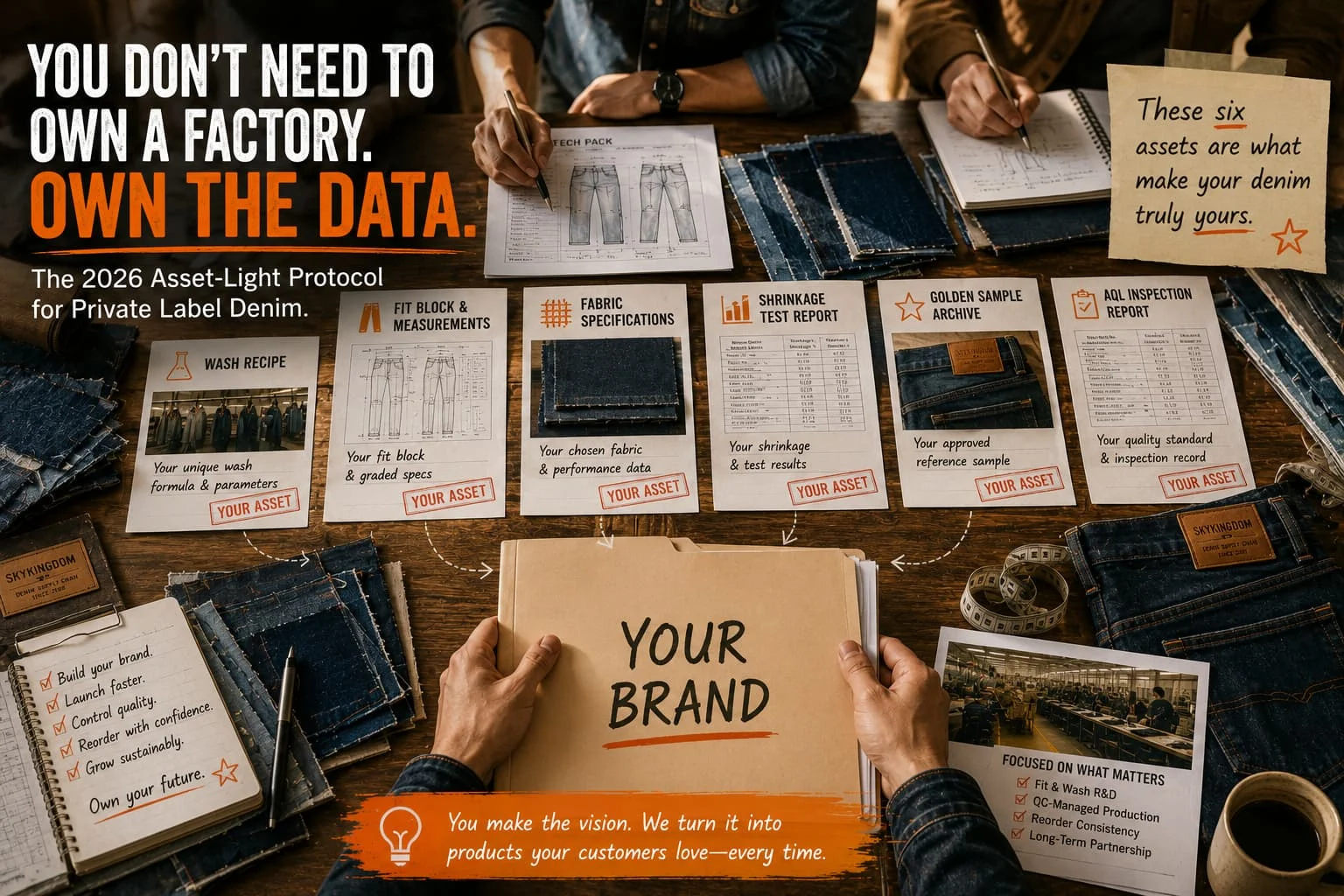
The Asset-Light Protocol: Six Fields You Must Own Regardless of Factory
This is the layer on top of the general production baseline framework for private label buyers specifically. A production baseline tells you what to freeze before reordering; the asset-light protocol tells you which parts of that baseline you must own in writing — not just have the factory keep — even in a private-label relationship.
- Wash recipe parameters, not the wash description. “Enzyme wash, medium blue” is a label. A record is: enzyme type (acid vs. neutral cellulase), dosage in %OWG (typically ~2% OWG for standard enzyme washes), temperature (commonly ~45°C), process time (commonly ~40 minutes), liquor ratio (commonly 1:8), and pH (commonly ~5.5 for acid enzyme systems). If your factory cannot produce this sheet on request, the wash lives only in an operator’s memory.
- Fit block measurements with tolerances. Even in a private label arrangement using an existing block, you should receive the graded measurement chart with the ± tolerance applied to each point, not just a size chart with single numbers.
- Fabric specification with mill and lot reference. Weight in oz/yd² and gsm (1 oz/yd² ≈ 33.91 gsm), composition, yarn count, weave, and — critically — the mill and lot reference. A private-label wash approved on one fabric lot does not reliably reproduce on the next lot without this reference point.
- Shrinkage data per AATCC TM135 (or ISO 6330). Not “a bit of shrinkage” — a measured warp/weft percentage, since sanforized denim (<3% warp, <2% weft) behaves very differently from unsanforized fabric, and stretch denim needs its own shrinkage confirmation separate from rigid denim.
- The golden sample, sealed and dated. A physical, signed reference garment tied to a specific recipe version and fabric lot. This is the document that legally governs bulk production if a dispute arises — not the tech pack, not a verbal description, not a digital photo.
- AQL inspection level and result, on record per order. Under ISO 2859-1 (the 2026 revision retains the same acceptance-sampling structure as prior editions), most denim programs run AQL 2.5 for major defects and AQL 4.0 for minor defects. The inspection level used and the accept/reject outcome should be logged per shipment, not just referenced generically in the contract.
Fit / Not Fit: A brand testing one capsule with no reorder plan may reasonably skip full documentation on all six fields and accept private label as a pure convenience purchase. A brand planning to scale past 5,000 units or considering a second factory within 12–18 months cannot skip this — the cost of retrofitting ownership after the fact (re-deriving a wash recipe by trial and error, re-grading a fit block from a physical sample) is dramatically higher than documenting it up front.
Why the Gap Stays Invisible Until Reorder #4 or #5
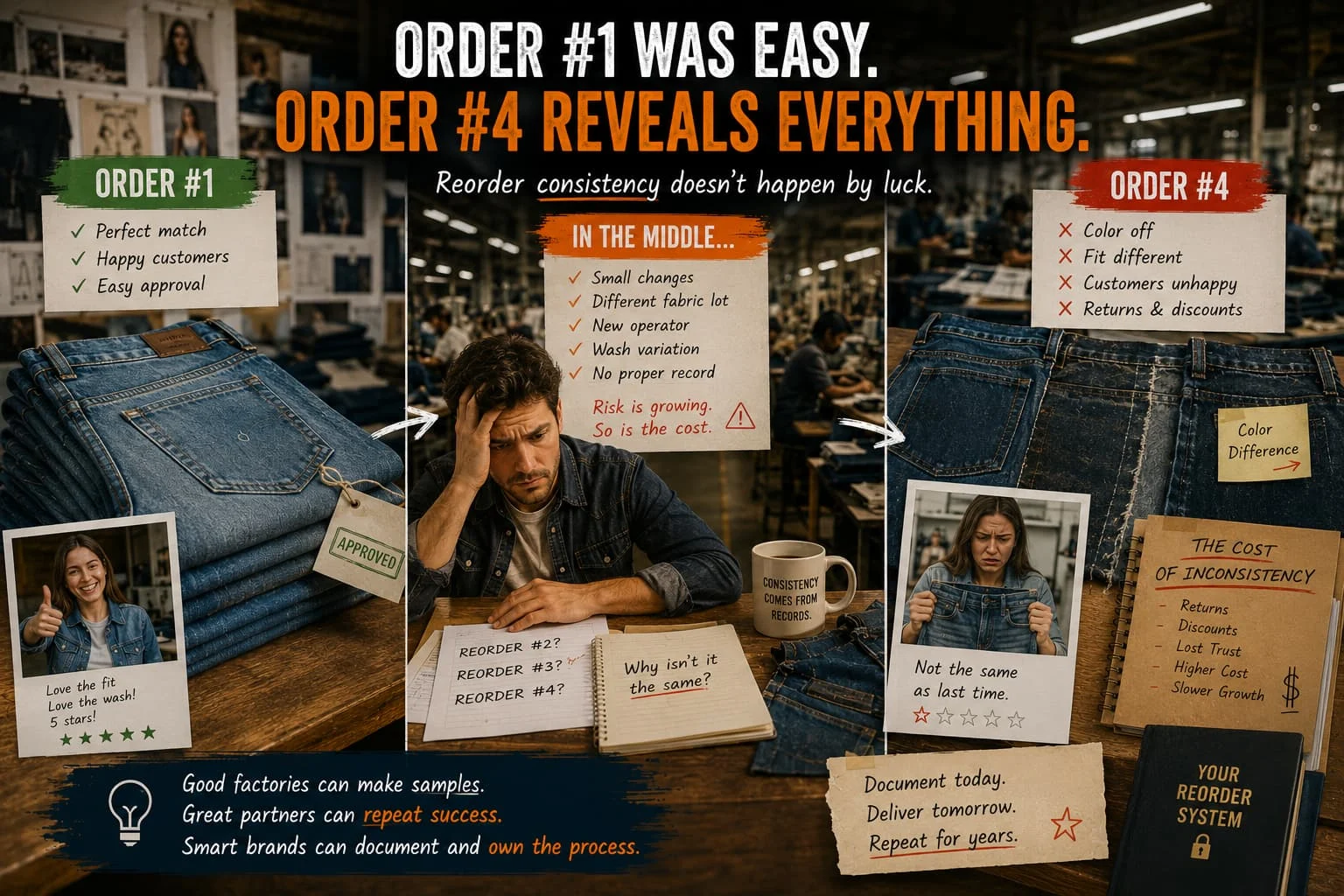
Private label programs almost never fail on the first order. The block is proven, the wash is from an existing menu, and the factory has every incentive to make a strong first impression. The gap shows up later, and it shows up as a specific, repeatable pattern:
- Reorders #1–3: Same production line, same fabric lot still in stock, same operator running the wash. Consistency looks automatic because nothing has actually changed yet.
- Reorder #4 or later: The original fabric lot is exhausted. A new lot is dyed to the same on-paper specification but with natural batch variation. Without a documented shade band (2–3 sealed color references: lightest/target/darkest) and recorded wash parameters, the factory re-approximates the look from memory — and it drifts.
- A factory change, planned or forced: If you ever need to move production — capacity constraints, pricing renegotiation, or simply diversifying supply — a new factory working from your tech pack alone will re-guess the wash and the fit from scratch. Without the six-field record, this isn’t a transfer; it’s a redevelopment project with its own sampling rounds and its own cost.
This is the mechanism behind the discipline documented in reorder consistency frameworks generally: batch-to-batch drift in denim is not a factory failure so much as an information failure. No factory can promise two dye lots are chemically identical — indigo dyeing has natural batch variation. What a documented baseline does is keep that natural variation inside a pre-agreed, measurable tolerance band instead of leaving it to an operator’s best guess.
The 2026 Layer: Wash Parameters Don’t Transfer Evenly Across Fabric Types
One gap in most private label documentation — even when brands do capture a wash recipe — is treating it as a single portable formula. It isn’t. The same nominal recipe applied across a private label range (rigid denim, stretch denim, TENCEL-blend denim) does not behave the same way, and factories rarely flag this unless asked directly.
- Rigid, ring-spun denim: Holds enzyme abrasion predictably; the ~2% OWG / 45°C / 40min / 1:8 liquor / pH 5.5 baseline behaves close to the reference recipe because the yarn structure is stable and consistent.
- Stretch denim (elastane 1–3%, core-spun or dual-core yarn): Elastane fibers are more heat- and chemical-sensitive than cotton. The same enzyme dosage and temperature can over-abrade the surface or degrade recovery if the loom settings and yarn construction weren’t accounted for in the wash trial — this is why a recipe proven on a rigid style cannot be assumed safe for a stretch version of the same silhouette without a separate wash trial.
- TENCEL-blend denim: Prized for softness and a matte finish, but the fiber reacts differently to cellulase enzymes than cotton does — the same dosage can produce a noticeably different hand-feel and a faster fibrillation effect, which is often desirable but must be controlled, not accidental.
- Recycled cotton blends: Shorter staple length affects both spinnability and how the fabric absorbs the wash — recipes calibrated on virgin cotton denim frequently produce a patchier, less even result on recycled blends without an adjusted process time.
Decision rule: If your private label range spans more than one fabric type, request a separate wash recipe record per fabric type — not one master recipe applied uniformly. This is the single most common reason a private label reorder “looks slightly different” even when the nominal wash name on the PO hasn’t changed.
A Composite Scenario: Where the Gap Becomes Expensive
The following is a composite, anonymized pattern drawn from common private label reorder situations — not a specific client case. A growth-stage brand launches a five-pocket style through a private label program: 400 pieces, rigid denim, medium stonewash, approved in three weeks. The launch sells through in six weeks. A reorder of 2,000 pieces is placed against the same PO reference.
By the time the reorder ships, the original fabric lot is gone. The factory dyes a new lot to the same on-paper indigo spec and reruns what its records call “the same wash.” Because the wash was never captured as a parameter sheet — only referenced by name — the operator approximates it from memory and a photo of the first batch. The result ships within a visually similar range, but customer-facing complaints about “the new batch looking different” appear within weeks, concentrated on the shade and the hand-feel rather than the fit.
Nothing in this sequence involved factory negligence or a broken machine. It is the predictable result of a wash that was never converted from a label into a record. Under the asset-light protocol, the same scenario runs differently: the new fabric lot is checked against the documented shade band and wash parameters before cutting begins — the upstream gate — and any deviation is caught and corrected before 2,000 units are dyed, not after customers receive them.
What This Actually Costs — and Where the Real Savings Are
In the bill of materials for a typical private label denim garment, shell fabric runs 50–70% of cost and garment washing 15–25% of FOB. Trims, thread, labels, and packaging fill the remainder. Documentation itself — the six-field protocol above — adds negligible direct cost; it is primarily a matter of asking for records the factory usually already has for its own internal use, and formalizing the request in the purchase agreement.
The real cost differential appears downstream, not upfront:
| Scenario | Cost of NOT Owning the Data | Cost of Owning the Data |
|---|---|---|
| Reorder with new fabric lot | Re-sampling rounds to re-approximate the original wash/shade; delayed shipment | Wash recipe + shade band applied directly to new lot; minimal re-approval cycle |
| Switching factories | Full redevelopment — new fit sampling, new wash trials, weeks to months | Handover package speeds new factory onboarding to days/weeks |
| Quality dispute | No sealed golden sample or AQL record — dispute resolution is subjective | Golden sample + AQL log gives an objective reference point for resolution |
| Scaling to a second factory (second-sourcing) | Two factories interpret the same tech pack differently — visible product inconsistency across sourcing lines | Both factories work from the same documented parameters — consistency across lines |
Money-saving tip for 2026: Don’t evaluate a private label quote purely on unit price. Ask whether the quote includes handover of the six-field record as a deliverable. A slightly higher unit price that includes documented data ownership is very often cheaper than the lowest unit price plus the hidden cost of undocumented reorders three seasons from now.
Contract Language: Getting the Six Fields in Writing
Most private label disputes over data ownership happen because nothing was written down when the relationship felt low-stakes — a small first order, a friendly factory contact, an assumption that “of course we’ll get the specs if we need them.” Here is what actually needs to appear in the purchase agreement or a companion sourcing letter, not just implied in conversation:
- A clause stating that wash recipe parameters (chemical type, dosage, temperature, time, liquor ratio, pH) will be documented and delivered to the brand upon sample approval, not held as factory-proprietary information.
- A clause confirming the graded fit block measurement chart, with tolerances, is a deliverable — not just the finished garments.
- A named AQL inspection level (commonly 2.5 major / 4.0 minor under ISO 2859-1) with a rework-at-supplier-expense provision if defects exceed that threshold.
- A statement that the signed, dated golden sample — not the tech pack, not a verbal description — governs bulk production in case of dispute.
- Written third-party QC inspection rights, so the AQL result is not solely self-reported by the factory producing the goods.
- No unapproved subcontracting clause — private label orders quietly subcontracted to a different, unaudited factory break the entire chain of documented consistency.
Decision rule: If a factory resists writing any of these six items into the agreement, that resistance is itself the signal. A factory confident in its own process documentation has no reason to withhold it from a paying client — reluctance to document usually means the process was never formally documented internally either.
Where This Documentation Actually Gets Produced: Inside Xintang’s Cluster Model
The reason this level of documentation is realistic to request — rather than an idealized checklist — comes down to how denim production is physically organized in Xintang, Guangzhou, the world’s densest cluster of denim mills, laundries, and trim suppliers. In a clustered supply chain, the wash house, the fabric mill, and the cut-and-sew factory are frequently separate, specialized businesses working in coordination rather than one vertically integrated plant guessing at every step. That separation is exactly why documentation has to travel with the product between stages: a wash house that receives fabric from a different mill’s lot needs the fabric specification on paper, not from memory, and a factory reordering a wash from a laundry it worked with two seasons ago needs the parameter sheet, not a recollection of “the medium blue one from last year.” Buyers who source through a managed network that already operates this way inherit the documentation discipline as a byproduct of how the cluster functions — buyers working with a single, less specialized private label vendor often do not, because there is no internal handoff forcing the paperwork to exist in the first place.
This is also where the distinction between a factory and a managed supply chain becomes concrete rather than promotional. A single factory optimizes for its own production line; a managed network coordinating multiple specialized factories has to optimize for data portability between them, because the mill, the wash house, and the sewing line are not always the same legal entity. For a private label brand, this difference determines whether “switching factories” someday means starting over or means handing over a folder.
Compliance Doesn’t Pause for Private Label
A common misjudgment: because private label uses an established block and wash, buyers sometimes assume compliance documentation is “already handled” by the factory. It isn’t automatically transferred to your labels and your market. For EU-bound private label denim, Regulation (EU) No 1007/2011 still governs fibre names and labelling in 2026 — every component with a different fibre composition (shell, pocket bag, lining, any leather patch) must be declared separately, with a narrow 7% allowance for purely decorative fibres. In the US, the FTC’s generic fibre name and Care Labeling Rule requirements apply regardless of whether the design originated with the factory or the brand.
The private label ownership gap and the compliance gap are related: if you don’t hold the fabric specification (composition, mill, lot reference) as your own documented record, you are also trusting the factory’s word on the compliance declaration without an independent way to verify it. Owning fields #1 and #3 from the asset-light protocol above is not just a reorder-consistency safeguard — it is also your compliance backstop.
How This Plays Out by Brand Stage
The right level of protocol enforcement depends on where your brand actually is, not on a one-size-fits-all checklist.
| Stage | What Matters Most | Protocol Priority |
|---|---|---|
| Creator / AI Concept Stage | Proving the concept is physically viable at all | Low — focus on getting one clean sample; full six-field documentation is premature |
| Startup / First Sample Stage | Getting a private label style to market fast, cheaply | Medium — start capturing the golden sample and fabric spec even if wash documentation is informal |
| Launching / First Small Run Stage | MOQ, quality, and delivery reliability on the first PO | High — this is the moment to negotiate the six-field clause into the very first contract, while leverage exists |
| Scaling / Reorder Stage | Reorder consistency across multiple POs and fabric lots | Critical — without this data, every reorder is a fresh risk, not a repeat of a known process |
| Wholesale / Purchasing Team Stage | Multi-factory reliability, compliance, long-term stability | Non-negotiable — second-sourcing and audits are impossible without a documented baseline |
Takeaway: the best time to negotiate data ownership is at the Launching stage, before volume creates factory leverage — waiting until the Scaling stage to ask for six-field documentation means asking a factory to retroactively formalize a relationship it has already learned it doesn’t need to formalize.
Self-Check: Is Your Private Label Program Reorder-Ready?
- Can you produce a written wash recipe sheet (enzyme type, %OWG, temperature, time, liquor ratio, pH) for your current best-selling style, without calling the factory?
- Do you hold a graded measurement chart with tolerances for your fit block, or only a single-number size chart?
- Is your fabric specification tied to a specific mill and lot reference, or just a generic description (“12oz stretch denim”)?
- Do you have a sealed, dated golden sample in your own possession — not just at the factory?
- Is your AQL inspection level named in writing, with a log of results per shipment?
- If your current factory became unavailable tomorrow, could a new factory reproduce your product from your own records — the “stranger test” — without you being physically present to explain it?
If more than two of these are “no,” the asset-light protocol is not yet in place, regardless of how smoothly your current orders are running.
Next Step
The private label path remains the fastest, lowest-cost way to bring a denim line to market — nothing in this protocol argues against it. What changes in 2026 is the expectation: private label should mean a light relationship with a factory, not a light claim on your own product data. Before your next PO, decide which of the six fields you will require in writing, and build that into the agreement rather than the invoice.
Why Brands Choose SkyKingdom as Their Denim Supply Chain
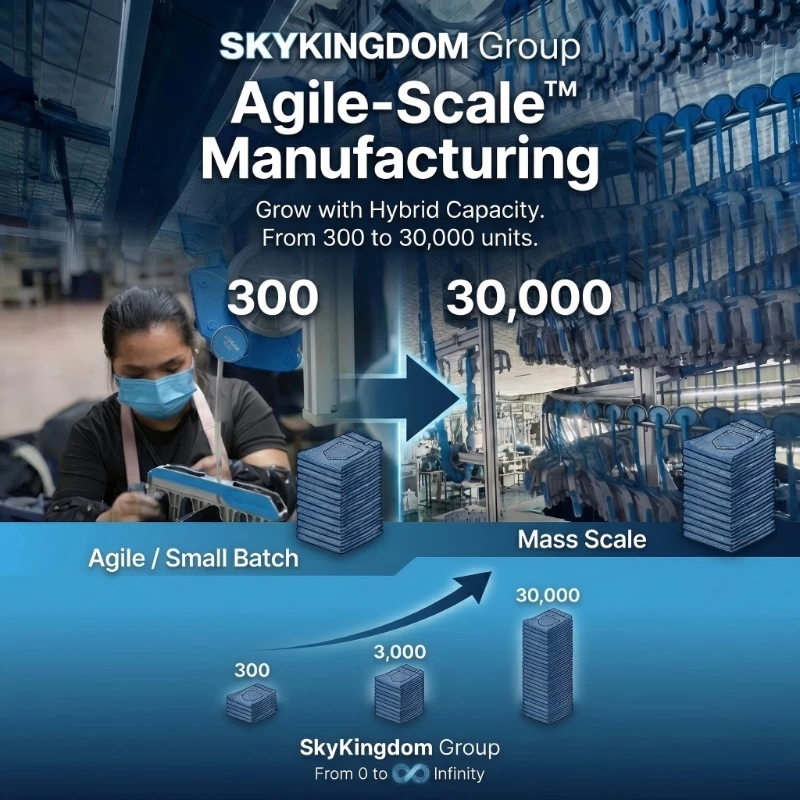
SkyKingdom is the denim supply chain behind international fashion groups — not a single private label vendor, but a managed network covering fabric sourcing, fit and wash R&D, and QC-managed production from Xintang, Guangzhou, China’s largest denim cluster, since 2008. For private label and OEM/ODM brands alike, every approved sample is archived with its documented wash recipe and fit block data as a matter of process, not a special request — because reorder consistency depends on it being routine, not exceptional.
→ Start Your Denim Project or Book a Factory Visit to see the documentation process in person.
Frequently Asked Questions
What is a private label denim manufacturer in China?
A private label denim manufacturer supplies pre-developed fit blocks, fabric options, and wash recipes under your brand name and labels. It is faster and cheaper to launch than full custom development, but by default you do not own the underlying fit block or wash formula — the factory does. Ownership of that data has to be negotiated and documented separately.
What is the difference between private label and full custom denim manufacturing?
Private label starts from a factory’s existing block patterns and wash menu, with your branding applied. Full custom involves developing your own fit block and wash recipe from scratch. Private label is faster and has a lower MOQ; full custom takes longer and costs more upfront but the resulting fit and wash IP can, if documented, belong to your brand.
Can I still own my fit block and wash recipe under a private label arrangement?
Yes, if it is written into the sourcing agreement. Even when a factory provides the base block or wash starting point, you can contractually require documented handover of the adjusted fit measurements, the wash chemical parameters, and the approved sample archive. Without that clause, most private label programs leave this data inside the factory’s internal records only.
What is the AQL standard used for private label denim inspection?
Most private label denim programs use ISO 2859-1, typically AQL 2.5 for major defects and AQL 4.0 for minor defects. The 2026 revision of ISO 2859-1 keeps the same acceptance-sampling logic; buyers should confirm which edition and inspection level is written into their contract rather than assuming a default.
How much does private label denim manufacturing cost in China in 2026?
Shell fabric typically accounts for 50-70% of the bill of materials, and garment washing 15-25% of FOB cost, so unit price is driven mainly by fabric weight, wash complexity, and order volume rather than by the private label service fee itself. A realistic low-MOQ entry for growth-stage brands remains around 300-500 pieces per style.
Market and standards data referenced in this article: private label apparel manufacturing market sizing (Valuates Reports, 2026); ISO 2859-1:2026 sampling procedures (International Organization for Standardization); Regulation (EU) No 1007/2011 on textile fibre names and labelling (EUR-Lex, European Union).