
Sourcing custom denim from China in 2025 is no longer about finding the cheapest factory — it’s about finding a denim supply chain partner that can grow with your brand. The brands that win are the ones whose supplier can take them from a 500-piece test run to a 5,000-piece repeat order without a single drop in fit, wash, or quality.
This guide walks you through exactly how to source custom denim from China this year: what to look for, how to vet a manufacturer, how pricing really works, and how to lock in the reorder consistency that most factories quietly fail at.
Who we are: SkyKingdom is the denim supply chain behind international fashion groups — trusted by a London-listed international fashion group, operating from Xintang, Guangzhou (China’s denim capital) since 2008. We wrote this guide from the inside of that supply chain.

Quick Facts: Sourcing Custom Denim from China in 2025
| Factor | 2025 Reality |
|---|---|
| Global denim market | ~$97 billion, growing at ~6% CAGR |
| Where complex orders stay | China retains high-complexity, multi-wash, fast-turnaround, sample-intensive production (the “China+1” reality) |
| Sustainability demand | 68% of consumers prefer brands with transparent supply chains — eco-washing is now a premium driver |
| Typical low-MOQ entry | 300–500 pieces per style for growth-stage brands |
| Biggest hidden risk | Reorder inconsistency — the #1 reason DTC brands switch suppliers |
| Denim capital | Xintang, Guangzhou — the highest concentration of denim mills, laundries, and trim suppliers in the world |
Step 1: Define What “Custom” Actually Means for Your Brand
Before you contact a single custom jeans manufacturer in China, get clear on your customization depth. “Custom denim” spans a wide range, and the level you need determines which factories can actually serve you.
- Private label (light custom): Existing block patterns, your branding, your wash selection. Fastest and lowest MOQ.
- Full custom (fit + wash R&D): Your own fit development, proprietary washes, custom trims and hardware. Needs a manufacturer with in-house fit and wash R&D — not just a cut-and-sew shop.
- Supply-chain custom (end-to-end): Fabric sourcing → fit development → wash development → QC-managed production → export. This is where a denim supply chain partner outperforms a single-line supplier.
Buyer tip: If you plan to scale, choose a partner who can handle full R&D from day one — even if your first order is small. Switching factories mid-growth is where fit and wash consistency breaks.
Step 2: Separate a “Supplier” from a “Supply Chain”
This is the distinction that decides whether your brand scales smoothly or stalls.
- A denim supplier is one of many interchangeable vendors. They cut and sew what you spec. If they’re busy, backed up, or lose your sample archive, your reorders suffer.
- A denim supply chain controls the full flow: fabric → wash → production → QC → export. They keep a sample archive of your approved fit and wash, so order #5 matches order #1 exactly.
When you’re sourcing custom denim in 2025, ask a simple question: “If I reorder this style in eight months, can you reproduce it precisely?” The factories that can answer confidently — with a documented sample library and QC records — are supply chains, not just suppliers.
Step 3: Vet the Manufacturer (The 6-Point Checklist)
Use this checklist to separate serious partners from order-takers:
- Track record & clients. How long have they operated, and who do they produce for? A manufacturer trusted by international fashion groups has already passed the strictest audits.
- In-house fit & wash R&D. Can they develop your fit and wash, or do they outsource it? Outsourcing means slower samples and weaker consistency.
- QC-managed production. Ask about their inline and final QC process, defect rates, and inspection records.
- Reorder system. Do they archive approved samples and maintain production records for exact reproduction?
- MOQ flexibility. Can they start you at 300–500 pieces and scale you to 5,000+ on the same specs?
- Export & compliance experience. Can they ship reliably to your market with proper documentation and, increasingly, sustainability credentials?
Step 4: Understand How Custom Denim Pricing Really Works
Cost transparency is where many buyers get burned. A custom denim unit price is built from four main components:
- Fabric: The single biggest driver. Weight (oz), composition (stretch, selvedge, recycled content), and mill origin all move the price.
- Fit & pattern development: A one-time R&D cost for full-custom fits. Amortized across your order, it’s small — and it’s what protects your fit for every future reorder.
- Wash & finishing: Simple rinse vs. multi-step laser/ozone/hand-sanding washes. Eco-washing (low-water, laser, ozone) can command a premium but increasingly wins orders.
- Order quantity: Higher volumes lower per-unit cost — but a good partner keeps your low-MOQ pricing fair because they see the first order as the start of a reorder relationship, not a one-off.
Money-saving tip for 2025: Don’t over-optimize your first order’s unit price. The real savings come from a partner who holds your specs and washes stable across reorders — so you’re not paying for re-development every season.

Step 5: Prioritize Reorder Consistency (The Hidden Deal-Breaker)
Ask any DTC founder who has scaled a denim line: the hardest part isn’t the first order — it’s the fifth one looking exactly like the first.
Reorder inconsistency (a slightly different wash shade, a fit that drifts half a size, a trim that changed) is the #1 reason growing brands switch manufacturers. It quietly erodes customer trust and generates returns.
A denim supply chain solves this structurally:
- Approved sample archive — your golden sample is stored and referenced every run.
- Documented wash recipes — the exact wash formula is recorded, not re-guessed.
- QC records per order — measurable, comparable, auditable across runs.
If you plan to grow from 500 to 5,000 pieces, reorder consistency isn’t a nice-to-have — it’s the entire game.
Step 6: Factor In Sustainability — It’s Now a Growth Driver
Sustainable denim is no longer a niche request; it’s a market growth engine. With 68% of consumers favoring brands that are transparent about their supply chains, eco-conscious production is both a premium opportunity and a customer-acquisition edge.
When sourcing in 2025, ask your manufacturer about:
- Low-water and waterless washing (laser, ozone).
- Recycled and organic denim fabrics.
- Supply-chain transparency you can share with your own customers.
A partner who can produce credible sustainable denim lets you charge more and win the growing segment of eco-driven buyers.
Step 7: Start Small, Scale Smart
The smartest sourcing strategy in 2025 is to treat your first order as a trial of the relationship, not just a product.
- Start with a low-MOQ order (300–500 pieces) to test fit, wash, QC, and communication.
- Evaluate the experience: Were samples fast? Was QC documented? Was the wash exactly what you approved?
- Once proven, scale on the same specs — 1,000, then 5,000 — with a partner who reproduces your denim precisely every time.
This “start small, scale smart” path is exactly how growth-stage DTC brands build a denim line that survives their own success.
Why Brands Choose SkyKingdom as Their Denim Supply Chain
SkyKingdom isn’t a single-line supplier — we’re the denim supply chain behind international fashion groups. Since 2008, from Xintang, Guangzhou, we’ve delivered:
- Full supply-chain resources: fabric → fit & wash R&D → QC-managed production → export, under one roof.
- Proven trust: relied upon by a London-listed international fashion group and 100+ global clients across 190+ countries.
- Reorder consistency by design: an approved sample archive and QC records that keep order #50 identical to order #1.
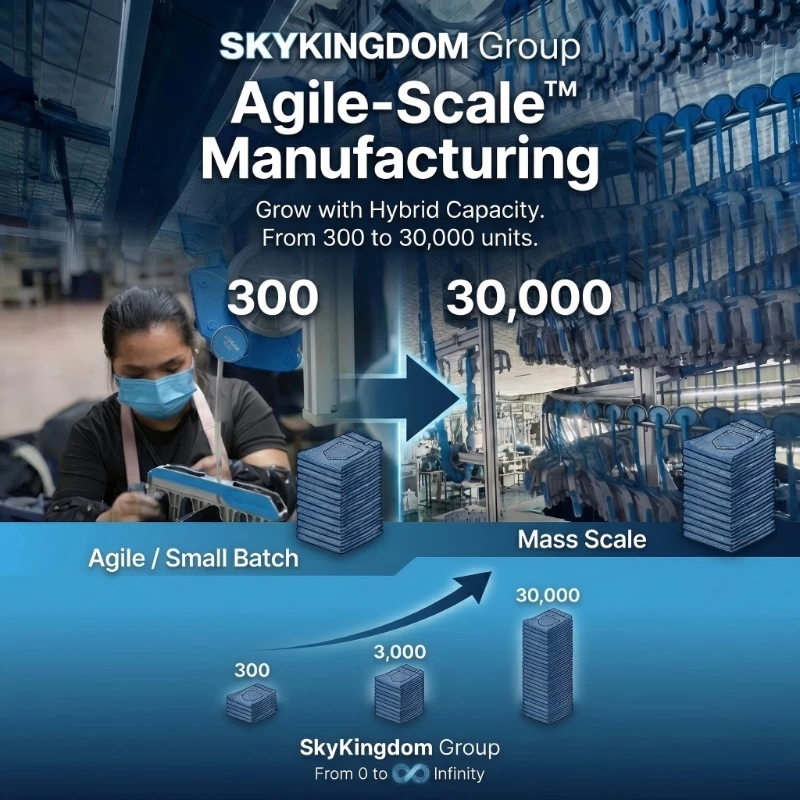
- Scalability: low-MOQ entry that grows with you — from a 500-piece test run to 5,000-piece seasonal reorders.
Whether you’re a growth-stage DTC brand or a multi-season group, we’re built to grow with you.
→ Start Your Denim Project or Book a Factory Visit to see the supply chain in person.
Frequently Asked Questions
What is the minimum order quantity (MOQ) for custom jeans in China?
For growth-stage brands, a realistic low MOQ is around 300–500 pieces per style. At SkyKingdom, we start brands at low MOQs deliberately — the first order is a trial run that lets us lock in your fit, wash, and QC before you scale to larger reorders.
How long does it take to produce a custom denim order?
Sampling typically takes 1–3 weeks depending on fit and wash complexity, with bulk production running 30–45 days after sample approval. A manufacturer with in-house fit and wash R&D shortens this significantly versus one that outsources development.
How do I make sure my reorders match my first order exactly?
Choose a manufacturer that maintains an approved sample archive, documented wash recipes, and per-order QC records. This is the difference between a supplier and a supply chain — and it’s why we keep order #50 identical to order #1.
How much does it cost to manufacture custom jeans in China?
Unit cost is driven by fabric weight and composition, fit/pattern development, wash complexity, and order quantity. Rather than chasing the lowest first-order price, focus on a partner who keeps your specs and washes stable across reorders — that’s where real savings compound.
Can a Chinese denim manufacturer produce sustainable / eco-friendly jeans?
Yes. Look for low-water and waterless washing (laser, ozone) and recycled or organic fabrics. Sustainable denim now commands a premium and helps you win the growing segment of eco-conscious buyers.
Why source denim from Xintang, Guangzhou specifically?
Xintang is China’s denim capital — the world’s densest cluster of denim mills, laundries, and trim suppliers. Sourcing here means faster development, more wash options, and a complete supply chain in one location.
SkyKingdom — The Denim Supply Chain Behind International Fashion Groups. Trusted by a London-listed international fashion group · Since 2008 · Xintang, Guangzhou.