
You’ve Tried Everything. The Problem Persists.
When was the last time a reorder landed on time—without you chasing for updates?
If you can’t remember, you’re not alone. Whether you’re just starting to place reorders or you’ve already cycled through two or three factories, you may be solving the wrong problem.
You’ve switched factories. You’ve added QC steps. You’ve written more detailed tech packs. You’ve even flown out to watch the line.
But delivery still drifts. Reorders still slip. Wash consistency still wobbles.
You start wondering if it’s bad luck, if every factory in this industry operates at this level, if denim is simply uncontrollable.
It isn’t.
The problem isn’t in the methods you’ve tried. It’s in how you’re attributing the conflict. You’ve been treating it as a communication problem, a quality problem, a capability problem. It’s none of those. It’s something else.
The Real Name of the Conflict: Uncertainty Allocation
Almost every conflict between a denim brand and its factory comes down to one question:
Who carries the uncertainty?
Brands want factories to absorb market uncertainty—last-minute order changes, shortened lead times, price pressure, delayed payments, internal approvals that drag while the ship date stays fixed.
Factories want brands to pay for that uncertainty—higher unit prices, upfront deposits, change-order fees, small orders deprioritized.
Both positions are reasonable. Neither side is wrong. But when neither yields, what breaks isn’t the brand and isn’t the factory. It’s the delivery.
This contradiction isn’t new—we covered how it produces “same factory, different results” in another article. What this piece does is different: it unpacks the conflict. What is it actually made of? Who should carry each part? How do you talk about it? How do you manage it?
Because most brands have never treated uncertainty as something that needs to be explicitly allocated. It gets shifted onto the factory by default, one change order and one delayed payment at a time.
The factory carries it until it can’t. Then delivery collapses. The brand attributes the failure to “the factory isn’t good enough,” switches suppliers, and the new factory—facing the same unresolved uncertainty—eventually breaks the same way.
Switching factories doesn’t fix this. You’re changing who carries the uncertainty, not the uncertainty itself.
There Are Four Types of Uncertainty, Not One
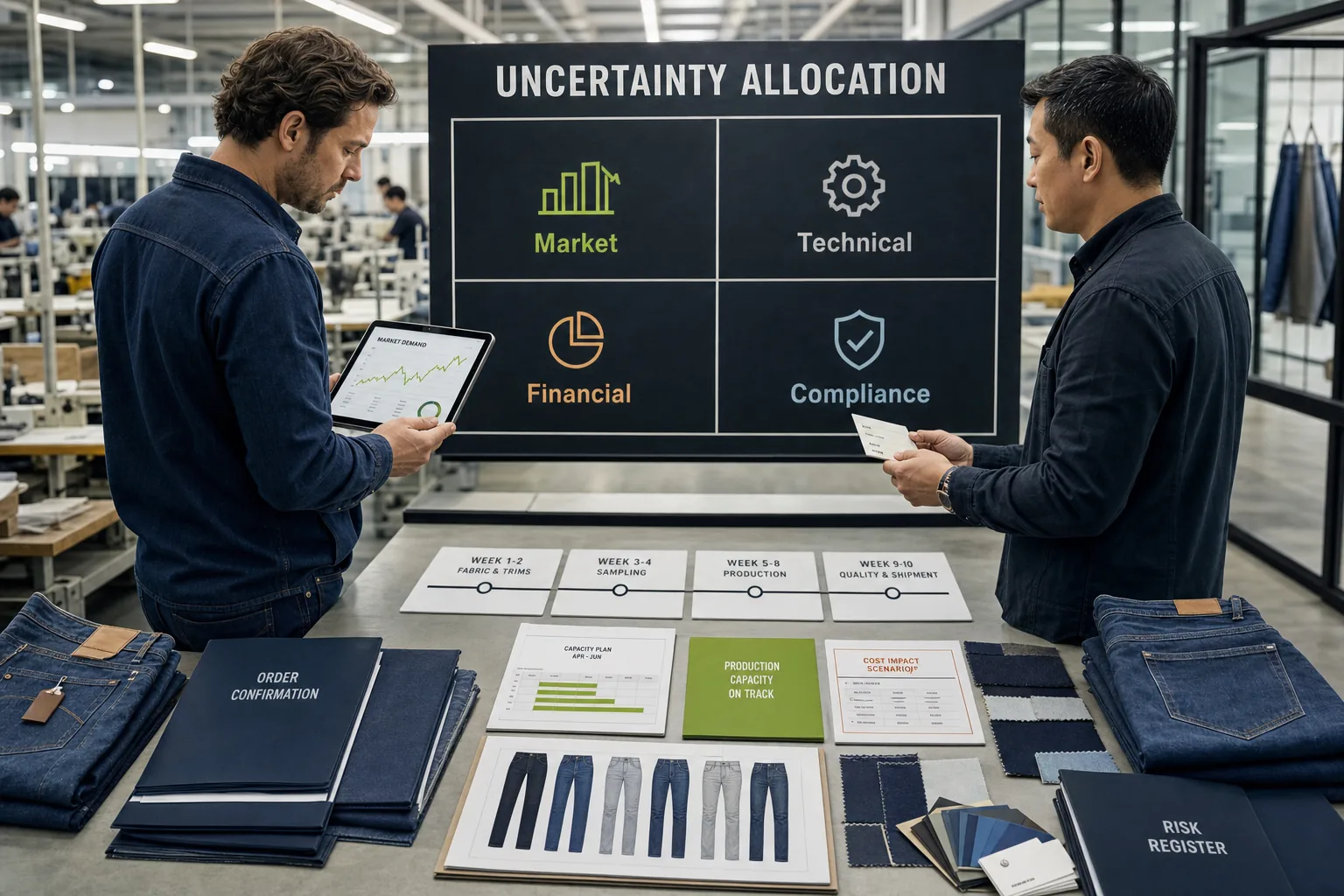
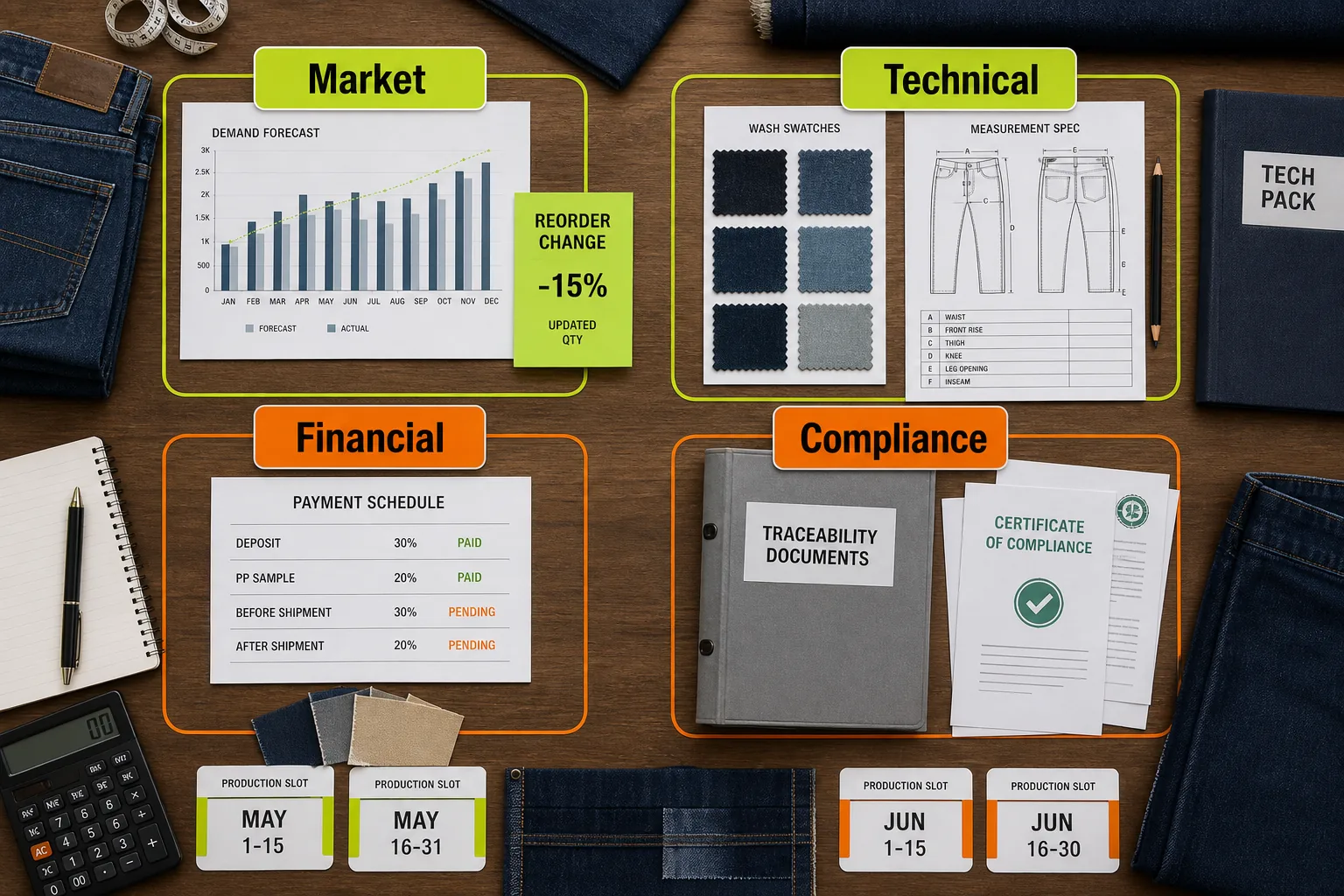
Treating “uncertainty” as a single block is one reason it never gets resolved. It comes in at least four types, and each has a completely different allocation logic.
1. Market Uncertainty
In one line: Demand volatility at the brand’s end of the market—the brand understands it best but routinely pushes it onto the factory.
Source: End consumers want fast, cheap, sustainable, individualized. The brand itself doesn’t know which style will explode next week.
Typical signs: Last-minute design changes, quantity adjustments, compressed lead times, demand for quick turns.
Characteristic: The brand understands the market best, but it transfers this uncertainty directly to the factory—change orders without change fees, volume increases without production-slot protection, quick-turn demands without price premiums.
2. Technical Uncertainty
In one line: The natural variability of denim craft—the factory understands it best but needs the brand’s cooperation.
Source: Denim isn’t standard apparel. Fabric shrinkage, wash color drift, laser consistency, hand-sanding feel—every stage has variables.
Typical signs: Deviation between sample and bulk, drift between first run and repeat order.
Characteristic: The factory understands the craft best, but it needs the brand to provide a complete tech pack, approve sealed samples on time, and not change standards mid-production. Technical uncertainty is bidirectional—it requires both sides to cooperate.
3. Financial Uncertainty
Every order a factory accepts, it’s fronting money for the brand.
Fabric has to be prepaid. Wages have to be paid monthly. Certifications cost money. Orders can be canceled.
And brand payment terms keep getting longer. EDC data shows the average payment cycle in denim is 77.5 days—two and a half times the industry standard of 30 days.
What does this mean? The factory is carrying the brand’s financial uncertainty with two and a half months of its own cash flow. That cost is either absorbed by the factory (and quality drops), or quietly added back into the unit price (and the brand wonders why it’s expensive). Either way, delivery suffers.
4. Compliance Uncertainty
In one line: New costs from certifications, carbon footprints, traceability—joint obligations, but the cost is routinely shifted by default.
Source: BSCI, Sedex, carbon footprint, traceability—each one is a cost line.
Typical signs: The brand requires a new certification but doesn’t pay for it separately.
Characteristic: Compliance is a shared obligation, but the cost is usually shifted to the factory by default. The factory either absorbs it, or quietly builds it back into the unit price—the brand doesn’t see it, but quality will reflect it.
Stack these four types together and the total is fixed. It doesn’t shrink because the brand is friendlier. It doesn’t disappear because the factory works harder. It can only be allocated—who carries it, how much, under what terms.
The problem: in a direct brand-to-factory relationship, that allocation is almost never talked about explicitly.
Why Uncertainty Gets Shifted Onto the Factory
Not because brands are malicious. Not because factories are weak. Because the structure makes it inevitable.
The Ethical Denim Council’s (EDC) 2024 State of the Denim Supply Chain report offers a few data points that show how systematic this one-sided shift has become:
- The average payment cycle is 77.5 days—two and a half times the 30-day industry standard. Financial uncertainty is being systematically shifted onto factories.
- 61% of suppliers have experienced order cancellations. Market uncertainty is being systematically shifted onto factories.
- 73% of suppliers consider current purchasing relationships unfair.
- 4 out of 6 brand employees agree that “asking suppliers to accept purchase order changes is normal business practice.” Brands themselves consider it normal to let the factory carry the load.
Ebru Debbag, Global Sales and Marketing Director at Soorty (one of Pakistan’s largest denim manufacturers), puts it more directly:
“It’s manufacturers who are taking the bigger risk when an order comes in.”
This isn’t one factory complaining. It isn’t one brand acting badly. It’s the natural outcome of a structural contradiction—when uncertainty isn’t allocated explicitly, it flows along the power gradient to whoever can least afford to refuse.
In a brand-factory relationship, the party that can least afford to refuse is always the factory.
A Scene That Repeats
This is a scene that plays out repeatedly across the denim industry. It’s not one brand’s story.
A brand in its scaling phase has worked with a factory for two years. The first three runs go smoothly—the brand places clear orders, the factory works to rhythm, delivery is stable. But from the fourth run, the brand’s end of the market starts shifting: one style takes off and needs a volume increase, another underperforms and needs to be cut, the wash direction for the new season gets revised at the last minute, and retail is pushing to compress lead times.
The factory doesn’t refuse. In a buyer’s market, the cost of saying no is too high. So it absorbs everything—reschedules production, shifts the master tailors’ rhythm, expedites fabric sourcing.
By the sixth run, the wash starts to drift. Delivery slips ten days. The brand confronts the factory. The factory’s response: “Every time you change the order, I have to reschedule. The tailors’ rhythm gets disrupted.”
The brand doesn’t hear what’s behind that sentence. It hears “the factory is making excuses,” attributes the failure to “the factory’s quality has dropped,” and switches to a new supplier.
The new factory’s first run is great—because uncertainty hasn’t started accumulating yet. By the third run, the brand is changing orders again, the new factory starts struggling under the load, and the same story repeats.
This isn’t a story about a factory. It’s a story about a collaboration structure. The uncertainty was never explicitly allocated. It just got handed to a different person to carry.
Three Attribution Traps Buyers Fall Into
Trap 1: Switching Factories Will Fix It
Many buyers say—or have heard a peer say: “We’ve tried three factories, and the quality is never consistent.”
That sentence is itself the signal. Three factories, the same problem—the variable isn’t the factory.
Switching factories changes who carries the uncertainty, not the uncertainty itself. The new factory faces the same market volatility, the same technical variables, the same financial pressure. When it can no longer carry the load, it performs exactly like the old one.
Diagnostic signal: If you’ve switched factories twice or more, and the problems keep looking the same (slipping delivery, drifting quality, broken communication), the problem likely isn’t the factory. It’s the collaboration structure between you and the factory.
Trap 2: Pressuring on Price Makes the Factory More Cooperative
Many buyers complain: “They keep raising prices, but quality doesn’t improve.”
But flip the question: when you pressure on price, are you leaving the factory a reasonable margin?
Price pressure makes a factory do one of two things: quietly lower the standard (swap fabric, skip process steps, loosen QC), or push your orders to the lowest priority.
A data point from the EDC report makes this clear—4 out of 6 brand employees consider order changes “normal.” Brands themselves think letting the factory carry the load is just how business works. But when the factory can’t carry it anymore, delivery becomes the casualty. Price pressure doesn’t make the factory more cooperative. It makes the factory return the uncertainty to you in less visible ways.
Trap 3: If the Factory Said Yes, It Can Actually Deliver
Brands often complain: “They said yes, but delivery keeps slipping.”
What the brand doesn’t ask: when the factory said yes, could it actually deliver—or did it just not dare say no?
Factories almost never say no to a brand. In a buyer’s market, the factory that says no loses the order.
So the factory agrees first, then “figures it out” during execution. The result of figuring it out: cut corners, delayed delivery, quality drift.
This isn’t dishonesty. It’s a structural incentive inversion. When the cost of saying no is far greater than the cost of agreeing and failing to deliver, the rational choice is to agree first and deal with it later.
A Better Framework: From “Who Bears It” to “How We Manage It Together”
Solving this conflict isn’t about making the brand compromise or the factory yield. It’s about converting the zero-sum question of “whose uncertainty is it” into the positive-sum question of “how do we manage uncertainty together.”
Three steps:
Step 1: Identify
Make every uncertainty in the collaboration explicit. Tag each one by type (market / technical / financial / compliance), probability, and potential loss.
Most brands have never done this. Uncertainty gets shifted by default in silence—that’s where conflict starts. Making it visible is the first step to resolving it.
Step 2: Allocate
For each uncertainty, decide who can carry it at the lowest cost and with the best outcome. The principle: the party best equipped to manage a given type of risk takes the lead, and the party carrying the risk receives commensurate compensation.
For example: Market uncertainty—the brand understands the market best, so the brand leads. But change orders come with change fees and production-slot protection. Technical uncertainty—the factory understands the craft best, so the factory leads. But the brand provides a complete tech pack and timely approvals.
Step 3: Buffer
For uncertainty that can’t be fully allocated, build shared buffer mechanisms—sealed sample baselines, change-order workflows, lead-time elasticity bands, payment milestones tied to production checkpoints.
A concrete example: when a brand wants to change an order, it doesn’t just throw the change at the factory. It first assesses which processes the change affects, how much rescheduling it requires, whether it will disrupt other orders—then issues the change as a unified instruction, with the corresponding change fee and production-slot protection. The factory doesn’t have to stop the line waiting for confirmation, and it doesn’t silently absorb the cost.
This is what SkyKingdom does—assess before changing, issue unified instructions, and make sure uncertainty is identified, priced, and buffered before it becomes the factory’s problem.
These three steps look simple. But in a direct brand-to-factory relationship, they’re almost impossible to execute. Not because neither side wants to, but because each stands inside its own information bubble: the brand can’t see the factory’s capacity structure and financial pressure; the factory can’t see the brand’s real market volatility.
Allocation Guide for the Four Types of Uncertainty
| Uncertainty Type | Typical Signs | Who Should Carry It | Why |
|---|---|---|---|
| Market (order changes / volume shifts) | Last-minute style changes, quantity adjustments | Brand-led + shared | Brand understands the market best, but the factory needs change fees and slot protection |
| Technical (shrinkage / wash drift) | Bulk wash diverges from sample | Factory-led + brand support | Factory understands the craft best, but the brand must provide a complete tech pack and timely approvals |
| Financial (payment cycle / cancellations) | Delayed payment, canceled orders | Brand bears + third-party buffer | The brand’s payment behavior directly determines the factory’s cash flow; a third party can set payment milestone protections |
| Compliance (certifications / carbon footprint) | New certification requirements | Shared + brand pays | Compliance is a joint obligation, but the cost should be borne by the party making the request |
The core logic of this table: uncertainty shouldn’t be carried by one side alone. It should be led by the party best equipped to manage that type of risk, with commensurate compensation flowing back.
Five Questions to Ask Yourself Before Your Next Factory Order
1. Which type of uncertainty do I generate most? Market, technical, financial, compliance—figure out which one you produce most often before you talk about allocation.
2. Have I explicitly told the factory about my uncertainty? Most brands have never had a direct conversation with the factory about “I may need to change orders—can you absorb that?” Uncertainty gets shifted by default in silence. That’s where conflict starts.
3. Does the compensation I give the factory match the risk I’m asking it to carry? If you’re asking the factory to accept change orders, compressed lead times, and delayed payments, do your price, deposit, and order mix actually cover those costs?
4. Is my internal approval chain creating artificial uncertainty? A lot of “factory delays” are actually caused by the brand’s own slow tech pack approvals, drawn-out reviews, and indecisive revisions. This is uncertainty the brand manufactures itself. It shouldn’t be pushed onto the factory.
5. Is there a “translator” between me and the factory? If the brand doesn’t have production management capability, and the factory doesn’t have market understanding, what’s missing between you is someone who can translate uncertainty into a shared language.
The diagnostic line: If you answer “no” or “not sure” to 3 or more of these 5 questions, your collaboration structure has a clear uncertainty-allocation gap. Switching factories won’t close it. Adding QC won’t close it. You need to redesign the collaboration structure—or bring in a role that can design and execute it for you.
When Direct Cooperation Isn’t Enough
If you’ve already switched factories twice or more and the same problems keep appearing, what’s missing isn’t a factory. It’s an uncertainty-allocation mechanism inside the collaboration structure.
That mechanism is hard for a brand and a factory to build on their own. Three reasons:
Information asymmetry—the brand can’t see the factory’s capacity structure and financial pressure; the factory can’t see the brand’s real market volatility. Without a translator, communication becomes two people talking past each other.
Power asymmetry—even when both sides want to allocate fairly, the buyer’s-market structure makes the factory afraid to raise it. Raise it, and it might get replaced. So the factory carries the load in silence, until it can’t, and then it collapses.
Execution gap—even if an allocation plan is agreed on, who executes it? Who tracks the change-order workflow? Who confirms sealed samples? Who stops the bleeding the moment something goes wrong? The brand doesn’t have the capability. The factory doesn’t have the incentive.
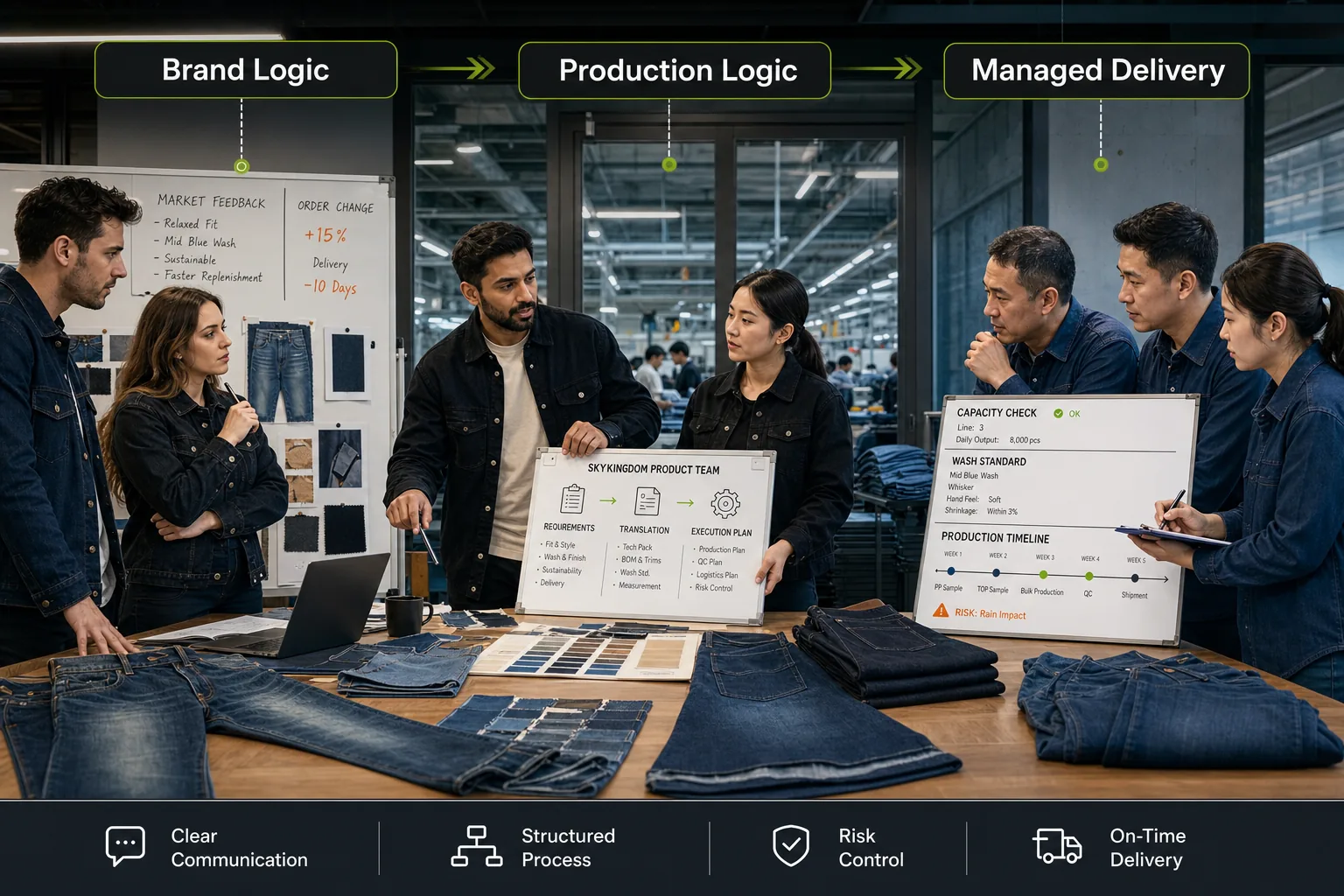
So this conflict can’t be resolved by the brand alone, or by the factory alone. It needs a role that stands in the middle—someone who understands the brand’s market logic and the factory’s production logic; who can translate each side’s uncertainty into a language the other can understand; who can design an allocation plan both sides accept, and then execute it.
We’ve broken down how that middle role actually works, and how it differs from working with a factory directly, in another article. We won’t repeat it here.
What SkyKingdom does is occupy that role—not pressing the factory on behalf of the brand, not papering over the brand on behalf of the factory, but standing in the middle, making uncertainty visible, allocating it, and managing it.
What to Prepare Next
If you’ve read this far and recognized that “my problem wasn’t a bad factory, it was a broken collaboration structure,” then before you look for the next factory, prepare three things:
1. Map your uncertainty inventory List every uncertainty you’ve pushed onto the factory in the past 12 months: how many change orders, how many delayed approvals, how many price pressures, how many late payments. Be honest. This is the prerequisite for redesigning how you work together.
2. Assess your production management capability Is your tech pack complete enough, your sample approval process rigorous enough, your QC checkpoints solid enough to let the factory execute independently? If not, you either build the capability—or find a middle role that can fill it for you.
3. Redefine your relationship with the factory Move from a transactional “I order, you make” relationship to a collaborative “we manage delivery together” relationship. That means being willing to pay for certainty—for more stable lead times, more consistent quality, more controllable reorders—at a fair price, rather than chasing the lowest unit cost.
Get these three right, and the next factory you find might actually be different.
If You’re Stuck in the “Switching Factories Doesn’t Help” Loop
If you’ve read this far and recognized that your delivery problems aren’t about a bad factory—they’re about uncertainty in your collaboration structure that no one is managing—let’s talk.
Send us your reference sample, target quantity, timeline, and main production concern. We can help you identify which type of uncertainty you’re generating most, how it should be allocated, and whether you’re missing a middle role.
No obligation to work together. But you’ll walk away with a clearer framework to take to your next factory.
FAQ
Q1: My factory relationship is good and communication is smooth. Why do I need to think about uncertainty allocation?
A good relationship and smooth communication don’t mean uncertainty has been explicitly allocated. Many “good” collaborations are actually cases where the factory is quietly carrying the uncertainty, and it only surfaces when the factory can no longer absorb it. Mapping uncertainty allocation in advance is the best way to prevent a sudden collapse.
Q2: Which of the four types of uncertainty is most often overlooked?
Financial uncertainty. Brands typically don’t realize how their payment cycle affects the factory’s cash flow. EDC data shows the average payment cycle is 77.5 days—meaning the factory is fronting two and a half months of capital costs for the brand. That cost is either absorbed by the factory (and quality drops), or quietly built back into the unit price (and the brand feels it’s expensive). Either way, delivery suffers.
Q3: What if I just want the lowest-priced factory?
Then this article probably isn’t written for you. The cost of a lowest-price strategy in denim is sustained uncertainty and quality drift. If you accept that cost, you can work directly with the cheapest factory. But if you’ve already paid for it in delays, rework, or lost customers, it may be more useful to reassess what “real cost” actually means.
Q4: Is “uncertainty allocation” just another term for “risk sharing”?
Close, but not the same. Risk sharing typically refers to responsibility allocation at the contract level, defined in advance. Uncertainty allocation is a more dynamic concept—it runs through the entire collaboration cycle and gets redistributed with every change order, every approval delay, every payment. Even with a well-written contract, allocation can still go out of balance during execution. So what it requires isn’t a contract—it’s a continuous management mechanism.